Technology & Sound Archives - Page 2 of 2 - The Birthplace of Country Music
Listen
Play
Loading station info...

High-Tech Vintage: Technology and the Delivery of Old-Time Sound

January 6 is National Technology Day – and so it seemed the perfect time to explore some of the Birthplace of Country Music Museum from the technology side of things! We’ve picked five elements of the content or the museum itself that tell just a little of the technology story here:

Recording and Playback Machines

The museum shares the story of the 1927 Bristol Sessions, but it also explores how sound technology shaped their success and evolved over the years. Inventions such as recording and playback machines played important roles. For instance, in 1877, Thomas Edison invented the phonograph, which was instrumental in distributing music in the early 20th century, including the songs recorded at the 1927 Bristol Sessions. Writing an article in 1878 on “The Phonograph and its Future,” Edison listed other possible uses for his invention beyond playing music, including elocution and other educational lessons; audio books (before Audible and iTunes!); to create sound effects for children’s toys; and most intriguingly, “family records,” where the last words of dying family members could be saved for posterity, like that of other great characters of the day.

Other innovators contributed to the development of this type of playback technology. In 1881, Alexander Graham Bell invented the graphophone, an improved version of the phonograph developed by Edison, and in 1894, Emile Berliner invented the disc gramophone method, which used different machines to record and then to play back the sound. Where earlier recording and playback machines used cylinders, either coated in tin foil or wax, Berliner’s gramophone used flat disc records.
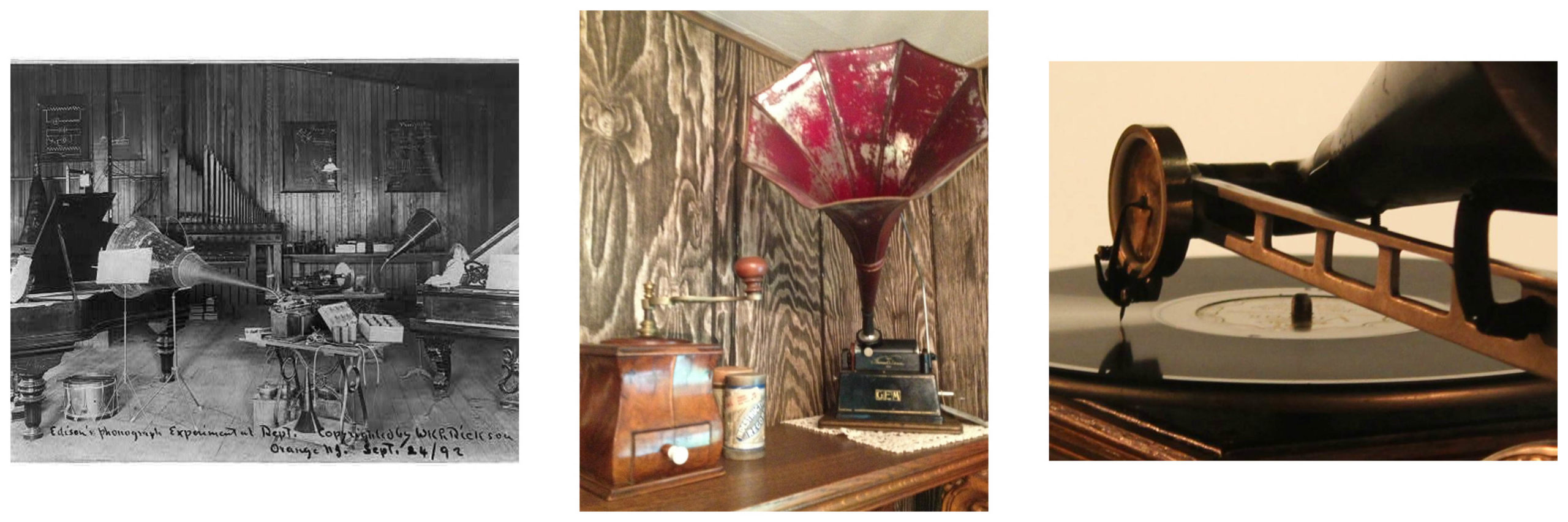
Left: Large room filled with musical instruments, a large phonograph and other equipment and furniture; center: A cylinder phonograph with rose red horn with cylinders and another machine nearby; right: A close-up showing the needle on a record disc.
Left: Thomas Edison’s Phonograph Experimental Department in the early 1890s; Center: A cylinder phonograph with rose red horn; Right: Record playing on a disc phonograph. Images are Library of Congress, Prints & Photographs Division, [reproduction number, e.g., LC-USZ62-90145] (left) and © Birthplace of Country Music (center, right)
Acoustic Design

The museum is a high-tech, interactive experience, one that is filled with music and sound. And because of that, it had to be designed strategically and carefully in order to provide the best possible experience to our visitors. For instance, the acoustic engineer advised the architects and exhibit designers on ways to define walls and ceilings to contain sound or keep it from bouncing around the open gallery spaces or the theater. The firm also worked closely with the technology team and media producers to define how the sound of each audio or audio/video production is delivered into the space. The goal was to provide an immersive experience, yet minimize unwanted “bleed” of sound between programs. Innovative acoustic wall panels and fabric mean that the acoustic technology is seamless and becomes a part of the museum experience itself, while speakers embedded underneath the pews in the chapel theater space mean that visitors feel like they are right in the middle of the congregation and they can often even feel it in their seats!

Left: The curved wall of the timeline with an oval white disc hanging above it; center: Several patrons sit in the pews of the chapel as they view the chapel film; right: The acoustic tile is a light beige color with several cut-out dots in a variety of patterns on its surface.
Left: A hanging acoustic panel above the timeline in the museum’s atrium exhibit space focuses the soundscape down towards visitors who stand in this area; Center: The sound design in the chapel helps patrons to feel like they are part of the congregation as they watch the film; Right: High-tech acoustic tile in the museum’s Performance Theater helps to make the sound experience in this space truly special. © Birthplace of Country Music, photographer: Neil Staples; © Hillmann & Carr; © Birthplace of Country Music

Orthophonic Technology

Orthophonic reproducers were an outgrowth of the electric microphones being used to record performers in the late 1920s. Electric recording captured a wider range of sound frequencies and produced recordings in which the instruments and voices sounded much more like live instruments and voices than they had on previous acoustic recordings. These reproducers were designed to be more sensitive to the nuances in the electric recordings, making the listener’s experience more pleasurable and true-to-life. The Bristol Sessions in 1927 were recorded using this process and many claimed that the Orthophonic recordings sounded even better than the live performances! Electric recording and Orthophonic machines, like later compact discs or HDTV, were a technological revolution that helped change the shape of the music industry.
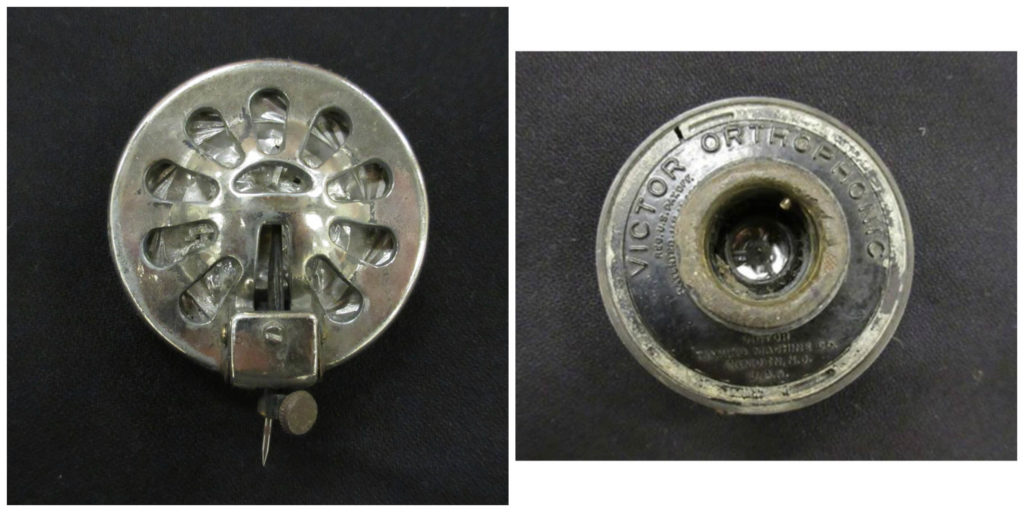
Two sides of an Orthophonic reproducer -- one looks like the front of an old-time microphone, while the other bears the name Victor Ortophonic. Both sides are made of silver metal.
These Victor Orthophonic reproducers (front and back), donated by Bob Bledsoe, are the pieces of the Orthophonic Victrola that connected the record to the sound horn. A listener would insert a needle into the reproducer, which would follow the groove on the record. The groove created vibrations that were made into sound waves by the reproducer and amplified by the sound horn. © Birthplace of Country Music

The Radio Station

During the planning stage of the museum, the exhibit content team discussed ways to make the space focused on radio history into an engaging experience for our visitors. The result? Radio Bristol, a live radio station! With help from a team of radio industry advisers, BCM applied to the FCC for a low-power FM license, secured the antennae, transmitter and equipment necessary for broadcasting, and created a working radio studio in the museum. And that’s where the technology gets really interesting because the station uses vintage equipment from older Bristol radio stations, refurbished and repurposed for today. For instance, a Raytheon console from 1940s WCYB Radio, sourced from local radio buff and collector William Mountjoy, was rebuilt by engineer Jim Gilmore, retired engineer from TNN. One of the mics in the radio studio is from local station WOPI and was used by Tennessee Ernie Ford when he was a DJ there. And there are numerous ways to deliver music in the station – from a record turntable to a live recording booth to the digital ease of tablets and MP3s. The station is what we call high-tech vintage!
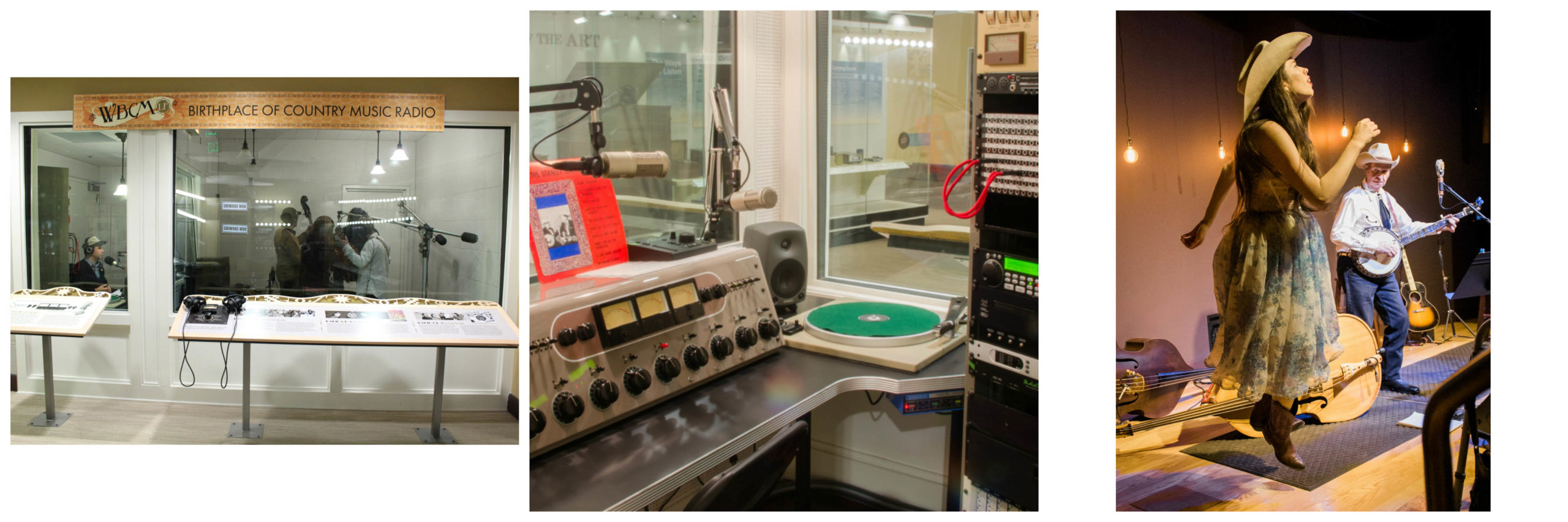
Left: A view of the radio station from outside the booths showing a DJ in the smaller room to the left and a band recording live in the larger space to the right; center: A view of the console, turntable, and other equipment in the DJ booth; Right: A musician on banjo plays while Martha Spencer flatfoots live on the Farm and Fun Time stage.
Left and center: The radio station in the museum has a booth for the radio DJ and a larger room for performers and musicians to record live; the DJ booth is fitted out with 1940s equipment upgraded to digital capability. Right: Live performances in the Performance Theater, such as this Farm and Fun Time show, can also be broadcast live from the museum and streamed on Facebook. © Birthplace of Country Music (left and center); © Birthplace of Country Music, photographer: Billie Wheeler

Technology Lessons

Finally, sometimes the technology isn’t an object from our collections or an innovative way to present the museum’s content. Rather it is found in educational programs where we share the story of that technology. For instance, for the past two years, museum staff and volunteers have participated in the Kingsport Mini Maker Faire where we have presented information about the museum’s exhibits and engaged in a variety of sound demonstrations, including an example of amplification and a homemade Chladni plate! We also offer a “History of Listening” lesson, available in the museum and to schools and other groups. Throughout history music has been experienced in a variety of ways, especially as advances in technology have developed over time. This lesson explores these technological changes and then compares how listening to music transitioned from being a mostly community-based activity, often through live performance, to listening either alone or together in person via technology and the virtual environments of cyberspace.

Left: A young girl listens to an explanation of amplification while looking at the equipment held by the head curator; Top right: A metal plate covered in blue sand sits between a museum volunteer and a young girl in one picture while the second shows the geometric pattern formed by the sound from the sound waves that have been directed to the metal plate; Bottom right: A drawing of the acoustic and electric methods of recording on a white board at a school in the first pic, while the second pic shows two tables bearing a variety of different playback machines such as a record player, a CD player, a tape player, and several cylinders and records.
Left: Museum head curator Rene Rodgers demonstrating sound amplification to a young visitor at the Kingsport Mini Maker Faire in 2017. Top right: Museum volunteer Matt Wood explains the Chladni plate to a child at the Kingsport Mini Maker Faire in 2018; the resulting pattern produced by sound waves. Bottom right: A basic drawing (very basic!) to differentiate the acoustic and electric recording methods during the “History of Listening” lesson at a local school; museum staff and volunteers demonstrate the lesson to teachers during a summer in-service. © Birthplace of Country Music


Making a Living Living Your Passion: How Lefty Frizzell and 10-Cent Records Inspired a Dream

Anyone who knows me, knows how important music is in my life. This not only includes my experiences as a musician and audio engineer, but also includes my longtime passion for collecting and listening to music on vinyl records. When I think back to how it all started, I can trace my love of vinyl records to two specific memories.

The first memory: A secondhand box of 45rpm singles from my grandparents that contained “Always Late with Your Kisses” by Lefty Frizzell, “Cathy’s Clown” by The Everly Brothers, and “Downtown” by Petula Clark. I still love all of the songs, but the signature voice of Lefty was “the one” for me. My 12-year-old mind was never the same, and I have been a fan of classic country-and-western music from that day forward.

The second memory is tied to my parents and their hobby of getting up very early and going to flea markets. When I was around 10 years old, I began pet-sitting, shoveling snow, and babysitting for extra money. This was in the mid-1980s and CDs were becoming THE musical format. Folks were dumping their vinyl and selling off records for 10-25 cents each at local flea markets. With five dollars, I could come home with STACKS of records and explore anything and everything I desired. One day I brought home the album After the Goldrush by Neil Young and was floored. The artwork and music blew me away, and I knew I had to keep looking for that next great album.

Fast forward 35 years. I now own two businesses devoted to records. One is called Well Made Music, where we cut master discs for the vinyl record industry. Records are pressed from PVC plastic, and the discs we create are coated with metal and formed into stampers that can press pucks of plastic into playable records. Prior to about 1948, this same process was used to make records out of shellac, a brittle and less durable compound from which 10” 78rpm records were made. These old, interesting records remain in demand for collectors of pre-WWII music.

The second business is The Earnest Tube, a recording studio devoted to recording artists in much the same fashion as Ralph Peer did on his fateful trip to Bristol in 1927. My business partner Dave Polster and I use a cutting lathe made around 1945 to cut audio onto blank lacquers discs. This technique is called “direct-to-disc” recording and was the way almost all recordings were made prior to about 1950. To be completely fair, Ralph Peer probably used actual wax to carve the grooves during the 1927 Bristol Sessions, but that technique went by the wayside in the 1930s and lacquer discs have been a staple in the industry up to, and including, today.

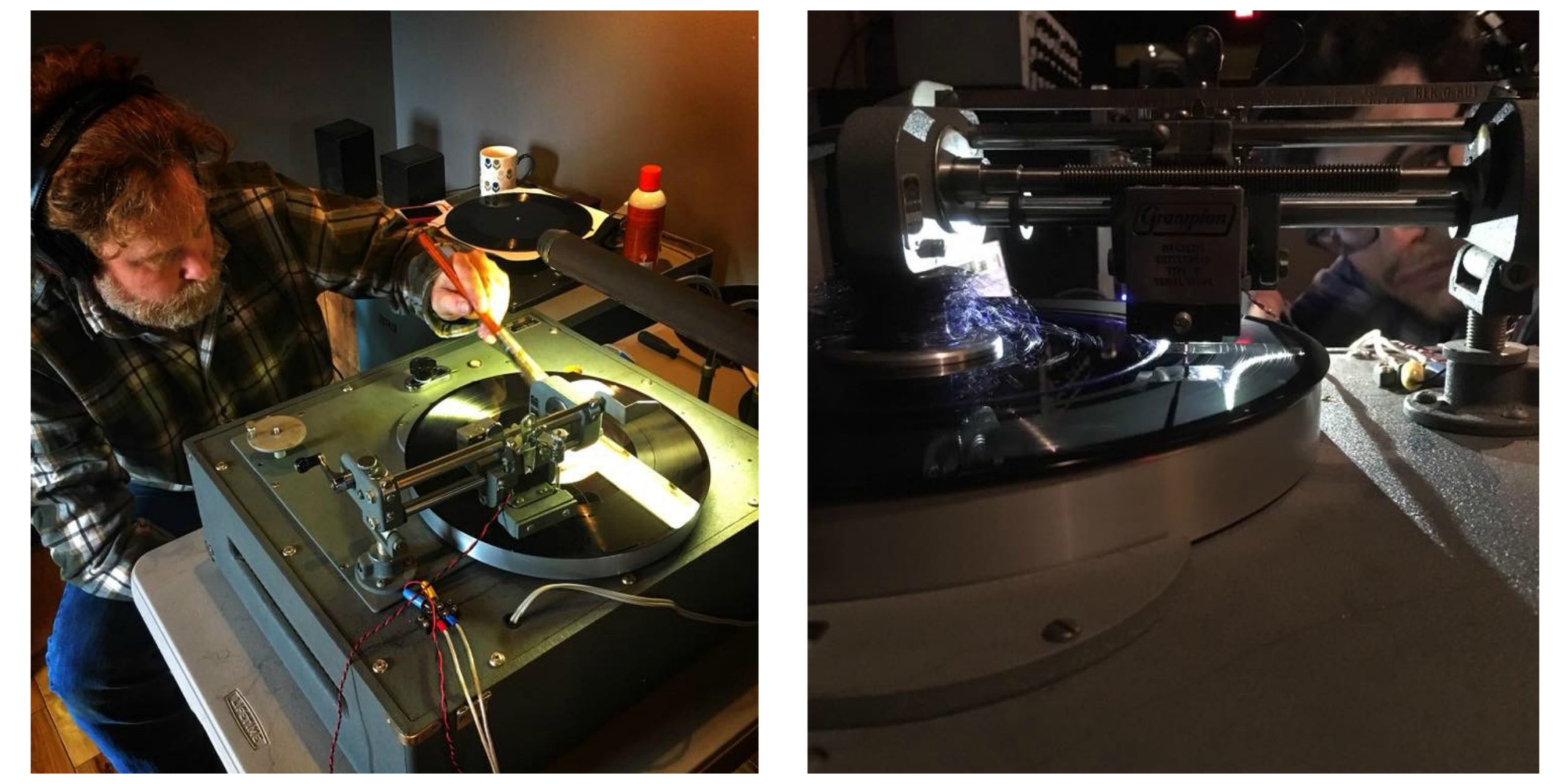
The picture to the left shows the author brushing a cut record as it spins on the lathe; the picture to the left shows a man peering into the inner workings of the machine cutting the record master.
Clint Holley records direct to disc on a vintage Rek-O-Kut recording lathe (left); Dave Polster watching a master being cut (right). © Clint Holley, The Earnest Tube

Recording direct-to-disc is totally different from modern computer recording. On a computer, the artists can record, edit, and manipulate the sounds they record in an infinite amount of ways. Rarely is any of the music you hear a complete performance. It is most likely many performances edited together to create the illusion of a complete song.

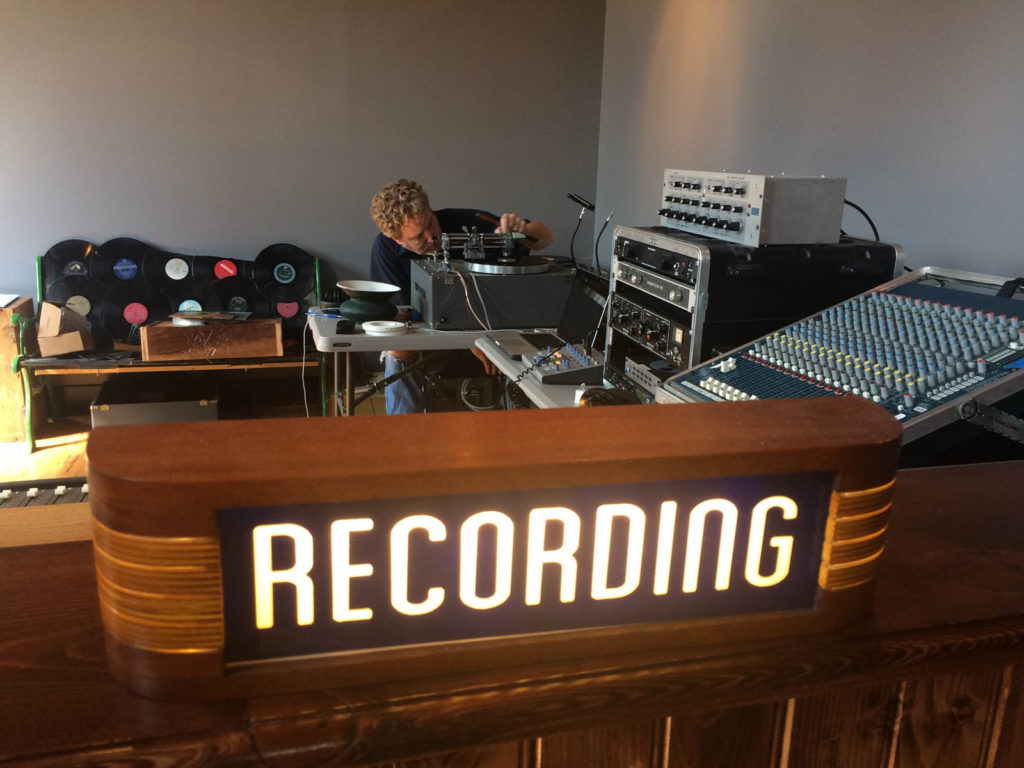
A large lit up sign reading "Recording" in front of the recording equipment at The Earnest Tube.
When the recording light comes in, it’s time to play! © Clint Holley, The Earnest Tube

Direct-to-disc recording is a “one take” process that leaves no room for the artist to hide. We place one, possibly two, microphones in the room with the artist or ensemble; we move the microphone (and musicians!) around the room until the desired “mix” is achieved; and then, we lower a sapphire cutting needle (stylus) onto the surface of a blank disc. The “Recording” light is turned on, and in the following moments, the artist performs the entire song – carving the grooves into the surface of the disc as he or she sings and plays, a direct representation of that performance – magical, personal, one-of-a kind, warts and all!

This raw energy is what gives music from the pre-war period, and especially the Bristol Sessions, that “special something” that draws in new fans almost 100 years later. “Single Girl, Married Girl” by The Carter Family is as urgent today as it was on those hot days of 1927, and the conviction of Alfred G. Karnes makes you want to join in with him as he sings “I Am Bound for the Promised Land.”

Although there are some people who think music recorded in this fashion is quaint or outdated, we have found quite the opposite. The artists who have recorded at The Earnest Tube have approached the process with an open mind and heart. A great example is Tim Easton’s Paco and the Melodic Polaroids. Easton, a repeat performer at the Bristol Rhythm & Roots Reunion (BRRR), recorded this entire album after BRRR 2017 at The Earnest Tube with one vintage RCA microphone. Easton has had great success with this album – indeed, it has been named a top album on many “Best of” lists of 2018.

The long road from Lefty Frizzell to Bristol and The Earnest Tube has been personal and long, but it has been more than worthwhile. I love the history of recorded music, and I love the place that Bristol, Tennessee-Virginia has in that story. It is my hope that The Earnest Tube can help continue to tell that story – as a humble witness and participant alongside others who have a passion for music and history, and with great institutions, such as the Birthplace of Country Music Museum.