

Technology & Sound Archives - The Birthplace of Country Music
Listen
Play
Loading station info...

The Complicated Origins of Recorded Sound: Phonograph vs Phonautograph

By Sam Parker, AV & Technology Specialist at the Birthplace of Country Music Museum.


This month marks the 148th anniversary of Thomas Edison’s cylinder phonograph, which was assembled on August 12th, 1877. But did you know, the history of sound recording technology doesn’t start with Edison, but rather was the culmination of decades of research and innovation? The anniversary of Edison’s phonograph inspired us to take a look at a French inventor whose device, although not commercially successful, is a landmark in the history of recorded sound that pre-dates the phonograph. 

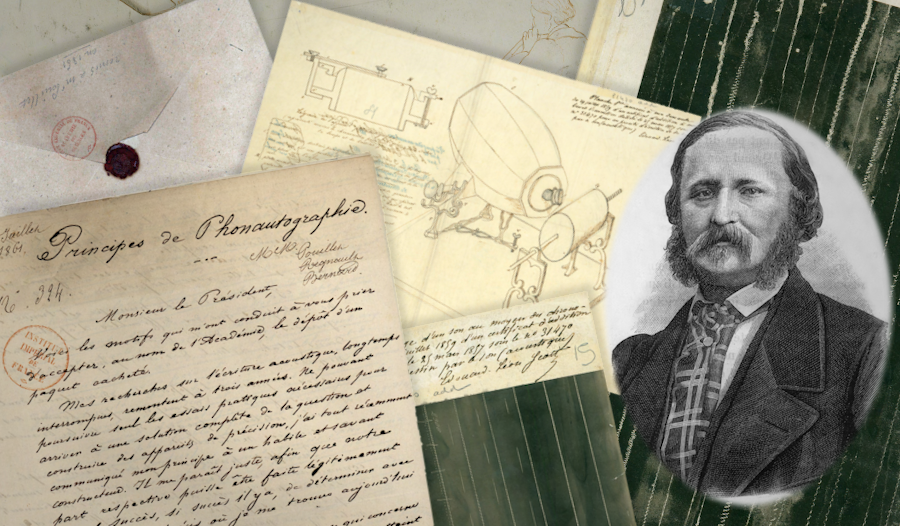
A drawing of Eduoard-Leon Scott de Martinville. He is an older man with a drooping mustache and thick sideburns, wearing a suit and ascot tie in the style of the late 19th century.
Édouard-Léon Scott de Martinville from Les Merveilles de la science, a book on scientific innovations. The plaid ascot tie isn’t just a fashion statement- the “Scott” in his name is reference to his family’s Scottish heritage.

The earliest known song recorded by a man-made device was sung while Edison was still a newsboy, but who was responsible for this momentous accomplishment? Édouard-Léon Scott de Martinville worked as an editor at a publishing company specializing in texts about scientific research and news in Paris. While reading about scientific innovations, he was inspired to replicate what the camera did, but for words instead of images.

Similar to Edison, Scott’s work built on the innovations and technologies of his predecessors and contemporaries. In a letter to the President of the French Academy of Sciences, he wrote about some of his predecessors: 

 As precedents, I had before me the siren of Cagniard-Latour, the toothed wheel of Savart, both suitable for counting the vibrations of the sounding body; Wertheim’s process for writing the vibrations of a tuning fork; the electromagnetic tour described by Mr. Pouillet for the same object. I have taken a step further: I write not only the vibrations of the bodies that primitively vibrate, but those transmitted mediately by a fluid — that is, by the surrounding air.

This letter was more than just a description of his idea; it was part of a process in 19th-century French academia to establish primacy when credit is given for an invention. At the time, when an inventor had an idea for a new innovation, they write it down, place it in a sealed envelope, and deposit it at the Academy’s office in Paris. These letters are not intended to be read– at least not immediately. The letters can only be opened by the person who left them, or their family, after the inventor’s death. This system was created so that, in a situation where two different people claim to have made the same invention, the one who invented it first can prove it with a dated letter verifying when they developed the concept. This came into play a decade later when Edison began working on his phonograph. Once it began to attract attention in the papers, a Parisian inventor requested the Academy open his letter, in which he wrote about a process of replicating sound very similar to Edison’s nearly two weeks before Edison did. 
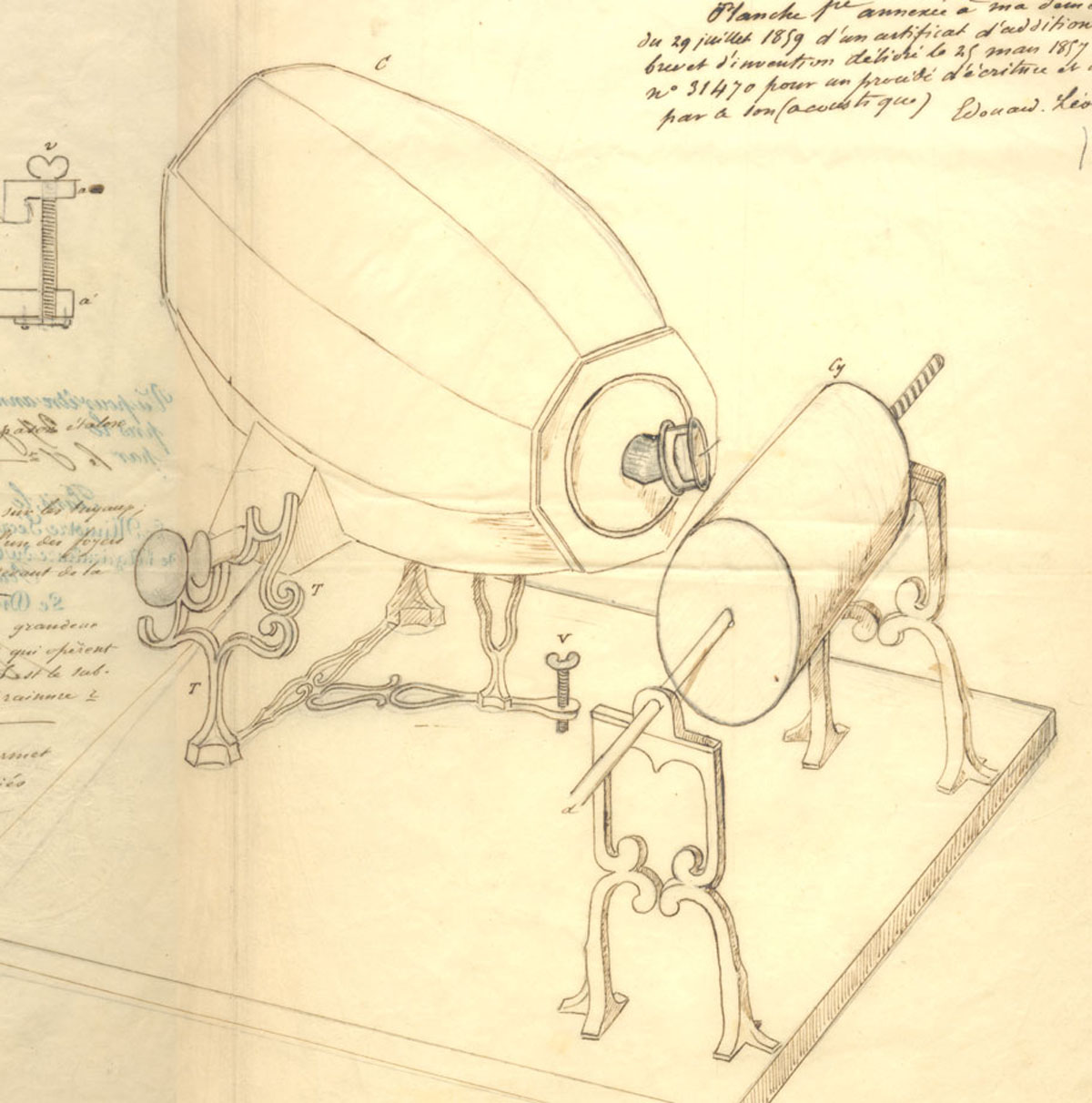
A sketch of the phonautograph.
A sketch of the phonautograph made by Scott in 1859, notice the cylinder and the plaster “barrel” horn’s similarity to Edison’s later phonograph.

After combining the technologies and discoveries of his predecessors, Scott and a “skillful and learned manufacturer” built what was essentially a large mechanical version of a human ear. They called it the phonautograph. The phonautograph used an acoustic horn (similar to Edison’s phonograph) attached to a diaphragm to vibrate a boar’s bristle, inscribing the vibrations on a plate of glass covered with a thin layer of lampblack. For the first time, a physical record of sound waves had been captured.

So then, why do we celebrate the phonograph and not the phonautograph? 

There is one key factor that kept the phonautograph classified as a scientific curiosity instead of a culturally revolutionary invention. Sure, the phonautograph created recordings, called phon­autograms, but Scott had not yet devised a way to play them back. Scott’s recordings looked, to the untrained eye, like scribbles on a plate of dark glass or piece of paper. Scott hoped that he would be able to develop a method to read the sound waves, but this never came to fruition. Despite not being able to read sound, Scott was aware that his new technology was groundbreaking. He once remarked, “I see the book of nature opened before the gaze of all men, and, however small I may be, I dare hope to be permitted to read it.” 

A phonautograph of a tuning fork, showing the steady soundwaves against lampblack.
A phonautograph, displaying the soundwaves of a tuning fork. Scott and other early sound engineers used tuning forks to calibrate the speed of their recordings, as they resonate at a constant frequency. Images from the French Academy of Sciences.
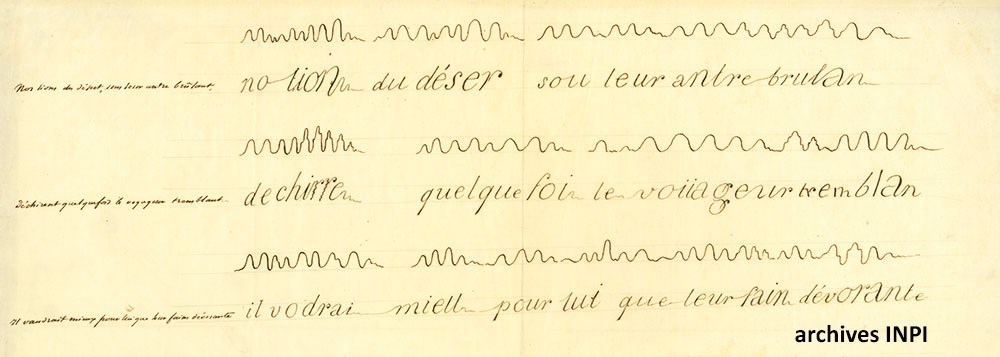
Notes by Scott matching soundwaves with the words he had recorded.
A study by Scott attempting to match up soundwaves to the specific syllables in the words he recorded. Image from the archives of the Institut national de la propriété industrielle.

Scott worked with the French Société d’Encouragement pour l’industrie Nationale (Society for the Encouragement of National Industry) and German Physicist Rudolph Koenig to further develop the phonautograph, moving from a small plate of glass to a cylinder that could capture around 20 seconds of sound. They marketed the phonautograph as a research tool for further understanding acoustics and the nature of sound waves, and recorded numerous phonautograms to examine the represented changes in pitch, tone, and timbre in speech and song.

For a long time, we were unable to recover the sound from phonautograms, but in 2008, researchers with FirstSounds developed a way to reproduce the recorded audio. For the first time in over a century and a half, we can listen to the first ever song recorded by mankind: a French folk tune, “Au Clair de la Lune,” sung by Scott himself. The biggest challenge was that the phonautograms were not recorded with the intention of being played back. They contained smudges and skips, and the speed of the recording often changed depending on how fast the phonautograph’s crank was being turned, which led to wildly varying pitches. FirstSounds was able to overcome these challenges using modern technology similar to the process recently used to recover our own transcription disc.
The Technology That Made the Bristol Sessions Possible

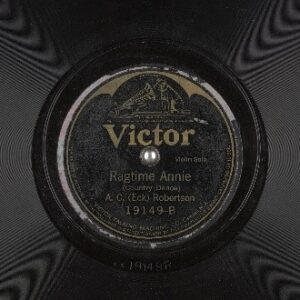
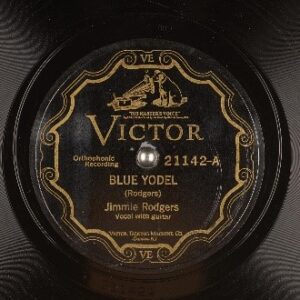
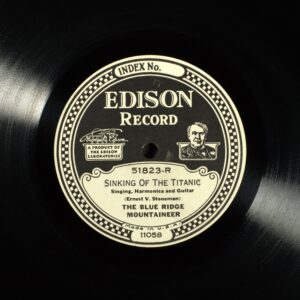
A lot of quality time can be spent in the 78 RPMs and Cylinder Recordings section of archive.org, especially if you are old enough to remember 78s or just love exploring old music. One striking thing about the site is how the quality of these recordings gets much better after 1925. Click on the record labels below to hear the difference.

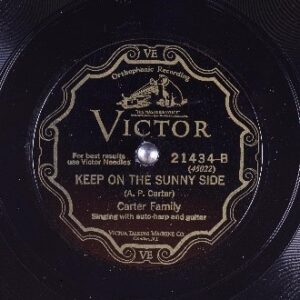
An old record with a weathered label depicting a dog listening to a phonograph over the word "Victor." Underneath, it reads "Keep on the Sunny Side" (A.P. Carter), Carter Family singing with auto-harp and guitar.
“Keep on the Sunny Side,” Carter Family, 1927
An old record with a weathered label with an image of a dog listening to an old phonograph, reading "Victor, Ragtime Annie (Country Dance), A.C. (Eck) Robertson"
“Ragtime Annie,” Eck Robertson, 1924
An old record with a weathered label depicting a dog listening to a phonograph over the word "Victor." Underneath, it reads "Blue Yodel" (Rodgers), Jimmie Rodgers, vocal with guitar.
“Blue Yodel,” Jimmie Rodgers, 1927
An old record labeled "Edison Record: The Sinking of the Titanic, Singing, Harmonica, and guitar. Ernest V. Stoneman, The Blue Ridge Mountaineer." On the sides of the label are an image of a laboratory with the words "A product of the Edison Laboratory" under it, and an image of Thomas Edison.
“Sinking of the Titanic,” Ernest “Pop” Stoneman, 1926. Although the electric microphone had been invented in 1925, Edison refused to adopt it until late 1927.


The technology behind this change in sound quality goes a long way toward explaining why the Bristol Sessions were such a success. In fact, an argument can be made that the Bristol Sessions had to happen after 1925 and before 1930, or they would not have happened at all.

The first device to record sound and play it back was the phonograph invented by Thomas Edison in 1877. Recordings were made on wax cylinders that were sold with the recording machines. These early machines were mostly marketed as dictating machines. During the 1890s some musical recordings were created one at a time and sold to nickelodeons to be played on primitive jukeboxes, but there was no practical process for mass-producing music recordings until after 1900, when Emile Berliner perfected a record player that played discs (instead of cylinders. The signing of opera star Enrico Caruso by Berliner’s Victor Company has been cited by many as the event that launched the modern recording industry (Caruso’s 1904 recording of Vesti la giubba sold a million copies).

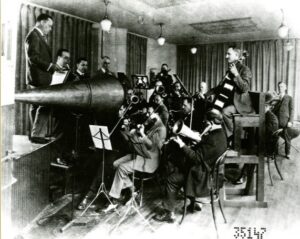
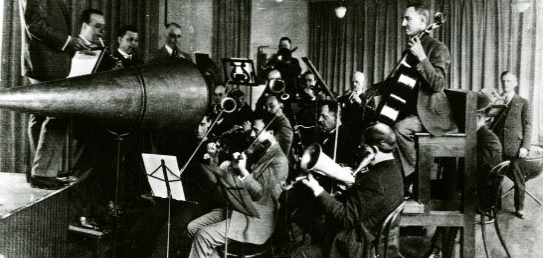
An image of men playing in an acoustic recording session. Multiple musicians sit crowded around a large metal horn, playing directly into it so it captures their sound.
Acoustic recording session. Credit: Library of Congress.

In those days masters for commercial recordings were created by musicians who sang or played in front of a large metal horn that funneled sound waves to a vibrating diaphragm. These vibrations were transferred to an attached stylus that etched the sound waves onto a master wax disc. Adjustments to the balance and tone of these purely acoustic recordings could only be made by positioning the musicians. The sound quality was compromised by the narrow frequency range that could be captured (100 to 2500 Hz), and the low volume level of the recordings severely restricted the dynamics.

Even given the compromised sound quality, acoustic phonographs and records were popular. Jimmie Rodgers bought a phonograph in the early 1920s. His wife Carrie later recalled that Jimmie bought records “by the ton” despite their marginal household income. Maybelle Carter’s husband Eck was a U.S. mail clerk, the “best job in the Valley” and loved buying gadgets of all kinds. He was a classical music buff and had a large record collection.

Nevertheless, the poor audio quality of acoustically recorded phonograph records hurt sales, especially starting in the mid-1920s when people started buying radios.

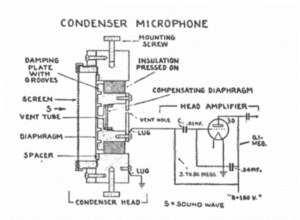
Diagram of a condenser microphone, showing the electronic components in detail.
Diagram of a condenser microphone. Credit: shure.com.

Things changed dramatically when Western Electric, the laboratory complex for the Bell Telephone company, developed the “Westrex” system of electronic recording that used condenser microphones. A condenser microphone consists of a diaphragm and a metal plate that creates an electronic signal. The electric sound produced by this system had a greatly expanded frequency range of 60 to 6000 Hz, and the volume could be boosted by the then-new vacuum tube amplifiers.

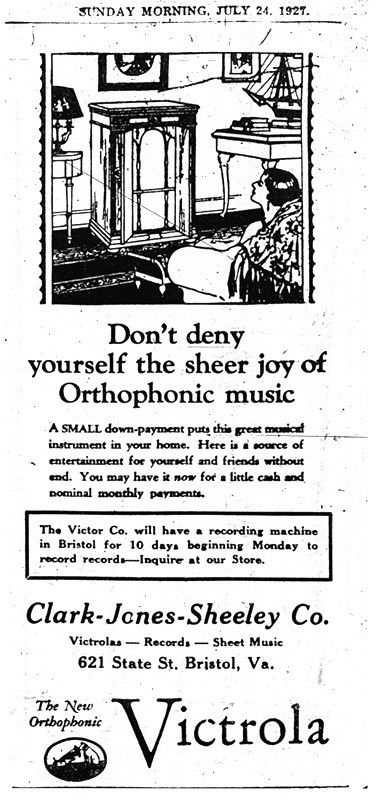
Western Electric licensed this revolutionary technology to the two leading American recording companies, Victor and Columbia, in 1925. Victor’s “Orthophonic Victrola” was the first consumer phonograph designed to play electrically recorded phonograph records.

This new technology was a sensation. The entire U.S. record industry had a profit of $123,000 in 1925. In one week in 1926 Victor sold $20 million worth of Victrola players.

This new technology made the Bristol Sessions possible. A giant horn was no longer necessary to make recordings. This meant that musicians no longer had to travel to Victor’s headquarters in New Jersey or other large cities for recording sessions. The recording equipment could more easily be packed into suitcases and transported anywhere a train or truck could go. This notably included places like rural Tennessee and Virginia, where musicians making country, then called “hillbilly” music, lived.

The original note advertising the Bristol Sessions appeared in a Victor Orthophonic ad! Click to enlarge. Credit: Image courtesy of the Bristol Herald Courier

The electronic recording boom of the late 1920s was short-lived. The stock market crashed in October of 1929, which triggered the Great Depression of the 1930s. U.S. record sales went from $104 million in 1927 to $10 million in 1930. This also applied to record sales from Bristol Sessions artists. In his biography of Ralph Peer, Barry Mazor observed:


[Jimmie] Rodgers’ fairly dependable sales in the high-flying half-million-copy neighborhood were over; five to ten thousand copies sold had become the new “good,” and as early as spring 1930 Peer would need to reassure Jimmie that “on a percentage basis your stuff sells at least as much as anybody else’s. In other words, you are still at the top of the heap, but the heap isn’t so big.’”

Although the record sales dropped precipitously, some Bristol Sessions artists, such as Jimmie Rodgers and The Carter Family, managed to continue selling their music despite the struggling economy. Many others, such as Ernest “Pop” Stoneman, did not record much, if at all, during the Great Depression.
The advent of the Western Electric microphone and Orthophonic Victrola in 1925 directly affected the success and influence of the 1927 Bristol Sessions. Had the sessions taken place after 1930, the Great Depression would likely have hindered the success of the records regardless of the technology used or talent recorded. The “Big Bang” of modern country music ignited when Ralph Peer’s business know how, the talent of the artists who recorded, and the technology that more accurately captured the music all came together in Bristol in 1927.


By Ed Hagen, Gallery Assistant and guest blogger

Thomas Edison: From “Mary Had a Little Lamb” to Recorded Music

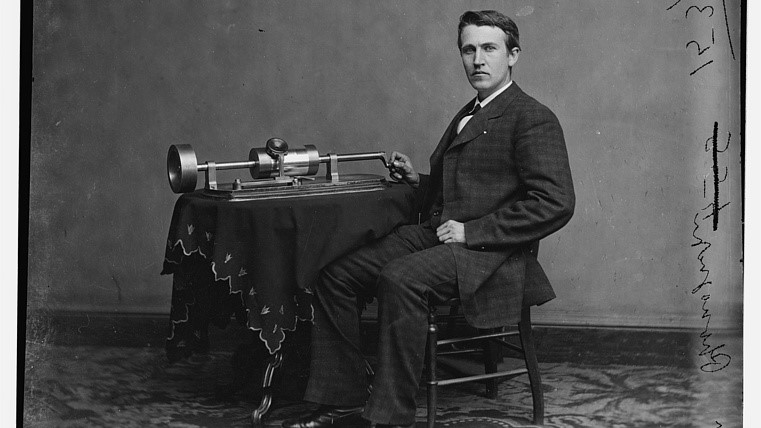
On December 24, 1877, inventor Thomas Edison filed for a patent for his “talking machine” or cylinder phonograph. This technology was transformative, successfully reproducing recorded sound and thus setting the stage for our experience of listening to the music we love whenever and wherever we want to!

To celebrate this important date in sound history, it is worth briefly exploring the story of Edison’s early work in recorded sound. Other inventors had already made inroads with different technologies that facilitated communication and transmitted sound – for instance, Samuel Morse with the telegraph in 1844, and Alexander Graham Bell with the telephone in 1876. However, the recording and playback of sound had not been achieved before Edison’s work, the result of several months of diligent labor on the concept of the phonograph. He marked his success with the recording and playback of his own recitation of the nursery rhyme “Mary Had a Little Lamb,” and his remembrance of this occasion can be heard below. Later Edison noted: “I was never so taken aback in my life – I was always afraid of things that worked the first time.”

Two months after filing, the patent for Edison’s phonograph was issued on February 19, 1878. At first, Edison thought that his machine would be primarily useful in the business world as a correspondence and dictation device. Along with that function, however, he envisioned various other uses, including the connection to playing music:

  • Phonographic books for blind people
  • A device for teaching elocution
  • The reproduction of music
  • A “family record” machine to record memories, sayings, last words of dying relatives, etc.
  • Music boxes and toys
  • “Talking” clocks that could keep you on schedule
  • To preserve languages and their pronunciation
  • An educational resource to preserved teachers’ lessons and explanations for later referral
  • To record telephone conversations
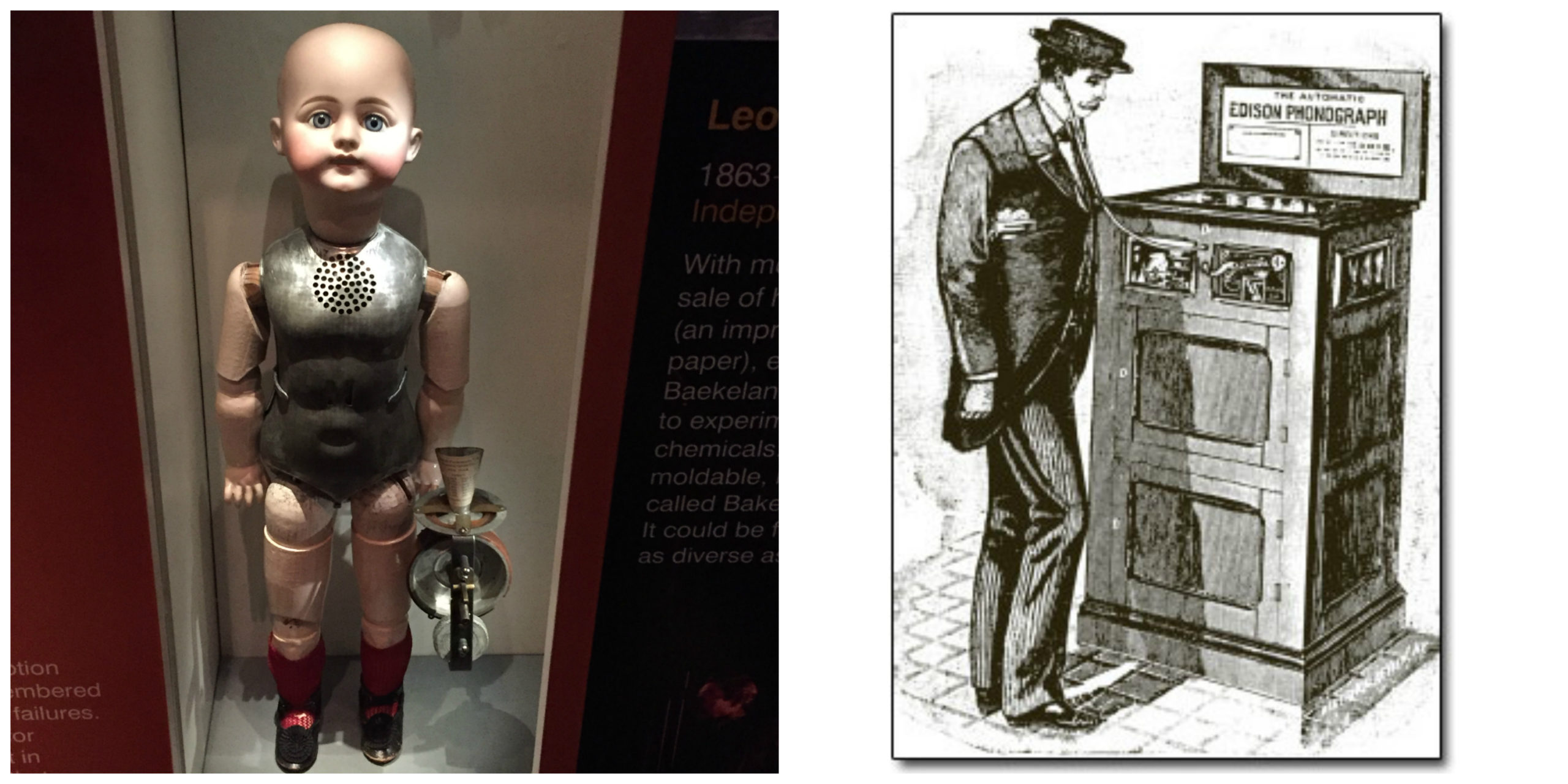
Left: A baby doll with porcelain head (bald), metal body with speaker area at top of torso, and articulated wooden limbs. Right: A 19th-century drawing of a man standing in front of a large cabinet Edison phonograph with what look like earphones plugged into the machine.
Left: In 1890, Edison’s company began producing “talking” doll toys that contained small wax cylinder playback machines. Frankly, this is the stuff of nightmares… Right: In late 1889, “coin-in-the-slot” phonographs were introduced in San Francisco, giving people the chance to listen to songs at 5 cents each. The first of these used an Edison phonograph as its base machine. Photograph taken at the National Museum of American History; artist’s rendering of a coin-slot phonograph from radiomuseum.org

The general way these early cylinder phonographs worked was that a person would talk (or sing) into the large end of an acoustic recording horn, which fit into a machine housing a diaphragm and stylus. The sound wave vibrations caused a carriage arm to move across a metal cylinder wrapped in tinfoil (later these became wax cylinders) upon which the stylus inscribed a continuous vertical groove – thus recording the sound being made, which could then later be played back and listened to with delight!

Edison bowed out of the phonograph field for almost 10 years as he concentrated on creating and mass-producing the electric light bulb – creating light out of the darkness in wealthy homes and many cities. But when he returned to the technology of recorded sound, he was continually innovating and producing new models and types of phonographs, and one of his subsidiaries – Columbia Phonograph Company – had also been producing cylinder recordings of popular music of the day. As with most technology, competitors arose and new versions and innovations were developed throughout this time, including the graphophone of Alexander Graham Bell, Chichester Bell, and Charles Sumner Tainter and Emile Berliner’s disc gramophone, and the switch from acoustic horn to electric microphone recording. And with them, and over the following years, came more and more musical recordings by different companies and within a variety of genres – from what is widely considered the first “satisfactory” musical recording (of Italian tenor Enrico Caruso) in 1902 to the later early “hillbilly” tunes of the 1920s that we know and love.

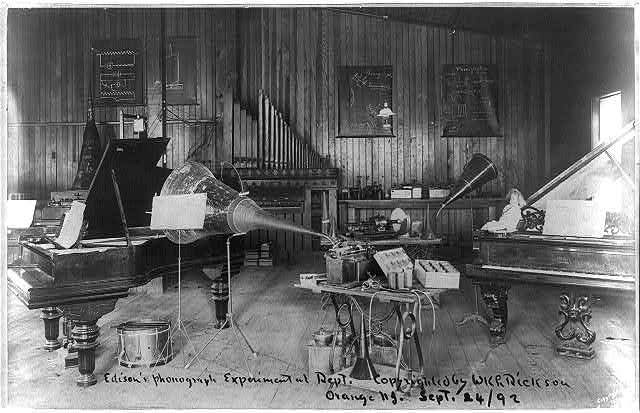
A black-and-white photograph of a large room filled with different musical instruments, including two pianos, a small drum, and what looks to be a small organ, along with several phonograph machines.

Edison’s phonograph experimental laboratory in Orange, New Jersey, in 1892. Image from the Library of Congress

This blog post shares only one small part of Edison’s story – and an even smaller part of the story of recorded sound. If you want a much fuller history of Edison’s work and impact, there is much to be found on the internet – including a great article from the Library of Congress. Interestingly, research has also uncovered several older instances of recorded sound – that of the French inventor Edouard-Leon Scott, whose invention, the phonautograph or phono-autograph, produced a sound recording almost 20 years before Edison’s phonograph, including a snipped of the song “Claire de Lune.” Check out this NPR transcript of an interview with Patrick Feaster, one of the researchers, as he describes the discovery, noting: “It’s the earliest recognizable recording of the human voice, the earliest recording of a vocal musical performance, the oldest recognizable snippet of sound in any recognizable language. So, it’s a lot of firsts.”

Putting the Band Back Together!: Using Cutting-Edge Technology to Recover Sounds From the Past

At the Northeast Document Conservation Center (NEDCC) in Andover, Massachusetts, we recently completed an especially rewarding project for the Birthplace of Country Music Museum. The museum honored us with the task of recovering nine previously unheard, live recorded songs performed by The Stanley Brothers & The Clinch Mountain Boys on the Farm and Fun Time radio show, circa 1950, from a damaged transcription disc – a project supported by the Virginia Association of Museums’ “Virginia’s Top 10 Endangered Artifacts” in 2018.

We were so thrilled to be a part of this project for two reasons in particular. One, despite our northern orientation, The Stanley Brothers happen to have quite a fan base here! And two, we always welcome a challenge, and this disc delivered.

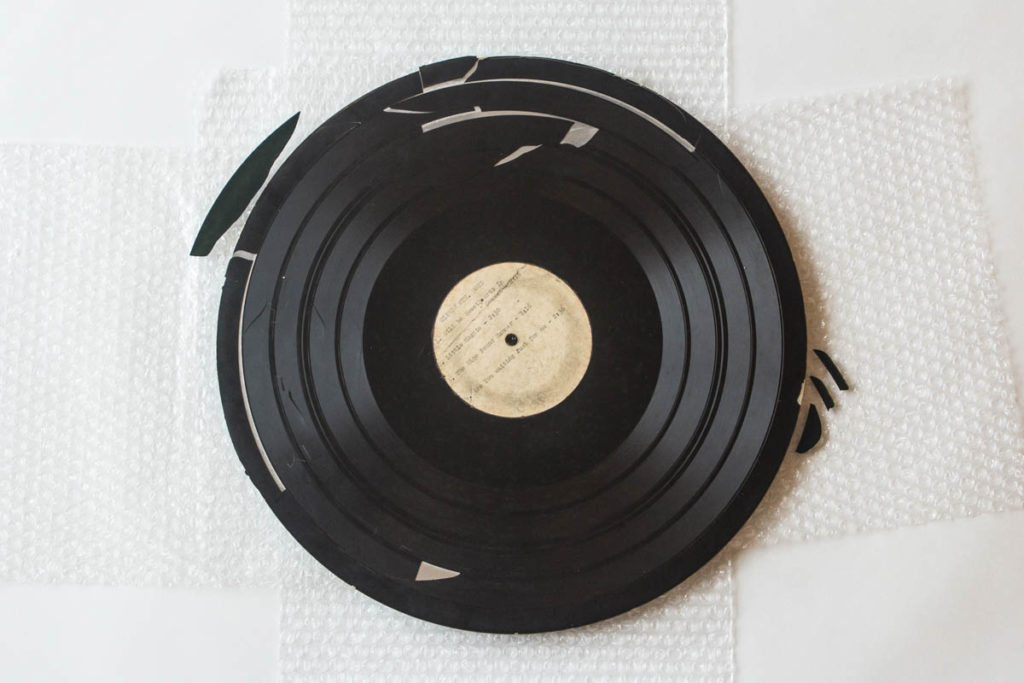
The Farm and Fun Time disc showing signs of delamination. © Birthplace of Country Music; donated by Glen Harlow via Dean Casey

The damage seen on the disc in the image above is called delamination, and it means the grooved lacquer coating is separating from the aluminum base. Any missing piece of the lacquer is a loss of the audio content. Additionally, a delaminating disc cannot safely be played with a stylus because the physical contact will cause further damage.

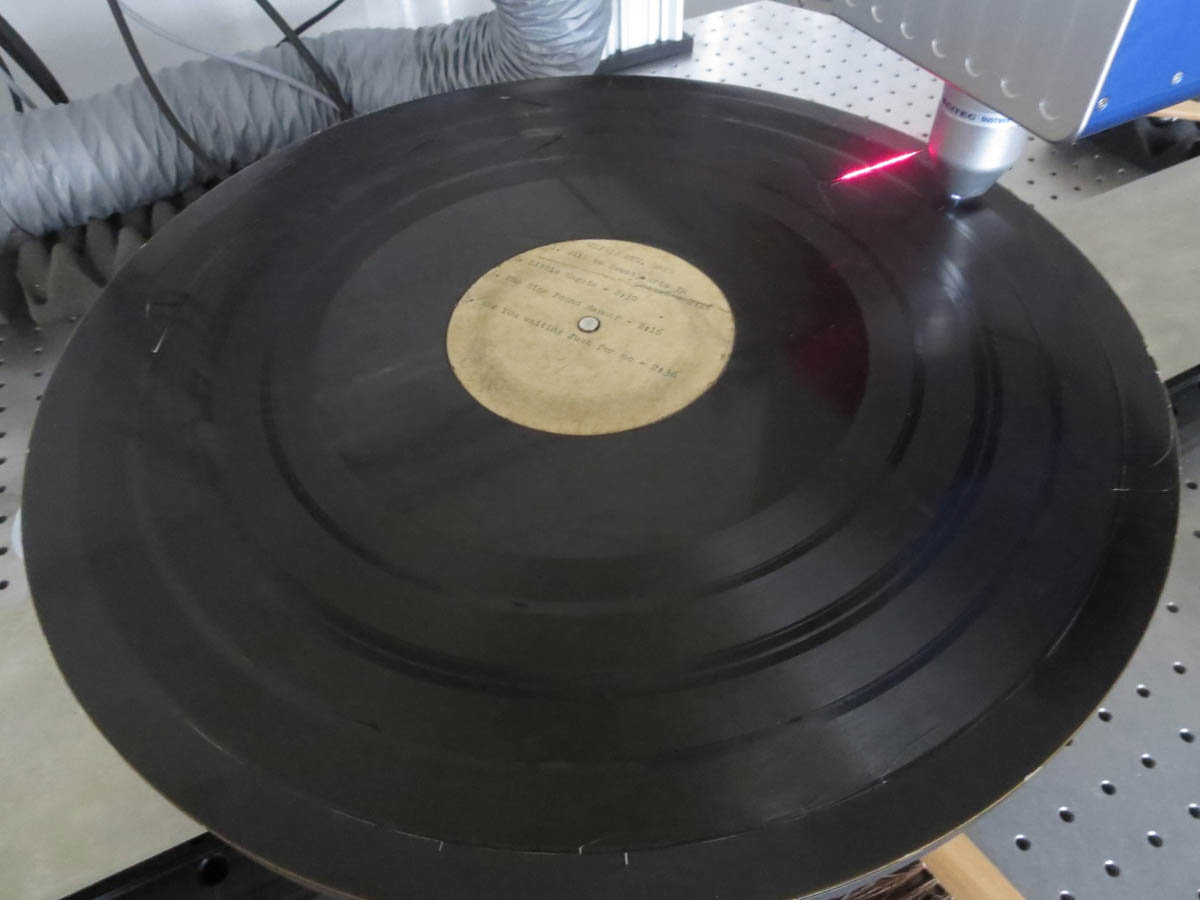
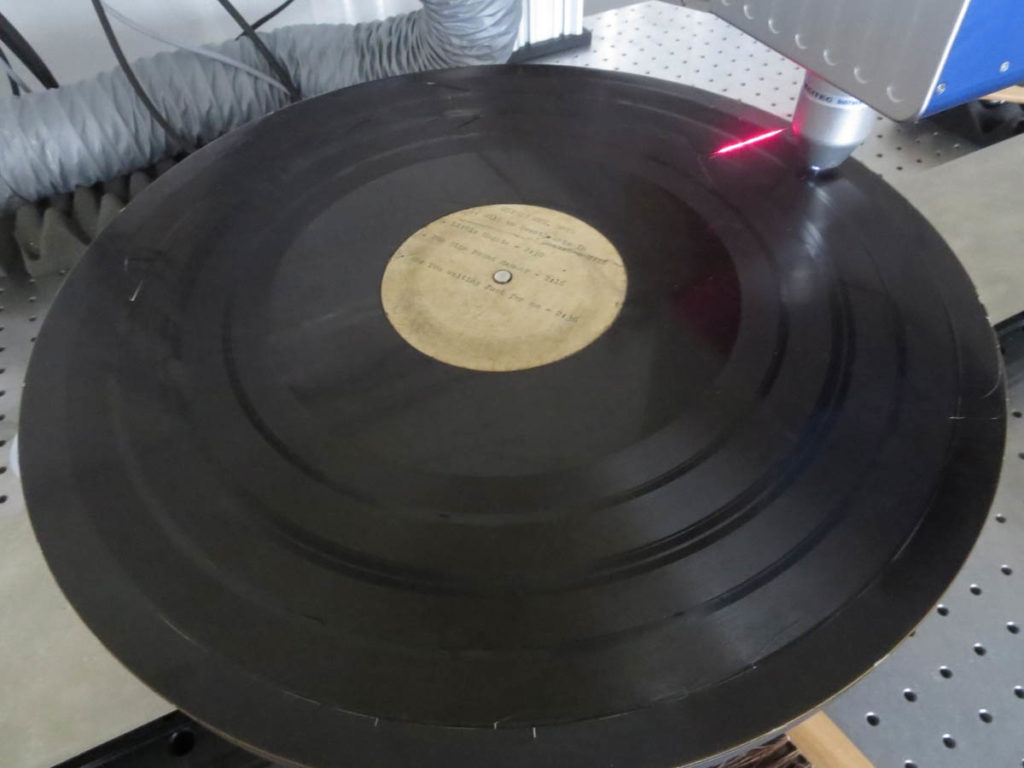
Therefore, in order to safely retrieve the audio from the disc, we used a non-contact, optical-scanning technology called IRENE. With IRENE, we take microscopic images of the grooves, and those images are analyzed in software to produce an audio file. The concept is fairly simple, but the process can be challenging for damaged media like this.

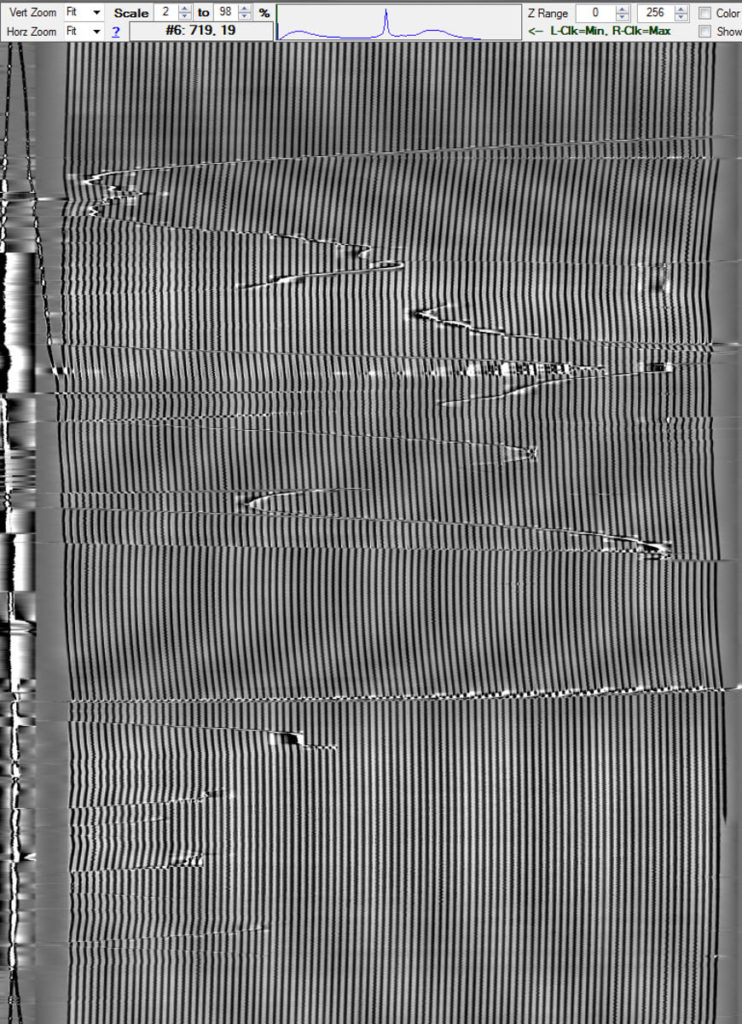
First, we carefully “puzzled” the separated pieces of lacquer back together on the disc. We did this by lining up the grooves as best as possible, without touching the grooved surface. The added challenge here is that delamination occurs with a loss of plasticizer. The lacquer becomes brittle, shrinks, and can warp. This means that the grooves won’t be perfectly aligned. A slight offset of the grooves might not seem dramatic to the human eye, but on a microscopic level (which you can see in the images), the disruptions can be quite dizzying.

After puzzling, we imaged the disc with a Precitek CHRocodile CLS Confocal Microscope. This “camera” captures the horizontal motion of the grooves by measuring the groove’s depth. The disc is carefully mounted on a platter that rotates beneath the camera as the grooves are imaged. The image resolution is based on the disc’s original recording speed and the desired specifications for the resulting audio file. Other factors, such as the disc’s reflectivity and surface wear, dictate other imaging parameters – like the optical sampling rate and exposure.

Imaging the disc with the IRENE system 3D camera. © NEDCC

The process creates a high-resolution TIFF image file of the surface of the disc, where you can see the extent of the damage and misaligned grooves due to delamination:

Image of the grooves on the disc resulting from the IRENE imaging process with the 3D camera. © NEDCC

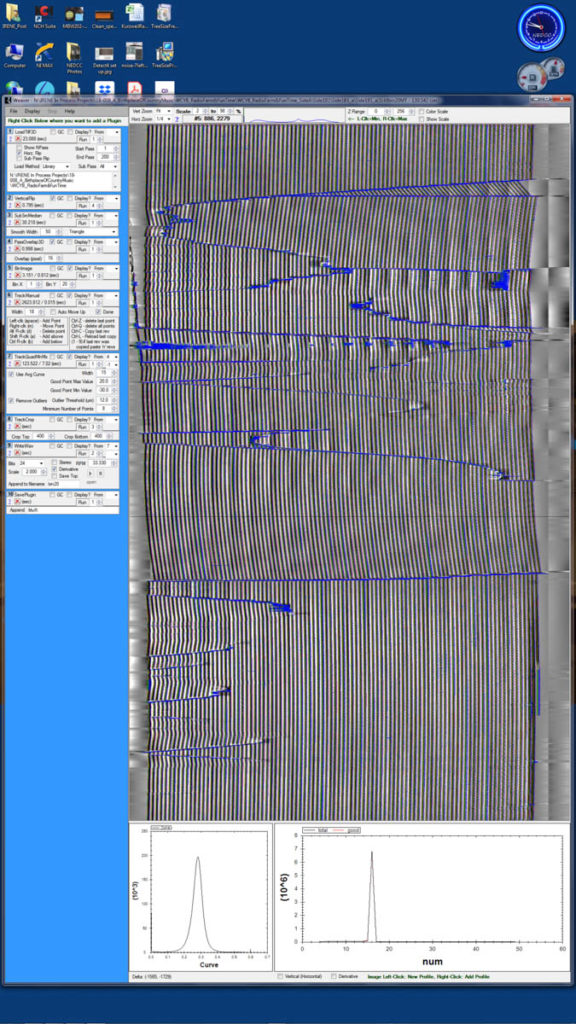
One of the biggest challenges for us is getting the software – called Weaver – to follow the correct path of the groove as it shifts along the breaks. To enable this software to properly track the grooves on delaminating discs like this, we painstakingly plot the trajectory of the groove in a process called manual tracking. With proper tracking enabled, Weaver can mimic the motion of a stylus through the grooves to produce an audio file.

Weaver is a modular program built on a series of plug-ins, and our work involves selecting and adjusting settings within a set-of plug-ins. Each plug-in enables or performs a different analysis function to produce audio. For example, the VerticalFlip plug-in flips the image. This was necessary because these discs were originally recorded from the inside-out, and our cameras are only configured to scan in one direction. Flipping the image and then reversing the resulting audio file gives us the same results if we had played the record from the inside as it was originally intended. A series of tools like this allow us to manipulate the images in a variety of ways to accommodate different types of media and the unique damage they may have incurred during their lifetime.

A TIFF image of the grooves being processed for audio in the Weaver software after it has been “manually tracked.” © NEDCC

Our goal is to produce a digital file that most accurately represents the audio on this disc in its current condition. On damaged discs like this, there can be brief moments where the audio drops out due to a missing piece of lacquer. Though there is some damage on the Farm and Fun Time disc, the “raw” audio from the Weaver software is remarkably listenable. And the true measure of success for this project: it’s also danceable!

In addition to the raw audio, we created separate listening copies for this project that have been processed with historically-accurate playback equalization and some restoration work to reduce the noise and to get rid of the clicks and pops. Though this process is subjective, we did our best to respect the content. The “cleaned-up” audio is more listenable but still reminds us of the disc’s condition and the music’s place in history.

The quality of the original recording plays a large role in the fidelity of the audio we’re able to capture. In this case, it probably helps that the recording took place in a studio with professional audio engineers. And the musicians were pros too – they knew how to approach the microphone when it was their time to sing or take a solo.

Here’s a short clip to get a sense of the result:

Clinch Mountain Boys – Nine Pound Hammer sample (from WCYB Farm & Fun Time Transcription Disc)

That we were able to image the disc before it incurred any further delamination or other damage was also critical for the quality of the resulting audio. Lacquer-coated instantaneous discs are some of the most inherently fragile formats in archival collections. Delamination is one of the major preservation threats, and it can progress relatively quickly.

The museum is owed much appreciation for their efforts to save the disc before it was too late, and we’re grateful to have had the opportunity to help preserve this audio treasure! And for your chance to hear the first reveal of the songs from this rescued disc, be sure to attend the live Farm and Fun Time show in the museum’s Performance Theater on February 13 or listen online via Radio Bristol’s Facebook page!

You can learn more about the Birthplace of Country Music Museum’s valiant efforts to save the disc, including how the disc was carefully packaged and transported to NEDCC, here. You can learn more about IRENE at NEDCC here.