Personalities Archives - The Birthplace of Country Music
Listen
Play
Loading station info...

Come Out Singing: The Music and Activism of Patrick Haggerty

By Sam Parker, AV & Technology Specialist at the Birthplace of Country Music Museum.


From the campfires of Valley Forge, to religious reformers in the First Great Awakening, to even our journey into space, LGBTQ+ people have been present and participating throughout American history. The American music industry, and even country music, are not exempt from their influence. While strict social norms and regular violence forced many early queer musicians to hide their identities, some decided to take a stand regardless of the consequences. To celebrate Pride Month, let’s explore the life and work of country music’s first openly gay musician, Patrick Haggerty.

Patrick Haggerty was one of ten children born on a Washington dairy farm in 1944. His father, whom Patrick would later refer to as the “Saint of Dry Creek,” understood that his son was different. Not many farmer’s sons in the 50s were asking their fathers to help them make wigs out of baling twine for a drag performance at a talent show.  It was also not very common for farmers to give their sons tips on how to do better at the next one on the drive home. In his youth, Patrick won a 4-H cooking contest and was invited to Canada to demonstrate his skills for Queen Elizabeth II. When his father saw Patrick practicing his curtsies in a cooking apron, he wasn’t bothered by his son behaving like a proper lady, what bothered him was that his son was curtsying to the Queen of England! The Haggertys were Irish, after all. Patrick’s father didn’t want his son to be ashamed or hide himself as he later recalled his father telling him, “Over and over again in a hundred different ways … not to sneak; he said it would ruin my immortal soul.”
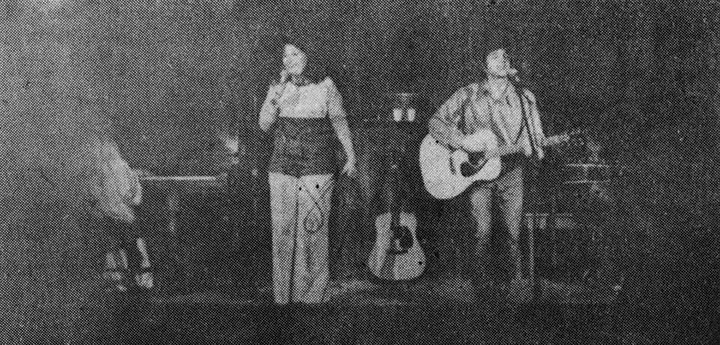
A grainy, black-and-white photo of a young Patrick Haggerty performing with Lavender Country. Only Patrick, playing guitar, and Eve Morris singing are easily visible.
The only surviving image of a Lavender Country performance, early 1970s. From Paradise of Bachelors.

Patrick took his father’s words to heart and credits the moral as his inspiration for creating the first gay country music album in the early 1970s, Lavender Country. In the years following the Stonewall Uprising, the American LGBTQ community was energized, producing numerous works of art and protest collectively. Patrick’s band, also called Lavender Country, was one of these efforts, combining Patrick’s singing with Michael Carr on keyboard, Robert Hammerstrom on guitar, and Eve Morris singing and playing fiddle. Seattle’s LGBTQ community entirely funded their self-titled first album– the studio, promotion, and distribution of the album’s 1,000 copies was all a community effort to get their message out in the open. This decision was made to avoid those in the country music industry who would have refused to produce their music, or demanded significant changes to it. Patrick believed that Lavender Country would be his first and last album due to its controversy– “I knew Lavender Country would define me musically, and I couldn’t have a career anywhere in music because I wrote it. … But I knew that when I made it and I’ve never regretted that decision.”
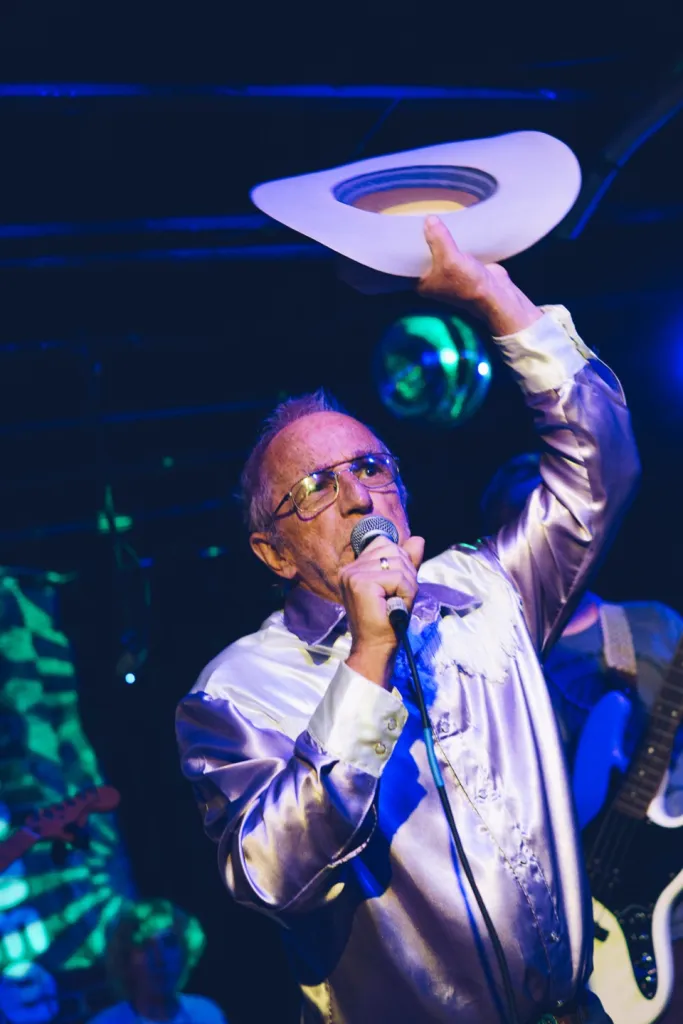
Patrick Haggerty, singing while holding up his cowboy hat. He is wearing a lavender-colored western outfit, with white tassels and accents, and holding a microphone.
Patrick performing during Lavender Country’s comeback. From Paradise of Bachelors.

Notably, Lavender Country’s music was written to speak directly to its queer audience, especially those living closeted lives in rural areas, those who did not understand their feelings, what they meant, or what to do about them. The songs addressed the intersectionality of gay liberation, the necessity of anonymity in gay relationships at the time, and the prospect of a future where people can live and love as they please.
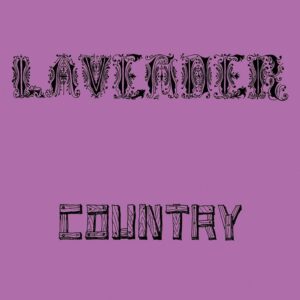
Lavender Country album cover.
Lavender Country’s album cover. Before you listen, note that due to the experiences of the LGBTQ+ community in the US and the nature of protest music, the lyrics contain adult language.

Yet, Patrick treats the question of “is it real country?” with derision. “If you challenge my credentials on my country-ness,” he said in an interview, “do so at your own peril.” Along with the rest of Lavender Country, Patrick performed at the first Seattle Gay Pride celebration in 1974, along with numerous other Pride events in the Pacific Northwest over the next two years. Shortly after the album’s release, a DJ for a Seattle radio station was fired for playing one of their songs, which featured an explicit title and lyrics in line with their campy, proud, and out theme.

The band broke up in 1976, and Patrick began to focus on working as an activist for anti-racism and pro-LGBTQ causes. He ran unsuccessfully for Seattle City Council, as well as the Washington House of Representatives. He co-parented two children and eventually met his future husband, Navy veteran J.B. Broughton, with whom he continued his activism as the AIDS crisis set upon the American queer community. 

Patrick continued performing here and there, mostly at retirement homes for older audiences, and a couple publications made some mention of Lavender Country as the first openly gay country group. Still, Patrick’s comeback wouldn’t really come until someone uploaded one of his album’s songs to YouTube in 2014, leading to renewed interest in Lavender Country. Their original 1973 album was re-released under the Paradise of Bachelors label, and Patrick’s music experienced an explosion of popularity. Patrick toured across the country, gave interviews on the radio, appeared in documentaries about himself, and the album Lavender Country was even adapted into a modern ballet performance. In 2019, after 46 years, Lavender Country released their second full-length album, Blackberry Rose and Other Songs and Sorrow. Patrick died of complications following a stroke on Halloween of 2022, though his legacy as an activist and musician lingers. When asked how he feels about his music’s comeback during Lavender Country’s 2014 revival, he said, “…before I go to my grave, I’m getting the last laugh, because Lavender Country is going to outlive me.”
Both Kinds of Music: What is the difference between Country and Western?

By Ed Hagen, Gallery Assistant and Guest Blogger


What’s the difference between Country and Western?

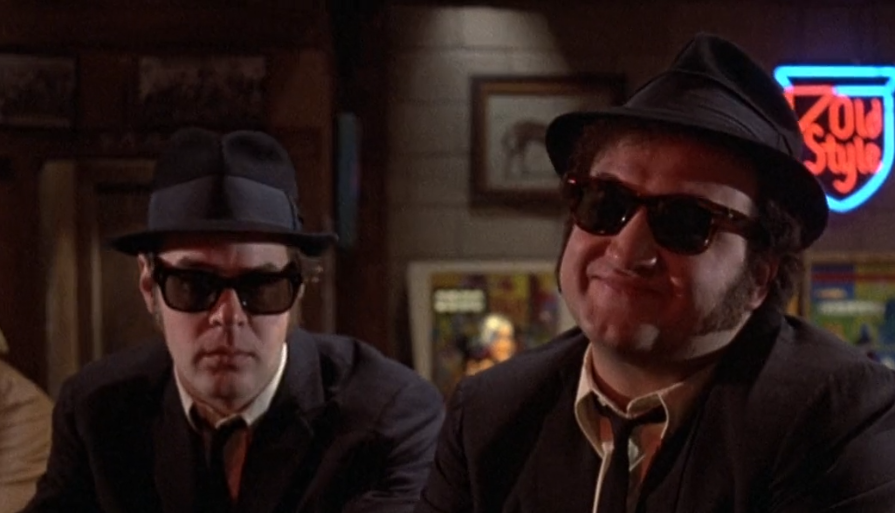
Many people are familiar with a popular scene in The Blues Brothers movie where the character played by Dan Ackroyd asks the woman tending bar, “what kind of music do you usually have here?” She responds, “Oh, we got both kinds, country and western.” Although intended as a joke, the question can be taken seriously. They are two distinct musical styles. And both styles were popularized by musicians from the 1927 Bristol sessions. 

The words we use to describe music have changed almost as much as the music itself. In the 1920s, the music we now refer to as country was known as hillbilly music. The phrase “country and western” first started to appear in print in 1944, with peak usage in 1973. Billboard charts, which initially had listings for “folk” and “hillbilly” records, switched to “country and western” in 1949, and used that label before settling on “Hot Country Singles” in 1962. Listeners in the 1950s knew what you meant when you said “country and western.” Today, not so much.

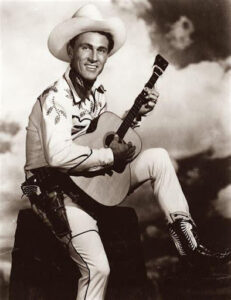
Singer and actor Ken Curtis, posing in a white cowboy outfit and holding a guitar.
Ken Curtis posing in costume. Image found on Hollywood Page Of Death on facebook. Click for one of his songs.

Country music has its roots in Appalachian music, which in turn can be traced to Scotch and Irish folk music and African musical traditions. It typically involves storytelling. Popularized by the Carter family, it is the music associated with Nashville and the Grand Ole Opry. The emphasis in country music is on melody and lyrics. Think of songs like He’ll Have to Go, I Can’t Stop Loving You, He Stopped Loving Her Today, and Jolene. These songs are country, not western.

It is a bit harder to define western music. Many listeners would think of cowboy songs sung by artists like Gene Autry and the Sons of the Pioneers. Autry started out as an obscure radio singer in Chicago. His big break came in 1935 when he was signed by Republic Pictures to make low budget Westerns. These films featured Autry using his own name, breaking into a song from time to time, often while riding his horse Champion. His theme song was Back in the Saddle Again, but he is also remembered for his popular Christmas songs: Santa Claus Is Comin’ to Town, Here Comes Santa Claus, Frosty the Snowman, and Rudolph, the Red-Nosed Reindeer.

The Sons of the Pioneers was a vocal group formed in 1933 in the Los Angeles (LA) area. The original trio consisted of Bob Nolan and Tim Spencer and was led by a truck driver and fruit picker named Leonard Slye. They soon added the brothers Karl and Hugh Farr. These five are often referred to as the “Original” Sons of Pioneers since the band has continued to rotate members and is still active today! LA in the 1930s was a good place to be for talented cowboy singers. The group found work in western movies and recorded a best-selling record, Tumbling Tumbleweeds. In 1937, Slye left the group, changed his name to Roy Rogers, and became one of America’s favorite singing cowboy stars. His place in the Sons of the Pioneers was taken by Ken Curtis, who is better known today for his role as Festus in the TV show Gunsmoke.

These cowboy songs were typically accompanied by simple first-position triads played on a guitar. In fact, first-position triads are often called “cowboy chords” today.

But that’s just one type of western music. Another variant can be traced to the Bristol sessions, specifically to up-tempo tunes recorded by Jimmie Rodgers. Rodgers, a native of Mississippi, was strongly influenced by African American acoustic blues players that he met and played with when he worked on railroads in the South and West. Rodgers often played songs that featured bass runs between the chords that swing hard. 

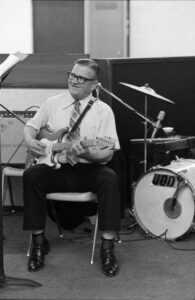
white man with glasses wearing a white short-sleeved button down shirt and tie sit in a chair playing a guitar.
Picture of Eldon Shamblin, Western music pioneer and member of the Texas Playboys. Photo is from AskZac.com “The Story of Eldon Shamblin’s 1954 Gold Stratocaster – The First Custom Colored Strat” Click to hear him play!

In the 1930s and 40s the big jazz bands of stars like Benny Goodman and Count Basie dominated popular music, and a number of them started specializing in western songs. The most famous of these western swing bands were organized by Bob Wills (the Texas Playboys) and Spade Cooley. Western swing bands featured fiddles, horns, brass, and piano players. Playing in giant ballrooms like the Aragon in Santa Monica, they got the volume they needed with drums and modern electric and steel guitars, instruments that drowned out conventional acoustic basses. So guitar players like the Texas Playboys’ Eldon Shamblin, playing in the Jimmie Rodgers style, mixed bass runs with the rhythm chords. This style worked for Rodgers and Shamblin because they both swung those bass lines hard.

Western swing, unlike cowboy songs, was dance music. It differed from big band swing because wasn’t based on jazz music. Take, for example, a song like Take Me Back to Tulsa, which was originally a traditional fiddle tune, Walkin’ Georgia Rose. The Texas Playboys changed the words and had a hit with it as a big band tune. The underlying harmony of the song was just two cowboy chords. Western swing bands didn’t play complex extended chords or rhythm changes. But they got you out of your chair.

The big western swing bands died out at about the same time that the popular jazz swing big bands broke up, probably due to the economics of keeping a large band together. But western music stayed popular with the next generation of smaller combos led by western stars such as Ernest Tubb, Buck Owens, and Merle Haggard. Powered by drums and electric instruments, these more modern western stars kept people dancing.

So when the bartender told the Blues Brothers they have both kinds of music, perhaps she meant the bar featured old-time and traditional country musicians as well as western and western swing acts! Either way Jake and Elwood probably were not what the crowd at Bob’s Country Bunker was expecting.

Troubadour or Tramp? The Protest Songs of Joe Hill

By Sam Parker, AV & Technology Specialist at the Birthplace of Country Music Museum.


Protest and labor have been common themes of American folk music for a long time. Woody Guthrie, Pete Seeger, and Phil Ochs are all notable for their recordings of old union ballads and folk tunes, as well as the many songs they each wrote detailing the struggles of America’s poor and downtrodden. One musician penned nearly thirty songs and poems within the span of just four years that remain in the American folk lexicon to this day. In the century after his death, he’s been remembered as a troubadour, a rebel, and a martyr. His music has been sung by numerous artists for decades, and tributes to him have been performed by artists such as Billy Bragg, Paul Robeson, Bruce Springsteen, and most famously Joan Baez at the 1969 Woodstock Music and Art Fair. To commemorate May 1st – known around the world as International Workers’ Day – let’s dive into the life and music of Joe Hill.

Joel Emmanuel Hägglund was born in Sweden in 1879. His father died when he was just nine years old, a tragedy that forced Joel and all of his siblings out of school and into the workforce. As a child laborer, Joel worked in a rope factory and later as a stoker for a steam-operated crane until his mother passed away in his early twenties. After her death, the six Hägglund siblings decided to sell the family home and went their separate ways. Joel and his brother Paul emigrated to New York, and from there he traveled with the millions of other itinerant workers thronging the nation’s cities, farms, and railroads.

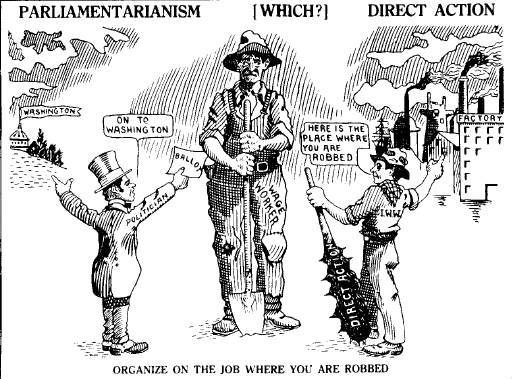
A cartoon published in the IWW's newspaper, the Industrial Worker. It shows an American worker between two men, one a politician holding a ballot and the other a Wobbly holding a club labeled "Direct Action." The cartoon is meant to suggest that direct action (strikes, sabotage, and the like) at the workplace is more effective than political reform.
Cartoons such as this one were commonplace in the IWW’s newspaper, the Industrial Worker, promoting the IWW’s views that direct action was a more effective way of achieving better rights and working conditions.

As Joel walked and train-hopped westward, his hopes of America being a land of wealth and opportunity quickly faded. He lived and worked among the deep wealth disparity that dominated the receding Gilded Age of the United States, working for dollars a day and facing discrimination as an immigrant. By the time he reached San Francisco, Joel was going by the name “Joseph Hillstrom,” later shortened to “Joe Hill,” likely to protect himself from anti-union blacklisting. By this time, Joe had become a “Wobbly”, a member of the Industrial Workers of the World (IWW), a labor union rising in both membership and notoriety at the time.*

The IWW differed from other unions of the period. They advocated for One Big Union across all industries, workplace democracy – where workers collectively decided on pay and conditions, and vehemently opposed scabbing – when workers cross a picket line to fill jobs left by those on strike. They advocated for direct action, valuing strikes and sabotage to force rapid changes over gradual reforms through political avenues. These characteristics led Wobblies to be called radicals, and anyone carrying the IWW’s little red membership card was viewed as a troublemaker and rabble-rouser.

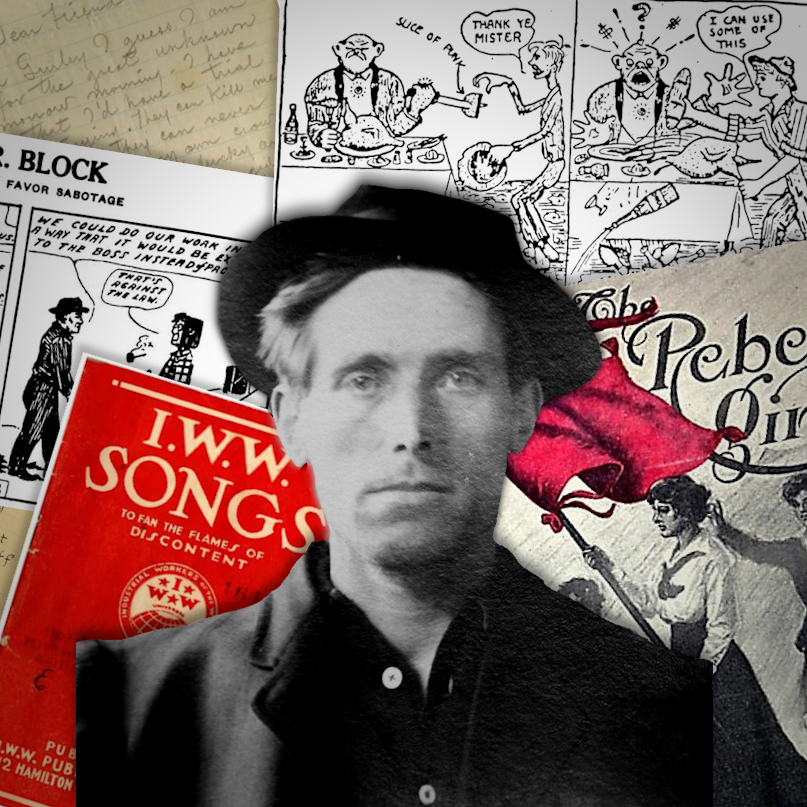
Cover of "The Rebel Girl" music sheet, written by Joe Hill. It depicts a woman, based on Elizabeth Gurley Flynn, carrying a red banner with a pennant reading "One Big Union" flying from its flagpole.
Cover of “The Rebel Girl” music sheet, from the Library of Congress’s online catalog.

Since childhood, Joe demonstrated musical talent, which he continued to do when he became a Wobbly. Joe often wrote lyrics set to the melodies of popular songs, including  “The Preacher and the Slave,” which is set to the tune of “In the Sweet by-and-by.” This song attacked the Salvation Army, which IWW members referred to as the “Starvation Army,” for focusing on workers’ spiritual rather than their material well-being. The song even coined the phrase “pie in the sky” with its lyrics.

One of Joe’s most famous songs is “The Rebel Girl,” which he wrote for fellow Wobbly and suffragette Elizabeth Gurley Flynn to expand IWW recruitment among women. Joe believed the organization was incomplete without the representation of working women. In the Wobbly newspaper Solidarity, Joe wrote that without women, “We have created a kind of one-legged, freakish animal of a union.” In 1990, Hazel Dickens, another musician and activist, recorded the song for the Smithsonian Folkways album Don’t Mourn, Organize! Songs of Labor Songwriter Joe Hill.

"Mr. Block" comic strip from the IWW's newspaper, the Industrial Worker. In the strip, Block refuses to take part in strikes or sabotage to force a mine owner to adopt safer work practices, leading to the death of a miner.
A Mr. Block strip from the IWW’s Newspaper, the Industrial Worker. Block was often a stand-in for workers opposed to more radical actions like strikes and sabotage. Click to enlarge.

Joe also wrote a song for “Mr. Block,” a cartoon character appearing in the IWW’s newspaper. Mr. Block is a literal blockhead meant to represent workers tricked by capitalism and patriotism, or sometimes who just belonged to the wrong union. Many comic strips involved Mr. Block praising the United States, hoping he’ll get rich if he works hard enough, or decrying the IWW’s radicalism, only to end up unemployed, destitute, injured, or a combination of the three. Almost all of Joe’s songs had political undertones. He saw music as the best way of reaching other working-class people, as he wrote: “A pamphlet, no matter how good, is never read more than once, but a song is learned by heart and repeated over and over. And I maintain that if a person can put a few common sense facts into a song and dress them up in a cloak of humor, he will succeed in reaching a great number of workers who are too unintelligent or too indifferent to read.”

During the night of January 10th, 1914, Joe arrived on the doorstep of a Salt Lake City doctor, bleeding from a gunshot wound. He claimed it was from an angry husband, but across town, local police had been investigating the shooting of a former policeman. One of the shooters had been wounded, and this was enough for the police to pin the crime on Joe. Though no witness could identify Joe conclusively, and the murder weapon was never recovered, he was found guilty and sentenced to death. Joe chose to be executed by firing squad, remarking, “I have been shot a few times in the past and I guess I can stand it again.” While in Prison, he wrote to one of the IWW founders, Big Bill Haywood: “Goodbye Bill: I die like a true rebel. Don’t waste any time mourning, organize! It is a hundred miles from here to Wyoming. Could you arrange to have my body hauled to the state line to be buried? I don’t want to be found dead in Utah.”

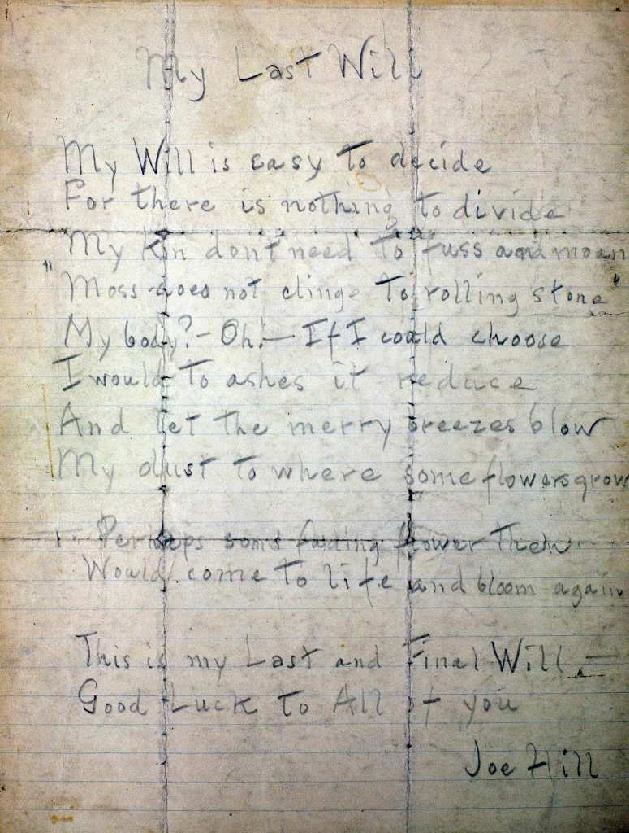
Joe Hill's final will, written while he was waiting for his execution. It reads: "My will is easy to decide For there is nothing to divide My kin don't need to fuss and moan "Moss does not cling to rolling stone" My body? Oh, if I could choose I would to ashes it reduce And let the merry breezes blow My dust to where some flowers grow Perhaps some fading flower then Would come to life and bloom again. This is my Last and final Will. Good Luck to All of you Joe Hill"
Joe Hill’s will, and final poem, written while awaiting execution. Click to enlarge and read.

Joe wrote a short poem on the day of his execution, requesting to be cremated and his ashes spread. While blindfolded and tied to a chair, Joe shouted the order to fire himself. There was a small service in Salt Lake City before his remains were moved to Chicago, where thousands of supporters listened to his songs and followed his casket to the cemetery where he was cremated. His ashes were divided up and mailed to IWW locals and supporters across the globe – Utah was exempted per his wishes. Most were spread in the wind, while other parcels were collected, confiscated, and in a few unusual cases even consumed.

Joe Hill’s musical legacy didn’t die with him. After his death, poet and screenwriter Alfred Hayes wrote the poem “Joe Hill,” later put to music by Earl Robinson and performed by artists such as Paul Robeson, Joan Baez, and Bruce Springsteen. The song tells of a vision of Joe Hill visiting the narrator in their sleep. The ghost’s message echoes his final letter to Bill Haywood: Don’t waste any time mourning, organize!


Some Labor/Protest Musician Museums in the US to check out:

The American Labor Museum

National A. Philip Randolph Pullman Porter Museum

West Virginia Mine Wars Museum

Woody Guthrie Center


*For more on a 1916 strike the IWW was involved in check out our interview with the American Labor Museum from 8/15/2024 on Museum Talk!

Emmylou Harris and Her Guitars

Ellie Davis is an intern at the Birthplace of Country Music Museum and a student at East Tennessee State University where she studies Human Studies with a minor in Old Time Music Studies.


As an avid old-time and folk musician, I thought I’d share some interesting background behind one of my lifelong inspirations, Emmylou Harris, and more specifically, the story behind her guitars. As a young girl, I was always so drawn to Emmylou because of her beautiful voice, her unapologetic stage presence, and her big, powerful guitar.

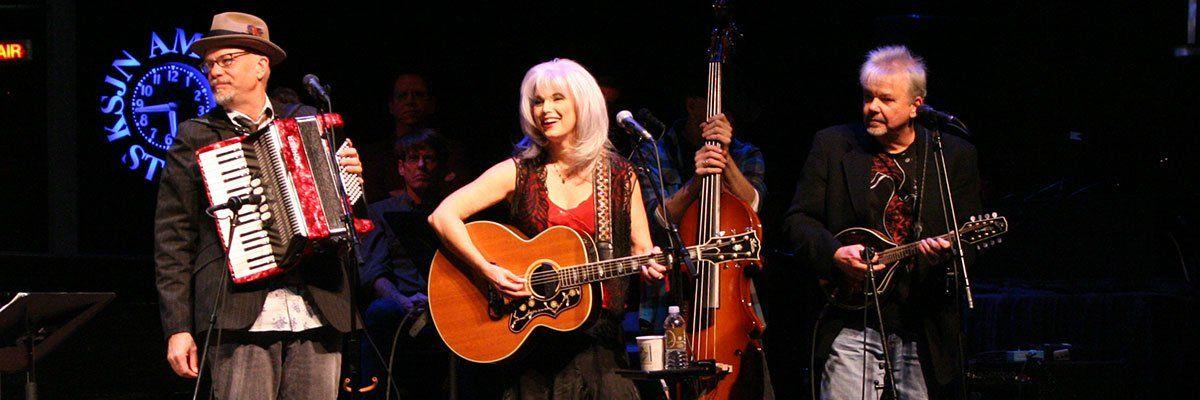
An image of Emmylou Harris, standing between two other musicians with her guitar. She has white hair, is smiling, and lightly strumming the guitar.
Picture of Emmylou with her guitar.

For those who might need an introduction or refresher on Emmylou Harris, she is a fourteen-time Grammy Award winner and Country Music Hall of Fame inductee, and has been a pioneering women musician in country and folk music for decades. Emmylou’s career was transformed when she was discovered by country music legend Gram Parsons in the early 1970s, and when he invited her to join his band, their duet harmony singing immediately captivated listeners. Another one of Emmylou’s most memorable collaborations was with Dolly Parton and Linda Ronstadt, where their iconic 1987 album, “Trio”, featured unforgettable harmonies that remain a landmark in country music history.

Gram Parsons & Emmylou Harris performing “Big Mouth Blues” live in 1973 at the Liberty Hall in Texas. In 1973, Gram Parsons, a pioneering country rock artist, passed away at age 26. There are few recordings of him performing live.

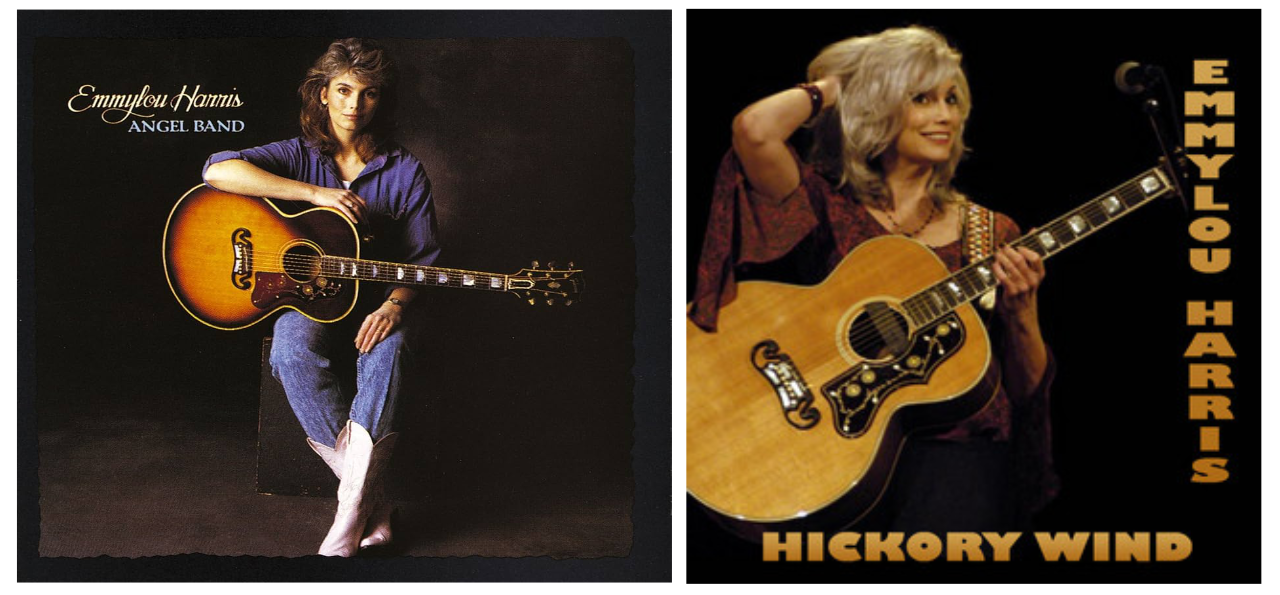
Now, let’s get back to Emmylou’s guitar. Because the music industry has notoriously been unwelcoming to women musicians, it’s too often generally accepted that women should not take up as much space, or be heard as loudly as their male counterparts. This is one of the reasons women rarely performed solo for many years and you still don’t often see women performing with big guitars. Like a lot of country artists, Emmylou found her signature guitar early on, and it remained her staple instrument for decades. This guitar for Emmylou was the. With the S and J standing for “Super Jumbo” this guitar is large bodied, with a rosewood neck, maple sides and back, mother-of-pearl inlay, and has strong bracing inside the body of the guitar. For non-guitar nerds, bracing refers to a guitar’s internal support system; essentially the bones of the guitar. It’s made of thin pieces of wood that are glued to the inside of the guitar’s top, and they help to both strengthen the instrument and control the vibrations of the strings, making the sound better and stronger. Gibson calls this guitar the “King of the Flat Tops” due to its popularity with American artists, but you almost never see a woman playing one. You can see Emmylou’s SJ-200 pictured on her 2001 album, Hickory Wind and a darker stained version of the same model on the cover of her 1987 album Angel Band.

Two albums by Emmylou Harris, "Angel Band" and "Hickory Wind." She appears posing with her guitar on both, while much younger on "Angel Band," and in front of a microphone on "Hickory Wind."
Picture of Angel Band and Hickory Wind albums

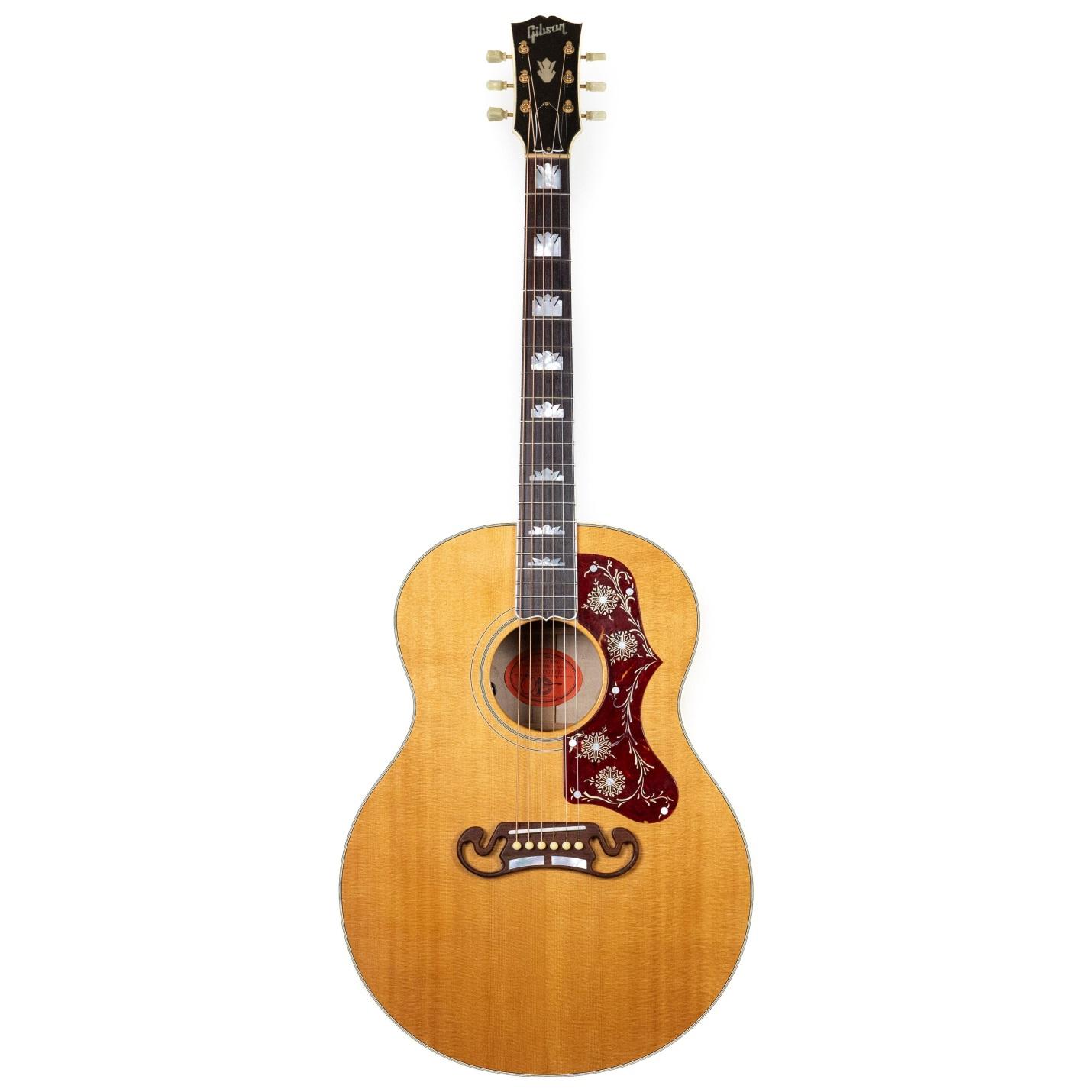
Because Emmylou made this guitar model so famous, Gibson even created a limited edition custom model dedicated to her, called the Gibson L-200. It’s a slightly smaller and lighter weight model of the exact same guitar with the exact same bracing inside it, making it more accommodating to smaller musicians while still preserving the full and striking sound. Emmylou now performs most often with the L-200. Gibson introducing a new custom model in honor of Emmylou shows how she has led by example and carved out space in the music industry for other women musicians to rise up and feel more of a sense of belonging.

Image of the Gibson L-200, a light-colored acoustic guitar. The pick guard is adorned with flowers and vines.
This image of a Gibson 2004 L-200 Emmylou Harris guitar is from rudysmusic.com.

Just like Gibson did with their custom, guitar, I hope to honor Emmylou’s unique musicianship with this ode to her instrument and how she likes to be heard. Emmylou is admired because of the duality in her musicianship. She can sing so tenderly and allow her femininity to be so prominent, and at the same time, she takes up space with her big guitar and her strong voice. The harmonious balance she strikes between vulnerability and strength paves the way for so many women musicians following in her footsteps.