
Music & Songs Archives - Page 8 of 30 - The Birthplace of Country Music
Listen
Play
Loading station info...

Celebrating Jimmie Rodgers: A Short Lesson in His Guitar Style

Today is the anniversary of Jimmie Rodgers’ passing on May 26, 1933, and therefore we wanted to celebrate him with this blog post by volunteer Ed Hagen – including a short lesson in Rodgers’ iconic guitar style! Ed moved to Bristol last summer, and he soon joined us at the Birthplace of Country Music Museum as a Gallery Assistant. He has played guitar for many years, mostly jazz, but he has been working hard on the rudiments of country and bluegrass since moving to Tennessee. As Ed says, “There is no better place to start than with the guitar style of Jimmie Rodgers!”

Jimmie Rodgers

Jimmie Rodgers was born in 1897 in Meridian, Mississippi, and he learned to play guitar while working on the railroad as a water boy and brakeman. He was influenced by the music played and the songs sung by the African American railway workers he met at the railway yard and around town – their call-and-response singing style during work and the blues songs they sang made a distinctive mark on Rodgers’ sound. He also spent time in Meridian’s opera house, vaudeville theaters, and hotels where he heard jazz, parlor music, and popular tunes, all of which also provided inspiration.

In 1927 he moved to Ashville, North Carolina, where he started playing on the local radio station with a small band made up of three musicians from Bristol, Tennessee-Virginia. Later that year they heard about recording sessions that were going to be held in Bristol conducted by the Victor Talking Machine Company, and so they traveled up to audition. These were the famous “1927 Bristol Sessions” that we celebrate at the Birthplace of Country Music Museum today. After arriving in Bristol for their audition, Rodgers and the band ended up recording separately, with speculation attributing this to an internal squabble or a change made by producer Ralph Peer. For Rodgers, this led to a recording contract and huge success as a recording and performing artist – though for only six short years before his death from tuberculosis in 1933 – and he is now celebrated as the “Father of Country Music.”

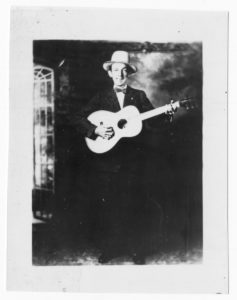
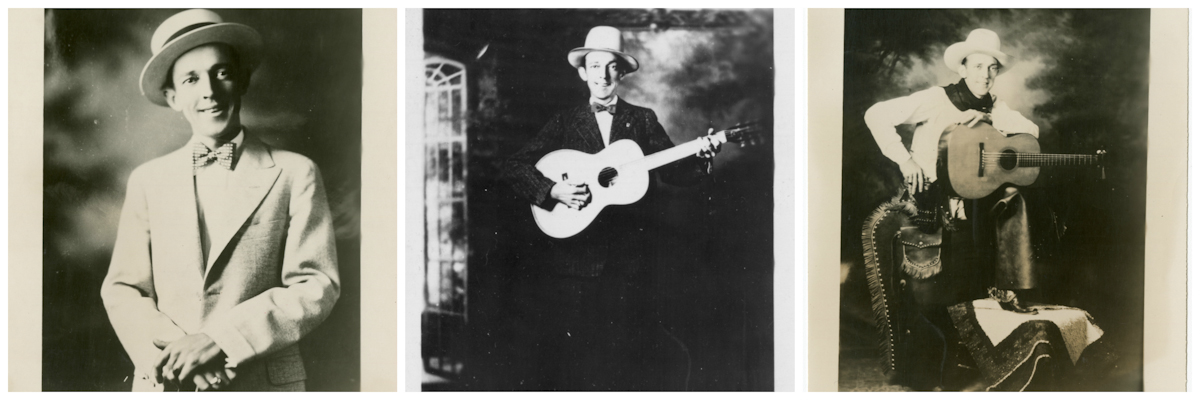
Black-and-white photograph of Jimmie Rodgers. He is a white man, and he stands in front of a faux photographic background that looks like a garden trellis. He is wearing a dark suit, a bow tie, and a white stetson-style hat, and he is holding his guitar.

Promotional portrait of Jimmie Rodgers. From the John Edwards Memorial Foundation Records, #20001, Southern Folklife Collection, Wilson Library, University of North Carolina at Chapel Hill

Jimmie’s Guitar Style

Jimmie Rodgers’ guitar style is iconic and made a huge impact on country music musicians and beyond – numerous artists have copied and embellished it for their own music playing throughout the years. It is based within a traditional style of guitar playing, but he is one of the most successful and well-known performing and recording artists to play in this style, and he certainly knew how to make it his own!

For guitar players, it’s a great style to learn because it is so versatile. As the bartender in the Blues Brothers would put it, the style works for both kinds of music, country and western. You can slow it down for a Hank Williams’ ballad, or swing it hard for a Bob Wills’ two-step. You can use it to play Gene Autry cowboy tunes or just about any Merle Haggard or Buck Owens tune. And once you master it, the style gives you the foundation to play the related but more challenging guitar styles of Maybelle Carter, Merle Travis, and Chet Atkins.

Playing Guitar Jimmie Rodgers-Style

Before we can play this guitar style, we need to begin with short introduction on how to play traditional country bass, because that is the foundation of the style. For the most part, traditional country bass players play the root note of the chord on the first beat of the measure, and the fifth note of the chord’s major scale on the third beat. The fifth can either be played above or below the root. Playing behind a C chord, these notes would be C and G. This is called playing “one five.”

A triplet (that is, three notes played where a quarter note would ordinarily be played) can be played on the fourth beat of a measure, especially before a chord change. This triplet anticipates the chord that is played in the next measure, either ascending or descending to the root of the target chord. The three notes in the triplet are the three tones just above or below the root of the target chord. For example, if ascending from a measure of C to a measure of F, the triplet at the end of the C measure would be the fifth, sixth, and seventh tones of the F major scale.

If descending from a C measure to a G measure, the notes of the triplet would be the fourth, third and second tones of the G major scale.

Alternatively, a bass player will sometimes play a third on the third beat, especially if that note is a seventh of the target chord (the chord to be played in the next measure).  If moving from a C to an F, for example, the third in C (E) is the seventh in F. Or sometimes, just to keep it simple, the bass player will play the root on the third beat.

Rodgers does all of this on the guitar rather than on a bass. He plays a bass line on his guitar by fingering a first-position chord with his left hand, which will typically have the first and fifth notes of the major scale on the bottom three (EAD) strings. Just like any country bass player, he’ll “one five” it, playing the first and fifth tones on the first and third beats of the measure, mix in triplets, and occasionally drop in a root or third on the third beat. While doing this, he’ll strum the treble strings on the other beats. This allows him to effectively play bass and guitar at the same time.

This is sometimes called a “boom chuck” rhythm, similar to a military band’s “oom pah” or a stride piano player’s left hand. The “boom” is the bass note, and the “chuck” is the strum. Sometimes, to spice it up, a down-up strum is added to the chuck, creating a “boom chucka” (sometimes called a “church lick”). So the last beat of a measure might be a “chuck,” a church lick, or a triplet.

A brief note about the strum: These first position chords typically include open strings, and no particular effort is made to dampen them. It is not essential to play every string on every chord; the treble top notes (the B and E string) are often omitted.

There are no strict rules about any of this, except that it all has to done with confidence and a swing feel. You should be able to sing, play the bass and chords, and drop in a triplet or church lick as the mood strikes you. This all comes with practice.

The exercise below will get you used to playing ascending and descending triplets. Start slow and play it until it becomes second nature.

Providentially, Rodgers made The Singing Brakeman, a short sound film released in 1930 where he plays guitar and sings three songs, so you can see exactly how he plays. The film is available on YouTube. You’ll need to take one precaution if you are playing along with the video. The guitar in the film is tuned a half step high, so to play along you’ll have to tune your guitar up a half step or put a capo on the first fret. When we talk about these tunes below, we’ll do so as if the recording was in standard tuning, that is, when he fingers something that looks like a C chord in the film, we’ll call it that, even though we are hearing a C# chord on the soundtrack.

With all this in mind, let’s take a look at the first song in The Singing Brakeman, “Waiting on a Train.” Rodgers begins by imitating a train whistle, and then sings some nonsense syllables over this short guitar opening:

The partial F chords in the first bar are played as four simple down strokes on the four beats. The second bar is a boom chuck, playing the root instead of the fifth on the third beat. The third bar is two church licks. He ends the fourth bar as a triplet leading into the first bar of the chorus, which is played “one five.”

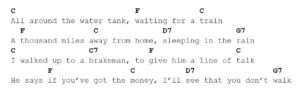
I’m not going to tab out the rest of the song. It goes against the spirit of how these songs are played. Players are free to sprinkle triplets and church licks wherever they like. Jimmie Rodgers likely never played the same song the same way twice. But to get you started, the chords for the first verse go like this:

Four lines from the song "Waiting on a Train," showing the different keys for playing on guitar.

This is just a start for aspiring Jimmie Rodgers-inspired players, but it should give you a good place to begin as you explore the wonderful musical world of “America’s Blue Yodeler,” “The Singing Brakeman,” and the “Father of Country Music”!

Radio Bristol Spotlight: Chance Lawson

Radio Bristol is proud to offer a platform to local and regional artists, artists who are often underrepresented on a national level yet deserving of that audience. As part of Radio Bristol’s core mission, we are pleased to share our latest Radio Bristol Spotlight post. Radio Bristol Spotlight is a series highlighting top emerging artists in our region. Through interviews and performance we will learn more about the musicians who help to make Central Appalachia one of the richest and most unique musical landscapes in the world.

Singer-Songwriter Chancellor (Chance) Lawson has been turning heads with his acoustic solo originals, recently winning the Tennessee Songwriters Week Competition for the Northeast Tennessee region. Local finalists performed at The Down Home in Johnson City, Tennessee, competing for a chance to play a showcase at Nashville’s acclaimed listening room, the Bluebird Cafe .The competition was hosted at six different historical venues throughout the state, and celebrates the “foundation of the craft for which Tennessee is known – music.”

A photograph of a white man standing in front of a vinyl banner for the Tennessee Songwriters Week Competition; you can see a stage area with instruments behind the banner and the man. The man is young, with wavy brown chin-length hair; he is wearing glasses, a white t-shirt, and jeans. He holds a guitar in one hand.

Chance Lawson at The Down Home in Johnson City, Tennessee, following his performance for Tennessee Songwriters Week Competition finals. Courtesy of Chance Lawson

Growing up in Kingsport, Tennessee, Lawson has been a staple at open mic nights and stages surrounding the Tri-Cities, performing with the collectively run indie-rock band Donnie and the Dry Heavers. This summer the musician also plans to open up a brand new venue in his hometown – the Market Street Social Club will be an inclusive space for pickers of all levels and performers of everything from music to stand-up comedy. The club will host multiple open mics weekly, as well as live performances by regional and touring artists. Recently we got to visit with Lawson in the Radio Bristol studio where he shared plans for the new space, plus some of his original tunes and off-the-cuff asides about his laid back approach to creating music.

Complete with Stetson and cowboy hat, Lawson confidently strolled into the studio and started things off with a bluegrassy original tune called “The Flood.” Fashioned together with idyllic imagery and fluid flatpicking, the song depicts a listless experience of existing – using water as a metaphor for the ebb and flow of emotion, proclaiming Lawson’s ability to remain stable and to keep “holding on” even while expressing an inner need for traveling that keeps his feet from “rooting.” Inspired by heralded Americana songwriters such as Jason Isbell and John Prine, Lawson is an astonishingly polished performer whose dues earned at countless local venues are paying off. His songs, embellished by effortless guitar playing and velvety smooth twang-tinged vocals, offer a bona fide look into the raw talent that comes from our region.

Playing on a brand new Taylor guitar that was part of the prize for winning the Tennessee Songwriters Week Competition, Lawson admitted that he was shocked when his name got called as the overall winner for the Northeast Tennessee region at The Down Home. Lawson’s flare for creating original music has been opening up major doors for the songwriter. He spoke highly about his experience playing at The Bluebird Cafe in Nashville, saying that he felt like folks there were super supportive, and he was impressed by the other songwriters such as Tyson Leamon and Jacob Rice, who made it clear why they had won for their prospective regions.

A black-and-white photograph of a white male musician wearing a white Stetson-style hat and holding a guitar. He is standing in front of a radio booth.

Chance Lawson at the Radio Bristol studio. © Birthplace of Country Music

Raised playing gospel music at Cross Roads United Methodist Church and taught guitar by his mother, Lawson comes from a family with deep musical roots. His grandfather was celebrated country music star Red Kirk, who made appearances on historic radio programs such as WNOX’s MidDay Merry-Go-Round, WLS’s National Barn Dance, the Louisiana Hayride, and the Grand Ole Opry. With country music and traditions running through his veins one might find it surprising that one of Lawson’s earliest and most impactful influences was The Grateful Dead. He described first hearing “Friend of the Devil” during a hazy car ride and becoming completely hooked on the sound, which to him blended the traditional bluegrass scales he grew up on with a more meandering sideways-hippie-infused sound. Becoming a “Dead Head” seems to have sparked a creative ember for Lawson who then shared a song called “Jerry and Jesus.” The song reads as a thoughtful plea for reconciliation across musical and philosophical boundaries. Lyrics such as “Let’s get along, let’s throw a party tonight…now that’s worth praying for. Let’s make mistakes, that’s how we learn anyways…Who said you can’t love Jerry and Jesus?” offer a heartfelt perspective on merging Lawson’s Tennessee roots with a broader worldview. The seemingly paradoxical inclination to meld stylistic influences from traditional music along with subjective songwriting makes Lawson’s songs a provocative and compelling listen.

While playing in the Radio Bristol studio, Lawson also performed “Happy Man,” the tune that won him the Tennessee Songwriters Week Competition. Inspired by his girlfriend, the catchy song mixes pop sensibilities by blending country twang with rhythm-and-blues vibes…think Bill Withers meets Gary Stewart. The song is refined yet maintains its authenticity. To watch a live performance of the song watch the video below, and be sure to follow Lawson’s music online via his Facebook page.

Chance Lawson performing “Happy Man,” winner of the 2022 Tennessee Songwriters Week Competition.

Ella Patrick is a Production Assistant at Radio Bristol. She also hosts Folk Yeah! on Radio Bristol and is a performing musician as Momma Molasses.
The Way We Worked in Music and Song

Music and work have always gone hand-in-hand. Songwriters often use their craft to reflect the realities of day-to-day life – and for most of us, a big piece of our lives is given over to the time we spend doing our jobs. Therefore, it is no surprise to find songs across genres that tell stories of labor.

Our current special exhibit – The Way We Worked, here at the museum from the Smithsonian Institution Traveling Exhibition Service for just a few more days! – inspired the curatorial team to explore the connections between work and music, and in the process gave us a really wonderful playlist of labor-related songs. Check out some of these connections with the songs below and dig a bit deeper into this history with us!

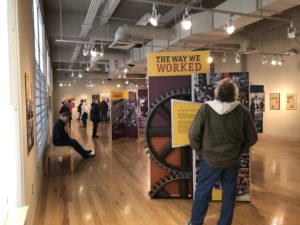
A view of the Special Exhibits Gallery with visitors exploring the stand-up panel modules for The Way We Worked. In the foreground, a man with a dark jacket and a hoodie stands in front of the opening panel.

The Way We Worked on display in the museum’s Special Exhibits Gallery. © Birthplace of Country Music Museum

Songs that reflect different forms of labor or jobs are common in early hillbilly music, as well as in contemporary country. The songs are often particular to the time period in which they were written or look back on the past with nostalgia. Several different types of labor are commonly reflected in hillbilly music – especially farming, timber and lumber work, coal mining, and work on the railways – and those themes are also found in later country music.

Farming

At the turn of the 20th century, almost half of all Americans lived on farms. Farm work and a rural lifestyle was a major part of their lives, though farming for subsistence or profit was – and still is – difficult and uncertain. Artists like Ernest Stoneman sang about that uncertainty. For instance, his 1934 recording “All I Got’s Gone” reflected the impact of the Great Depression on rural people who had bought more than they could afford before it hit, only to lose everything once the stock market crashed so that they had to go back to subsistence farming or survive without much else to support them.

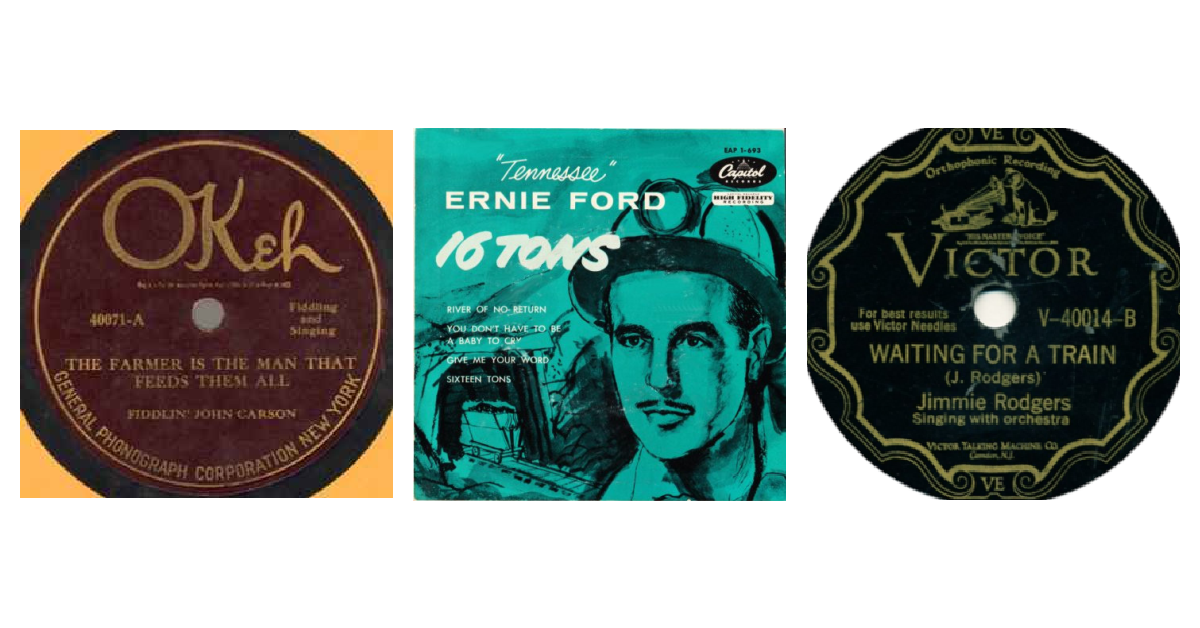
Other songs of the era focused on both the importance and the precariousness of the farming life, songs like Fiddlin’ John Carson’s “The Farmer is the Man (That Feeds Them All)” (1924) and “The Honest Farmer” (1925). Carson’s 1924 recording was later taken up and sung by Pete Seeger as a protest song. One of The Carter Family’s songs – “The Homestead on the Farm” (1929) – is told from the perspective on a man who has left his family farm behind to make his way in the world and remembers it fondly with lyrics like “You could hear the cattle lowing in the lane / You could almost see the fields of bluegrass green.”  Many modern country songs hearken back to the farming days with nostalgia and also celebrate the work that farmers do – for example, “International Harvester” by Craig Morgan (2006) and even “She Thinks My Tractor’s Sexy” by Kenny Chesney (1999)!

Timber

In the late 19th and early 20th centuries, abundant and rich natural resources, coupled with low land costs, made Appalachia the site of a major boom in the logging industry. This brought huge changes in land ownership and usage – with land being taken over by outside investors and corporations – and often had devastating environmental and social effects on the region. And it wasn’t just the Appalachians that saw the growth of timber work; other areas of the country (and beyond) have a similar history, and as with farming, songs were sung about this common labor. For instance, the lyrics to “Once More a-Lumbering Go” was written down by a New England lumberman named John Springer in the 1850s, and several versions of the song were later recorded in the field by song collectors and ethnomusicologists. Smithsonian Folkways produced an album in 1961 called Lumbering Songs from the Ontario Shanties, and the library at the University of Wisconsin-Madison created a K-12 lesson plan about Wisconsin’s lumberjack songs. Later artists have also recorded songs about the timber industry, including Johnny Cash’s “The Timber Man” from his 1975 children’s album and Bill Stains with “The Logging Song” (1979).

Coal Mining

Coal mining has been a major part of Appalachian communities for over a century and holds a special place in the economic and environmental history of this region. Therefore, it is only natural that working in coalfields and living in coal towns has provided a source of musical inspiration for many, including songs about the hazards and dangers of this labor and the conflicts between workers and the coal companies that employed them. Blind Alfred Reed’s “Explosion in the Fairmount Mines” (1928) and Hazel Dickens’ “Black Lung” both highlight the very real dangers miners faced, both deep in the mines and after they’ve left them behind.

One of our favorite songs about coal mining is “Sixteen Tons,” written by Merle Travis and recorded by Bristol’s very own Tennessee Ernie Ford in 1955, along with a host of other artists over the years. Travis’s lyrics reflected the bravado of the men who toiled underground in dangerous conditions and then later sometimes came to blows in their down time, but most importantly it also focused on the struggles that miners and their families faced living in a company town and owing their bosses their wages to survive. With lines like “You load sixteen tons, what do you get / Another day older and deeper in debt” and “I owe my soul to the company store,” those economic hardships certainly become clear to the listener. Songs like Florence Reece’s “Which Side Are You On?” Joe Hill’s,” Hazel Dickens’ “They’ll Never Keep Us Down,” and numerous songs about union activist Joe Hill underline the struggle workers’ too often faced for safe working conditions and livable wages.

Railroads

Railroads were also a major industry – and hugely important to the transportation of resources like timber and coal – in the United States in the mid- to late-19th century and early 20th century, and large numbers of Americans worked for the railroad. Train songs were particularly popular in the early 20th century and covered a wide variety of subjects, including railroad construction and changing technology (for example, various songs about John Henry, the “steel-driving man”), rail travel, train bandits, the wandering hobo living life on the rails (Jimmy Rodgers’ “Waiting for a Train,” 1929), and even as a spiritual metaphor within sacred and gospel music (The Carter Family’s “The Little Black Train,” 1937). And sometimes songs turn the usual story on its head – for example, Amythyst Kiah recently recorded “Polly Ann’s Hammer,” a song based on the John Henry tale, though this time told from the perspective of Henry’s wife.

However, railway songs very often focused on train wrecks – an all-too-frequent danger of the early railroading years. Some lamented passengers who lost their lives, but most of them memorialized the crewmen killed in the line of duty on the rails, along with celebrating their heroism. Songs like Henry Whitter’s “Wreck of the Old 97” (1923), Blind Alfred Reed’s “The Wreck of the Virginian” and Mr. and Mrs. J. W. Baker’s “The Newmarket Wreck,” both recorded at the 1927 Bristol Sessions, and “Engine 143” by the Carter Family (1929) share the news of these tragedies in chorus and verse form. Later artists hearken back to these days in song too – for example, “The Great Nashville Railroad Disaster (A True Story),” recorded by David Allan Coe in 1980.

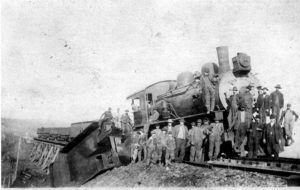
A black-and-white image of a steam locomotive on the railway with the cars behind it derailed from a bridge behind it. Several male workers and bystanders pose in front of the locomotive.

A train wreck near Benhams, Virginia, in the 1920s. Photograph reproduced with permission from the Bristol Historical Association

Work and Music

This post just touches on the tip of the iceberg for songs about work – there are so many out there, and so many themes and topics explored in those songs that there’s not room in one post to cover them all! For instance, just a few include Hattie Burleson’s “Sadie’s Servant Room Blues” (1928), which notes the indignities of work when you are required to work long hours for low pay, while being treated with little respect due to race; Dollie Parton’s “9 to 5” (1980), a beloved movie theme song that was inspired by a women’s activist movement that fought for equal pay and treatment in the workplace; Johnny Paycheck’s “Take This Job and Shove It” (1977), chronicling the frustration of a man who worked for years for little reward – and then, being a country song, he also lost his girlfriend or wife; and Sam Cooke’s “Chain Gang” (1960), a song that reflects the harsh realities of Southern justice through unpaid labor in the Jim Crow era.

You can check out the Virtual Speaker Series presentation we did on this topic in December here, along with three related playlists: here, here, and here! I hope this post and the music it celebrates give you a starting point for exploring the history of work through song!

The Way We Worked special exhibit is on display at the museum through Sunday, January 23 so come see it while it is still here! And tune into our Radio Bristol Book Club show on Thursday, January 27 at 12:00pm as we continue our exploration of work history through a discussion of Denise Giardina’s Storming Heaven, followed by an interview with the author.

René Rodgers is Head Curator at the Birthplace of Country Music Museum. Erika Barker is the museum’s Curatorial Manager.

A Celebration of Black Contributions in Country Music

Today is Martin Luther King Jr. Day, and organizations in the Tri-Cities area are marking this date with a variety of programs over the course of the month. For instance, later this week, our Museum Talk hosts will be chatting with Richard Josey, founder of Collective Journeys, about his DEAI (Diversity, Equity, Accessibility, Inclusion) work with the Virginia Association of Museums.

We also contributed a country music playlist for the Appalachian Peace Education Center’s MLK Day programs this past weekend. Country music has been influenced by a wide variety of different musical traditions over the years. Enslaved people from Africa brought the knowledge and memory of the banjo – a common instrument in country and bluegrass – with them when they were forcibly transported to these shores. And since its early days in the 1920s, Black artists have contributed to the history and sound of country and old-time music. Our playlist celebrates several of those artists.

Screenshot of the Spotify playlist listing the various Black country artists included on it.

The museum’s Spotify playlist to mark Martin Luther King Jr. Day 2022.

El Watson, Tarter & Gay, and the Tennessee Chocolate Drops played on early country music recording sessions in East Tennessee (though their songs were categorized at the time as “race records” rather than “hillbilly records”). El Watson was the only African American musician to record at the 1927 Bristol Sessions, putting down two songs: “Narrow Gauge Blues” and “Pot Licker Blues.” He also played bones on a few songs recorded by the Johnson Brothers, and Charles Johnson played guitar on Watson’s recordings – these are some of the earliest integrated recordings in country music. Ralph Peer of the Victor Talking Machine Company came back to Bristol in 1928 to record more musicians from this area, and this time the sole African American act was a duo called Tarter & Gay. As with El Watson, they recorded two sides – “Brownie Blues” and “Unknown Blues” – that were marketed as race records. The Tennessee Chocolate Drops – made up of brothers Howard and Roland Armstrong and Carl Martin – recorded “Knox County Stomp” for Vocalion at the Knoxville Sessions in 1930.

Lesley Riddle worked with A. P. Carter as they traveled around Southern Appalachia to collect songs for The Carter Family to perform and record. He also taught them several songs, including “The Cannon Ball,” and his guitar playing influenced Maybelle Carter’s guitar style. Riddle later moved to Rochester, New York, where he sometimes played music in small venues around the city in the 1960s and 1970s. He met Mike Seeger in 1965 and recorded music for him and performed as part of the urban folk revival.

Elizabeth Cotten, guitarist and banjo player, was an important influence in American folk music; her connection to the Seeger family, especially Mike Seeger, played an important role in her amazing musical talent being recognized and celebrated. Her style and repertoire – based on earlier African American music and instrumental traditions and delivered in her unique left-handed playing – impacted a variety of musicians who followed her. Honored as a National Heritage Fellow in 1984 and winner of a Grammy at the age of 90, the Smithsonian recognized her as a “living treasure” before her passing in 1987.

Black-and-white photograph of Black musician Elizabeth Cotten. She is wearing a light-colored long-sleeve shirt and plays a guitar.

Elizabeth Cotten playing guitar. Credit: Library of Congress

Brownie McGhee, born in Knoxville but raised in Kingsport, made his mark in music locally, but also put down songs for a recording session in Chicago in the 1940s. Alan Lomax later recorded McGhee, providing an important record of his musical talent – and as with other Black musicians whose music intersected with early traditional and old-time music, he was also active in the folk revival. McGhee recorded “Sittin’ Pretty” with fellow artist Sonny Terry.

DeFord Bailey, a talented harmonica player, was the first African American artist to perform on the stage of the Grand Ole Opry in Nashville in the 1920s. Bailey was nicknamed “the harmonica wizard” by George Hay, WSM’s station manager – one of his most famous pieces on the show was “Pan American Blues,” which recreated the evocative sounds of a locomotive. Bailey recorded for various labels and performed live throughout the South and Midwest, but sadly his music career was curtailed by a business dispute; he later opened a shoeshine parlour.

These early African American performers gave way to later musicians who have made their own mark on country and old-time music. Charley Pride, once a Negro league professional baseball player, rose to fame in the late 1960s and early 1970s. He became a very popular country music star and is one of only three Black members of the Grand Ole Opry. “All I Have to Offer You (Is Me)” was his first number one hit.

This album cover shows an image of Black musician Charley Pride looking off into the distance over green fenced fields and trees. He is wearing a black jacket with a light-colored collared shirt underneath.

Album cover for Charley Pride’s Country, released in 1979 by Reader’s Digest.

Dom Flemons and Rhiannon Giddens are founding members of the Carolina Chocolate Drops, an important Black string band; they now have thriving solo careers. Both artists use their music to illuminate African American histories. In 2018, Flemons released an album focused on Black cowboys through Smithsonian Folkways. He chose to feature “Lonesome Old River Blues,” a song originally recorded by Roy Acuff and the Crazy Tennesseans in the 1930s, on this album in order to illuminate the influence of African American traditions on early country music. Giddens’ musical output has consistently helped to tell the story of the Black experience, and she recently led an all-female banjo “supergroup” called Our Native Daughters that shares African American histories and stories from the female perspective. Her version of “Freedom Highway,” a 1964 Civil Rights protest song, is taken from her second solo studio album and features fellow artist Bhi Bhiman.

Amythyst Kiah, a local musician and singer from Johnson City, Tennessee, did her degree at ETSU in the Bluegrass, Old-Time, and Country Music program and contributed to the exhibit content at the Birthplace of Country Music Museum. She is part of the Our Native Daughters group and has recently released a new Rounder Records solo album, Wary + Strange. Her song “Black Myself” was first released on Songs of Our Native Daughters and then re-released on Wary + Strange – the song’s powerful lyrics, coupled with Kiah’s amazing voice, pack a real punch.

Jerron “Blind Boy” Paxton is a young singer and multi-instrumentalist originally from the Watts district of Los Angeles, California. His playing styles are akin to pre-WWII blues and jazz in the vein of artists like Fats Waller, Bessie Smith, and Lonnie Johnson. The Southern roots of his grandparents who moved from Louisiana to California in the mid-1950s provided the influence that became his signature sound. The song we feature is “Railroad Bill,” the B-side of a single released on Evangelist Records of London, England, which also happens to be a product of his first-ever professional recording session. Paxton has appeared in the documentary film The American Epic Sessions, as well as voicing a character in the animated miniseries Over the Wall. We have been very lucky to have Paxton play here at the Birthplace of Country Music Museum and the Bristol Rhythm & Roots Reunion Festival.

Texas-born Charley Crockett is a blues, country, and Americana singer-songwriter with 15 albums under his belt starting with 2015’s A Stolen Jewel through to his 2021 release Music City USA. Crockett has been steadily gaining popularity and is an established part of authentic roots music’s current youth movement. Also having appeared at the Bristol Rhythm & Roots Reunion, Crockett has garnered a faithful local fanbase. The track “Jamestown Ferry” is a mid-tempo honkytonk number from 2017.

This image shows an African American man playing guitar and singing into a mic on an outdoor stage. He wears a light-colored cowboy hat, sunglasses, and a patterned shirt in blues and greens.

Charley Crockett performing on stage at Bristol Rhythm & Roots Reunion in 2021. © Birthplace of Country Music; photographer: Billie Wheeler

These African American artists are just a few of those that have made their mark on roots, country, and old-time music. We hope you enjoy our playlist, and that it leads you deeper into this history and music!

About the Authors

René Rodgers is Head Curator at the Birthplace of Country Music Museum. Scotty Almany is the museum’s Digital Media, Programming, & Exhibit Logistics Manager.