Music & Songs Archives - Page 28 of 30 - The Birthplace of Country Music
Listen
Play
Loading station info...

Instrument Interview: Maybelle Carter’s Guitar

“Instrument Interview” posts are a chance to sit down with the instruments of traditional, country, bluegrass, and roots music – from different types of instruments to specific ones related to artists, luthiers, and songwriters – and learn more about them. Ten questions are posed, and the instruments answer! Today we talk to one of Maybelle Carter’s guitars:

 What model are you, and when were you made?

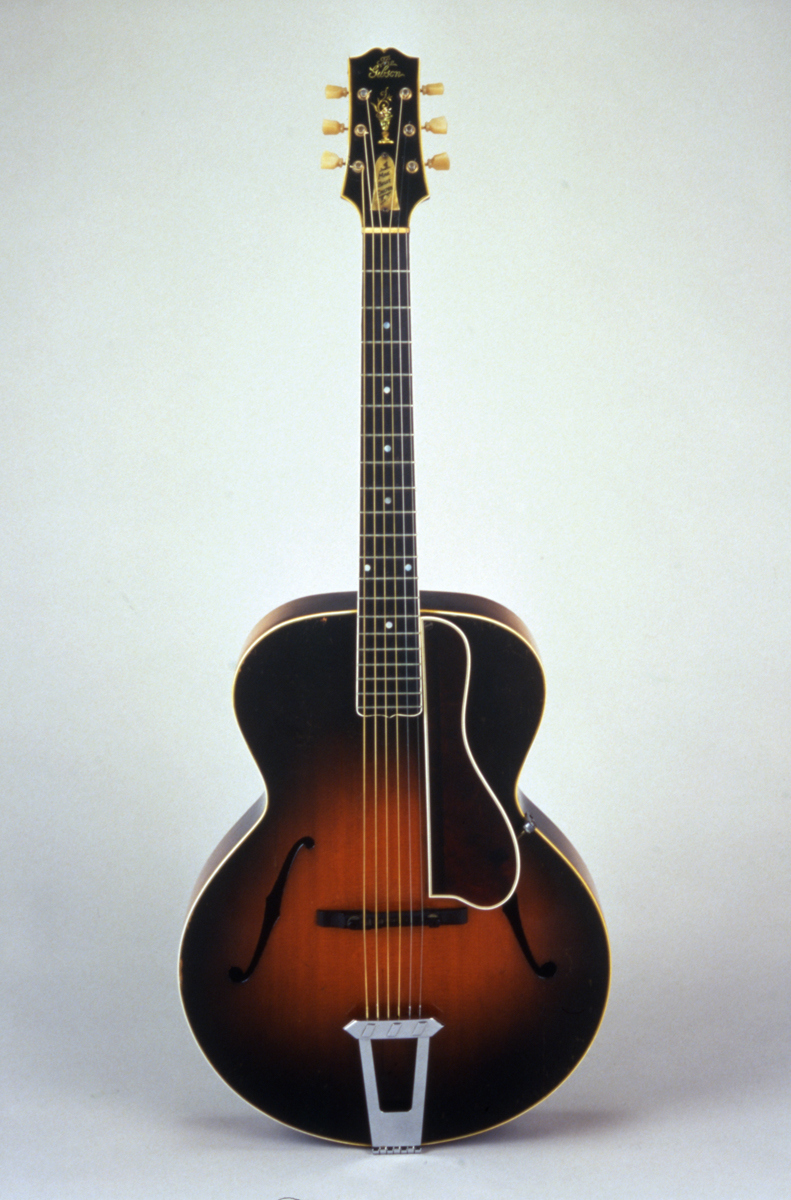
I’m a 1928 Gibson L-5 guitar, made at the old Gibson factory in Kalamazoo, Michigan. Lloyd Loar, the famous engineer who redesigned a lot of Gibson’s product line in the early 1920s, introduced my model in 1922 as the top-of-the-line guitar. Unlike most earlier guitars, I have a carved arched top and violin-style F-holes instead of the round sound hole in the middle. You might say I’m like a guitar that thinks it’s some kind of oversized violin. But at least Maybelle didn’t try to play me with a bow!

Well, speaking of Maybelle Carter, when did you become her instrument? Did she play you at the famous Bristol Sessions when The Carter Family made its first recordings?

Well, no, Maybelle didn’t have me yet when she did those recordings in Bristol in 1927. That was actually a year before I was built in Kalamazoo. On those first six sides that Maybelle recorded with Sara and A. P., she was playing a cheap Stella flat-top guitar. That would have been a good enough instrument for most early country musicians, but Maybelle was no ordinary player. She deserved something bigger, louder, with a more authoritative voice. So after their records started selling well and Ralph Peer invited them to come to New Jersey to make new recordings with better equipment, Maybelle and her husband Eck (A. P.’s brother) went out and bought her the best guitar they could find. I cost $275, which was an awful lot of money in 1928.
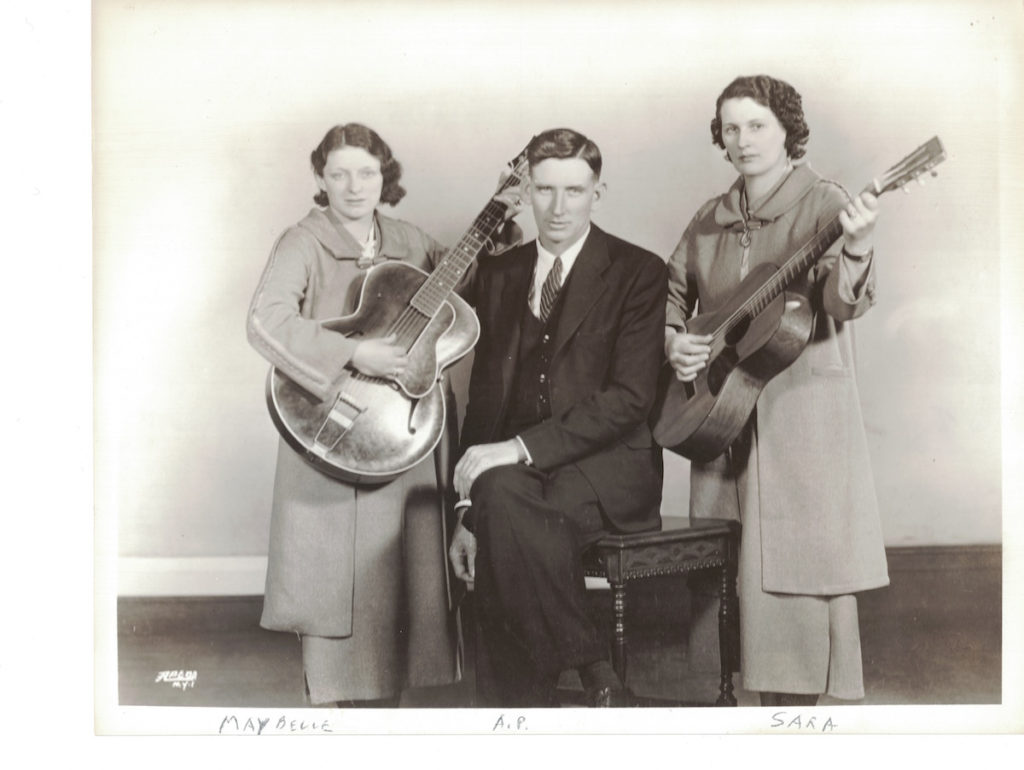
A picture of The Carter Family -- Maybelle holding her guitar, A. P., and Sarah holding her guitar
A publicity still of The Carter Family – Maybelle holds her Gibson L-5 guitar. From the collection of the Center for Popular Music, Middle Tennessee State University

What did Maybelle do to bring out your true and distinctive voice? What made her such a great player?

The biggest thing, I guess, is that she played me with such command and authority. She was the driving force of the band’s instrumentation, since Sara just played some lighter second guitar or autoharp, and A. P. hardly ever played any instrument on record. Sometimes Maybelle was the whole band! So she took some of the existing folk guitar styles and made them strong, polished, and professional. She made the guitar into a solo instrument in the country band, playing melody between vocal refrains and also providing a driving rhythm.

Really? How on earth did she do that?

Mostly it was her powerful right hand. It still makes me shudder to think about how clear and purposeful she was when she played. She commanded the sound out of me. Her most famous method was a thumb-lead style, which some people call the “Carter scratch.” I never did quite understand that, since it wasn’t really scratchy sounding at all. She wore a thumbpick on her right hand and used that to play bass notes and all those wonderful melodies on the bass strings of the guitar, and meanwhile she had a metal fingerpick on her index finger and used that to strum those great, driving chords on the upper strings. A real one-woman band!

How did that style suit you, as an instrument?

It suited me perfectly. Because I have an arched top and F-holes, my bass strings have more punchiness and less sustain than flat-top guitars. With all the activity of Maybelle’s right thumb and forefinger going on simultaneously, it was much better that my notes were shot out like cannon balls without any ringing sustain to muddy it up. In her hands, I was a melodic rhythm machine.

That idea of using your thumb and one finger reminds me of the clawhammer banjo style. Is it similar?

Hey, I’m a guitar! You’re going to make me talk about banjos? I’m just kidding. You know, Maybelle did play banjo in that clawhammer style, so that may have given her some notion of using her thumb. But really the styles are very different, because in thumb-lead guitar, the thumb is the one playing the melody. The motion of the right hand is totally different, too.

Did she always play using that thumb-lead style? Or did she use any other styles?

No, although it was her main style and the one that influenced younger players the most. Maybelle also developed into a really fine flatpicker, using the kind of pick that most guitar players favor nowadays and which used to be called a “straight pick.” With a flatpick she was able to play more on my treble strings, a predecessor to the way later bluegrass guitarists play their lead solos. She really liked to do this on blues songs like the “Coal Miner’s Blues,” but she also used this approach on songs like “You Are My Flower.” Boy, she made me sound amazing on that one. As for other styles, she didn’t do much of what people call fingerpicking, since that wasn’t a strong enough sound for her. And Maybelle did play slide guitar, but she didn’t use me for that.

Cover of The Carter Family songbook Album of Smoky Mountain Ballads -- picture of the Carters on the front showing Maybelle and Sara with guitars and A. P. without an instrument
This Carter Family songbook was published by Ralph Peer via his Southern Music Publishing Company in the late 1930s. Again, Maybelle is pictured with her Gibson L-5. Image reproduced with permission from peermusic; songbook in the collection of the Center for Popular Music, Middle Tennessee State University

What happened to you after the original Carter Family disbanded in 1944?

Maybelle continued playing me with the Carter Sisters, who were really her daughters, and in all of her music-making up to the time she died in 1978. She hung on to me until the end, even when money was tight and she could have sold me. We had a special bond, and I never sounded the same when somebody else tried me out – not even Chet Atkins. Maybelle played me on her solo records in the 1960s and 1970s, when she went on tour with the New Lost City Ramblers, and when she did “Keep on the Sunny Side” on the Nitty Gritty Dirt Band’s Will the Circle Be Unbroken? album.

What about “Wildwood Flower” from the Circle album?

No! Even though that was probably her most famous guitar song, with the Dirt Band she wanted to play it on autoharp just because she’d never recorded it that way.
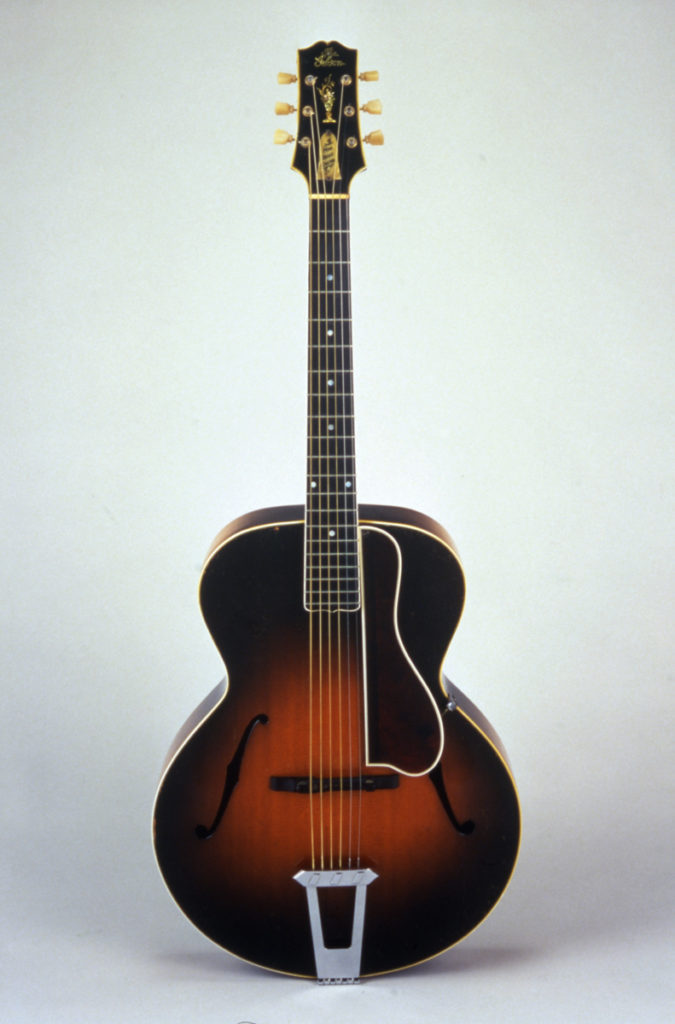
Maybelle's Gibson L-5 guitar
A formal portrait of Maybelle Carter’s Gibson L-5 guitar. Courtesy of the Country Music Hall of Fame® and Museum

Finally, what are you up to today?

Today I’m proudly on display at the Country Music Hall of Fame and Museum in downtown Nashville, alongside Sara’s autoharp, Bill Monroe’s mandolin, Earl Scruggs’s banjo, and Barbara Mandrell’s pedal steel. Back in 2004 I was almost sold off by my owner who had loaned me to the museum, but Maybelle’s family really wanted me to remain. I’m so glad they figured out a way to buy and keep me there in such illustrious company. I just wish I could get played more these days, but then again it’s OK. Nobody will ever play me the way Maybelle did.

Guest blogger Gregory Reish is the Director of the Center for Popular Music at Middle Tennessee State University. He is a scholar, teacher, and performing musician with expertise in a wide range of American vernacular styles.
 

“Sixteen Tons”: Merle Travis, Tennessee Ernie Ford, and Beyond

By Summer Apostol, October 17, 2017

Today marks the anniversary of two important dates in music history. On October 17, 1991, Tennessee Ernie Ford passed away, leaving behind a wide-ranging and hugely significant musical legacy. It was also on October 17, this time in 1955, that one of Ford’s most important and well-known songs was released: “Sixteen Tons.”

Born Ernest Jennings Ford in Bristol, Tennessee, on February 13, 1919, Ford would become a local legend and a national treasure. He paved his way in the world through his gregarious personality, his humor, his wit, and most notably, his distinctive baritone singing voice. Music had been a part of Ford’s life from a young age; in his memoir, he recalled: “We sang at home, we sang at church, and we sang at weddings and funerals and at prisons or wherever there happened to be a need for it. Not for money, mind you – we never got paid. We just enjoyed singing.” And, everyone sure did enjoy hearing Ernie sing – from his hometown, childhood church to his professors at the Cincinnati Music conservatory to the nation through the radio and television airwaves and the many songs he recorded.

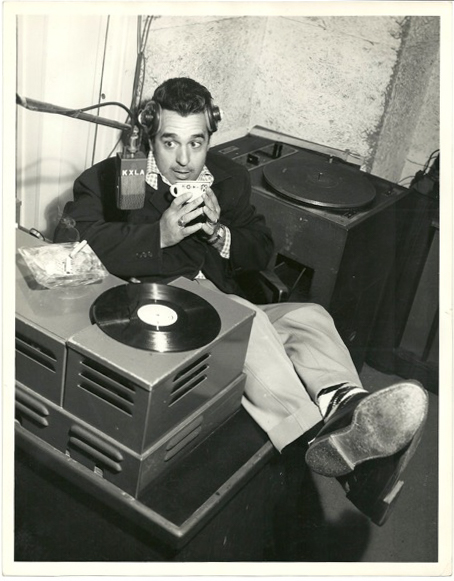
Radio station KXLA produced in-house promotional publicity photographs featuring Ford in 1949. From the collection of Tennessee Ernie Ford Enterprises LLP

“Sixteen Tons,” the song popularized by Tennessee Ernie Ford, was originally written by Merle Travis. In 1947 Capitol Records encouraged Travis to write a series of songs that “sounded folky” for an album, one that would tap into the American folk music revival that was just starting to take off. Travis drew inspiration from his family back home in Ebeneezer, Kentucky. He took the line “You load sixteen tons, what do you get / Another day older and deeper in debt” from a letter his brother had sent to him about the death of World War II journalist Ernie Pyle. Another famous line of the song came from a saying Travis’s father used to say: “I can’t afford to die. I owe my soul to the company store.” And so, “Sixteen Tons” was born on Travis’s album Folk Songs of the Hills.

Ford and Travis knew each other from the recording of Ford’s first album, on which Travis played the guitar. As support for his friend and a general love for the song, Ernie performed the song on his daily NBC television show, resulting in a huge amount of fan mail focused on this song. Ford’s live performance of the song later that year at the Indiana State Fair brought the crowd to its feet – they loved it! So, when Ford came under pressure from Capitol to record a new song as he approached breach of contract due to an overfull schedule, he turned again to the song written by his friend. On September 17, 1955, Ford recorded “Sixteen Tons” as the B-side to the record’s A-side: “You Don’t Have to Be a Baby to Cry.”

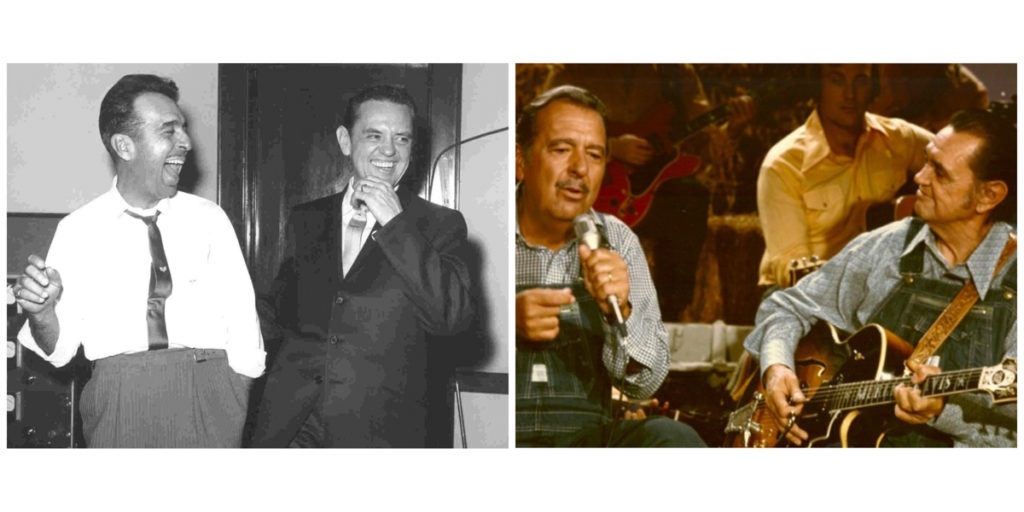
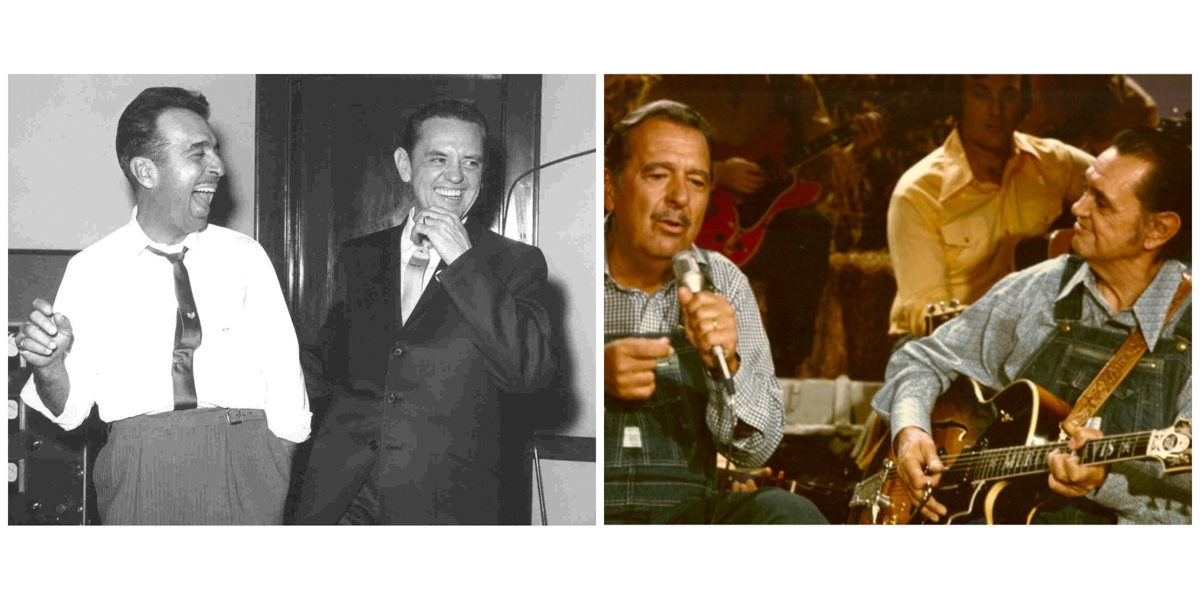
Ford and Travis shared a long friendship and a strong working relationship. The picture on the left shows them having a laugh together, while the one on the right shows them performing together on Hee Haw in 1977. From the collection of Tennessee Ernie Ford Enterprises LLP

Capitol thought the A-side song was going to be the record’s big hit, but “Sixteen Tons” – with its innovative modern instrumentation and a jazz-like arrangement including Ford’s distinctive snapping – was played more by DJs at radio stations across the nation. The success of Ernie’s version of “Sixteen Tons” was much bigger than the recording label could have ever expected. After only 11 days, the single sold over 400,000 copies, and after only a few months it became the fastest selling single in Capitol’s history with over 4 million copies sold. The record dominated both the country & western and pop charts in late 1955 and early 1956 – this crossover from country & western to pop was a rare thing, underlining the impact and appeal of Ford’s version of this song.

Tennessee Ernie Ford recorded hundreds of albums, won countless awards and honors – including three stars on the Hollywood Walk of Fame, a Grammy, and the Presidential Medal of Freedom – and hosted and guest starred on a number of television shows. His wide range of talent garnered him massive appeal, making him one of the most well-regarded crossover artists in modern history. His strides in multiple facets of the entertainment industry helped pave the way for other artists throughout the years.

Ford’s version, coupled with Travis’s relatable lyrics, account for the large number of covers of the classic “Sixteen Tons.” Notably, several of the covers are by artists whose musical background does not necessarily match with Ford’s musical legacy. Some of our favorite covers of “Sixteen Tons” are included below – have a listen and explore the evolution of Tennessee Ernie Ford’s influence on music through the years!

B.B. King & His Orchestra, 1956

Jose Guardiola (Spanish version “16 Toneladas”), 1960

Stevie Wonder, 1966

Johnny Cash, 1987

ZZ Top with Jeff Beck, 2016

Summer Apostol is an intern at the Birthplace of Country Music; she is studying history and sociology at Emory & Henry College.


Off The Record: The Jingle, The Rumble, The Roar – The Magic Of America’s Smoky Mountain Boy

By Bailey George, September 15, 2017

Our Radio Bristol DJs are a diverse bunch – and they like a huge variety of musical genres and artists. In our Off the Record series, we ask one of them to tell us all about a song, record, or artist they love.

From the great Atlantic Ocean to the wide Pacific shore, Roy Acuff represents our great musical heritage. To me and millions of others, he was and still is country music. His charm, his charisma, and his ability to handle an audience will never be surpassed. Though others have come and gone and might have had bigger star power or critical acclaim, he still stands as a giant in our music.

My discovery of “The King of The Hillbillies” came at a very difficult time for me in my life. My mother died of cancer when I was 10 years old. Suddenly the world as I knew it changed. I didn’t realize fully what had even happened. All of a sudden, I was motherless and lost in a dark, threatening place. Then, one night while at my new residence with my grandparents, a Hee-Haw rerun aired on television.

Like a prophet from heaven, Roy Acuff came into my living room and with a whistle and Dobro kick-off, I was instantly hooked on this thing called country music. The piece: “Wabash Cannonball.” I was entranced by this man dressed in a modest suit and tie, suspiciously balancing and holding a fiddle, but never actually playing it, twirling a Yo-Yo and boldly pronouncing the names of each of his soloists including one “Bashful Brother Oswald.” As the tune ended, I immediately knew that this music was something I wanted to be in too.

I’ve always been interested in people who are larger than life. From my favorite childhood authors to my fascination with folks like Mark Twain and Walt Disney, I’ve always loved the people who could take me from the small community of Walnut Grove, South Carolina, to the largest adventures across the universe. While I had certainly listened to music before, specifically John Denver, Alan Jackson, The Beach Boys with my mother, and Carolina beach music (known to the rest of the world as 1950s rhythm-and-blues) with my grandmother, I had never really experienced music quite like this. The sound, look, and style of Mr. Acuff completely filled my mind with visions of Americana. I wanted to be Roy Acuff. I wanted to dress like him, sing like him, act like him. He was unlike anything I had ever seen and in all my experience diving into the history of American music, I have still never come across anything quite like him.

When you came to see Roy Acuff and His Smoky Mountain Boys and Girls, you got a show. Not a concert. Not a performance. But a SHOW. He had it all. Heart and home songs, sacred numbers, train songs, comedy from “Bashful Brother Oswald” and Sister Rachel, jug bands, harmonica solos, fiddle tunes, and featured vocalists all in one repertory group of “hillbilly” entertainers. I treasured that. I’ve always been a sucker for entertainment, and Roy Acuff and his team were never short on vaudeville-esque antics and razzle dazzle. In an age of loud arena-filling pop country schlock, this down-home, personal style of performance has grown even more fascinating to me, and it’s a tradition I hope to continue in my own musical pursuits.

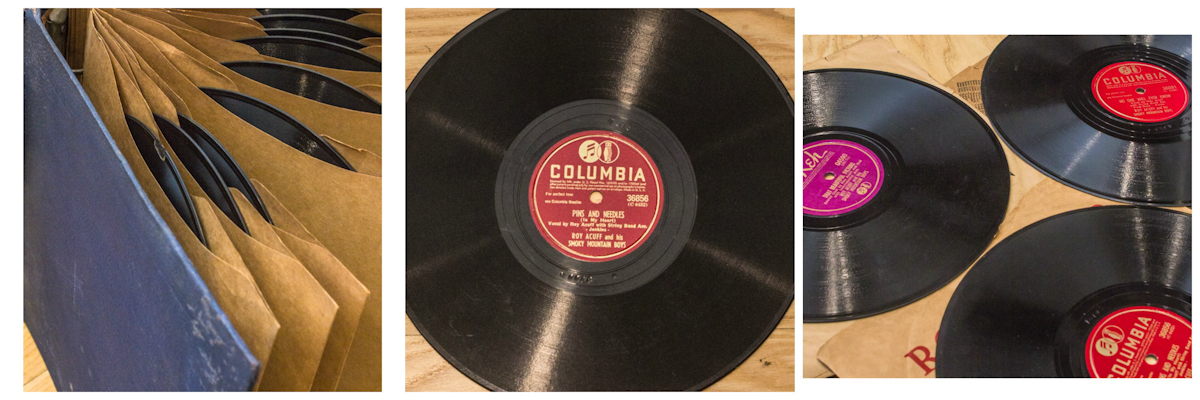
We have several Roy Acuff records in the museum’s collections. © Birthplace of Country Music; Gift of Betty Lou Dean and Roger Allen Dean

Admittedly, Acuff’s open-throat mountain style of country music might strike some modern ears as antiquated, rural, and possibly even melodramatic. But it was this passionate, heartfelt, and authentic performance that drew me in as something real and completely different from the more metropolitan sounds I’d been accustomed to in the music of my formative years.

Now, even as my music tastes have widened to include everything from classical arias to punk and rockabilly, Acuff still stands supreme in my mind as the world’s greatest performer. He was always true to himself and his music. He never updated during the heat of the rock-and-roll era. He stuck to what he knew.

And he worked hard! He traveled the world and entertained troops during three of our nation’s wars – World War II, the Korean War, and the Vietnam War. He brought the Grand Ole Opry and the city of Nashville to the forefront of the country music industry. He appeared in several Hollywood films, sharing the screen with huge stars such as Tex Ritter. He campaigned for governor of Tennessee. He shook hands with and hosted several presidents and heads of state. He was christened by Baseball Hall of Famer Dizzy Dean as “The King of Country Music” and was the first living inductee to the Country Music Hall of Fame in 1962. Yet, even with all those accolades, he was still the curly-haired boy from the Smoky Mountains. He never left behind his upbringing in Maynardville, Tennessee.

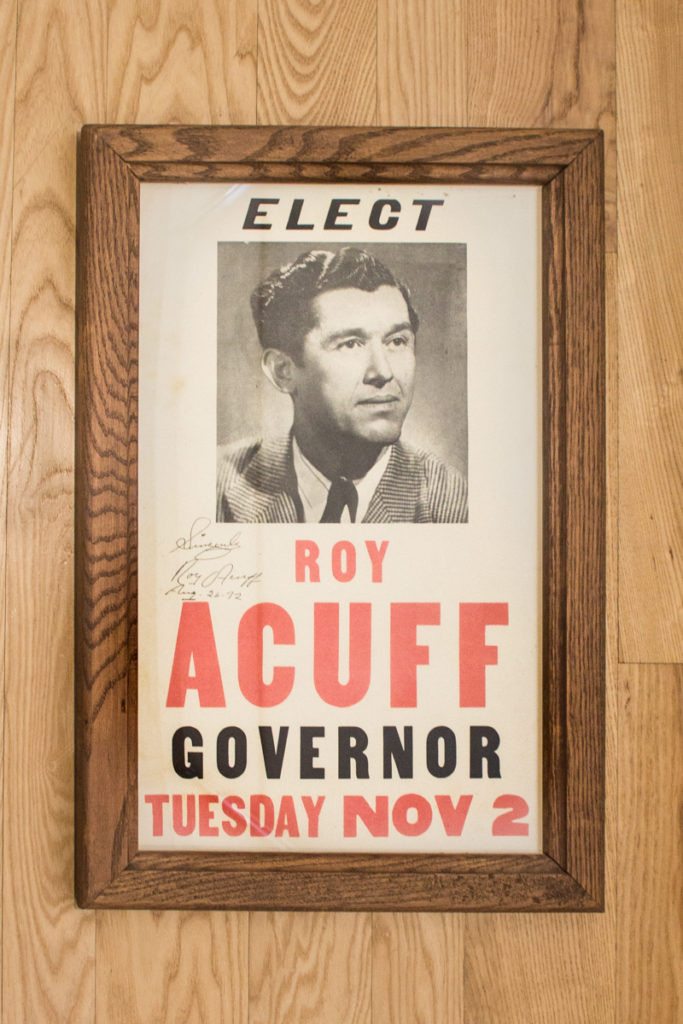
This poster from Roy Acuff’s 1948 gubernatorial bid was later signed by him in 1972. © Birthplace of Country Music; Donated at the request of the late William Wampler

Roy Acuff brought country music to the world and inspired me to dig deep into this fascinating and important music. Perhaps, the greatest lesson he taught me though was how to be humble. Always treat your audience with respect. Never be unapproachable. Stick around until every picture is signed and every hand is shook. “They’re the ones that got you here. Give them all you got.” That was the rule that Acuff lived by: a lesson often lost on many modern music performers.

Roy Acuff represented the best of mountain class and southern culture. He symbolized everything that’s great about our nation: work hard at what you believe in, but always be humble.

A jewel here on earth, a jewel now in heaven. Thank You, Mr. Acuff.

Guest blogger Bailey George is a DJ on Radio Bristol. He hosts The Honky Tonk Hit Parade every Wednesday from 3 to 5pm. Bailey plays the best in classic country, honky tonk, rockabilly, and all around good music for his listeners who he calls “The Greatest People in the World.”

Ernest Stoneman’s First Hit: “The Titanic”

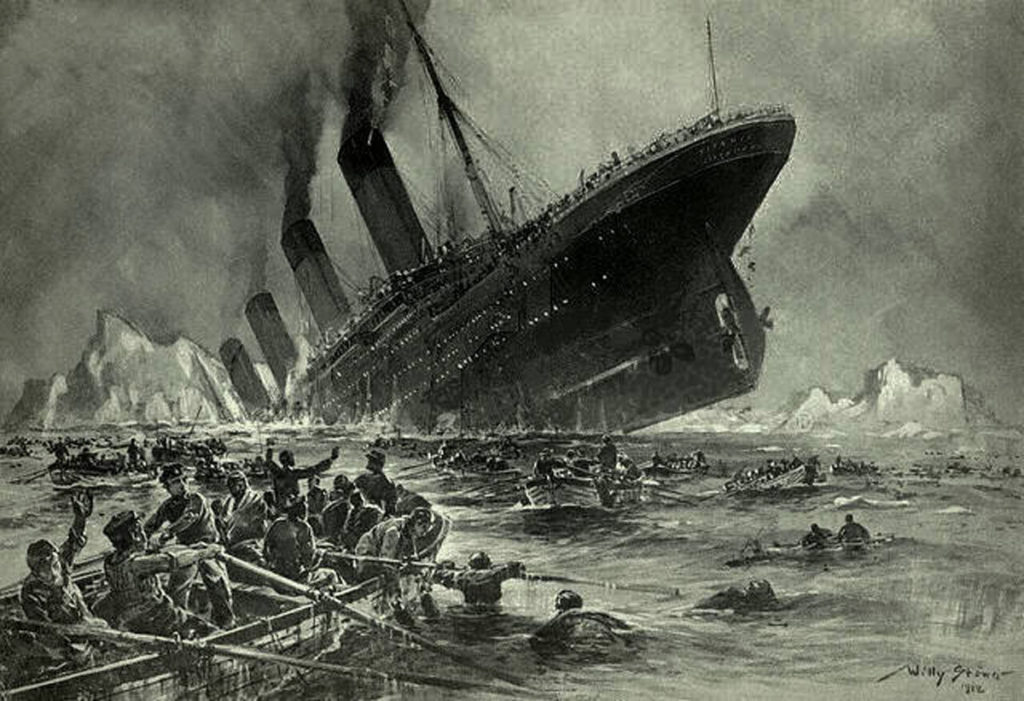
The unsinkable RMS Titanic sank in the cold Atlantic waters on April 15, 1912, claiming over 1,500 lives of its passengers and crew, and capturing the attention and imagination of the world from that moment forward. After years of searching, the wreckage of the Titanic was discovered on September 1, 1985; researchers continue to study the wreckage and ephemera that connects to the ship and its passengers, and the story of the Titanic still resonates today.

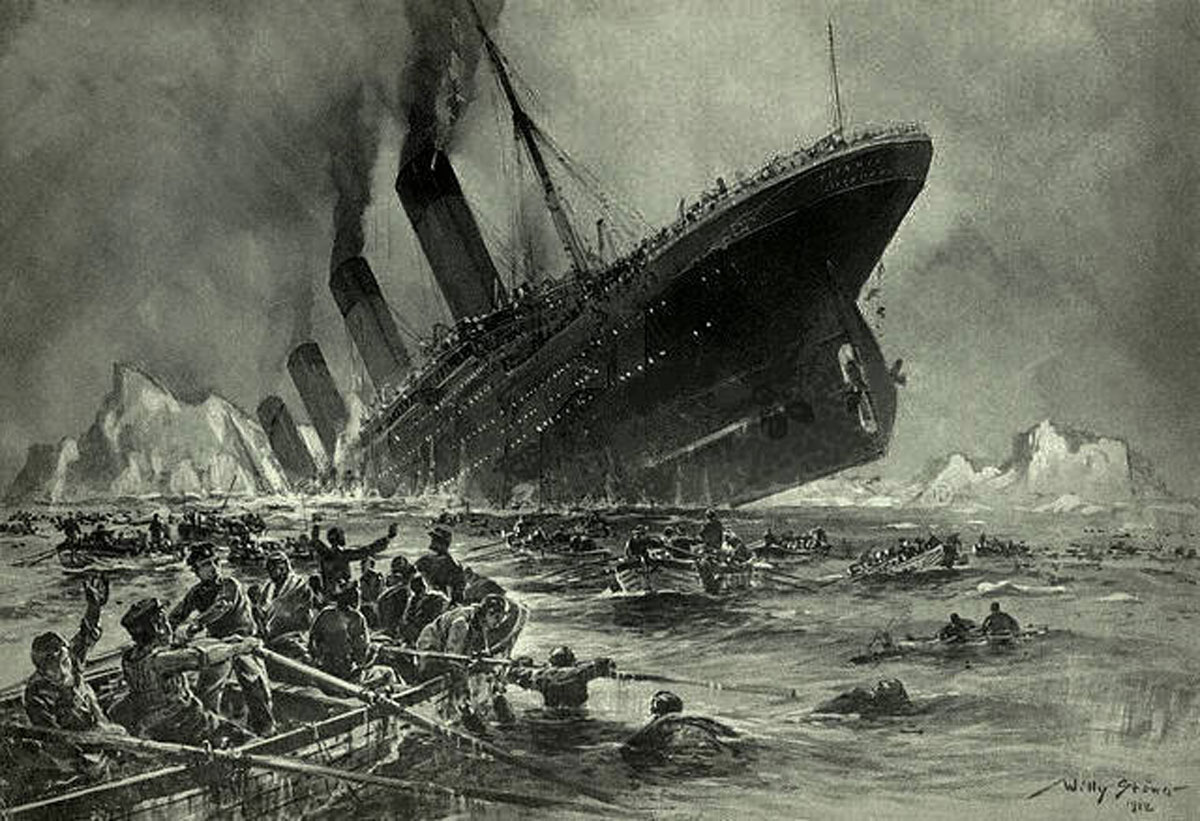
1912 engraving by Willy Stöwer: Der Untergang der Titanic. Public domain image from Wikimedia Commons

To mark the date of that discovery, we wanted to explore the retelling of the Titanic’s story in song – as with many disasters of the day, the wreck of the Titanic gave rise a few years later to a song detailing this contemporary history, one that was part of people’s lives and memories. In early September 1924, Appalachian musician Ernest “Pop” Stoneman traveled to New York to make his first recordings with OKeh Records, part of a few days of recording that also included Fiddlin’ John Carson and several other musicians as OKeh continued to build their catalog of popular American music. Stoneman chose two songs for this session, one of which was “The Titanic.”

That first recording in 1924 was not released – Stoneman and the OKeh executives thought that it was too fast, so he agreed to travel back to New York to do another recording of the song. On January 8, 1925, he recorded it again, and it was released later that year. This version of “The Titanic” (OK 40288) was a success, which led to further trips to New York to cut new records. He then recorded the song again in 1926, this time under the title “The Sinking of the Titanic” for the Edison label (Ed 51823, 5200).

Stoneman’s lyrics to “The Titanic” tell the story well, including a bit of social commentary about the difference between rich and poor on the voyage:

It was on Monday morning just about one o’clock,
That the great Titanic begin to reel and rock.
Then the people began to cry, saying, “Lord I’m a-going to die.”
It was sad when that great ship went down.

Chorus:
It was sad when that great ship went down,
Husbands and wives, little children lost their lives.
It was sad when that great ship went down.

When they were building the Titanic, they said what they could do.
They were going to build a ship that no water could not go through,
But God with his mighty hand showed to the world it could not stand.
It was sad when that great ship went down.

Chorus

When they left England, they were making for the shore.
The rich they declared they would not ride with the poor.
So they sent the poor below, they were the first that had to go.
It was sad when that great ship went down.

Chorus

When the people on the ship were a long ways from home,
With friends all around them, didn’t know their time had come,
For death came riding by, sixteen hundred had to die.
It was sad when that great ship went down.

Chorus

Stoneman wasn’t the only artist to record a song detailing the Titanic’s sad fate. Tony Russell’s Country Music Records: A Discography, 1921—1942 details the various recordings of the song:

“The Titanic,” Ernest Stoneman September 4, 1924 (unissued) and January 8, 1925

“The Sinking of the Titanic,” Vernon Dalhart, June 4, 1925

“The Sinking of the Titanic,” George Reneau, October 14, 1925

“The Sinking of the Titanic,” Ernest Stoneman, June 22, 1926

“The Sinking of the Titanic,” Richard “Rabbit” Brown, March 11, 1927

“Sinking of the Great Titanic,” Vernon Dalhart, May 23, 1928

Long after these early hits of hillbilly and blues records, the Titanic lives on in imaginations. Celine Dion’s “Love Theme from Titanic” (also called “My Heart Will Go On”) won a Grammy in 1999 for Record of the Year; the song was the theme song from James Cameron’s 1997 blockbuster film Titanic, which won 11 Oscars. And visitors pour into the many exhibits that chronicle the Titanic‘s history and display its once-seabound artifacts, including the Titanic museum attraction just down the road in Pigeon Forge, Tennessee.

And in 2013, Ernest Stoneman’s “The Titanic” was recognized with its own Grammy award when it was inducted into the Grammy Hall of Fame and recognized for its historical significance in recording history.

Jessica Turner is the Director of the Birthplace of Country Music Museum.