
Music & Songs Archives - Page 25 of 30 - The Birthplace of Country Music
Listen
Play
Loading station info...

Happy Birthday to Ernest Phipps!

There’s an old church joke about when Jesus returned to heaven after his time on earth. All the angels gather around to celebrate Jesus’s success overcoming death, and someone asks, “So now what’s the plan? How are we going to tell the world the good news?” Gabriel offers to blow his trumpet. Michael suggests a multitude of heavenly hosts. Jesus looks at the angels and says, “I’ve got it covered. I told these twelve guys, and they’re going to tell some people, and then those people will tell some people…”

As ridiculous as this sounded to the angels, this method of sharing the gospel tells us something about the music and ministry of Ernest Phipps of Gray, Kentucky, who was born on May 4, 1900. Ernest Phipps and His Holiness Quartet recorded six sides on Tuesday, July 26, the second day of Ralph Peer’s 1927 Bristol Sessions. Their recording of “Don’t You Grieve After Me” was issued with the earliest Bristol Sessions serial number and released in the first batch of Bristol sides in September 1927.

The music Phipps and His Holiness Quartet made in 1927 sounds like spirited old-time music. Phipps sings lead accompanied by a high harmony; a guitar or two and fiddle back the singing, and the fiddle plays the melody on instrumental breaks. Charles Wolfe conjectured that Ancil McVay played guitar and Roland Johnson played fiddle and that perhaps Alfred Karnes, another preacher from the Corbin area who recorded his own gospel sides that week, played the driving guitar bass runs. The singing and playing are raw and real, someone stomps on the one and three, and the distinguishing element of these songs, particularly “Do, Lord, Remember Me” and “Old Ship of Zion,” is a galloping, deep-in-the-beat feel.
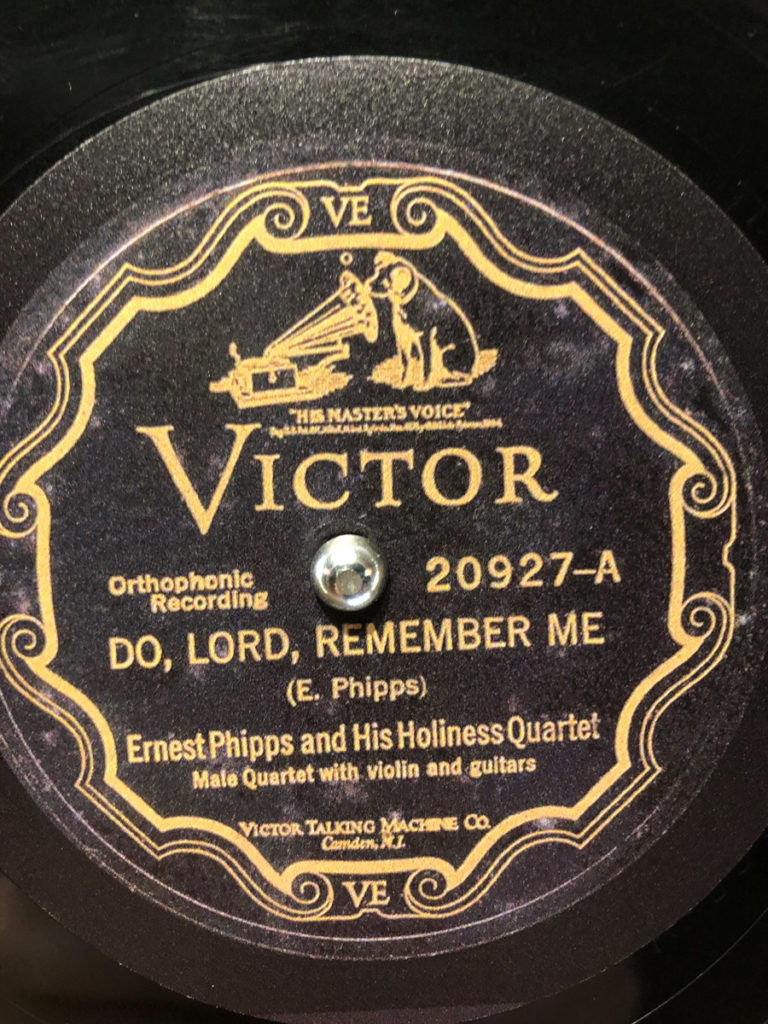
Reproduction Victor label of Ernest Phipps and the Holiness Quartet's "Do Lord Remember Me" showing the Victor Nipper logo and the name of the song and singers.
Reproduction Victor label of Ernest Phipps and His Holiness Quartet’s “Do, Lord, Remember Me.” Photograph © Birthplace of Country Music

Phipps worked his whole life in the coal business, as a miner, a truck driver, and later as co-owner of a small operation. He also preached and sang in the Holiness churches around Corbin, Kentucky from the 1920s until his death in 1963, minus a few years he was in the army during World War II. Much of what we know of his life comes from his youngest sister, Lillian McDaniel, and his stepsons W. R. and J. Randall Mays. Their memories do not fill in the whole picture of Phipps’s life, but they tell us enough to know that his ministry was his major focus, and that his music was likely a component of his ministry. He often visited churches to preach, and would also sing, but no one remembers his visiting churches to sing and not preach.
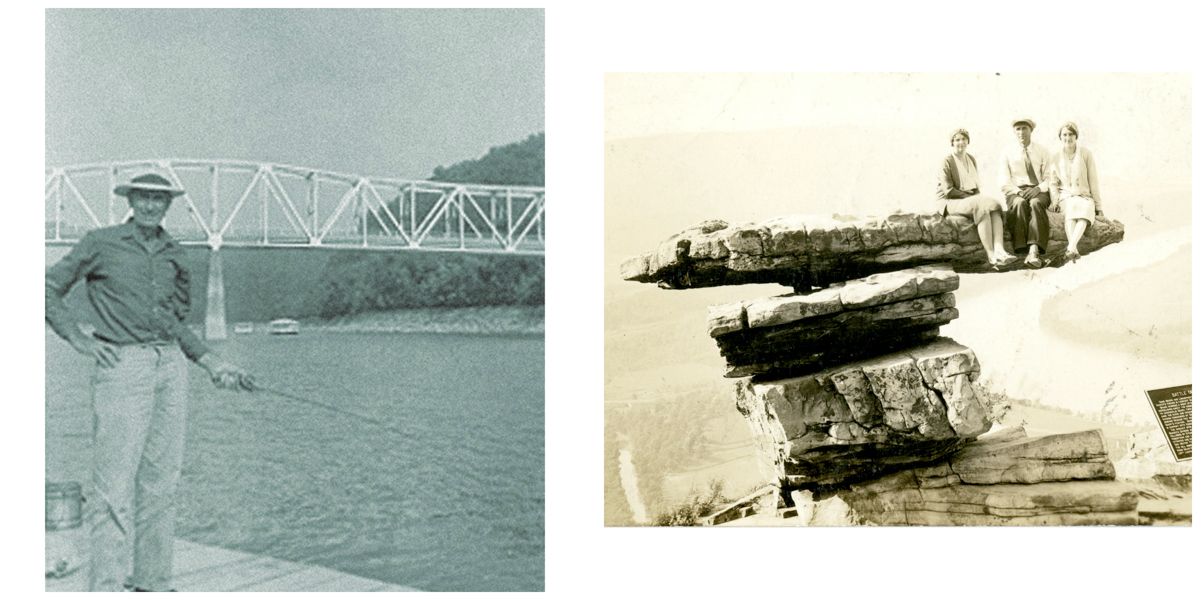
The picture to the left show Ernest Phipps in front of a bridge at the side of the lake; he is holding a fishing pole. The picture to the right shows Ernest Phipps, wife Minnie, and an unknown women perched on top of a "stack" of rocks above a river plain.
Ernest Phipps loved fishing and is pictured here at Cherokee Lake sometime around 1953. In the picture on the right, he is seen with his first wife Minnie and a friend posing on a rock outcrop; a historic site marker nearby references the Civil War’s Battle of Wauhatchie. Left: Courtesy of Rev. J. Randall Mays and Rev. W. R. Mays, stepsons of Rev. Ernest Phipps; Right: Donated to the Birthplace of Country Music Museum by Teresa Phipps Patierno in the memory of her grandfather, Ernest Phipps, a coal miner and Holiness preacher from Kentucky, a simple man who loved his Lord.

The idea that Phipps’s recorded music constitutes an early form of mass media evangelism may involve projecting motives from our time onto his, but nothing in Phipps’s story suggests that he sought a career in music; however, much evidence exists that Phipps sought to share his faith. When he returned to Bristol in October 1928, he brought eight members of his congregation – three female vocalists and five instrumentalists – who recorded six songs that “give us some sense of the power and drive of a real Holiness service,” in the words of Charles Wolfe. The group vocals shift moment to moment between harmony and unison singing and overpower the instrumentation on most songs. The string band groove of Phipps’s 1927 sides is replaced here with a less precise but no less energetic backing shuffle. During refrains, a chorus of handclaps on the one, two, three, and four beats propels these songs into a frenetic pace. These sides sound more like field recordings of a church service than commercial records, but Ernest Phipps and Ralph Peer were onto something: “If the Light Has Gone Out of Your Soul” backed with “Bright Tomorrow” sold almost 12,000 copies.

Here’s “Went Up In The Clouds Of Heaven,” one of the songs recorded by Ernest Phipps and His Holiness Singers at the 1928 Bristol Sessions:


Phipps’s recordings, especially from the 1928 sessions, have sent folk music scholars and fans in a number of interesting directions. Charles Wolfe remarked that Phipps’s recordings preserve “rare examples of the exuberant, ragged, hand-clapping Holiness music” of 1920s Appalachia, particularly Eastern Kentucky. Harry Smith included “Shine on Me” from the 1928 Sessions in his Anthology of American Folk Music alongside the most important American folk musicians of the first half of the 20th century. My work on Phipps suggests that his recordings pioneer a Southern Gospel music antithetical to the harmony singing of the Stamps Quartet, who also recorded at the 1928 Bristol Sessions.
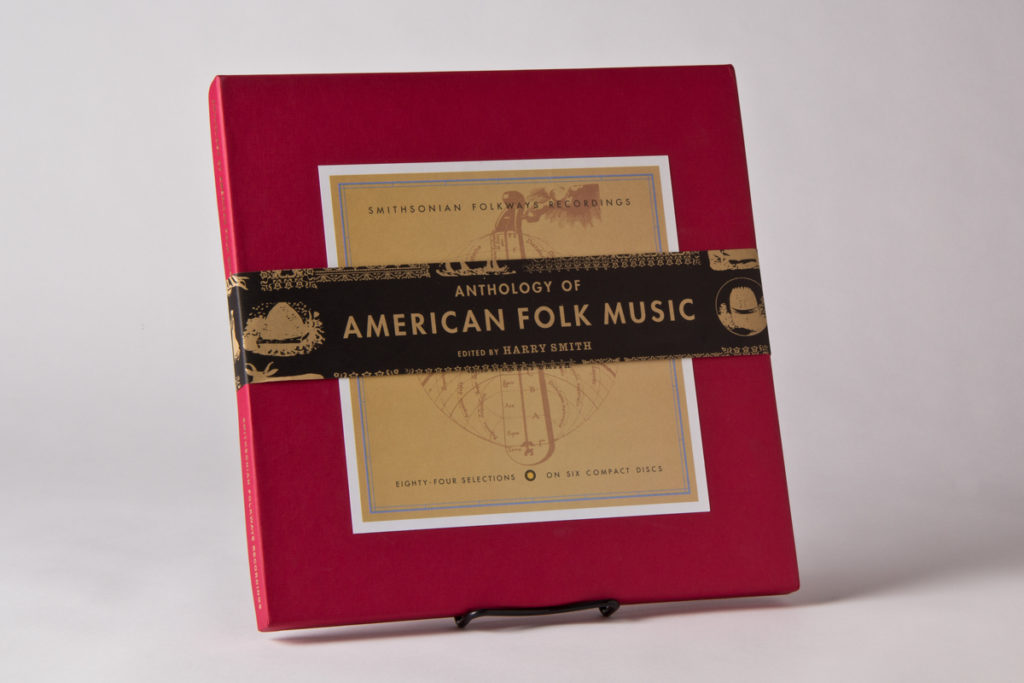
Simple photograph of The Anthology of American Folk Music CD set.
The cover of Harry Smith’s Anthology of American Folk Music.

Because of the spirit it preserves and represents, Phipps’s music has lived a remarkable life of its own. The life of Ernest Phipps suggests that his brief recording career served a purpose: to share the gospel with as many people as he could.

Brandon Story teaches English at King University in Bristol, Tennessee. His chapter “Gospel According to Bristol: The Life, Music and Ministry of Ernest Phipps” appears in Charles Wolfe and Ted Olson’s The Bristol Sessions: Writing About the Big Bang of Country Music.

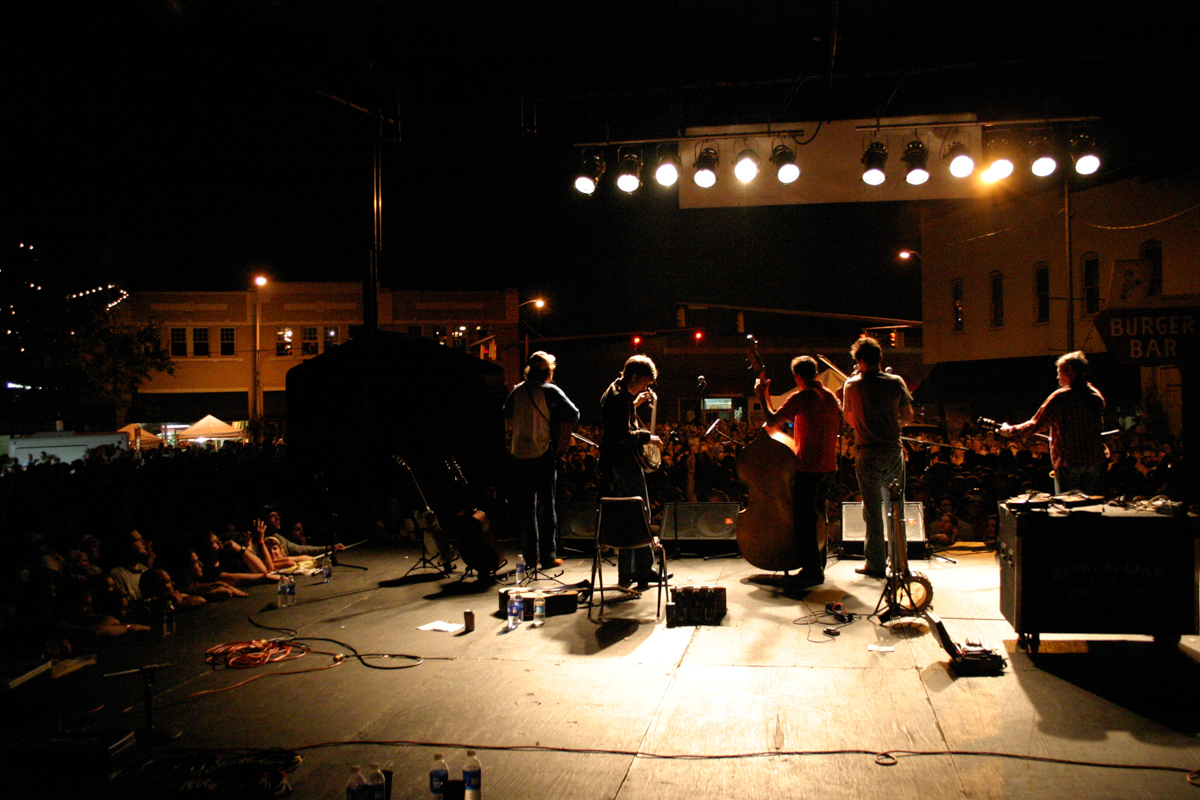
Pick 5: Spring is in the Air!

For our new “Pick 5” blog series, we ask members of the Radio Bristol team to pick five songs within a given theme – from heartsongs to murder ballads and everything in between! Once they pick their “5,” they get the chance to tell us more about why they chose those songs. With a diverse staff of knowledgeable DJs, we’re sure to get some interesting song choices, which might introduce you to some new music, all easily accessible by tuning into Radio Bristol!

Howdy Folks! It’s your old pal Nathan Sykes here with another installment of “Pick 5”! The dreary days of winter are hopefully behind us, and springtime is here once again. With temperatures rising and the landscape growing greener day by day, it’s hard not to be in good spirits, and, naturally, these good feelings manifest themselves in odes to the spring season leading us to my selection of five songs that are always sure to make me think of spring.

“When the Springtime Comes Again,” The Carter Family

I first heard this piece as “Little Annie” from the Lilly Brothers and Don Stover, but this song by The Carter Family is where they got the tune. What says springtime more than wild sheep wandering through the lane? Well, a lot of things, like birds and bees, but this song from the First Family of Country Music features all of the above.

“I Love You Best of All,” Mac Wiseman  

Here’s a classic from “The Voice with a Heart,” Mac Wiseman. If it is possible for a record to sound like springtime, here it is. The twin fiddles throughout this record are sweeter than the flowers, and Mac’s voice is as warm and bright as sunshine on a spring day.

 “The First Whippoorwill,” Bill Monroe  

While most songs of spring sound lighthearted and easy, here’s one that breaks the mold. In this piece, night birds cry a warning instead of the usual sweet songs of love. With the raw vocal duet of Bill Monroe and guitarist Edd Mayfield and the epic tuning slip midway through the banjo break, this is THE bluegrass music at its best.

https://www.youtube.com/watch?v=RCPHv73ZsG8

 “When the Cactus is in Bloom,” Jimmie Rodgers   

From America’s Blue Yodeler, here’s a classic from his 1931 session in Louisville, Kentucky, where he was accompanied by the dynamic duo of Cliff Carlisle and Wilbur Ball. This song makes you yearn for the saddle and the freedom that comes from riding down the dusty trail. And it reminds you that cacti bloom with beautiful spring flowers too.

“Spring Time in Dear Old Dixie,” Reno and Smiley  

Before it is summertime in a southern clime, it has to be spring. The tight harmonies of Don Reno and Red Smiley and the Tennessee Cut-Ups transport listeners to a bright spring day in that dear old sunny southland, and the joys of spring described here could warm even the dreariest of northern winter days.

So there you have it: my “Pick 5” of springtime songs, bringing to mind blooming flowers and love, warm days and buzzing bees. I hope these tunes put a little “spring” in your step!

“The Big Lineup Reveal” – Bona Fide Bristol Rhythm ’18

By Charlene Tipton Baker, April 18, 2018

The first time Old Crow Medicine Show played Bristol Rhythm & Roots Reunion, it was 2004. I have particularly fond memories of that year because, in my mind, that’s when we became a bona fide music festival – one destined to make as big of an impact on Bristol and our downtown community as the 1927 Bristol Sessions did for early commercial country music back in the day.

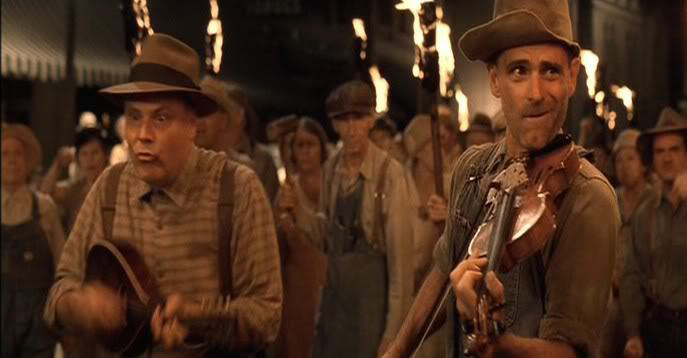
One might say Hollywood had a hand in it, as the success of three major motion picture soundtracks over the previous years had sparked popular interest in Appalachian music: The Coen Brothers’ cult classic O Brother, Where Art Thou?, Maggie Greenwald’s Songcatcher, both released in 2000, and Cold Mountain, which opened in 2003. The albums from these films were wildly successful, winning dozens of awards – Grammys and Grammy nominations among them – and cast a wide spotlight on the music and musicians of our region like never before. O Brother highlighted the career of Dr. Ralph Stanley, bringing him the further recognition he so richly deserved. Our friends the Reeltime Travelers (based in East Tennessee) were featured on the Cold Mountain soundtrack and were part of the “Down from the Mountain Tour,” an extension of the documentary film by the same name that featured artists and musicians from the O Brother soundtrack. In addition, our very own Ed Snodderly, a renowned singer-songwriter and owner of The Down Home in Johnson City, Tennessee, played a crazy fiddler in O’ Brother. The stars were totally aligned in our favor.

Still from the movie O Brother Where Are Thou? showing two old-time musicians (Ed Snodderly on fiddle)
Ed Snodderly (right) as Village Idiot in O Brother, Where Art Thou? 2001 Courtesy Buena Vista Pictures

By the time we started booking for 2004’s Bristol Rhythm, a trajectory had been set, and “Wagon Wheel” was nowhere near cliché. That was the year I fell in love with the festival – and Bristol – for real. That was the year I knew that my little hometown was destined for so much more. It would prove to be a record-breaking year for attendance (maybe 20–25,000? If memory serves!), and I will never forget the energy on State Street. It was magical.

I remember seeing Old Crow for the first time that weekend in 2004. They were so young and scruffy in their worn jeans, wrinkled flannel shirts, and unkempt hair. They were just kids! But they were absolutely on fire when they hit the stage. They played two sets that weekend, and they were the band everyone was talking about.

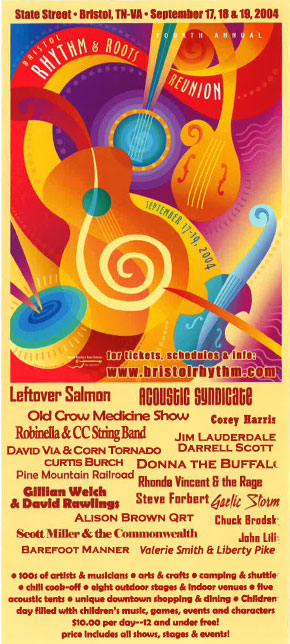
Front of the 2004 Bristol Rhythm rack card listing bands who played at the festival, including Old Crow Medicine Show.
The Bristol Rhythm 2004 rack card. © Birthplace of Country Music

I will add that they were also really nice to our volunteers and expressed genuine gratitude for the gig. And they knew Bristol’s history, even if Bristol wasn’t yet fully aware of that history yet. Every time I watch the films in the Orientation and Immersion Theaters inside the Birthplace of Country Music Museum, I am so glad to see those guys featured in them. Old Crow Medicine Show helped incite a new wave of progressive Appalachian music not seen since the days of Newgrass Revival – bands that would wield banjos like rock stars and generate enough crowd energy to fuel a small city.

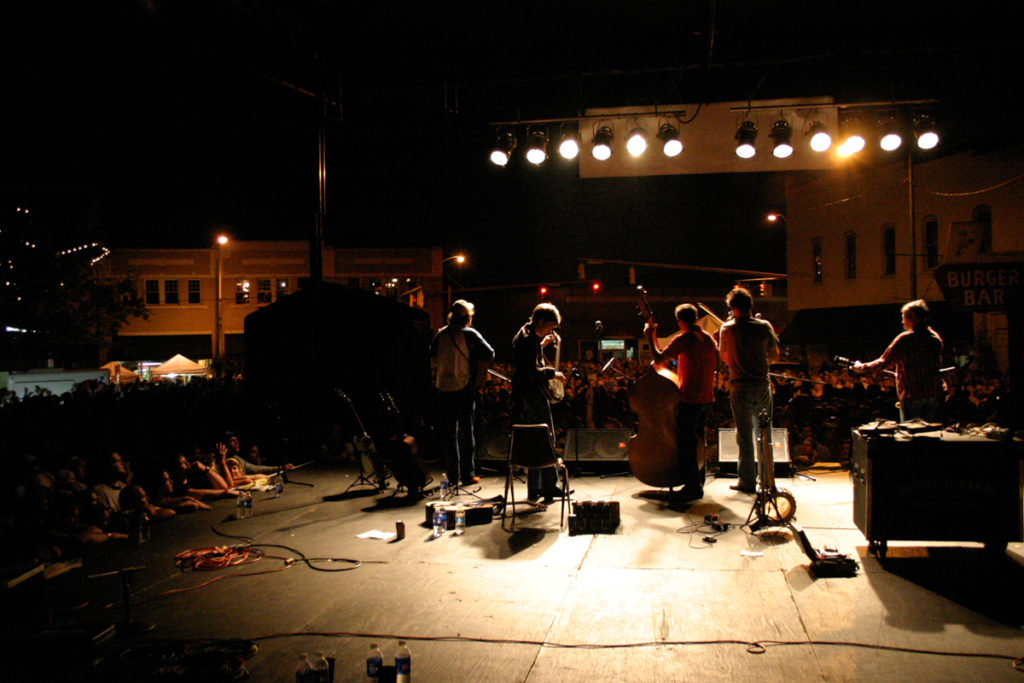
Old Crow Medicine Show on stage at Bristol Rhythm 2005, seen from behind looking out at audience
Old Crow Medicine Show on stage in 2005 when they returned to Bristol Rhythm & Roots Reunion. © Birthplace of Country Music

“The Big Lineup Reveal” for Bristol Rhythm ’18 stirred up a bit of sentimentality for 2004, which I didn’t quite expect, and lots of excitement for the return of Old Crow Medicine Show this year. So when putting together the 2018 Bristol Rhythm Spotify playlist, I felt it rather appropriate to start out with Old Crow singing “Wagon Wheel” – because it is a great song, despite the crappy covers, and it’s the one song that I identify most with Bristol Rhythm ’04, the year that defined the festival and paved the way for the lineup we’ll have this year. I hope you enjoy this eclectic mix tape of bands playing at Bristol Rhythm ’18!

Chasing Down the “Big-Eyed Rabbit”

All kinds of animals pop up in old-time songs. I got a mule to ride, my horses ain’t hungry they won’t eat your hay, cluck old hen, Indian ate a woodchuck, as well as pigs, possums and polecats – the list is endless. But my favorite will always be the big-eyed rabbit – appropriate for a post on the Easter weekend! It’s not the best-known old-time song out there, but it is one that is quite popular in southwest Virginia and northwest North Carolina.

A photograph of a rabbit in a meadow.
A real – rather than musical – big-eyed rabbit. Public domain image found on Pixabay

Rabbits are well represented in the old-time canon. Talking about rabbit songs with Trish Fore, a fellow BCM blogger and banjo player for The Cabin Creek Boys, she also threw out “Ol’ Captain Rabbit,” “Run Little Rabbit Run,” “Buck Eyed Rabbit” (recorded by the Hillbillies), and an old favorite I had forgotten, “Old Molly Hare.” Her husband Kevin, also a banjo player as well as a luthier, added “Little Rabbit Where’s Your Mammy?,” recorded by Crockett’s Kentucky Mountaineers. Another perennial favorite is “Rabbit Up a Gum Stump” (though sometimes it’s a possum up a gum stump), a favorite of such southwest Virginia legends as Albert Hash and Thornton Spencer.

Yonder comes a rabbit,
Fast as he can run,
Yonder comes another one,

Shoot him with a double-barrel gun, lord,
Shoot him with a double-barrel gun.

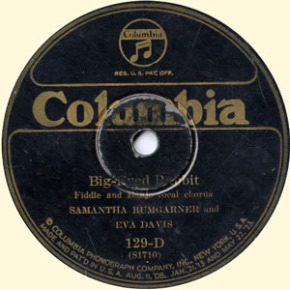
Figuring out the background and recording history of most old-time songs can get hazy, and my research first led me to a version of “Big-Eyed Rabbit” that seems to have been recorded in May 1939. That recording, done in Quitman, Mississippi, is in the Library of Congress and the credits are as follows: Sung by Charles L. Long with fiddle, with Sam Neal beating straws. I thought this version was the first recording of the song, but then found mention of Samantha Bumgarner recording 10 songs (often with Eva Davis) for Columbia Records in April 1924, one of which was “Big-Eyed Rabbit.”

Columbia record label for Samantha Bumgarner and Eva Davis's "Big-Eyed Rabbit"
The record label for Samantha Bumgarner and Eva Davis’s “Big-Eyed Rabbit,” Columbia 129-D (81710). Archie Green Collection (#20002), Southern Folklife Collection, Wilson Library, University of North Carolina-Chapel Hill

Whatever the origin, the song found enduring popularity in the Round Peak area of North Carolina as well as north of there around Galax, Virginia. It was recorded by Tommy Jarrell, Kirk Sutphin, and Kyle Creed and Fred Cockerham at various points. Kirk learned it from Tommy, who in turn had learned it from his father, Ben Jarrell. Trish told me: “I always thought that people sang about what they knew and things they enjoyed. Rabbit hunting is sport and also provided meat and food for the family back in the day, and even for some today. I know folks who still eat rabbit.”

Different versions of the song have two or three rabbit-related verses, in one of which the rabbit ends up in a frying pan. In another verse, seemingly out of place with the others, the song’s narrator sees his darling coming, telling us “her pretty blue eyes/shining bright like gold.”

Regardless, it’s a song that has got legs. It continues to be a favorite, recorded in the last few years by Crooked Road locals like Mountain Park Old Time Band and the New Ballard’s Branch Bogtrotters, who liked it so much they included it on two consecutive albums, the second of which even included an additional verse.

It has also captivated musicians from further afield. Canadian fiddler and step dancer April Verch, from Ontario’s Ottawa Valley, recorded the song and even borrowed the line “Bright like gold” for the title of the album it appears on. Verch is no stranger to southwest Virginia, having appeared at the Wayne Henderson Guitar Festival and Competition, and at a concert I attended a few years ago in Takoma Park, Maryland, she explained that she learned “Big-Eyed Rabbit” from watching an old documentary about – who else – Tommy Jarrell. Whatever the reasons for his popularity, the big-eyed rabbit, still skipping through the sand, is clearly here to stay.

Joseph Vess lives in Meadowview, VA, where he listens to lots of old-time music and occasionally plays the guitar. He thanks Trish and Kevin Fore for their invaluable assistance with this story. For more on the lyrics and history of “Big-Eyed Rabbit,” check out this link.