Music & Songs Archives - Page 21 of 30 - The Birthplace of Country Music
Listen
Play
Loading station info...

The Power of Music: Five Songs for Civil Rights

Here at the Birthplace of Country Music Museum, we’ve spent the past month and a half exploring the power and impact of visual imagery through the NEH on the Road exhibit For All the World to See: Visual Culture and the Struggle for Civil Rights (on display until January 7, 2019). But we’re a music museum, and one thing we know for sure: music has power and impact too.

And that is certainly true when you think about the music of the Civil Rights movement. Many of these songs had their origins in traditional hymns and African American spirituals, and while they weren’t all originally about freedom and social justice, their message was clearly relevant. Some were also revised to include new lyrics that spoke directly to the issues people were facing, such as voting rights. Others grew out of the musicians’ personal experiences or observations of the discrimination around them.  These songs – often and rightfully called anthems – inspired determination and bravery, helped to lessen fears and steady nerves, focused activists’ passion and energy on the task at hand, and acted as motivators to protesters and observers alike. They were delivered by professional musicians and groups like the Freedom Singers, but more importantly they became the unified voice of ordinary people displaying extraordinary courage at rallies, marches, and protests and in churches, meetings, and workshops.
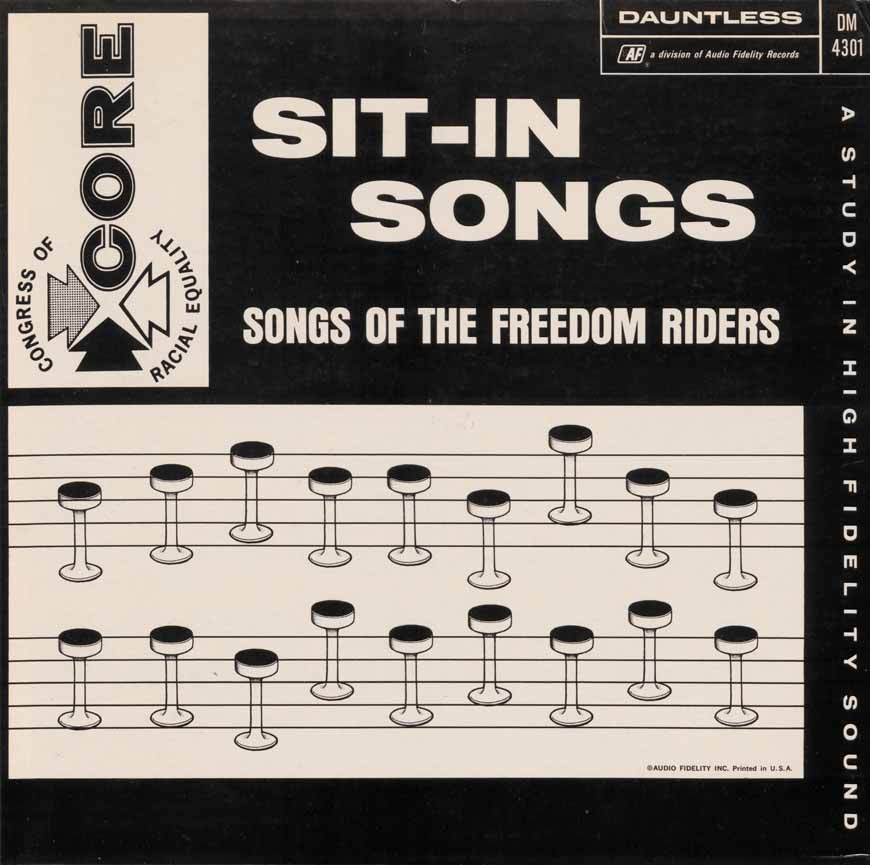
The album cover shows the CORE logo, the title, and a series of music notes in the form of diner counter stools.
The Congress of Racial Equality (CORE) produced a record of “sit-in songs” in 1962, which included “We Shall Overcome.” The musical notes are in the form of diner counter stools. This record went along with the Freedom Highways project, when activist volunteers worked to integrate chain restaurants along the main federal highways. Image from https://library.duke.edu/exhibits/johnhopefranklin/civilrights.html

There are many accounts of this music history and the songs of the Civil Rights struggle in books, audio collections, and films such as Strange Fruit: The Biography of a Song, We Shall Overcome: A Song That Changed the World, Let Freedom Sing: The Music of the Civil Rights Movement, Sing for Freedom: The Story of the Civil Rights Movement Through Its Songs, Voices of the Civil Rights Movement: Black American Freedom Songs, 1960-1966, Freedom Song: Young Voices and the Struggle for Civil Rights, and Soundtrack for a Revolution (screened at the museum in November). All of these are worth exploring to get a better understanding of the place and significance of music in the fight for civil rights over the years.

A blog post about this music would be incredibly long – it’s a long and interesting history and each song has a story! And so, we’ve chosen just five songs that highlight the power of this music, including a brief history or description of each, to get you started on an incredibly inspiring musical journey.

“Uncle Sam Says,” Josh White (1941)

Josh White’s 1941 record Southern Exposure: An Album of Jim Crow Blues, co-written with poet Waring Cuney, was called “the fighting blues” by author Richard Wright, who wrote its liner notes. One of its songs, “Uncle Sam Says,” highlighted the frustration felt by African Americans when faced with the continuing effects of Jim Crow even as they fought and gave their lives for their country. It was inspired by White’s visit to his brother at Fort Dix in New Jersey where he saw the segregated barracks and unequal treatment of the black servicemen. After the album was released, White was invited by President Franklin Delano Roosevelt to the White House for a command performance, the first black artist to do so.

“This Little Light of Mine,” Rutha Mae Harris

For many of us, “This Little Light of Mine” is a song of our childhood sung at school or church. But the song has a much more interesting history within the Civil Rights movement and beyond as a “timeless tool of resistance” – check out this NPR piece from August 2018 that celebrated the song as a true “American Anthem.” The song, both a spiritual popular in the black churches and a folk song, became even more impactful when it was employed by Civil Rights protesters and activists who often personalized the lyrics to the situation or as a way to name the oppressors they were facing. Original Freedom Singer Rutha Mae Harris demonstrates the energy and power of the song as she leads a contemporary group in its verses at the Albany Civil Rights Institute:

“I Shall Not Be Moved,” The Harmonizing Four (1959)

This African American spiritual is based on Jeremiah 17:8—9, reflecting the idea that the singers’ faith in God will keep them strong and steadfast. The song became a popular resistance anthem during the Civil Rights movement, especially in relation to sit-ins; it was also used as a labor union protest song. As with “This Little Light of Mine,” the lyrics were sometimes altered to speak to the specific cause. Maya Angelou’s poetry collection I Shall Not Be Moved was named after the song.

“Why Am I Treated So Bad?,” The Staple Singers (1966)

The Staple Singers met Dr. Martin Luther King Jr. in 1963 after a performance in Montgomery, Alabama. Roebuck “Pops” Staples, the band’s patriarch, said afterwards: “I really like this man’s message. And I think if he can preach it, we can sing it.” The group went on to write and perform many Civil Rights songs, including “March Up Freedom’s Highway” and “Washington We’re Watching You.” “Why Am I Treated So Bad” was written in reference to the treatment of the nine African American children at the forefront of integration in Little Rock, Arkansas, in 1957. It became a particular favorite of King’s and was often sung before he spoke to a crowd.

“We Shall Overcome,” Mahalia Jackson (1963)

One of the most well-known songs of the Civil Rights movement, “We Shall Overcome” exemplifies the resilience, determination, and hope of the activist leaders and the everyday protesters alike. Its origins stretch back to the early 20th century with Charles Tindley’s “I Will Overcome.” Striking workers took up the song in the 1940s, later sharing it with Zilphia Horton at the Highlander Folk School in Tennessee, a center for social justice and activism. White and black activists came together at Highlander for workshops and planning during the Civil Rights movement, and some of that work involved learning songs and how to employ them in protests. Musical director Guy Carawan learned a version of the song from Pete Seeger; Carawan later introduced the song at the founding convention of the Student Non-Violent Coordinating Committee. (To hear Candie Carawan talk about the work at Highlander and the power of music during the Civil Rights movement, check out December 19’s archived On the Sunny Side show on Radio Bristol; her interview is towards the end of the show.)

https://www.youtube.com/watch?v=vTyKJjj2oC0

Finally, did you know that there is a connection between Carter Family favorite “Will the Circle Be Unbroken?” and civil rights? The song has been sung by various activist musicians, including Jimmy Collier and the Movement Singers and Freedom Singer Bernice Johnson Reagon, and an audio history of the Civil Rights movement takes the song title on as its name.
Pick 5: Merry and Bright Christmas Favorites

For our “Pick 5” blog series, we ask members of the Radio Bristol team to pick five songs within a given theme – from heartsongs to murder ballads and everything in between! Once they pick their “5,” they get the chance to tell us more about why they chose those songs. With a diverse staff of knowledgeable DJs, we’re sure to get some interesting song choices, which might introduce you to some new music, all easily accessible by tuning into Radio Bristol!

When the chilly winds begin to blow through the hills and hollers of Appalachia, everyone knows that the holidays will soon be upon us. With tinsel and bright lights glimmering everywhere and friends and relations making merry, it’s hard not to be in the holiday spirit. If you need a little extra push to get in the Christmas spirit, however, look no further! For this month’s “Pick 5,” we turned to some of our BCM staff to select their favorite holiday tunes, ones to help our listeners feel merry and bright. Here are their selections:

“I Want a Hippopotamus for Christmas,” Summer Apostol, Frontline Associate

“I Want a Hippopotamus for Christmas” is my favorite Christmas song because of how ridiculously cute it is. What kind of kid asks for a hippo for Christmas? And are you sure nothing else will do, Gayla? The song just continues to baffle and stupefy you as you start to think about the logistics of obtaining a hippopotamus for a young child in Oklahoma City. I was first introduced to the song when I was ten years old. My best friend at the time made me a CD with “essential songs” I should know. “I Want a Hippopotamus for Christmas” was an instant favorite from this CD for me (“Hips Don’t Lie” by Shakira was a close second favorite on this mix). I would play the song on repeat and sing the song to my purple hippopotamus ty baby, imagining he was a real hippo. It’s not just nostalgia that makes this Christmas classic one of my favorites, it’s also the fact that 10-year-old Gayla Peevey, the original singer, was actually gifted a hippopotamus by a local promoter who oversaw a campaign to buy a real hippo for her based on the song’s popularity and Peevey’s local roots! Gayla donated her Christmas gift to the zoo, where he spent the remainder of his life, happy and content knowing that he made a little girl’s Christmas wish come true.

“Merry Christmas Everybody,” Scotty Almany, Digital Resources Manager

There were a few songs in contention for my favorite, but in the end, I chose the 1973 glam-era gem “Merry Christmas Everybody” from the British band Slade. I have been a huge fan of 1970s glam rock since my mid- to late teens, so the style of the song appealed to my everyday tastes in music, and I also like that it is a light-hearted tune that you can sing along with and enjoy. I also like the way the song was written. It seems like a lot of non-traditional holiday songs tend to be ironic or insincere, often coming across as hokey or just bad, but Slade seems to really be having fun in every performance I have seen or heard of the song. “So here it is, Merry Christmas, everybody’s having fun!”

“Happiest Little Christmas Tree,” Kim Davis, Director of Marketing

Christmas songs are my FAVORITE. In fact, I start listening to Christmas songs NON-STOP beginning November 1 and continue through to the end of the year. My current favorite is “Happiest Little Christmas Tree” by Nat King Cole. The song was released in the late 1950s on Cole’s Christmas album; however, I just discovered the song this year, nearly 70 years later. Just listening to the song will bring a smile to your face, especially, if you listen to it while looking at your festively decorated tree!

“Oh, I’m the happiest Christmas tree
Hoo hoo hoo, hee hee hee
Look how pretty they dressed me
Oh, lucky, lucky me.

I got shiny bells that jingle
And tiny lights that tingle
Whenever anyone passes by
I blink my lights and I wink my eye…”

With lyrics like that, how could you not get a smile on your face?

“Where Are You Christmas?” Erika Barker, Sales & Business Development Manager

“Where Are You Christmas?” is my favorite Christmas song in part because it was sung by my favorite character in my favorite Christmas movie: How the Grinch Stole Christmas (2000). When I was little I loved the Christmas season, and I wanted to be just like Cindy Lou Who, I would put my hair up in crazy Who-Hairstyles and dance around the house singing this song. As I have grown up, this song still resonates with me because as my world has changed each year so has the way I experience Christmas. Just because I am not the little girl pretending to be a Who in my parents living room anymore doesn’t mean the joy of Christmas has gone away. The magic of Christmas is still here if we just know how to look for it!

“Arthur McBride,” Emily Robinson, Collections Manager

I learned about this song from Rosanne Cash’s New York Times article about her favorite ballads a few years back. She says that she listened to it a thousand times. I did too. Paul Brady’s beautiful, lilting voice, his precise and intricate guitar playing… this gorgeous, haunting song should be on everyone’s Christmas playlist.

Off The Record: Hazel Dickens and Alice Gerrard – Pioneering Women of Bluegrass

Our Radio Bristol DJs are a diverse bunch – and they like a huge variety of musical genres and artists. In our “Off the Record” posts, we ask one of them to tell us all about a song, record or artist they love.

“West Virginia, oh my home
West Virginia, where I belong
In the dead of the night, in the still and the quiet
I slip away like a bird in flight
Back to those hills, the place that I call home.

Well I paid the price for the leavin’
And this life I have is not one I thought I’d find
Just let me live, love, let my cry, but when I go just let me die
Among the friends who’ll remember when I’m gone.”

“West Virginia My Home” by Hazel Dickens, courtesy of Cowboylyrics.com

I’m extremely proud of my Appalachian heritage and have made it my mission to promote the region in a positive light – there is just so much amazing music, culture, and history that has emerged from Appalachia! I’m also proud to call West Virginia my home state, and as a musician and scholar of traditional music, I’ve been greatly inspired by traditional folk singer-songwriter Hazel Dickens, a West Virginia native herself. Dickens became well known in the mid-1960s as a prominent female figure in Appalachian music, known for her high and lonesome mountain sound.

Today I’ll be highlighting some tunes from the album, Hazel Dickens and Alice Gerrard: Pioneering Women of Bluegrass, a Smithsonian Folkways collection. This album has been a true inspiration to me throughout the years, as the first time I heard it I was likely completing my undergraduate degree in Traditional Bluegrass Music from Glenville State College. Being in the college bluegrass band during this time was inspiring, and one of my favorite things to do was discovering “new” tunes from history.

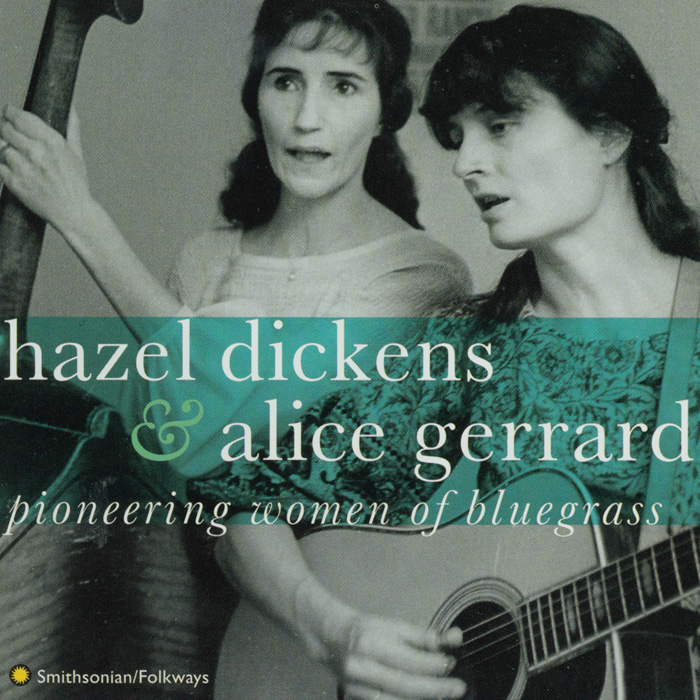
The album cover shows both women singing together and playing their respective instruments -- bass and guitar.
The cover for Hazel Dickens and Alice Gerrard’s Pioneering Women of Bluegrass album. From Smithsonian Folkways Recordings website

Hazel Dickens (June 1, 1925–April 22, 2011) was born in Montcalm, West Virginia, the 8th of 11 children. She grew up in a poor mining town, and her early exposure and experiences in poverty are a major theme in many of her songs. Influenced by early country musicians like The Carter Family and Uncle Dave Macon, Dickens merged elements from the country and bluegrass genres to tell stories of life as she knew it. At age 19, she moved to Baltimore to find work in a factory in order to escape the poverty-stricken hills of home. While in Baltimore, she and her siblings would often visit music festivals in the area. It was during this time in the 1960s that she befriended Alice Gerrard, a classically trained singer who had a love of old-time music. The two formed a duo, and with Hazel on the upright bass and Alice on the acoustic guitar, they toured and performed up until the late 1970s and were instrumental in the folk and bluegrass movement of the era.

Dickens and Gerrard became influential figures in traditional music during a time when women weren’t seen fronting a band. The folk music industry was dominated with male performers and instrumentalists, and in a magazine interview Dickens was quoted as saying “I’m not sure if they looked at us as a novelty, or if they took us seriously….” The duo produced four albums together, and their record Who’s That Knocking is one of the earliest recorded bluegrass albums created by women. With their powerful and soulful harmonies, and by recording a wide variety of songs addressing politics and Appalachian issues, the duo became and continue to act as powerful role models for women in music.

Here are just a few of my favorite songs from the Pioneering Women of Bluegrass collection, which features Dickens and Gerrard singing a variety of traditional songs highlighting poverty, love, and loss, amongst the popular themes, and with moving vocals, harmonies, and back-up instrumentation by Lamar Grier, Chubby Wise, David Grisman, and Billy Baker.

“T.B. Blues (They’re at Rest Together)”

This story song is a heart-wrenching one at best, telling the tale of love and loss and the heartbreak of being broken apart by illness, especially the relentlessness of tuberculosis.

“A Distant Land to Roam”

Dickens and Gerrard were inspired by The Carter Family and recorded several of their songs; “A Distant Land to Roam” was originally recorded by the Carters in 1929. The song tells the story of leaving home and eventually meeting one’s family again in heaven.

“I Just Got Wise”

One of my all-time favorites from this album, this witty and upbeat tune features a lady who is fed up with her cheatin’ lover. After being let down time and time again, she realizes he’s not going to change, and so she “got wise” and moved on.

Hazel Dickens are Alice Gerrard are true symbols of Appalachian musicians, and their music continues to act as a tool that gives the region and its people a voice, highlighting important issues surrounding poverty, mining, and everyday life. It’s always fun to bring these old and sometimes forgotten songs back to life – and to introduce them to new listeners. I hope you check out some of these songs and become inspired by their music today!

Bristol Rhythm Sounds of the Season: A Festivus for the Rest of Us!

Nothing brings people together like music and the holidays so, for those of us who are really missing the festival atmosphere of Bristol Rhythm & Roots Reunion and are looking for a way to extend that joyful noise into the Christmas season, we’ve got ya covered.

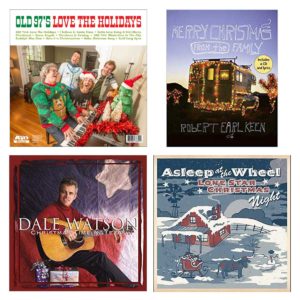
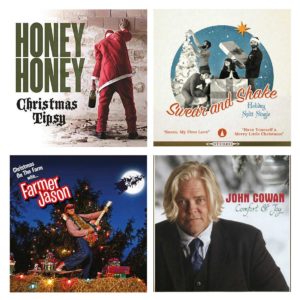
From rockin’ original cuts by Old 97’s, Scott Miller, and Deer Tick to Christmas standards bluegrass’d up by the Del McCoury Band, Ricky Skaggs, and Sam Bush, we’ve scoured the interwebz to compile for you some of the most awesome Christmas tuneage in the universe, guaranteed to fill your holidays with lots of Bristol Rhythm cheer.

So while you’re basting that turkey, trimming the tree, wrapping those gifts, or just sitting around enjoying a tasty seasonal beverage, make it a Bristol Rhythm holiday party with nearly four hours of Christmas music performed by an eclectic mix of stellar festival artists, all in one handy Spotify playlist—and have a very merry Bristol Rhythm Christmas!

Enjoy Bristol Rhythm Sounds of the Season: A Festivus Playlist for the rest of us!