Music & Songs Archives - Page 17 of 30 - The Birthplace of Country Music
Listen
Play
Loading station info...

Instrument Interview: A Guitar Built for Doc Watson

“Instrument Interview” posts are a chance to sit down with the instruments of traditional, country, bluegrass, and roots music – from different types of instruments to specific ones related to artists, luthiers, and songwriters – and learn more about them. Ten questions are posed, and the instruments answer! Today we talk with a guitar built for Doc Watson.

Tell us a little bit about yourself.

Hi! I am a handcrafted acoustic guitar based on a Martin 000 pattern. I was made by Jayne Henderson, the daughter of prominent luthier Wayne Henderson – in my opinion, she is the coolest Henderson! Being a 000 means that I am a smaller guitar, with thinner sides and a smaller body shape than the typical bluegrass Dreadnought guitar you see all the big country stars playing. My small stature doesn’t stop me in terms of volume and playability though!

I am made from white oak, which I know isn’t the typical material one would think of when it comes to guitars. However, at the time, my builder had just graduated from Vermont Law School with a degree in environmental law and policy, and therefore she wanted to try some local materials as she didn’t want to use any woods that were extinct or too hard to come by.

I was made for the incredible musician Doc Watson upon his request. He passed away about a week before I was finished, but that has not stopped me from spreading my voice loud and proud among other musicians – in fact, it has actually lead to some awesome opportunities where I have been played by all sorts of talented folks!
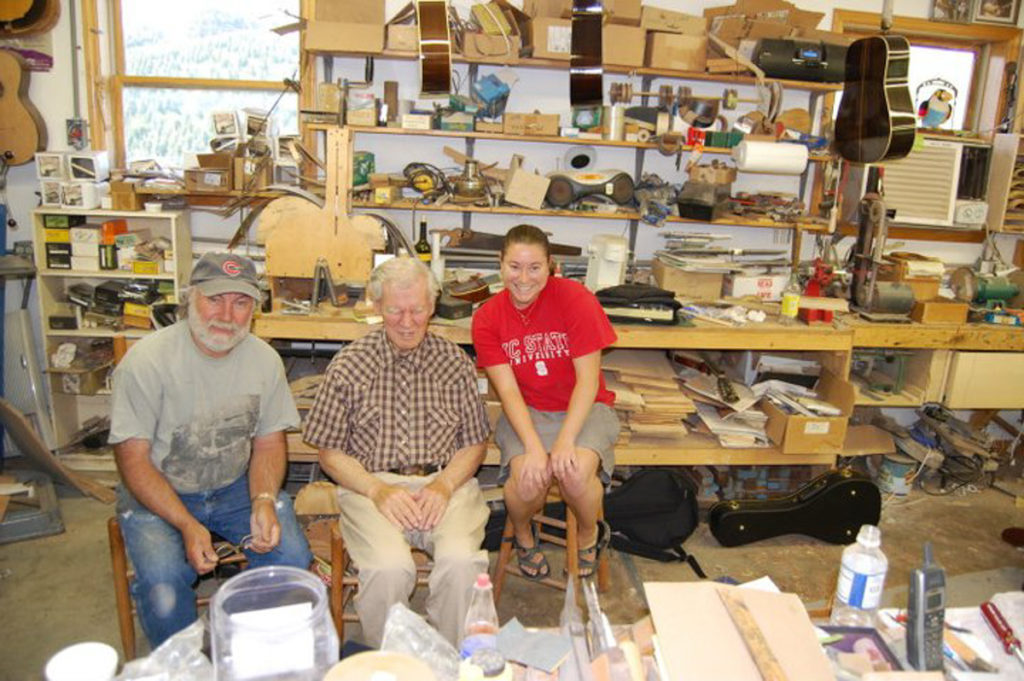
Wayne Henderson, Doc Watson, and Jayne Henderson posing for the camera in the Henderson workshop. Tools, instruments, and wood litter the background of the photograph.
Wayne and Jayne Henderson visiting with Doc Watson in Wayne’s workshop. Photography courtesy of Jayne Henderson

Why is oak such a strange wood to make a guitar from?

Well, while not many builders use it for a tone wood these days, it actually isn’t that strange historically. Martin, one of the best guitar manufacturers out there in my opinion, made parlor guitars from oak around the turn of the 20th century and into the 1920s and 1930s.

Jayne, my builder, found the board I am made from at a local lumber yard and chose it primarily because the board was the first one she had ever seen where she knew it was quarter-sawn, a term that refers to the grain of a tree running straight vertically for the length of the board. Boards that are quarter-sawn are the best for guitar material because they are usually the most stable pieces in terms of cracking and moving. Quarter-sawn boards are also best at allowing vibrations from plucked strings to run fastest through the board and then transmitting those vibrations into sound waves. She bought that board and took it to Virginia where her dad helped her cut it into a guitar set. The thinly sliced back and side pieces rang out loud and bright when Jayne and her dad tapped on them so they knew the pieces would make a great guitar.

What is the best part about being made from a material not typically used for guitars?

The coolest thing about being made from a piece of white oak is that it is a sustainable material that is easily available for building. A lot of historically used materials – such as Brazilian rosewood and Honduran mahogany – are becoming endangered or have even gone extinct so protecting those resources rather than using them is more important than ever. Even though there are currently some regulations monitoring the use, those types of wood won’t be around forever at the rate they are being harvested or destroyed in their countries.

I am also very proud that when you tap on a plank of oak, its tone is similar to that of Brazilian rosewood. What’s great is that oak comes from right here, in our own backyards, and it is prevalent enough that if you cut a few, or better yet, harvest a naturally felled tree, it won’t threaten the entire species or the subsequent species that rely on that tree for survival.
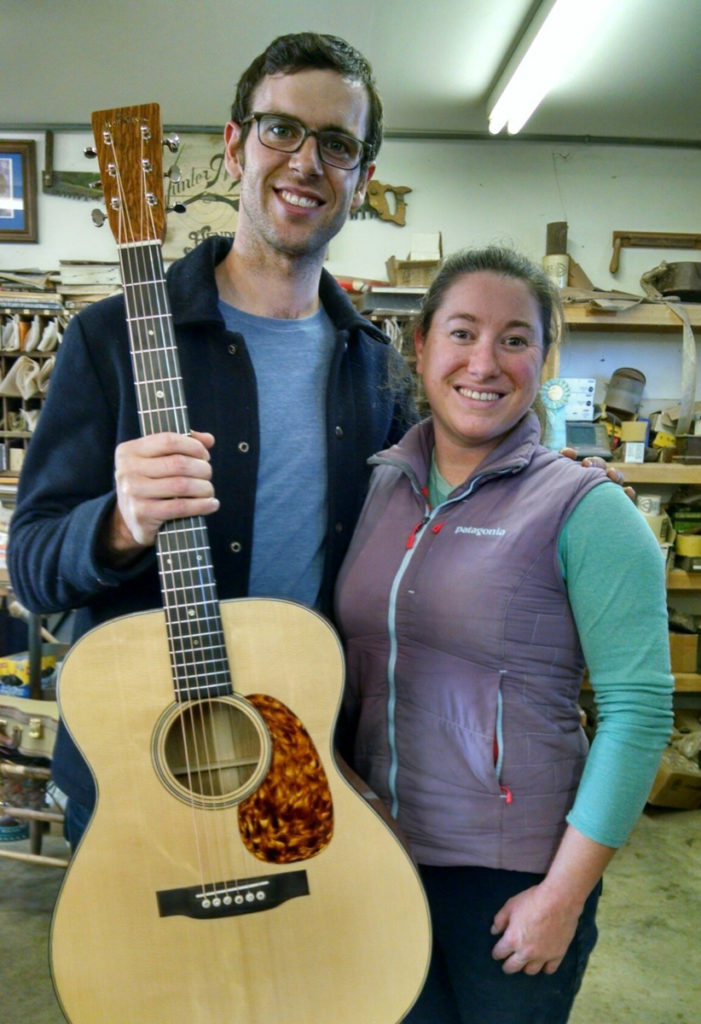
A tall man with Jayne Henderson in a workshop; the man holds the Doc Watson guitar, which is a pale wood with tortoise-like pick guard.
Jayne Henderson and friend holding the finished Doc Watson guitar; the simplicity of the design highlights the beautiful oak wood. Photograph courtesy of Jayne Henderson

You said you were made for Doc Watson. Who is that?

Doc Watson is a legendary musician known for his picking style and for pioneering new “licks” on old songs – licks that countless musicians following his footsteps strive to emulate, including Wayne Henderson. Doc was blind, which he once told Jayne was why he became a musician in the first place as it provided a means to express himself as well as carry a successful profession without the need to see. Jayne knew Doc Watson for her entire life because he had been friends with her dad through playing music together. Doc also has a few of Wayne’s instruments, one of which he proudly played during his last performance at Merlefest a few years back.

How did he find out about Jayne’s guitars?

The last years of Doc’s life, when he wasn’t traveling around playing as much, he would visit Wayne’s shop most Sundays. He would sit for hours and tell Jayne stories, like how he met his wife Rosalie or all the pets he has considered friends in his life, while petting her dog Harper who laid her head on his feet, oblivious to his celebrity status. Whenever Jayne finished a new guitar near one of those precious Sundays, Doc would always play it and sing a song or two.
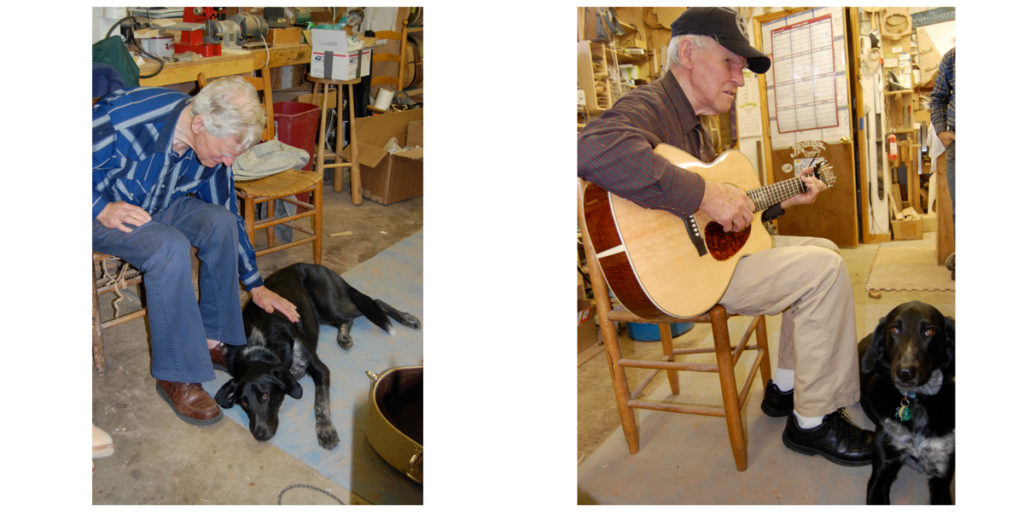
Two pictures of Doc Watson in the Henderson workshop, one where he is leaning down to pet Harper, a black hound-looking dog, and the other with him playing a guitar while Harper sits at his feet.
Doc and Harper hanging out in Wayne’s shop. Dogs are music lovers too! Photograph courtesy of Jayne Henderson

And then how did you come about?

As Jayne began building, she would show Doc her new guitars. He was so kind and generous with praise for each one, even though he claimed he would be honest with his critiques. One day Jayne asked if he would like her to build him one, and he said he would love that – soon enough I was in the works. I am a simple guitar, with minimal adornment, the only flashy thing being my brass encircled fret markers which reminded Jayne of the snaps on Doc’s plaid shirts.

How did Doc feel about oak being used for his guitar?

Jayne told Doc that she wanted to use a sustainable material for his guitar. Because she had just finished her degree from one of the top environmental law programs in the country, she thought it was important to include the principles she learned in her building. She asked if the oak she had found would be OK to use and showed him the boards so he could hear them ring. He told her, “Honey, that wood sounds great. Anything you want to make for me, I am going to love it.”
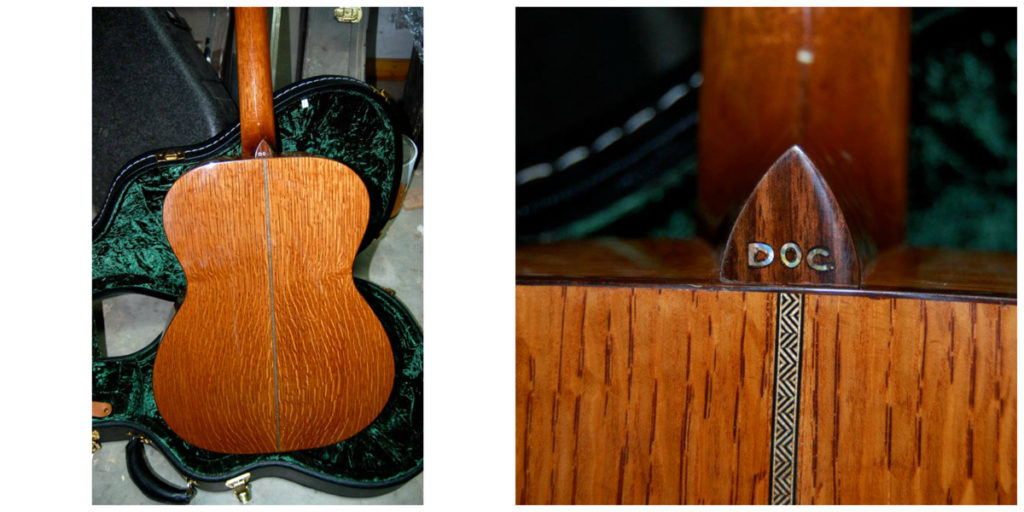
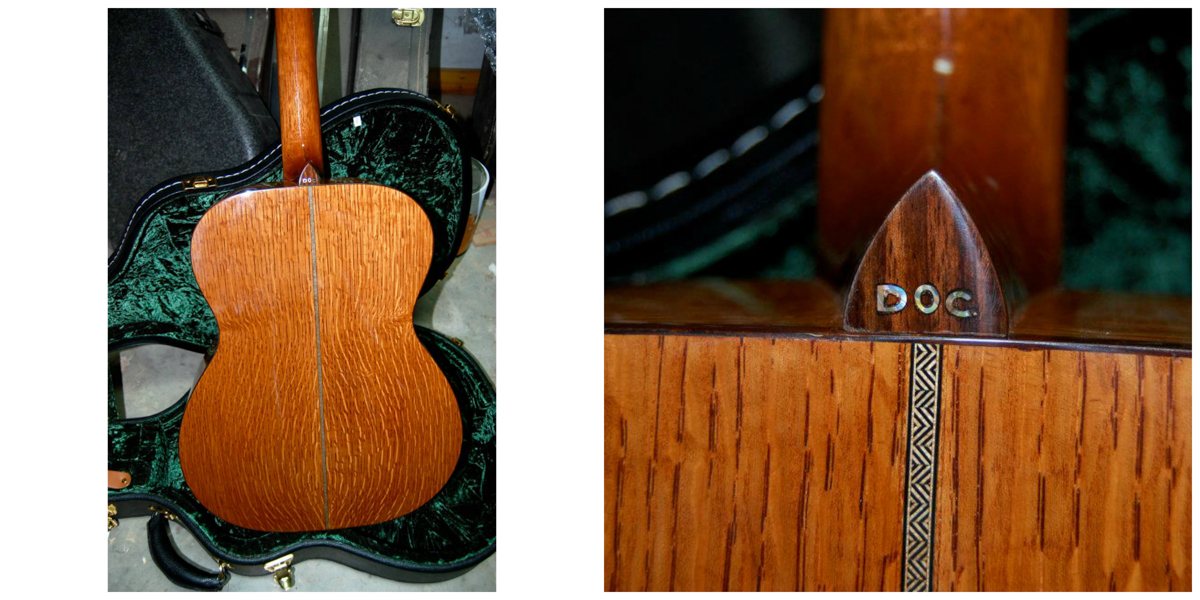
Left: The full back of the guitar showing the grain of the wood and the small strip of inlay decoration up the center of the guitar's back. Right: A detail shot of the heelcap inlay, which reads "Doc" at the top.
White oak back and heelcap inlay of the guitar built by Jayne Henderson for Doc Watson. Photograph courtesy of Jayne Henderson

So what happened next?

Well, as I was getting my top braces shaved down, the shop phone rang. Someone told Wayne that Doc had passed away. Jayne decided she would never be able to sell this guitar, one that she had made for her friend, so she set about making the neck comfortable for her hand instead. Once, a few months before, while testing a guitar she had just strung up, Doc told her, “You need to keep this guitar and learn to play it as well as your dad. Learn from him everything you can.” Sometimes I think I was meant to be Jayne’s guitar all along, that Doc wanted her to have a guitar. She didn’t have a full-sized one, just the tiny one her dad made her when she was eight years old, built with such precious materials she was almost scared to play it. She shaped my neck to fit her own hand and now practices on me as often as she can.

Do you get to go anywhere else?

Jayne loves to share me with her friends, because she wants everyone to have a great guitar if they need one. When she isn’t practicing her limited skills on me, her dad plays me on the PBS show Song of the Mountains and for Doc tributes at Merlefest. I have also gotten to sit with Zac Brown of The Zac Brown Band as he did an interview for CBS Sunday Morning, and I’ve traveled to Washington, DC for the first leg of Steve Martin’s musical Bright Star.
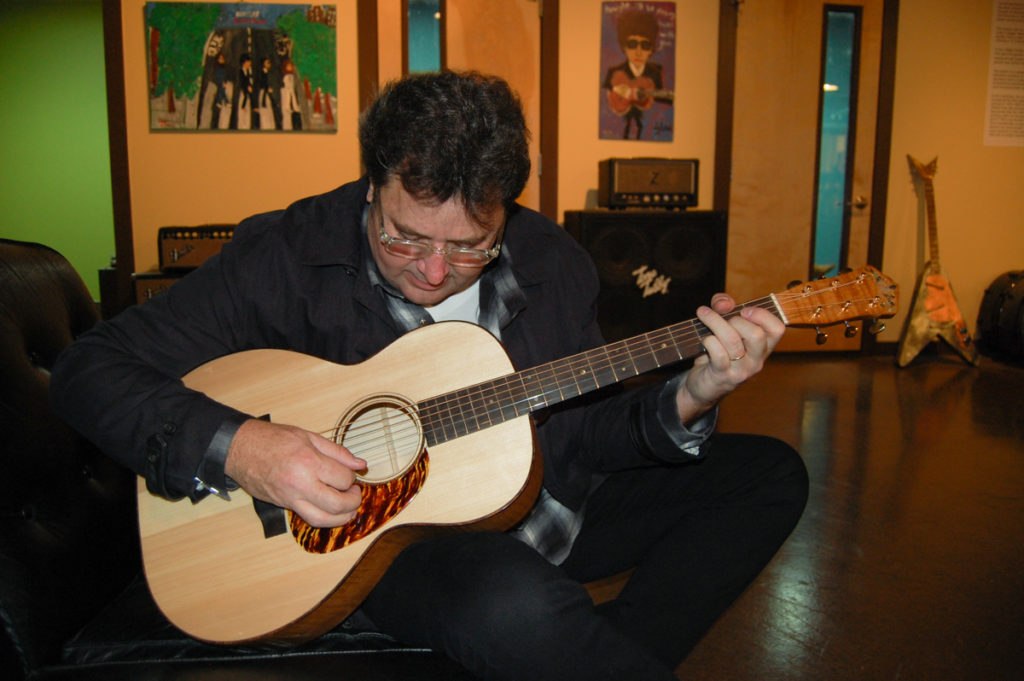
Vince Gill, wearing mostly black, playing the Doc Watson guitar in what looks to be a studio or green room space.
Vince Gill testing out Doc’s guitar. Photograph courtesy of Jayne Henderson

Is there anything you’d like to add about yourself?

I want to be sure everyone knows that just because you may come from sustainable, even humble, beginnings doesn’t mean you will shine any less than that flashy Brazilian rosewood adorning the backs of your counterparts!
“Tell It to Me”: The Johnson City Sessions 90th Anniversary

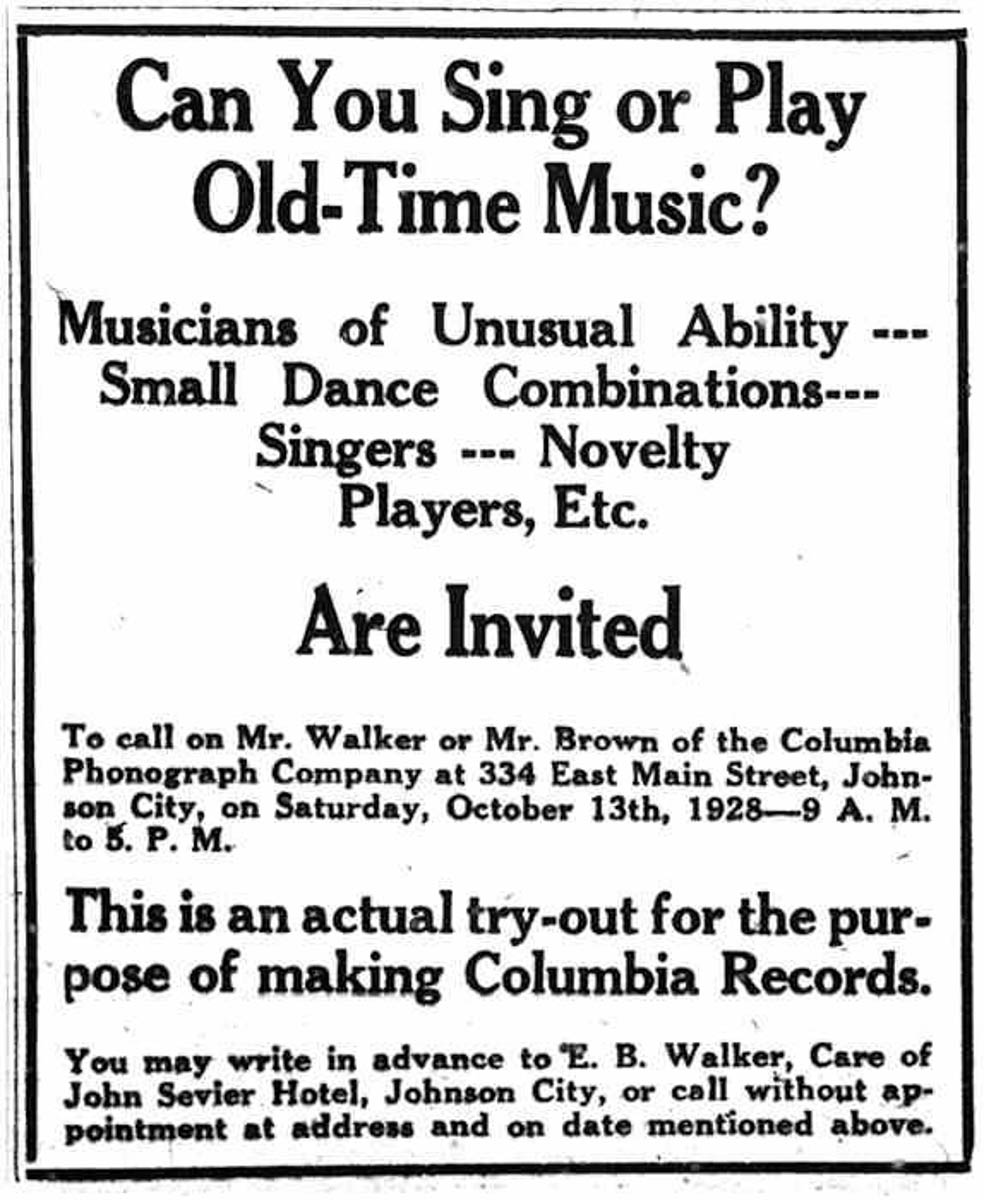
“Can you sing or play old-time music?”

This question was asked by Columbia Records in an advertisement in the Johnson City Chronicle on Wednesday October 3, 1928. That advertisement, seeking musicians specializing in regional old-time music, ran in various papers in Johnson City in anticipation of recording sessions spearheaded by visionary producer Frank Walker and now known as the Johnson City Sessions of 1928–29. Though more obscure than the famed Bristol Sessions that took place a year prior, the Johnson City Sessions, only 25 miles down the road, illustrate a more diverse and possibly equally important catalog of music that continues to have a significant impact on folk and roots musicians to this day.

Newspaper advertisement asking for a musicians of "unusual ability" of all types to come record.
Original Columbia Records advertisement published in the Johnson City Chronicle on October 3, 1928. Image from Ted Olson and Tony Russell’s The Johnson City Sessions 1928-1929, Bear Family Records: 2013

Ted Olson, writer and researcher of the Johnson City Sessions Bear Family 4 CD boxset, notes:

“The Johnson City Sessions were one of several significant location recording sessions conducted by commercial recording companies in Appalachia during the 1920s and 1930s. But the Johnson City recordings were unique. More than those from the other rival sessions of that era, they documented the broad sweep of the Appalachian song and tune repertoire, from the traditional to the contemporary, from the familiar to the obscure, and from the serious to the silly. While some of the recordings made in Johnson City during 1928 and 1929 were in the country music mainstream, other recordings stood out as truly unusual, even avant grade, anticipating future directions for as-yet-unborn music genres such as bluegrass, revivalistic folk, rock ‘n’ roll, and Americana. And looking back at those sessions 90 years later, one can’t help but wonder if country music might have taken a different course had the Great Depression not obliterated the distribution and potential influence of those exuberant, truth-telling Johnson City recordings. People in the 1930s depended upon art – and particularly music – to guide them out of the Depression, and the Johnson City recordings could have helped set a higher standard for relevancy in country music moving forward.”

Some of the songs recorded during these sessions have become standards in old-time repertoire including “Tell It to Me,” a riotous tune from the Grant Brothers who a year prior recorded in Bristol as the Tenneva Ramblers, or “The Coo Coo Bird” from the great Clarence Ashley, an artist whose music career was rejuvenated during the folk revival. “Old Lady and the Devil,” by Bill and Belle Reed, later found a home on Harry Smith’s Anthology of American Folk Music, a collection that would influence countless folk musicians including a young Bob Dylan.

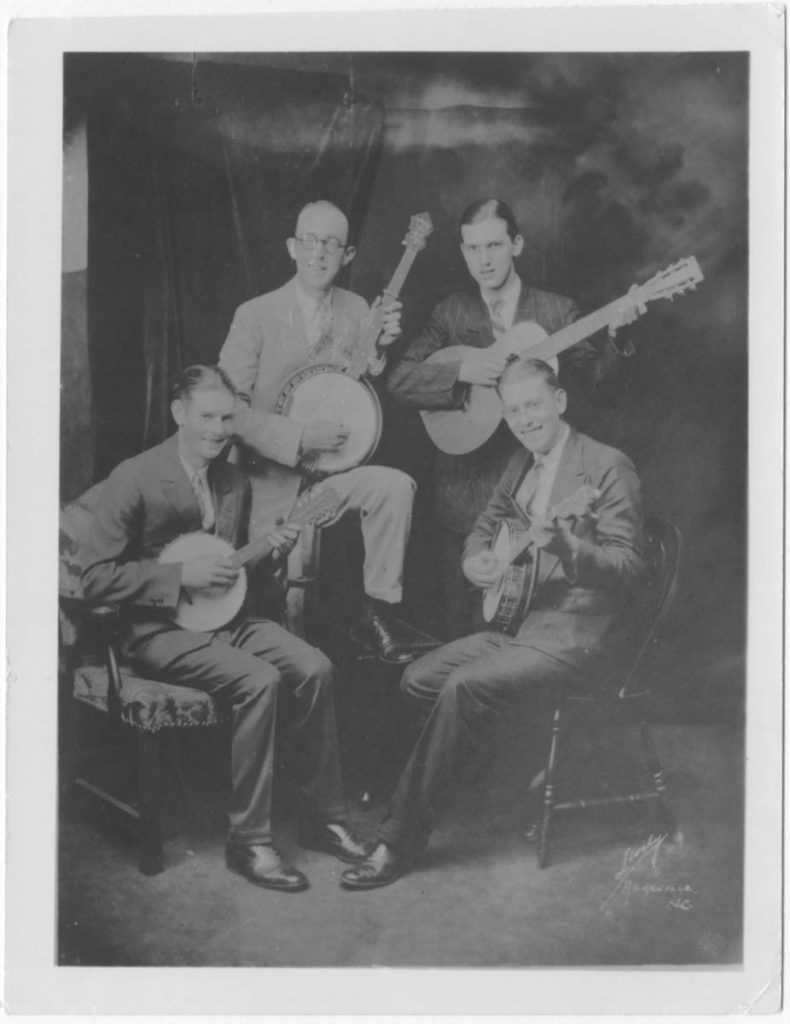
Portrait of Tenneva Ramblers with Jimmie Rodgers -- two seated musicians and two standing.
The Grant Brothers, a.k.a. the Tenneva Ramblers, recorded at both the 1927 Bristol Sessions and the Johnson City Sessions. They are pictured here with Jimmie Rodgers. PF-20001/1745_01 from the John Edwards Memorial Foundation Records (20001) in the Southern Folklife Collection at Wilson Special Collections Library, University Libraries, University of North Carolina at Chapel Hill

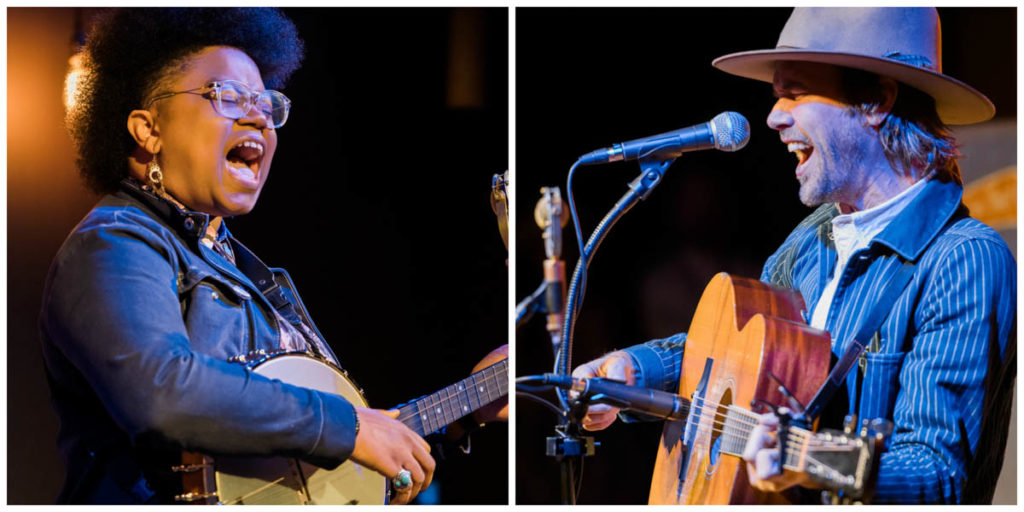
This impact is being celebrated in downtown Johnson City on Saturday, October 19, during an all-day event to mark the 90th anniversary of these sessions. The event will feature leading folk and roots artists, including Dom Flemons, Willie Watson, Amythyst Kiah, Bill and the Belles, Nora Brown, The Brother Boys, and many more. Roy Andrade, Associate Professor and head of the Old-Time Program at East Tennessee State University, notes that “the 90th anniversary of the Johnson City Sessions is exciting for those of us involved in old-time music in this town – the music is still very much alive here and the celebration will help us remember that the story is still being written.” And featured artist Amythyst Kiah says that the celebration is timely in that “the Johnson City Sessions is a celebration of the roots of American music and the preservation of a musical legacy that has captured the imagination of people all over the world.”

Left: Amythyst Kiah in jean jacket, eyes closed and singling with her banjo on stage. Right: Willie Watson, in striped jacket and hat, with his guitar.
Amythyst Kiah is one of the many talented artists who will be featured at the 90th Anniversary celebration of the Johnson City Sessions. Willie Watson will be headlining Saturday’s festival. © Birthplace of Country Music; photographer: Billie Wheeler

We invite you to be a part of this legacy by joining us at the Johnson City Sessions anniversary event on October 19 from 11:00am to 10:00pm – the event is free and open to the public! Radio Bristol will broadcast live from the Main Stage throughout the day, and you can also tune in here. Other activities include a square dance, children’s stage, vendors, and a record fair. Also of note, in celebration of the 90th anniversary, Bear Family Records has released a CD with 26 tracks from the sessions: Tell It To Me: Revisiting the Johnson City Sessions, 1928–1929.

Off the Record: First Songs by Michael Hurley

Our Radio Bristol DJs are a diverse bunch – and they like a huge variety of musical genres and artists. In our “Off the Record” posts, we ask one of them to tell us all about a song, record or artist they love.

One of the things that I love most about music is how we form bonds with sound internally, that moment when a song or an album can become “part of us.” It’s not always about how great the production is, or how perfectly everything is written; it’s about something we can’t grasp consciously, something that “strikes a chord” within us. I also find it interesting that periods of my life have been defined by what music I was listening to at that time. I’ve been inspired to think differently by a song, to pick up a new point of view and run wild with it after hearing a line in a verse. 

When I first started writing songs I was listening intently to two artists, for no apparent reason, other than they were resonating with me, and therefore defining that space in time. Those artists were the “King of Country” Hank Williams Sr. and the lesser known, though still reverently followed, Greenwich Village folkie Michael Hurley. His album was passed along to me on a scratched, Sharpie-scribbled burnt CD. When I pushed it into my old van’s disc player and listened, it turned my world upside down, or right side up…or whichever direction my head might have been headed in – expanding what I thought about songwriting, and what experiencing music could be for me. 

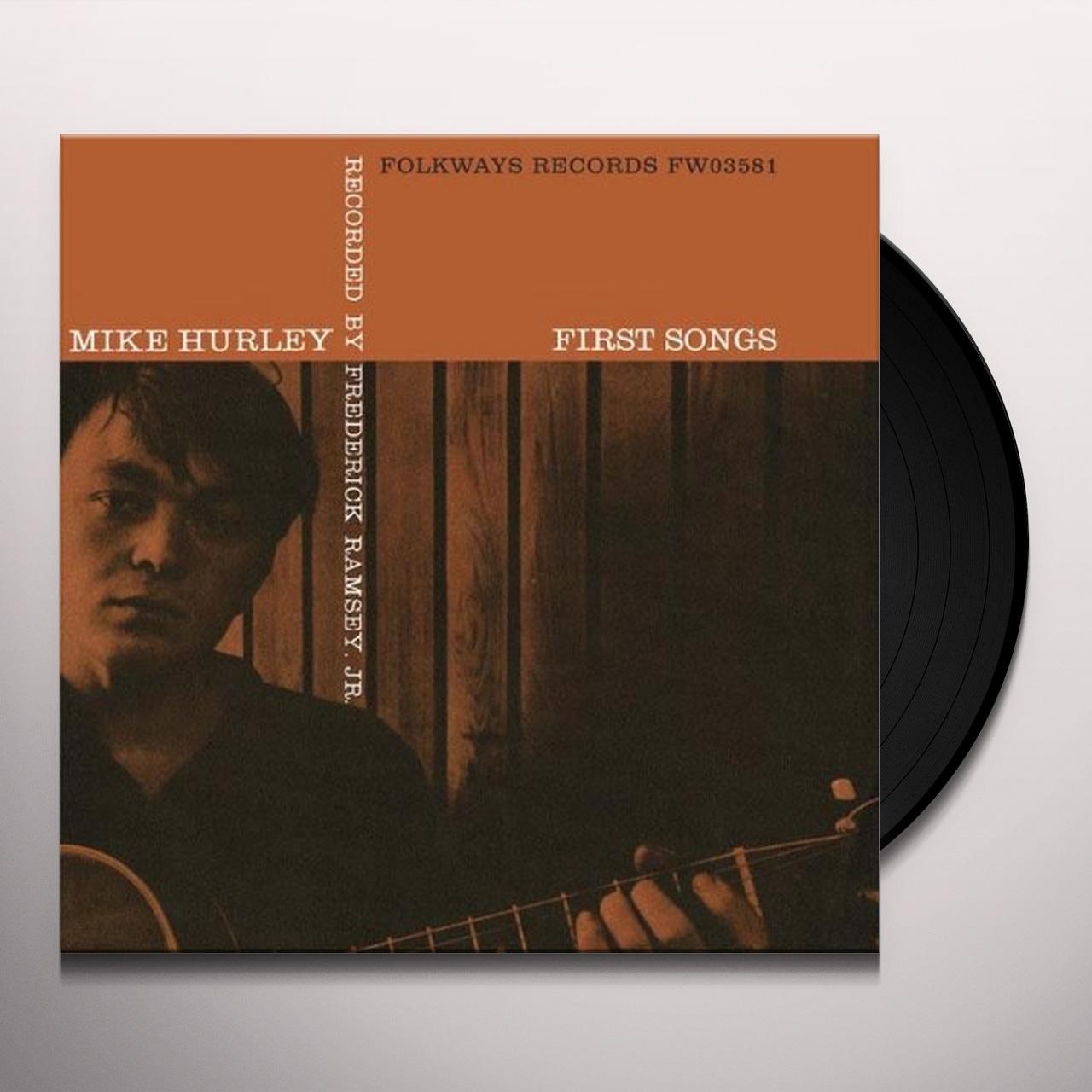
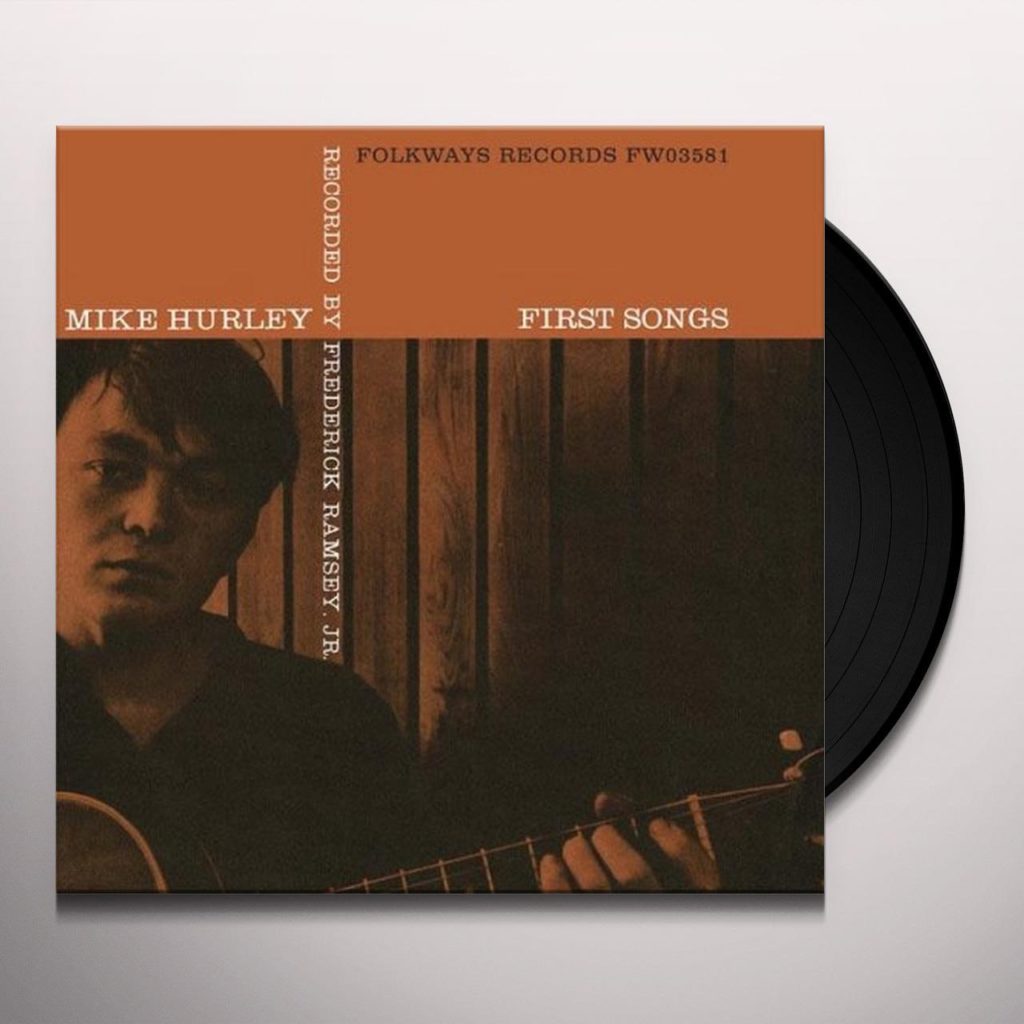
Picture shows album cover with Mike Hurley holding a guitar in front of a wood paneled wall. Record is slightly out of record sleeve.
Vinyl album of First Songs. Image from www.merchbar.com

Recorded in 1963 by Smithsonian Folkways on the same reel-to-reel machine that taped Lead Belly’s Last Sessions, First Songs is a collection of early work, put down when Michael Hurley was just 22 years old. The album was created with absolute simplicity, featuring only Hurley’s raw and expressive singing and a thumping acoustic guitar. The immediacy of his voice is lulling and warm, and his effortless crack into a yodel-esque vocal break lets us know that we are listening to a very special singer. The album sounds somewhere between a lethargic summertime country blues romp and a roughhousing porch jam. You can hear a foot tapping naturally throughout the recording, and every note is at once unapologetically quirky and endearingly human.

The album starts with the dreamy and nostalgic tune “Blue Mountain” – perfect for a sluggish sun-drenched afternoon during the “dog days” of summer. The track rounds out at over six minutes long, shrugging off any constraints of time, or care for the workaday world. This song has sent me past worry, feeling like a relaxed remembrance of a beautiful place, perhaps inspired by the singer’s childhood home in rural Bucks County, Pennsylvania.

Another track that lingers well past commercial playability is “The Tea Song,” which is over seven minutes long. Possibly made to be listened to as you wait for water to boil, the song highlights Hurley’s unique qualities as a songwriter, showcasing his ability to pair everyday experience with philosophical outlooks. I enjoy how his voice seems to be at once masterfully crooning/mournfully hollering about a lost love and “his thoughts and dreams that are distilled in the tea.”

The track “Just a Bum” feels like a nod to Woody Guthrie as it romanticizes the idea of a fireside poet who accidentally stumbles onto love while “traveling over land like a natural-born man.” To me this song speaks of the American folk music tradition, giving us a glimpse at the inner world of a roving performer, train hopper, and truth-teller. It’s jangling strum and unbridled singing make it feel up to snuff with anything else that’s part of the folk music cannon. 

After recording First Songs, Hurley went on to become a fixture of the Greenwich Village folk music scene of the 1960s, recording with bands such as The Holy Modal Rounders and Jeffrey Frederick & the Clamtones. He has also been held in high regard by artists such as Lucinda Williams, Vic Chesnutt, Woods, Calexico, Cat Power, Robin Holcomb, and Julian Lynch. Throughout his career of 31 releases, he has continuously blurred the edges between traditional folk, country, blues, and outsider music. Hurley has recently gained a dedicated following after Locust Music reissued First Songs under the new title of Blueberry Wine in 2001. Since then, he has been touring and has released more than 12 albums.

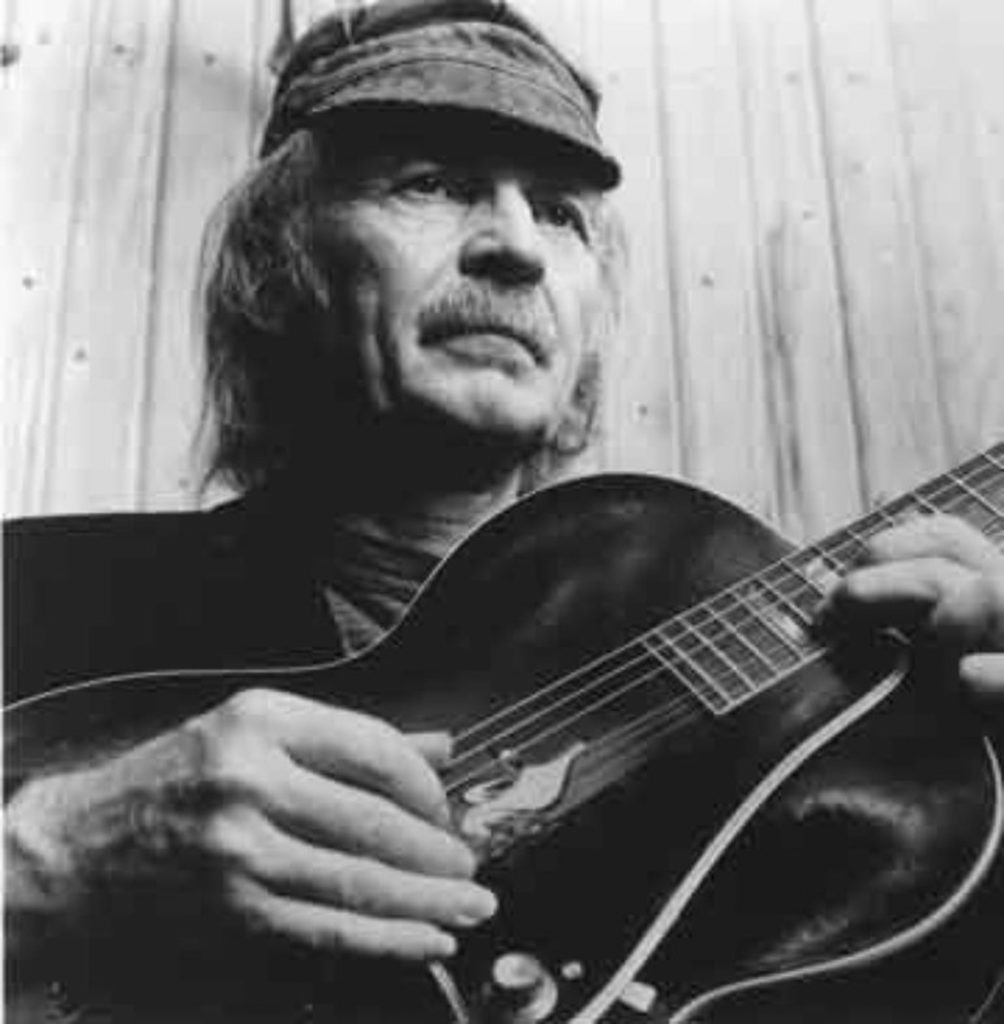
Black-and-white photograph of an older Michael Hurley wearing a cap and strumming a guitar.
Michael Hurley pictured looking contemplative with arch top guitar. Image from www.last.fm

I hope that this album is as special to some of you as it has been for me. And I want to encourage folks to follow their own “folk process,” finding music that for some reason feels meaningful and becomes part of your own story!

Mamas, DO Let Your Babies Grow Up to Be Cowboys (or Cowgirls)!

Today is the National Day of the Cowboy, marked in several states on the fourth Saturday of July every year. Country music, in the past and the present, is filled with the images of cowboys and cowgirls, and so we thought we’d mark today with our own celebration of cowboys with a music twist!C

Cowboy songs are said to have originated as a way to soothe nervous and apt-to-stampede cows on cattle drives out west. The yodels and soft crooning sounds in the songs would help to obscure the noises of the night that tended to spook the herd and also act as a kind of lullaby. The songs themselves often reflected a wide range of music, including old ballads, popular Tin Pan Alley tunes, Mexican songs, and blues forms. John A. Lomax published Cowboy Songs and Other Frontier Ballads in 1911, detailing 112 songs that he gathered through requests in newspapers and academic venues and by visiting known cowboy haunts. The first edition had a handwritten foreword by President Theodore Roosevelt.

Google cowboy songs today, and you can find numerous “best cowboy songs” lists, each with the individual author’s subjective preferences – from the well-known, and copyright challenged,“Home on the Range” to The Highwaymen’s “The Last Cowboy Song” to “Good Ride Cowboy,” Garth Brooks’ tribute to rodeo rider and sing Chris LeDoux. My personal favorite has always been “Mamas Don’t Let Your Babies Grow Up to Be Cowboys,” a love that began with the Alvin and The Chipmunks version of 1981 when I was a kid and thankfully later evolved to the much-better version by Willie Nelson and Waylon Jennings!

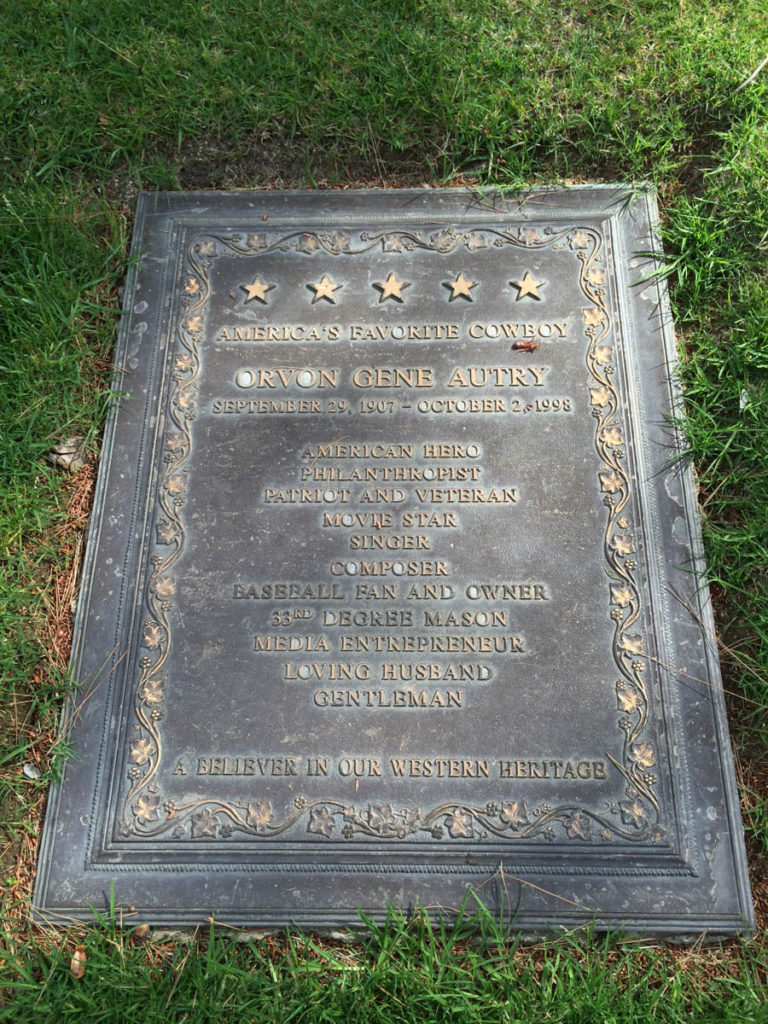
In line with cowboy music, there have been numerous musical cowboys on radio, records, and screen throughout the years. Gene Autry, “The Singing Cowboy,” did it all: singing, writing songs, acting, rodeo riding. He even owned a Major League baseball team in California for over 30 years. Autry has five stars on the Hollywood Walk of Fame, recorded over 600 songs – many of which were also written or co-written by him, starred in 93 films, and hosted his own television show. He is most well-known for “Back in the Saddle Again,” but his biggest hit wasn’t about the American West or cowboys at all – instead it was the Christmas classic, “Rudolph the Red-Nosed Reindeer.”

Grave of Gene Autry with a large memorial in the ground with his name and numerous accolades from American hero to Gentleman.
Gene Autry’s grave notes him as “America’s favorite cowboy” and “A believer in our western heritage.” Photograph by Arthur Dark from Wikimedia Commons

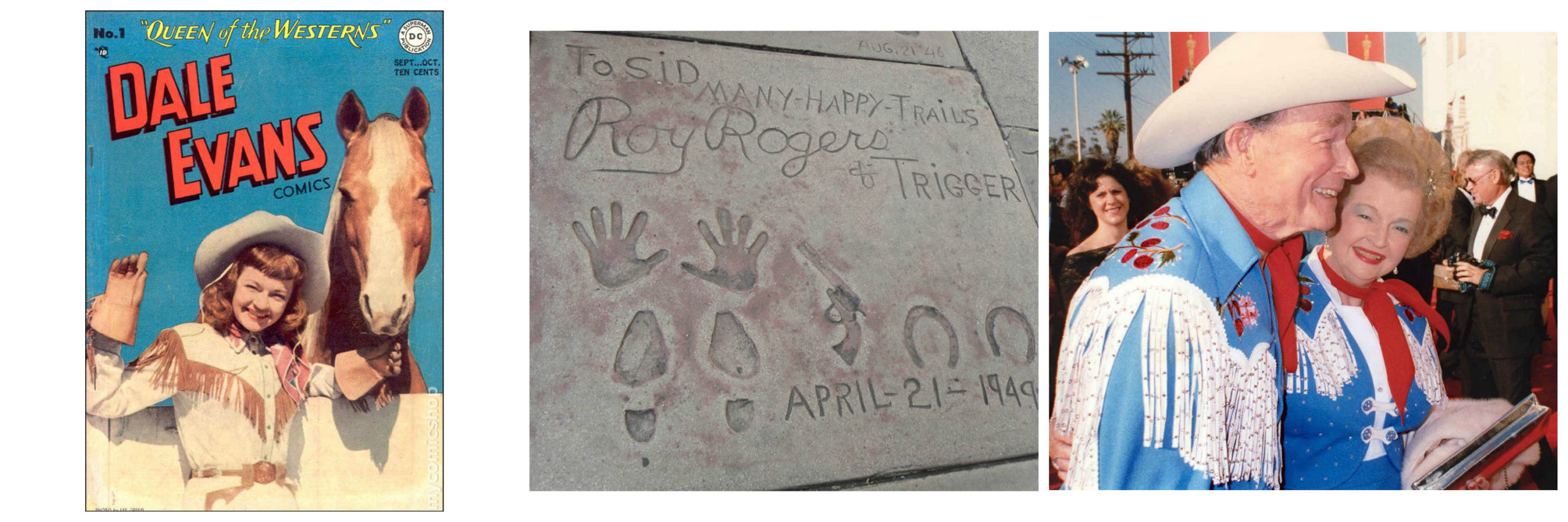
Roy Rogers and Dale Evans epitomize the musical cowboy and cowgirl. As a husband-and-wife team, they recorded songs and acted together; Evans was also a prolific songwriter. The song that is most associated with them is “Happy Trails.” Rogers, known as “The King of the Cowboys,” also brought his palomino Trigger and dog Bullet into many of his films and television shows. An exhibit on Evans at the National Cowgirl Museum & Hall of Fame in Fort Worth, Texas, shares this quote from her, the perfect tribute to the cowgirl’s strength and independence:

“‘Cowgirl’ is an attitude really. A pioneer spirit, a special American brand of courage. The cowgirl faces life head-on, lives by her own lights, and makes no excuses. Cowgirls take stands; they speak up. They defend things they hold dear.”


Left: Cover of Dale Evans comic book showing Evans in cowgirl gear with a palomino horse; Center: Signature and impressions in concrete noting To Sid, Many happy trails, Roy Rogers and Trigger, with handprints, footprints, and hoof prints. Right: Roy Rogers and Dale Evans in matching western wear.
Left: Dale Evans was featured in her own comic book series in the 1940s and 1950s.
Center: Roy Rogers’ and Trigger’s “signatures” at Grauman’s Chinese Theater in Hollywood. Photograph by NativeForeigner on Wikimedia Commons
Right: Roy Rogers and Dale Evans at the 61st Academy Awards. Photograph by Alan Light on Wikimedia Commons

Patsy Montana, born Ruby Rose Blevins, was another singing cowgirl. While visiting the World’s Fair in Chicago in 1933, Montana auditioned for a crooner role but ended up working with the Prairie Ramblers on WLS’s National Barn Dance, where she performed for around 20 years. She was the first female country music performer to have a million-selling record with “I Want to Be a Cowboy’s Sweetheart,” which was released in 1935. Her influence can be seen in later singers such as Patsy Cline and Devon Dawson, who provided the singing voice of Jessie the Yodeling Cowgirl from Toy Story.

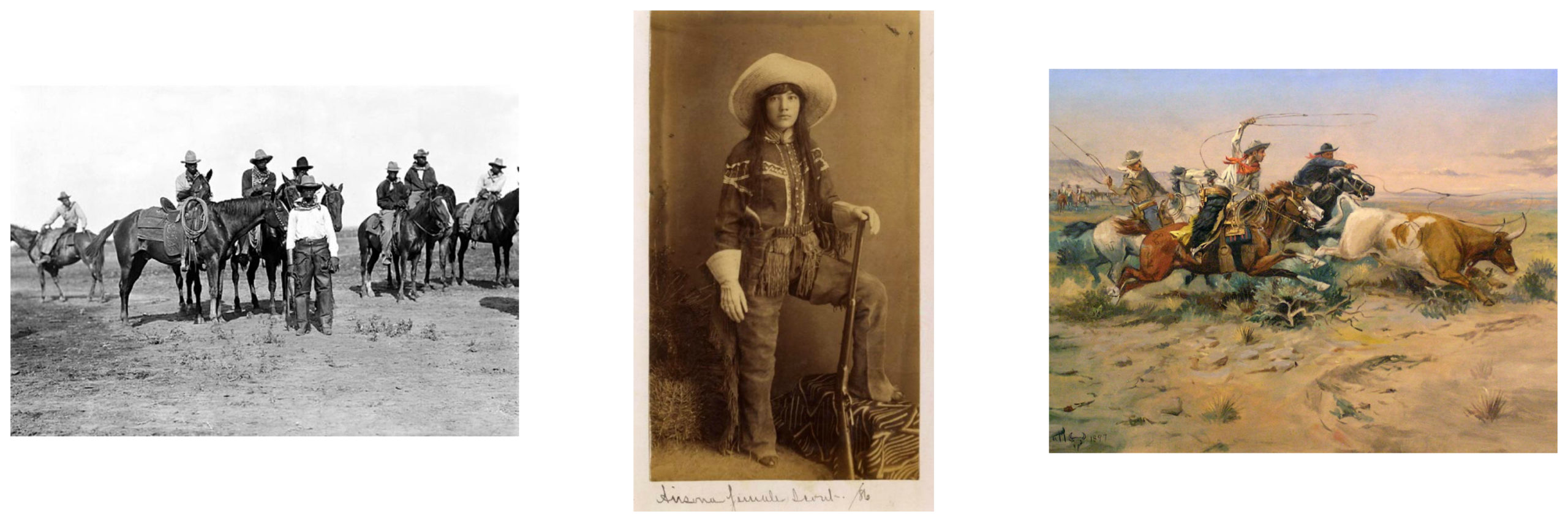
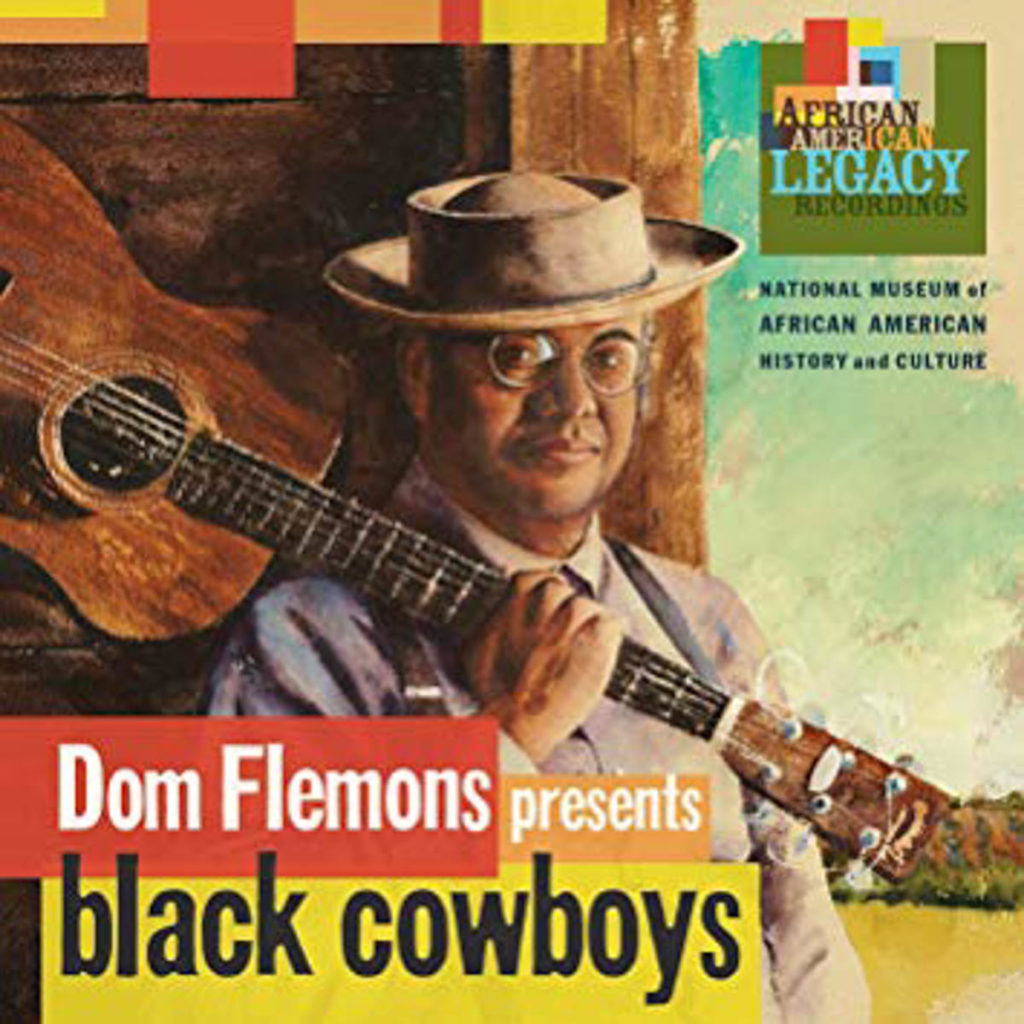
Dom Flemons Smithsonian Folkways album Black Cowboys, released in 2018, explores the history, music, and culture of the American Wild West from the perspective of the thousands of African American cowboys who also rode the ranges and pioneered the trails out west. Flemons’ album, and the research he did into the subject, underlines that cowboys weren’t exclusively white, despite popular imagery. One interesting character noted by Flemons is Bass Reeves, who became the first black deputy U.S. Marshall out west but also may have been the inspiration for the character of the Lone Ranger! Songs on the album include the familiar “Home on the Range,” “Goodbye Old Paint,” which was credited to a former slave and later cowboy, and an original song by Flemons that honors black movie cowboy Bill Hickett.

Cover of Dom Flemons' Black Cowboys with an illustration of Flemons with a guitar over his shoulder.
Dom Flemons’ Black Cowboys album cover. Smithsonian Folkways Recordings

This is just a small selection of music-related stories about cowboys and cowgirls, but hopefully it gives you a taste to listen and learn more – and to start celebrating every year on National Day of the Cowboy!