Music & Songs Archives - Page 13 of 30 - The Birthplace of Country Music
Listen
Play
Loading station info...

Pick 5: The Old Lonesome Quarantine Blues

For our “Pick 5” blog series, we ask members of the Radio Bristol team to pick five songs within a given theme – from heartsongs to murder ballads and everything in between! Once they pick their “5,” they get the chance to tell us more about why they chose those songs. With a diverse staff of knowledgeable DJs, we’re sure to get some interesting song choices, which might introduce you to some new music, all easily accessible by tuning into Radio Bristol!

Hey y’all! Long time no see! Seriously. It’s been almost half a year since I’ve seen most of you in person, and that’s a LOOOONG time. As we’re drawing close to the six-month mark of social distancing, quarantine, and travel restrictions, you’re perhaps feeling the strain of isolation and missing the carefree interactions we once had.

While we understandably must continue to participate in social distancing and taking all necessary precautions to end the COVID-19 pandemic, we can acknowledge the importance of striving for the greater good while also acknowledging the emotions and feelings that come with this situation. Though it’s for a good cause, feeling lonesome is still feeling lonesome. On the bright side, there’s nothing like a bad situation to pave the way for beautiful art, and loneliness and isolation are some of the most prominent themes in country and many other forms of music as well. So, until we meet again, here are some empathetic songs to add to your quarantine playlist!

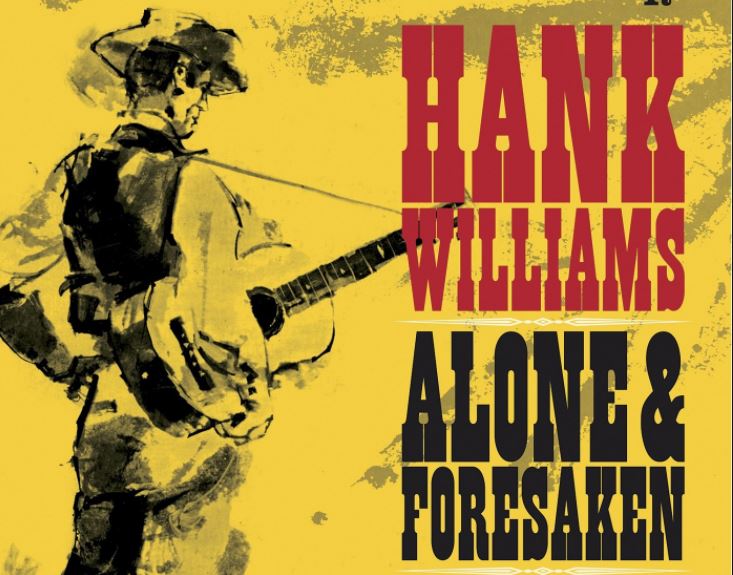
“Alone and Forsaken,” Hank Williams

Hopefully you’re not feeling THIS lonesome, but Hank Williams wrote a hauntingly beautiful piece of music – that really expresses this emotion – when he penned “Alone and Forsaken.”

“Lonely One in This Town,” Mississippi Sheiks

“Lonely One in This Town” is a real classic from the Mississippi Sheiks. Though it’s a lonesome song, you can’t help but smile and pat your foot to the Sheiks’ signature infectious beat. And while you’re at it, check out more music from the Sheiks catalogue – you’ll surely be a fan for life!

“When You’re Far from the Ones that Love You,” McMichen’s Melody Men

Here’s a sweet melody from the swingin’-est Georgia fiddle man, Pappy Clayton McMichen. Maybe you’re far from your family, missing your significant other in a long-distance relationship, or sad to not be spending time with friends who live far from your current home or through social distancing. Whatever the situation, “When You’re Far from the Ones that Love You, “ a beautifully crooned Tin Pan Alley piece, will hopefully bring you some comfort.

“On a Desert Isle,” C. W. Stoneking

Isolation isn’t necessarily a bad thing, and C. W. Stoneking’s “On a Desert Isle” tells a lovely tale of living an isolated life in a tropical clime set to a dreamy melody. If one must be isolated, what better place than an island paradise?

“Call Me,” The Louvin Brothers

Though you can’t visit your friends and loved ones right now as much as you could before, we have a world of technology to keep us connected. Call or Facetime your friends, and it’s almost as good as being there in person. This classic – “Call Me” – from Ira and Charlie Louvin is about just this very thing.

Bristol Rhythm Legacy Staff Playlist

This is the first time I have ever written a blog, so for me this is pretty exciting! We’re missing Bristol Rhythm & Roots Reunion this year, and to cheer up the staff, we thought it would fun to get them to make a playlist of their favorite songs from festivals past. I have many more than ten, but have narrowed it down to some sentimental favorites to share with you. These are mine in no particular order. You’ll find the entire staff playlist at the bottom of the page, so keep scrolling!

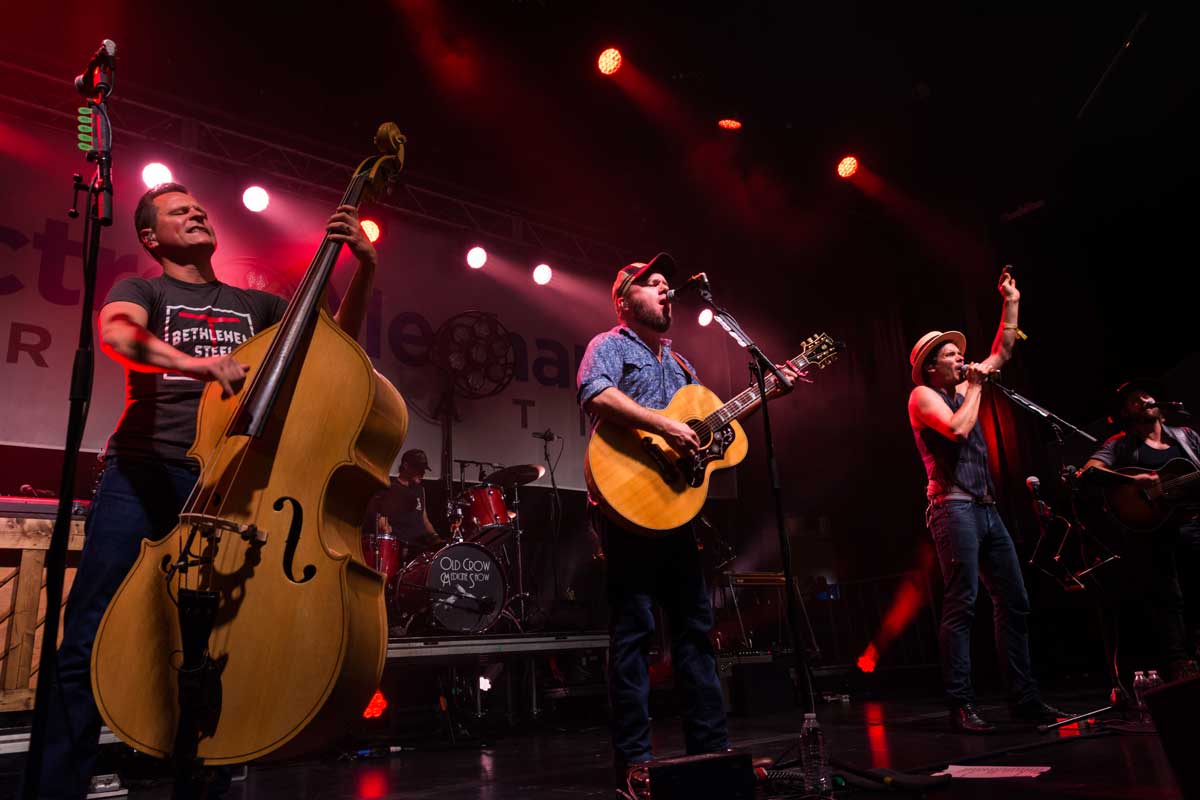
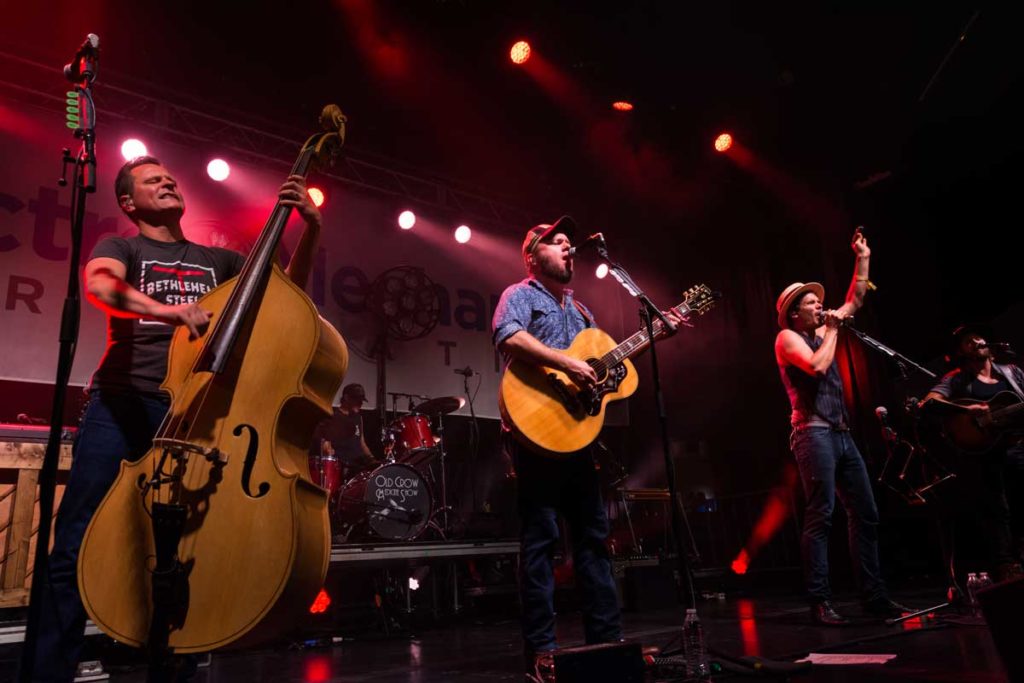
The band Old Crow Medicine Show performing on stage at Bristol Rhythm & Roots Reunion.
Old Crow Medicine Show returned to Bristol Rhythm & Roots Reunion in 2018.

#1 “Wagon Wheel” by Old Crow Medicine Show
I chose this song because we had tried for so many years to bring Old Crow Medicine Show back to the festival, and to see how the crowd reacted when they performed that song put a gigantic smile on my face! I don’t get to listen to much music during festival weekends, but I made it my mission to see every minute of Old Crow’s set – and I did! Pure joy!

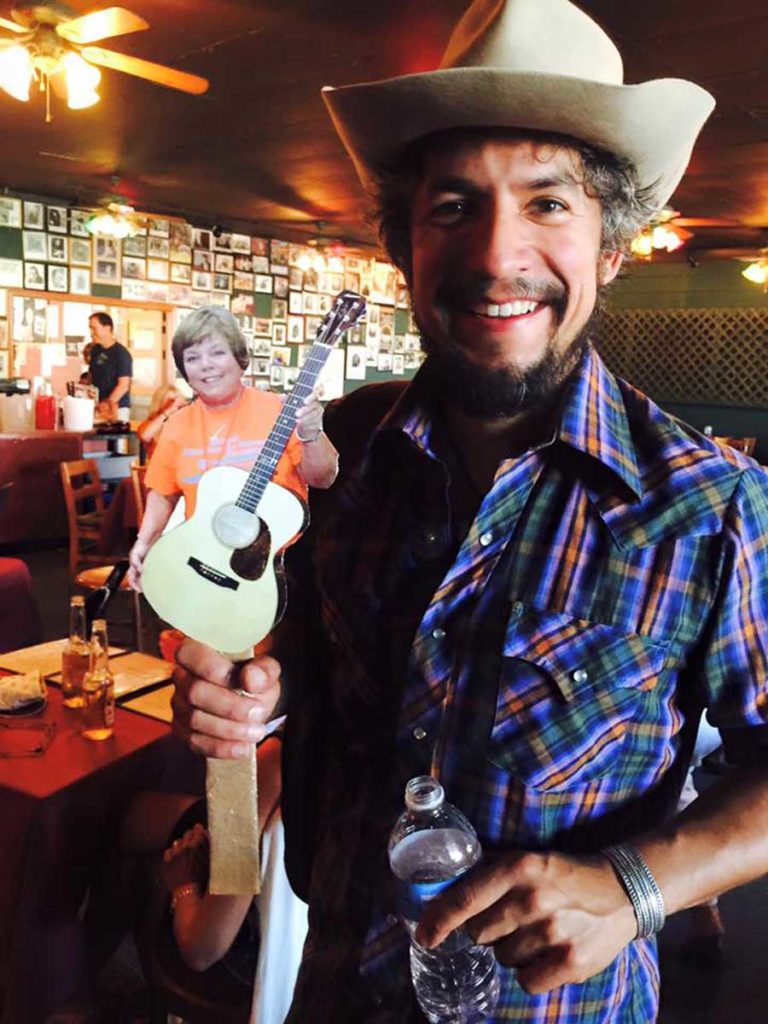
Cruz Contreras of The Black Lillies holding up a "flat Leah" - a little poster sized image of Leah on a stick.
Cruz Contreras of The Black Lillies with “Flat Leah.” Always good times with him and the band at Bristol Rhythm & Roots Reunion!

#2 “Whiskey Angel” by The Black Lillies
If I didn’t choose a Black Lillies song, Cruz might never speak to me again! Actually, this is the one band that I know practically every word to their songs, though I sing them in my head because I can’t carry a tune in a bucket! “Whiskey Angel” is probably one of my favorites, and when my grandson Will was four years old he told me it was his favorite song, too. A great memory!

One of the best music videos EVER!

#3 “Dead Ringer” by The Whiskey Gentry
It’s hard not to choose a song by Whiskey Gentry. The band is no longer together, but fortunately lead singer Lauren is still performing with her husband Jason under the name Lauren Morrow. “Dead Ringer” is just a fun song, and Lauren’s voice is so awesome! The video for the song is also amazing. Our loyal Bristol Rhythm fans have come to love them as much as I do.

Leah poses with the band Folk Soul Revival at The Long Road Festival in the U.K.
Leah with Folk Soul Revival at The Long Road Festival in the U.K. in 2018.
The Birthplace of Country Music and Virginia Tourism Corporation were sponsors of the event and enlisted several regional artists to perform there.

#4 “Jawbone Blues” by Folk Soul Revival
Folk Soul: It would have been a shame not to pick a song from one of our own. I chose “Jawbone Blues” because I love Daniel’s voice on this particular song. Such a great band and a local treasure!

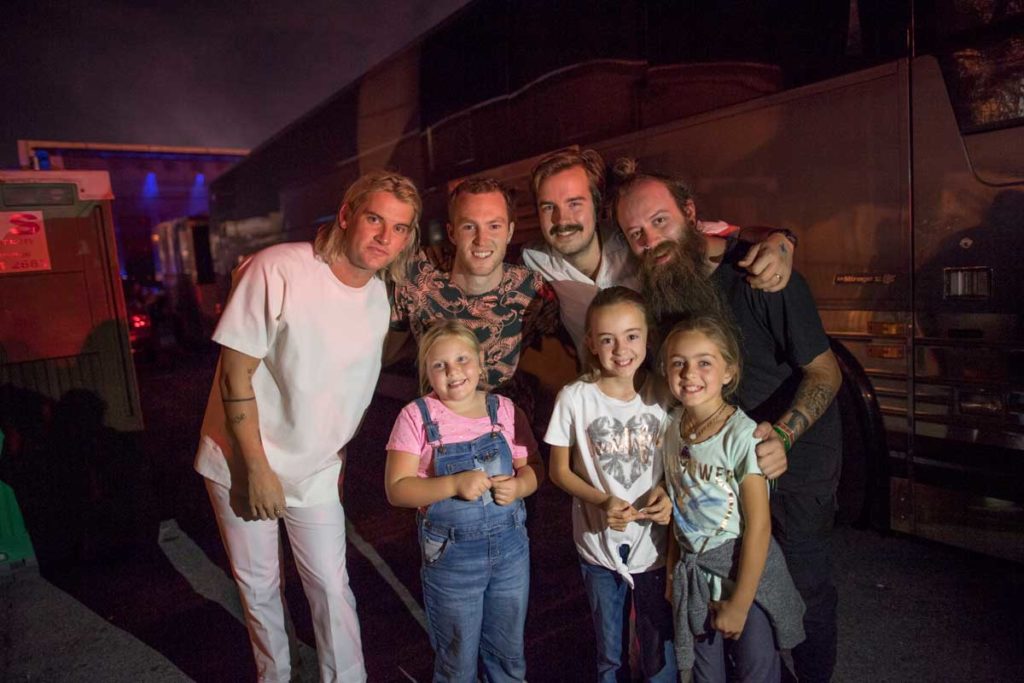
The Band Judah & The Lion posing for pictures with Leah's granddaughter Mary Nell and two friends backstage at the festival
My granddaughter Mary Nell (in overalls) with her friends and favorite band Judah & The Lion at Bristol Rhythm 2017.

#5 “Take it All Back” by Judah & The Lion
My granddaughter Mary Nell was so excited about Judah & The Lion coming to Bristol Rhythm & Roots Reunion because it was her and her best friend Cassidy’s favorite band. The girls where so excited to get to meet them and get their picture taken with them. I don’t do much of this, but I just had to make that happen for the girls! It was an epic moment when they did “Take it All Back.” The crowd was so loud as they danced and sang with them. I knew we had hit a home run with this band! 

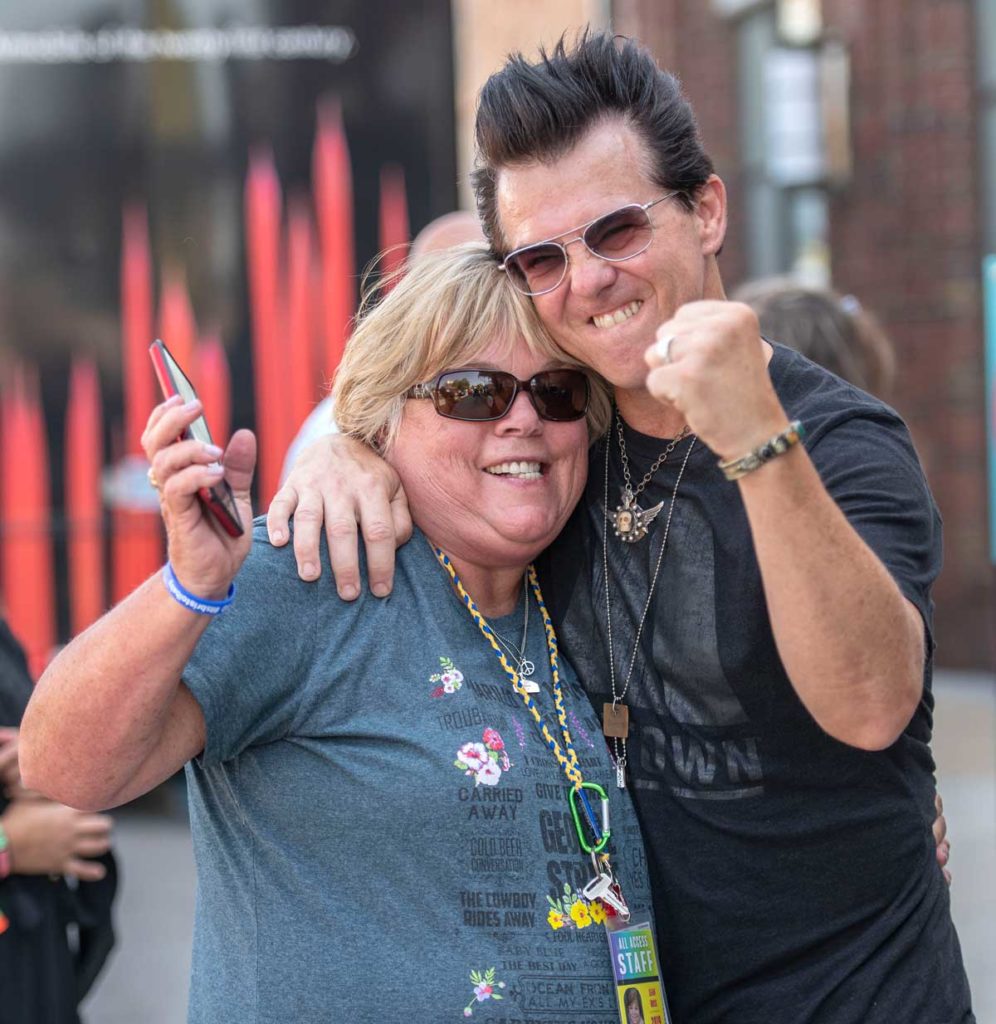
Leah posing with Mike Farris at Bristol Rhythm 2019.
Leah with Mike Farris at Bristol Rhythm 2019.

#6 “Mercy Now” by Mike Farris
What’s not to love about Mike Farris and his awesome voice? For this I’ll just say we all need a little mercy now!

Legendary artist Doc Watson performs at Bristol Rhythm & Roots Reunion 2008.
The late, great Doc Watson performing at The Paramount for Bristol Rhythm 2008.

#7 “Shady Grove” by Doc Watson
Doc Watson was such a special man, and I am so glad we had the opportunity to host him at our festival. I’ve heard him sing “Shady Grove” most every time I was fortunate enough to see him.  The reason I like it is because he always smiled and looked happy while singing it.

Eilen Jewell singing in front of a crowd at Borderline Billiards.
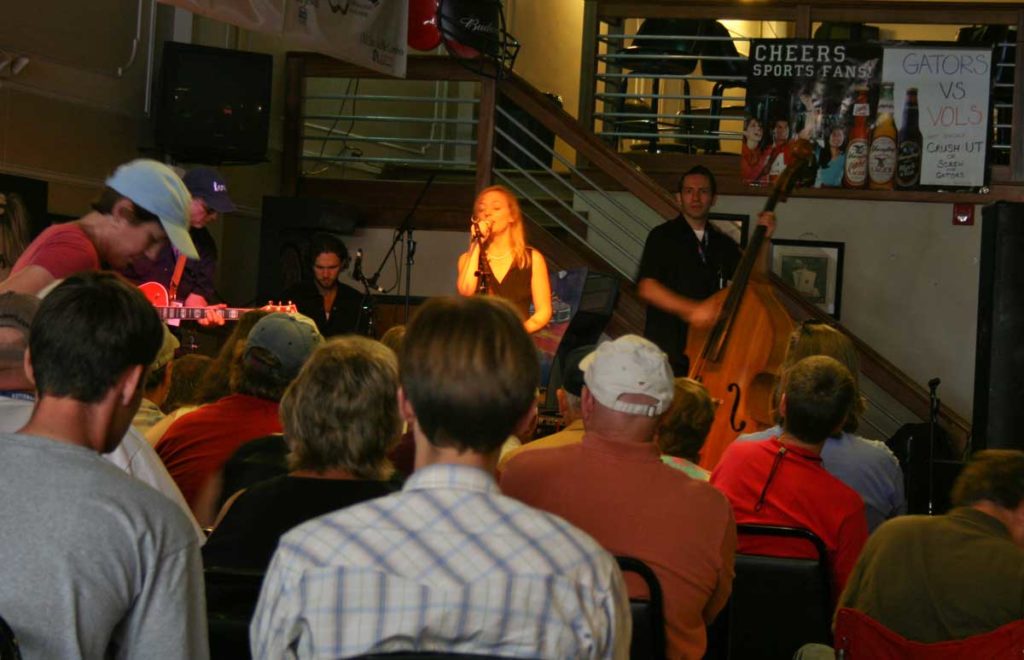
Eilen Jewell performing at Borderline Billiards at Bristol Rhythm & Roots Reunion 2008.

#8 “Heartache Boulevard” by Eilen Jewell
She is an artist that I still listen to because I just love her voice.  If you’ve never listened to her music, do yourself a favor and look her up.

The Hackensaw Boys performing on the Piedmont Stage during Bristol Rhythm 2010.
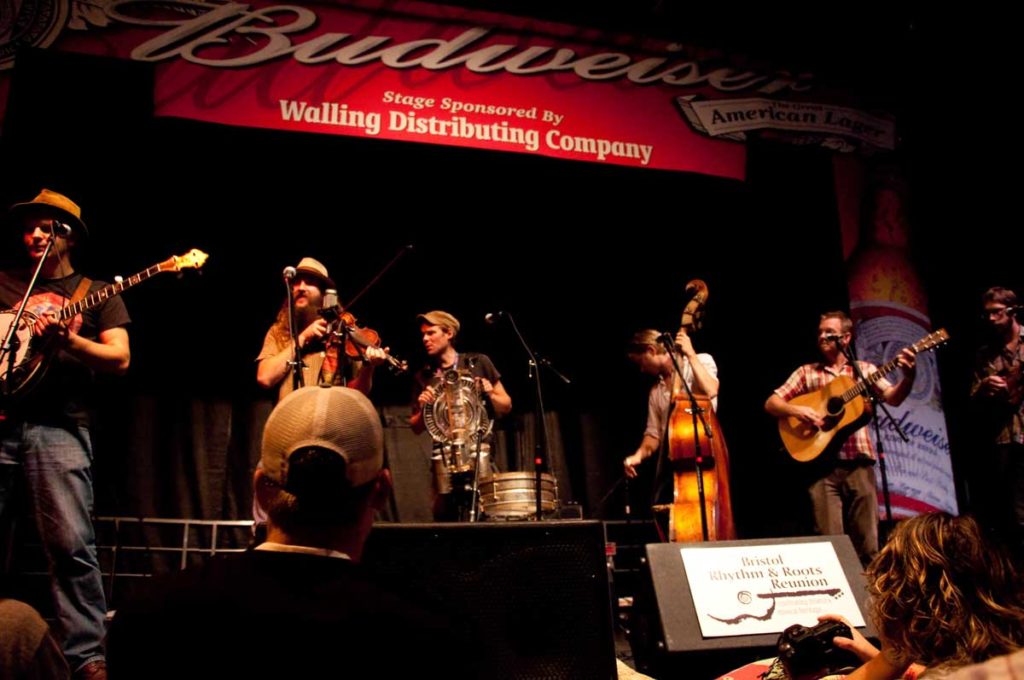
The Hackensaw Boys performing on the Piedmont Stage, Bristol Rhythm 2010.

#9 “Radio” by Hackensaw Boys
When my grandchildren Will and Mary Nell were little, we would dance around the room on fake drums to “Radio.” They made me play it over and over! Will went up on stage with me one year at the festival to help introduce them. Wonderful memories!

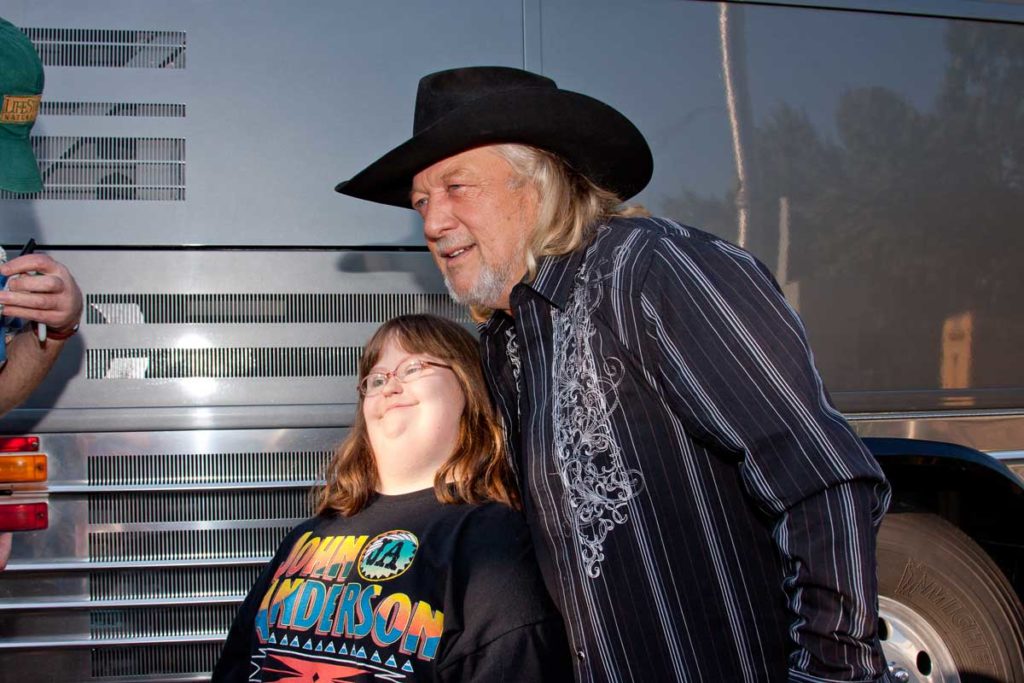
Country music star John Anderson posing with a young fan wearing his t-shirt during Bristol Rhythm 2010.
John Anderson taking time to pose with fans backstage during Bristol Rhythm 2010.

#10 “Swingin'” by John Anderson
What can I say? I wish we were all swingin’ together today!

To listen to the full playlist of the BCM team’s favorite Bristol Rhythm songs, including Leah’s picks, see below.

The Power of Music: Suffrage Songs

Today is the 100th anniversary of the ratification of the 19th Amendment, which states “The right of citizens of the United States to vote shall not be denied or abridged by the United States or by any State on account of sex.” In other words, it finally gave American women the right to vote and be represented.

Congress ratified this amendment on June 4, 1919, but it still needed to be affirmed by 3/4 of the states in order to become law. Suffragettes and their supporters had been working for this day since 1832, and the very first amendment for women’s right to vote was introduced in 1878, taking 42 years to reach ratification. The road was long and hard with women fighting through words, negotiation and diplomacy, and acts of civil disobedience to gain the right to vote. American democracy has been a beacon to many outside our shores, but it makes one pause to think that women only gained this basic right 100 years ago.

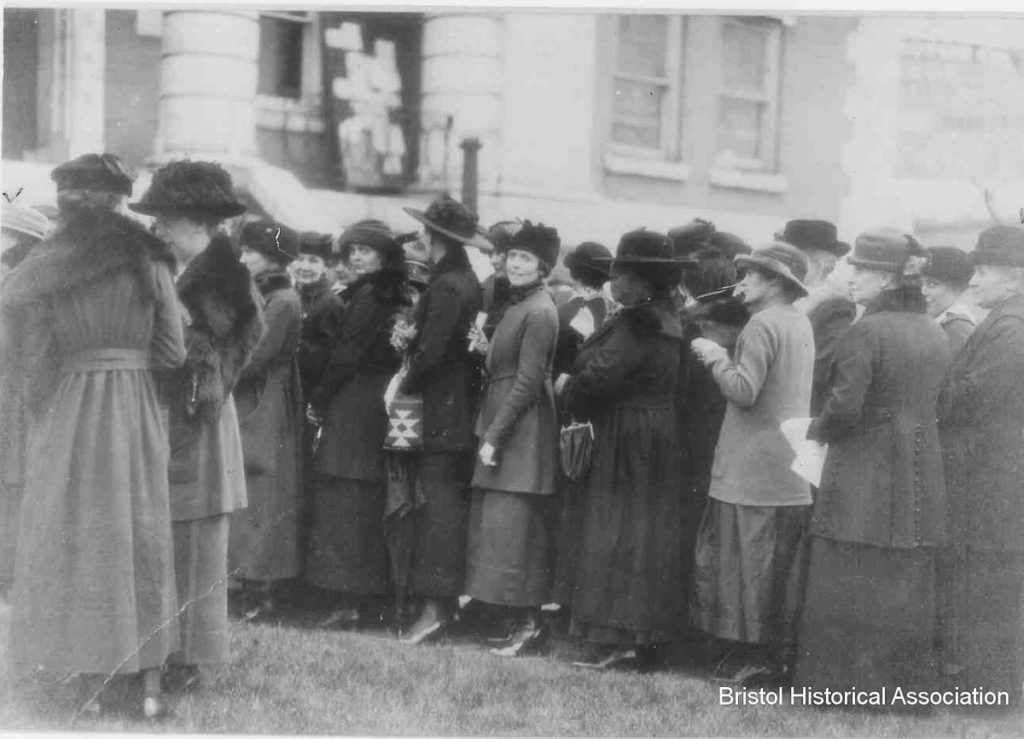
A line of women crowd in front of a building. They are wearing early 20th century clotes, and one of the women looks out from the line and directly at the camera.
Women line up to vote for the first time in Bristol, Tennessee-Virginia, after passage of the 19th amendment. Image courtesy of Bristol Historical Association

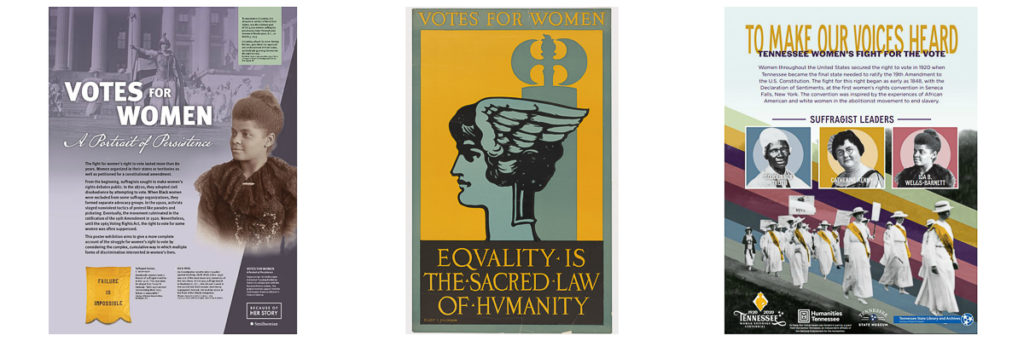
The Birthplace of Country Music Museum is fortunate to have two poster exhibits that explore this complex history, the people who fought to be recognized, and the acts that brought them to victory on August 18, 1920. The first – Votes for Women: A Portrait of Persistence – comes to us from the Smithsonian Institution Traveling Exhibition Service. This exhibit traces the story of women’s suffrage, of inclusion in and exclusion from the franchise, and of our civic development as a nation while also examining the relevance of this history to Americans’ lives today. The second – To Make Our Voices Heard: Tennessee Women’s Fight for the Vote, created by the Tennessee State Museum and the Tennessee State Library and Archives – digs deep into the history of the woman’s suffrage movement, Tennessee’s dramatic vote to ratify the 19th Amendment in 1920, and the years that followed. Both of these exhibits will be on display by September 1 and are definitely worth a visit over the next few months!

Right: The introductory panel for Votes for Women bears text and images on the subject, including a woman dressed in classical garb in front of a government building and a portrait of Ida B. Wells. Center: The graphic poster reads "Votes for Women" and "Equality is the sacred law of humanity" and bears the image of a woman's head with wings at her hair and a sculpture of a double-headed axe behind her. Left. The introductory poster for To Make Our Voices Heard has portraits of several suffrage leaders, text, and a picture of suffragettes marching.
Right and left: The introductory panels to the Votes for Women and To Make Our Voices Heard exhibits. Center: Graphic poster from the suffrage movement. Equality Is the Sacred Law of Humanity, c. 1903–1915; Lithograph by Egbert C. Jacobson Courtesy of Schlesinger Library, Radcliffe Institute for Advanced Study, Harvard University

As a music museum, there is one thing we know for sure: music has power and impact, and so I wanted to explore some of the songs that helped fuel the suffrage movement. Artists have long used songs to throw light on the world around them – for instance, Hazel Dickens and other musicians who highlighted the tribulations and dangers of Appalachian coal mining communities or the anthems, often with their origins in African American spirituals and traditional hymns, that powered Civil Rights activists in the struggle. Music is a way for people to express their contemporary burdens and their dreams for a better future.

The women of the suffrage movement also lifted themselves up with song, highlighting the rights they were fighting for and inspiring them in that fight. The lyrics to these songs were often set to popular tunes or traditional hymns, thus making them easier to sing and remember. For instance, “Human Equality,” written in the 1870s by William Lloyd Garrison, was sung to the tune of another popular song used in support of labor reform and abolition. While not about women’s right to vote, the poem”Rights of Woman,” written by “A Lady” in 1795, declared women free and was later set to the tune of “My Country Tis of Thee.” “Daughters of Freedom” was published in 1871 and was composed by Edward Christie with lyrics by George Cooper, while a song by Frank Boylen from 1881 asked “Shall Women Vote?” America being the melting pot that it is, some songs also came from immigrant sources, such as “Damen Rechte (Suffragettes),” a popular Yiddish song that not only called for women’s right to vote but also extolled other freedoms and equality in society at large. Some songs were also written specifically for suffrage marches and meant to be played by brass bands, such as “Fall in Line.” Around 1880, D. Estabrook wrote “Keep Woman in Her Sphere,” which on first glance seems to be anti-women’s rights with various men declaring that women should stay in their traditional roles and not expect equal rights. However, the last verse turns this notion on its head with the assertion:

I asked him “What of woman’s cause?”
The answer came sincere —
“Her rights are just the same as mine,
Let woman choose her sphere.

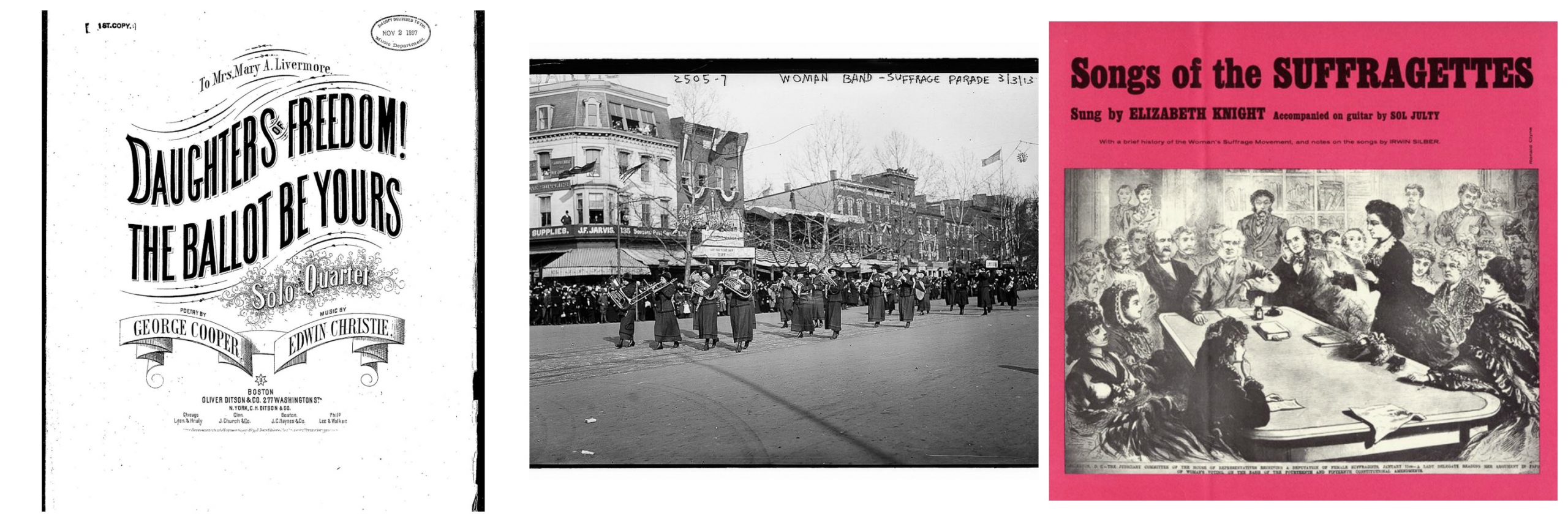
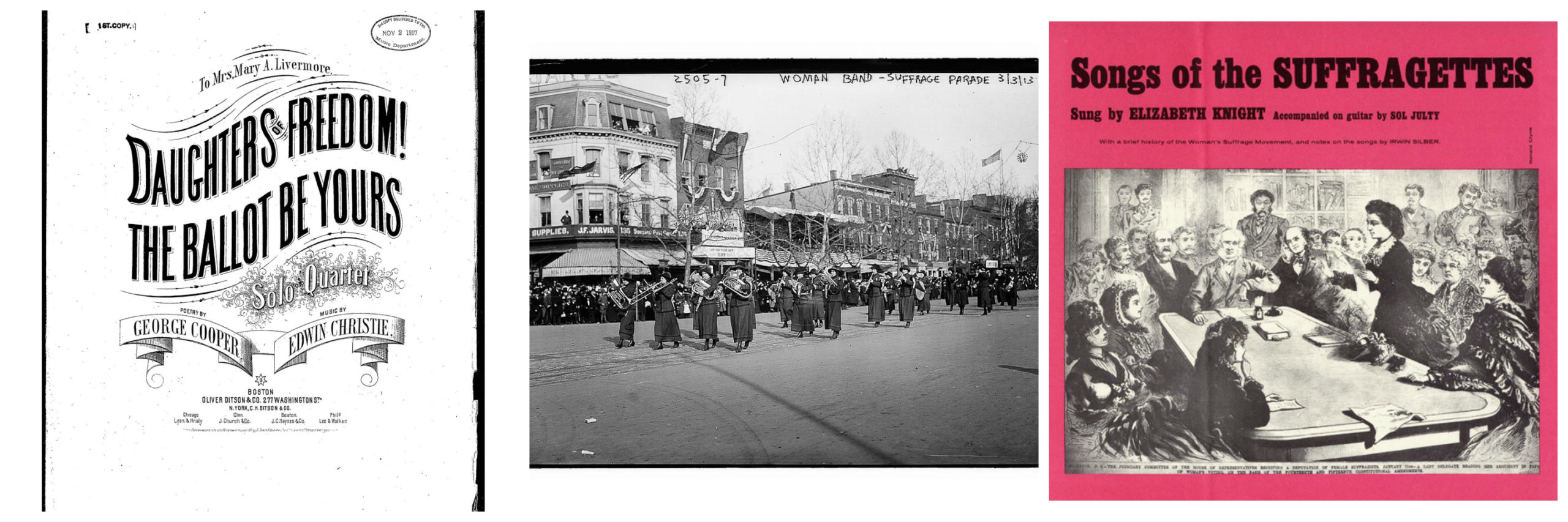
Left: The sheet music cover has bold script with the title of the song, and notes that it is for solo quartet and records the names of the composer and lyricist. Center: A female suffragette band marches down a wide city street. Left: The cover of the Songs of the Suffragettes album is bright pink and has an illustration of a suffrage meeting, with several people around a large table and an audience ranged behind them.
Right: Cover of the sheet music to “Daughters of Freed! The Ballot Be Yours.” Library of Congress. Music Division, Microfilm M 3500 M2.3.U6A44
Center: National American Woman Suffrage Association parade held in Washington, D.C., March 3, 1913. LC-B2- 2505-7, Bain News Service photograph collection, Library of Congress
Left: Unfortunately, very few suffragette songs were recorded at the time of their usage, but you can hear many of these rousing songs on the Smithsonian Folkways recording Songs of the Suffragettes, sung by Elizabeth Knight.

Where there was a fight for women’s rights, however, came societal and political push back – also expressed through music. Songs that mocked the suffragettes’ struggle and emphasized women’s “proper” place abounded, such as “Since My Margaret Became a Suffragette,” “The Anti-Suffrage Rose,” “Mind the Baby, I Must Vote Today,” and “Your Mother’s Gone Away to Join the Army” both published in the early 1910s. Various songs also questioned the other changes women were embracing, often deemed as “unladylike.” This was especially true as women pushed for less restrictive clothes like the “Bloomer costume,” which was attacked in the 1851 song “The Bloomer’s Complaint.” Women riding bicycles were also seen as a sign of these times; indeed, Susan B. Anthony viewed bicycles as doing “more to emancipate woman than any one thing in the world.” “Eliza Jane,” a song from 1895, brought all these horrors together – less restrictive clothing, bicycles, and the desire to vote!

Was there any connection between suffrage and the songs of early country music? I don’t know of any hillbilly songs that embrace the suffrage movement in song, but there are certainly a few songs that reflect the changes that were happening on this front and give hints to women moving beyond their stereotypical roles. For instance, The Carter Family’s “Single Girl, Married Girl,” recorded at the 1927 Bristol Sessions and sung only by Sara and Maybelle, contrasts the freedom of the singleton with the restrictions a married woman bears taking care of husband, babies, and home. And as with the anti-suffrage songs, there were also reactions from hillbilly musicians to the ways women’s roles were changing. Blind Alfred Reed, another 1927 Bristol Sessions singer, later recorded “Why Do You Bob Your Hair, Girls?,” which declared that “every time you bob it, you’re breaking God’s command,” and “Woman’s Been After Man Ever Since,” which bemoaned the early days of Eve in the Garden of Eden and all the ways women were trying to be like men in contemporary society. More disapproval of women’s ways can be found in Ira and Eugene Yates recording “Powder and Paint” from the Johnson City Sessions in 1929.

Finally, it’s worth noting a couple of great songs that teach the history of the suffrage movement and celebrate its achievement. The first is from a much-loved slice of my childhood, Schoolhouse Rock“Sufferin’ till Suffrage,” sung by the wonderful Etta James. And then, of course, there is Dolly Parton (it’s ALWAYS Dolly…). In 2018, she contributed to 27: The Most Perfect Album, “a collection of songs about the Constitutional amendments that have shaped our democracy, and yet are often at the center of fierce political debate.” Dolly’s song about the 19th amendment starts with a brief spoken introduction to the suffrage story, and soon transitions into a rousing song about the fight for the vote.

Real Folk: A Few of My Favorite Things

On March 6, the museum opened a special exhibit called Real Folk: Passing on Trades & Traditions Through the Virginia Folklife Apprenticeship Program, in partnership with the Virginia Folklife Program. While the COVID-19 situation meant that for three months no one was able to visit the exhibit – except virtually – we have now reopened, and the exhibit is waiting to be enjoyed through its closing date in August!

This is one of my favorite special exhibits that we’ve had on display at the museum – the images by photographers Pat Jarrett and Morgan Miller are stunning, the stories of the master artists and apprentices told by Virginia State Folklorist Jon Lohman are fascinating, and the range of crafts, trades, and traditions astounding.

Here are just a few of the interesting things I’ve learned from Real Folk:

A Virginia Town’s Salty Past

Saltville – found in the Southern Appalachians – is named for its unusually high number of salt marshes, or as locals call them, salt licks. Not only is the salt source extensive here, but the salt from Saltville is also especially salty – around 10 times saltier than ocean water! Saltville’s natural salt deposits have influenced the history of the region from the late Pleistocene period, when they attracted Ice Age mammals and Paleoamericans to the area, to early European traders to the Civil War when nearly two-thirds of the South’s salt was produced in Saltville and two bloody battles were fought here.


Jim Bordwine’s family has lived in and around Saltville since the 1770s. He has dedicated his life to educating the public about Saltville’s history and continuing its traditional craft of making salt, including passing down this knowledge to son Baron through an apprenticeship. © Birthplace of Country Music Museum
Quilt Signals

We have quite a few quilt connections in our museum – from the huge Birthplace of Country Music quilt hanging in our atrium to the quilt “tapestries” on sell in The Museum Store to the museum’s color scheme based on old quilts and flour sacks. Master Artist Sharon Tindall has conducted substantial research in support of the theory that African American quilts contained coded messages integral to the success of the Underground Railroad, codes that told enslaved people about what to expect next on their journey and how to find safe haven.


Sharon Tindall specializes in early African American quilt patterns and in working with fabrics that aren’t typically used in quilting, such as Malian mud cloth. She shared her experience with apprentice Nancy Chilton. © Birthplace of Country Music Museum
A Connection Between Music and Language

The đàn bâu – translated to mean “gourd lute” – is a monochord or one-stringed instrument, which plays a central role in Vietnamese music. Playing the đàn bâu can create microtones capable of imitating the six essential tones and variations of the Vietnamese language, nearly impossible to achieve with any other instrument. Traditionally, it is also used as an accompaniment to Vietnamese poetry readings.


Nam Phuon Nguyen began playing an instrument called the đàn bâu at 17, later touring and performing throughout the United States with her family. She is seen here with her apprentice Anh Dien Ky Nguyen. © Pat Jarrett/Virginia Folklife Program

From Everyday Object to Musical Instrument

Music has often been made from everyday objects – for instance, think of a washtub bass or the spoons. The steel drum, or “pan” as it is called in the Caribbean, was invented in Trinidad around World War II, when island locals resourcefully crafted these instruments from oil drums left behind by the U.S. Navy. Contemporary pans are created when a 55-gallon steel oil drum is hammered concave, a process known as sinking. The drum is then tempered and notes are carefully grooved into the steel, resulting in a melodic percussive instrument that can play three full octaves.


Master Artist Elton Williams, who worked with apprentice Earl Sawyer, grew up in Trinidad and immersed himself in every aspect of steel bands. He is a musician, composer, tuner, and now one of the few steel pan makers in the U.S. © Morgan Miller/Virginia Folklife Program

For the Love of Fonts

Prior to the advent of photocopiers, short-run quick print, email, and social media, the local letterpress was the primary producer of the vast majority of materials for mass communication – from church bulletins to wedding announcements to commercial advertisements, and so much more. My favorite elements of letterpress are the individual letters used in the printing process (and so many possible fonts!) and the wonderful act of rolling out the ink ready to print. We have our own letterpress studio here in Southwest Virginia at the Burke Print Shop in the Wayne C. Henderson School of Appalachian Arts.


Left: Images from the letterpress apprenticeship between Garrett Queen and Lana Lambert in the Real Folk exhibit. Right: Letter blocks at the Burke Print Shop. © Pat Jarrett/Virginia Folklife Program; © Rene Rodgers

Different Dulcimers

When I used to think of a dulcimer, I thought of one particular type – an hourglass-shaped instrument – because we had one like that hanging in our home when I was a child. Since then, I’ve learned there are many types of dulcimers (all from the zither family) that are played in many places throughout the world – from the Appalachian or mountain dulcimer and the hammered dulcimer to the banjo dulcimer and the bowed dulcimer – with different shapes and different ways of being played. The dulcimer from my house – and the one most familiar around our area – is the mountain dulcimer, a fretted string instrument that first appeared in the 19th century among Scots-Irish communities. It is also known as the lap dulcimer.


Left: Phyllis Gaskins, seen here with apprentice Anna Stockdale, plays the Galax dulcimer, which is lozenge-shaped, has four strings all tuned to the same note, and is played with a turkey or goose quill. The Galax dulcimer is intended to be an equal instrument in old-time string bands, mirroring the fiddle. Right: Master Dulcimer Maker Walter Messick apprenticed Chris Testerman, an award-winning fiddler who is already considered one of the great up-and-coming luthiers in the region. © Pat Jarrett/Virginia Folklife Program

An Unorthodox Route to Creativity

The late Pastor Mary Onley, known as “Mama-Girl,” was a self-taught artist who came from generations of farm laborers, working in the fields herself at the age of 12. Severe allergies resulted in several hospitalizations, and during one of these, she reported being visited by a spirit who instructed her to create art out of paper and found objects – something she had never done before. She went on to become one of the most celebrated folk artists on the East Coast, creating lyrical newspaper and glue sculptures that reflected her inner visions and unique creativity.


In 2016, Mama-Girl taught son David Rogers her unorthodox artistic techniques and how to open his mind to receive his own divine artistic inspirations. © Pat Jarrett/Virginia Folklife Program