Music & Songs Archives - Page 12 of 30 - The Birthplace of Country Music
Listen
Play
Loading station info...

Instrument Interview: The Kazoo

“Instrument Interview” posts are a chance to sit down with the instruments of traditional, country, bluegrass, and roots music – from different types of instruments to specific ones related to artists, luthiers, and songwriters – and learn more about them. Ten questions are posed, and the instruments answer! Today we mark National Kazoo Day by talking to the kazoo!

I thought kazoos were just silly party favors, but you’re an actual musical instrument?

Well, I do have a reputation as a birthday party favor, probably to the extreme annoyance of many parents! But I am so much more than that. Kazoos are membranophones, where the tonal qualities of the instrument are produced as the player hums. I am also related to mirlitons, which are vibrating membrane instruments.

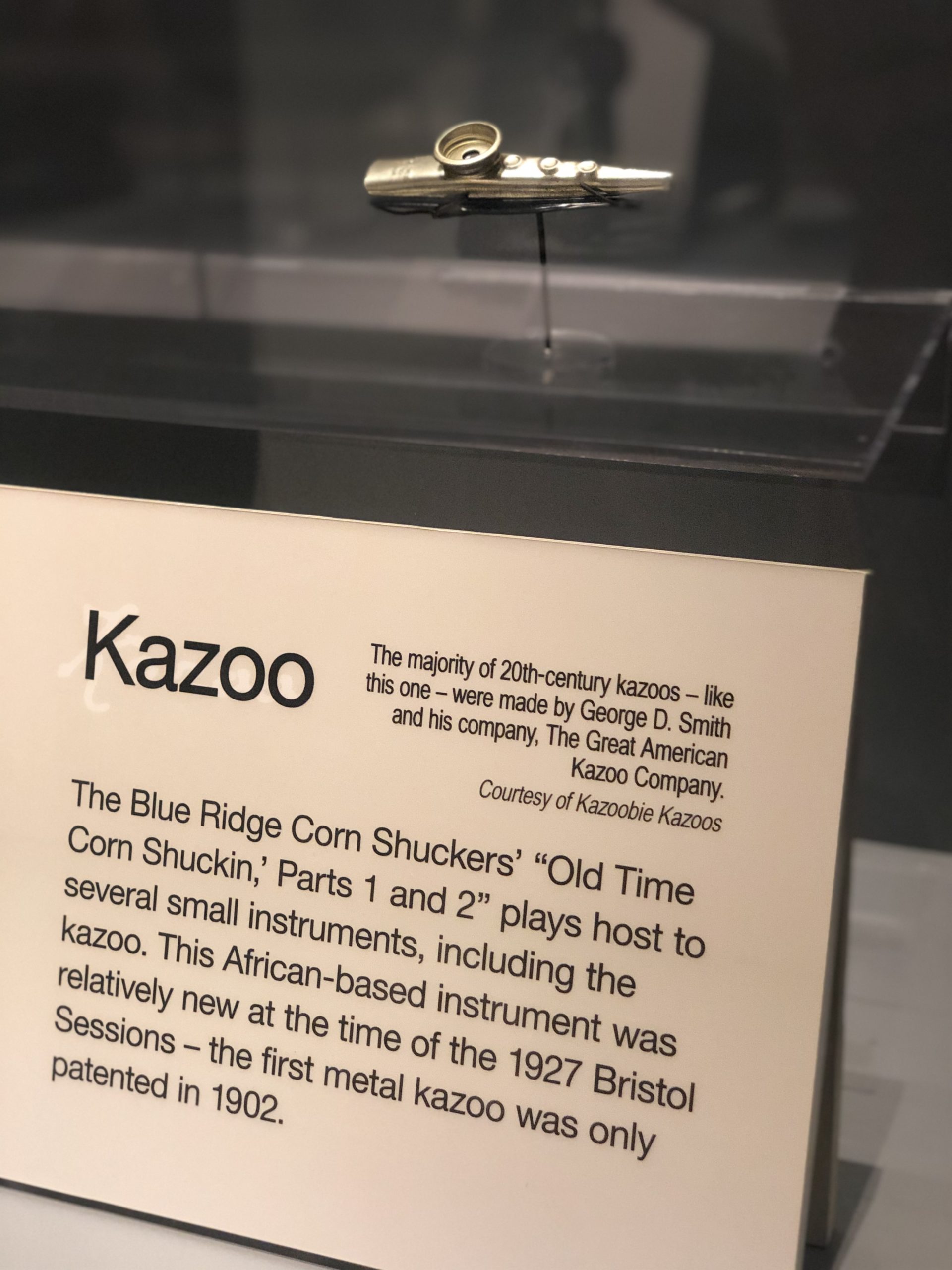
A metal kazoo on a display stand within a glass case with an interpretive label in front of it with a brief text about the kazoo.

The Birthplace of Country Music Museum has a George D. Smith metal kazoo in our instrument gallery. It is on display courtesy of Kazoobie Kazoos, a plastic kazoo manufacturer in Beaufort, South Carolina. © Birthplace of Country Music

Where do you come from?

My ancestors go back to early mirlitons from Africa. They were made from cow horns or gourds, and their membranes were from spider egg silk. It must have been a tricky business to make them! These African horn-mirlitons were used for ceremonial purposes as a way to distort or mask the human voice.

Kazoo-like instruments are also known in ancient Mexico, though these looked more like recorders and the membrane was made from slivers of corn husk.

A lot of people think of the kazoo as an American instrument. How did you come about here in the States?

Different types of kazoo-like instruments, based on the African mirlitons and common in folk music, could be found in North America in the 1800s. But the kazoo as we know it is attributed to an African-American man named Alabama Vest who came up with the idea of this small instrument and then worked with Thaddeus von Glegg, a German clock manufacturer, to make his concept into reality in the 1840s.

How the kazoo went from Alabama Vest to mass production follows a couple of possible routes. The Historical Folk Toys site notes that a traveling salesman named Emil Sorg was charmed by Vest and von Glegg’s instrument, and so took the concept to create his own kazoos in New York, partnering with die-maker Michael McIntyre and starting production in 1912. McIntyre knew that to succeed, mass production was necessary and so he soon went into business with Harry Richardson, a large metal factory owner. By 1914 they were mass producing kazoos as the instrument’s popularity, and sales, skyrocketed. In 1916 their company became known as The Original American Kazoo Company, and McIntyre was awarded a patent on their kazoo in 1923. In 1994 The Original American Kazoo Company was producing 1.5 million kazoos per year! The company stayed in business until 2003, and the factory site now houses a kazoo museum.

However, the Vest-Sorg-McIntyre-Richardson kazoos were not the only ones being developed in America over this period. Another instrument – a “toy trumpet” that worked in a manner similar to the kazoo – was patented by Simon Seller in 1879. And the first instrument patented under the name “kazoo” was one created by Warren Herbert Frost – his patent was issued in 1883. However, the first metal kazoo was patented by George D. Smith in 1902.

What do you look like?

My basic shape is a tube where one end is larger and slightly flattened and the other is in the shape of a circle; both of my ends are open and uncovered. On top, I have another circular hole – known as the membrane hole – and a wax membrane can be found in the small chamber below this hole. I’ve been called “the Down South Submarine” because my shape resembles these underwater vessels.

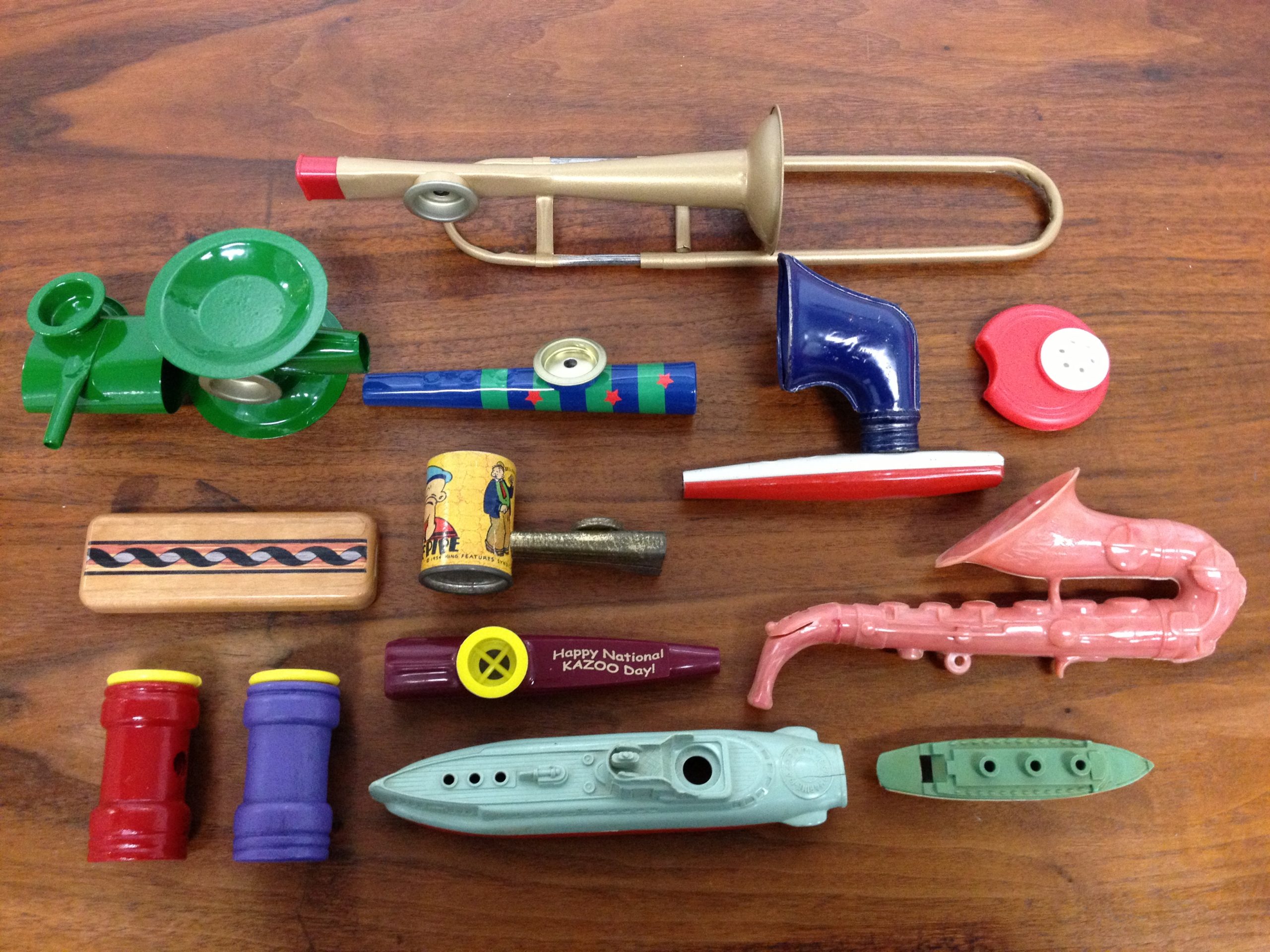
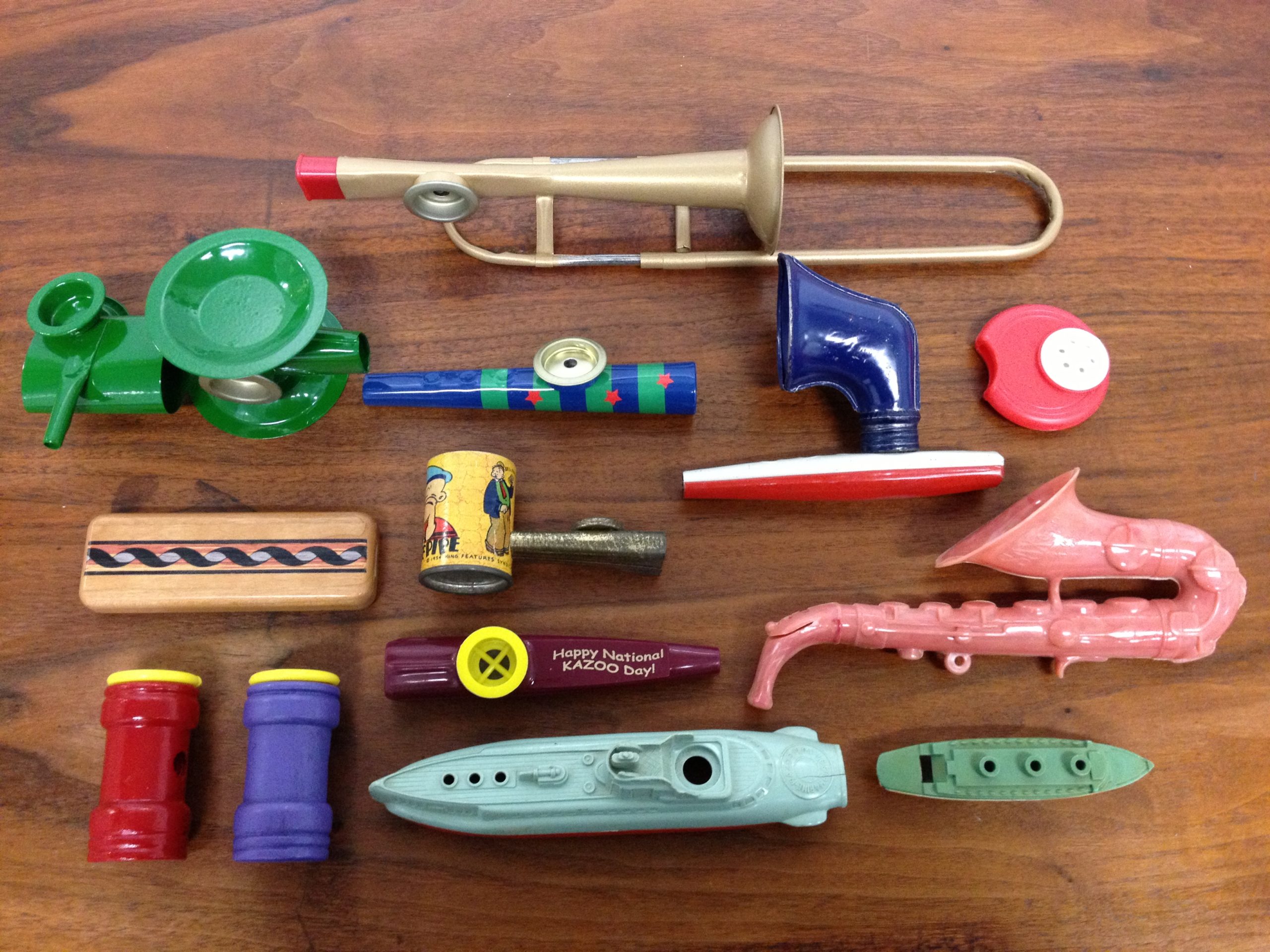
Over the years, however, I have taken on many other shapes and forms, including being made directly in the shape of a submarine. Another example, a circa 1930 paper kazoo, was shaped like a 1920s-era microphone. Many kazoos have also been made in the shape of saxophones – Scott Paulson of the UC San Diego Library notes that “a good player could easily imitate a saxophone and create a debate: ‘kazoo or saxophone’”!

A variety of colorful plastic kazoos -- from common kazoo shapes to a pink saxophone shape to submarine/military ship shapes, to a trombone shape.

A collection of differently shaped kazoos. Courtesy UC San Diego Library

How are you played?

To play me, you should hum into the flattened opening. This makes the membrane vibrate, creating a sound that can be changed by the pitch, loudness, and nature of your humming. You can also alter the sound I make by covering the membrane hole, either in part or completely. Check out this video for a tutorial.

Many people make the mistake of blowing into me and then thinking I am broken as no sound comes out, but this will not work for creating kazoo music!

Are there any famous kazoo players or performances?

There are! Unsurpisingly you can hear the kazoo’s comic effect on Frank Zappa’s first album, Freak Out! Comb-and-paper kazoos appeared on the Beatles’ song “Lovely Rita” from the Sgt. Pepper’s Lonely Hearts Club Band album, and Sir Paul McCartney played the kazoo on the 1975 Ringo Starr single “Sweet 16.” World Wrestling Federation duo Edge and Christian often brought their kazoos into the ring, driving their foes to distraction with their playing and often winning the bout as a result. Jimi Hendrix used a comb-and-paper kazoo on his 1968 recording of “Crosstown Traffic.” Kazoos – to imitate the sound of electric razors in an executive washroom – were also used in the song “I Believe in You” in the Broadway comedy How to Succeed in Business Without Really Trying.

Some performers made a career of their kazoo playing, such as Barbara Stewart who even performed at Carnegie Hall! And some composers have written their own kazoo music – for example, Mark Bucci composed his “Kazoo Concerto,” which premiered at a Leonard Bernstein Young Peoples’ Concert with the New York Philharmonic in 1960.

I’ve named just a few, but if you look for them you can find all sorts of famous kazoo performers or performances!

Were you played at the Bristol Sessions?

I sure was! Kazoos were commonly used in jug bands and comedy songs, and that is where you will find me on the 1927 Bristol Sessions recordings. Ernest Stoneman joined together with different configurations of friends and family to record several songs for Ralph Peer in 1927. One of those configurations was made up of Stoneman, Bolen Frost, George Stoneman, Iver Edwards, Kahle Brewer, and Uncle Eck Dunford to form the Blue Ridge Cornshuckers singing “Old Time Corn Shuckin,’ Parts 1 and 2.” As the song progresses, Stoneman invites each musician to introduce himself, play a little bit, and then take a sip from the passing jug!

Even though you are a light-hearted – and fun to play – instrument, do you get used for serious purposes too?

Yes, indeed, I am sometime used in speech therapy to help strengthen oral and speech skills – for instance, kazoos can help children in the production and awareness of speech. We can also be used to help speech recovery for people who have suffered a brain injury, and to help in speech production and awareness for the deaf or hard of hearing. Kazoo use can even play a role in increasing respiration and oxygenation.

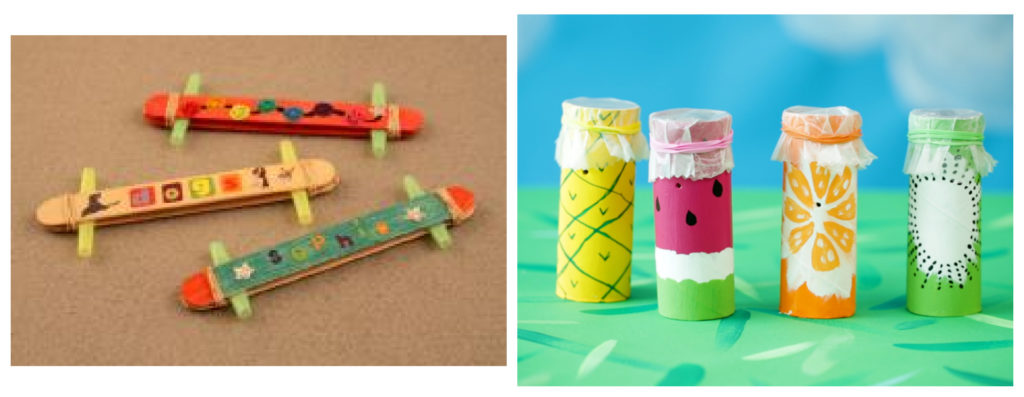
Left: Three popsicle kazoos decorated with stickers and colored markers. Right: Four toilet paper roll kazoos, painted to look like different fruits.
Fun and colorful make-at-home kazoos.

How do I make my own kazoo?

There are a few ways to make your own kazoo. You can make one using popsicle sticks, a straw, and rubber bands as seen here; using a toilet paper tube and wax paper as seen here; or the classic comb-and-paper version as seen here. Get crafting!

Anything else you want to share with us?

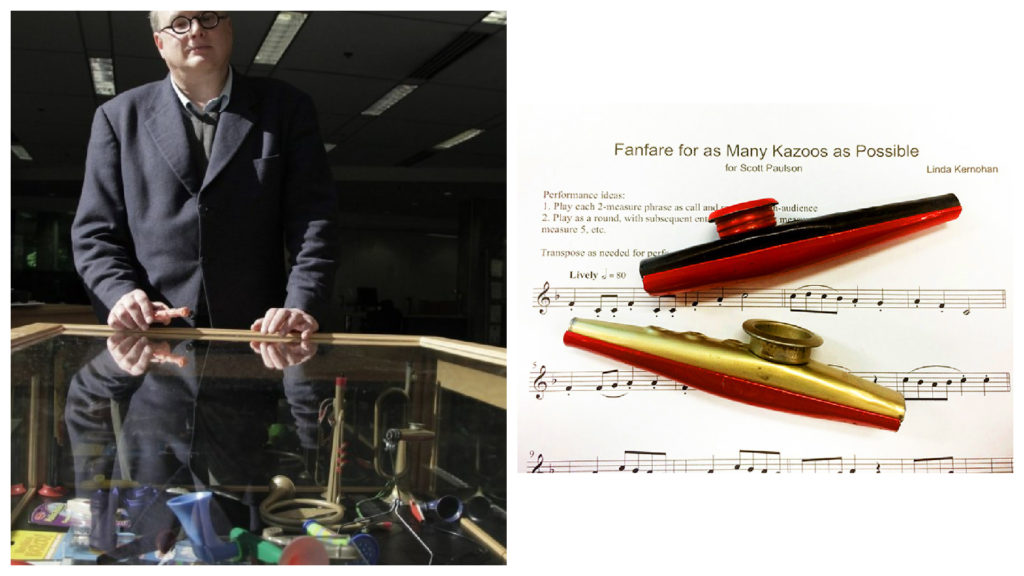
Special thanks to Scott Paulson of the UC San Diego Library for his help with kazoo facts and photos! The Library has hosted special events around National Kazoo Day for the past few years. Starting off from a challenge to use “serious library tools to investigate a light, playful topic,” the Library’s “kazoo salute” has included exhibits, live kazoo performances, and the commissioning of original kazoo music.

Finally, the kazoo is known as “the most democratic of all instruments” because ANYONE who can hum can play it! So give me a try!

Left: A man wearing a dark suit and glasses stands behind a tabletop glass case filled with kazoos. Right: A piece of kazoo music with two kazoos superimposed on top.

Scott Paulson with a UC San Diego Library kazoo display; “Fanfare for as Many Kazoos as Possible,” an original composition by Linda Kernohan. Courtesy UC San Diego Library

Pick 5: Songs to Ring in the New Year

For our “Pick 5” blog series, we ask members of the Radio Bristol team or our BCM staff to pick five songs within a given theme – from heartsongs to murder ballads and everything in between! Once they pick their “5,” they get the chance to tell us more about why they chose those songs. With a diverse staff of knowledgeable DJs, we’re sure to get some interesting song choices, which might introduce you to some new music, all easily accessible by tuning into Radio Bristol!

For this final “Pick 5” of the year, four members of staff shared songs with us that made them think of a new year, new beginnings, new resolutions, basically anything that rings in the new and says goodbye to the old, along with the fifth pick, an old and traditional favorite. This past year has been difficult on so many fronts – from the heartbreak and devastation of the COVID-19 pandemic and social justice issues to economic hardship and natural disasters to the isolation we’ve all felt, along with “murder hornets” and other oddities. While 2020 has been incredibly challenging, we’ve also found strength and courage, empathy and compassion within it, and so we can hold onto those feelings as we head into the new year – with just a few songs to help create a “new start” soundtrack to help us take those first few tentative steps forward!

“New Year’s Eve,” Jerry Douglas – June Marshall, Museum Manager

“On New Year’s Eve, swear I can change, become a child again… Let myself believe that the days to come are mine.” 

I love remembering what it was like as a child when there were no adult worries yet and just taking things as they came and staying in the moment. Enjoying those moments for what they were.  Some of these lyrics take me to that place again and bring joy to my heart once again…

“This Will Be Our Year,” The Zombies – Toni Doman, Grants Coordinator

In regards to new beginnings, The Zombies said it best:

  • “You don’t have to worry
  • All your worried days are gone
    This will be our year
    Took a long time to come.”  

I picked this song because of the positive vibes and message within the lyrics, lighthearted and catchy melody, and references to the good things to come just over the horizon if we can just hang on a little while longer. We could all use a little more positivity; the forecast may call for rain but there are brighter and sunnier days ahead! 

“New Day Rising,” Hüsker Dü – Scotty Almany, Digital Media, Programming, & Exhibit Logistics Manager

A song that comes up for me within the theme of “newness” is the title track from seminal Saint Paul, Minnesota punk rock band Hüsker Dü’s third album, New Day Rising.  

The emotion from this song comes from its sound and delivery, especially because the lyrics are about 99% of the song’s title repeated throughout. There is an urgency that can be translated as triumph or motivation to persevere all depending on your current mood when you hear this one. It really gives me the same feeling that I felt from the “This too shall pass…” parable of King Solomon’s Ring, which is a lesson that has been a constant in my life since I first heard it as a teenager. For me, this makes it a perfect anthem for embarking on 2021. There is light on the horizon but plenty of work still to be done. There is a New Day Rising and how it goes has a lot to do with how we approach/navigate it.

“Somewhere Over the Rainbow,” Israel Kamakawiwo ‘ole – René Rodgers, Head Curator

I’ve always liked this song, ever since first hearing it sung by Judy Garland during my childhood viewing of The Wizard of Oz. But this tune became even more magical to me the first time I heard it sung by the much-missed and revered Hawaiian singer Israel Kamakawiwo ‘ole. The lyrics are simple and familiar, but Iz’s version with his lovely voice backed by ukulele (the happiest of instruments) just makes me feel hopeful and joyous. It makes me imagine that we can look beyond the rainbow to a better day, wish on stars for dreams, large and small, and move forward into the new year with purpose.

“Auld Lang Syne,” various

“Auld Lang Syne” is a New Year’s Eve tradition, and therefore there are hundreds of versions of this song out there in live performances, recordings, and movie and television soundtracks. You can find a version in every genre and by numerous artists — including a traditional “Celtic” version by Mari Campbell and Emily Smith, a Lou Rawls’ R&B cover, a punk rock interpretation by MxPx, a stringband performance in a stairwell by the US Army’s Six-String Soldiers, a sweet and soulful version by Daniel Dye and the Miller Road Band, and one wonderfully adorned with the Scottish pipes by the rock-fueled Red Hot Chili Pipers. But my personal favorite is the home-recorded bluegrass version by Reina del Cid below that I found on YouTube just by chance.

The song’s lyrics are from a 1788 poem by Scottish poet Robert Burns, and it was popularized in the United States by Guy Lombardo from his first New Year’s Eve performance of the song in 1939. “Auld Lang Syne” is literally translated as “old long since” and more familiarly thought of as “days gone by,” “long long ago,” and “old time.” The song is sung as a way of bidding goodbye to the past year, something I think so many of us are feeling we want to do to 2020 with an additional “good riddance.” However, leaving behind 2020 can’t be done without the remembrance of friends and family we’ve missed seeing and those we’ve lost, and without looking back on the hard lessons and truths we’ve learned with the intent of coming together to make the world a much better place. And so I take to heart certain lyrics in the song, from the additional meaning behind “for auld lang syne” as “for the sake of old times” to “And there’s a hand my trusty friend! / And give me a hand o’ thine!” to “a cup of kindness,” and look to the year ahead with those sentiments in mind.

Instrument Interview: The Bones

“Instrument Interview” posts are a chance to sit down with the instruments of traditional, country, bluegrass, and roots music – from different types of instruments to specific ones related to artists, luthiers, and songwriters – and learn more about them. Ten questions are posed, and the instruments answer! Today we talk with the bones.

What are you?

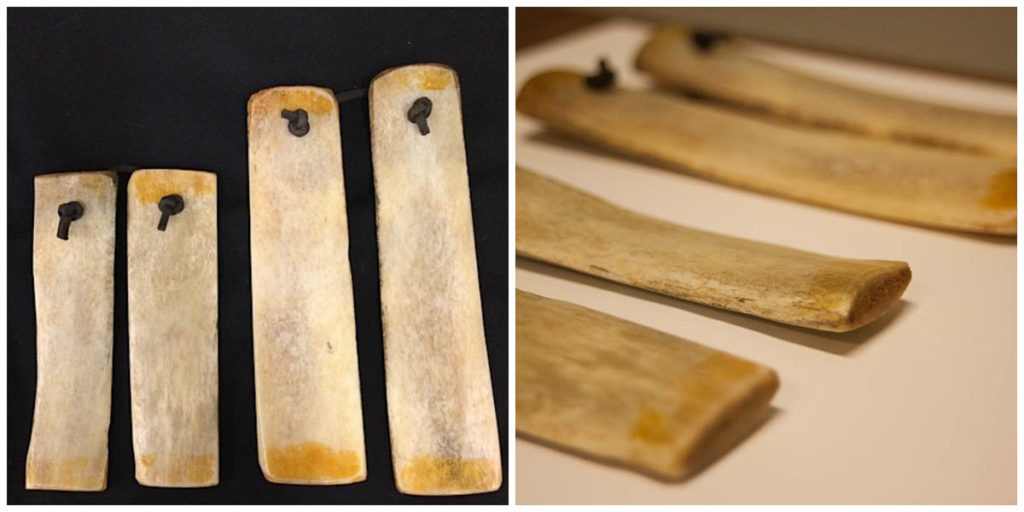
I am a type of percussive instrument known as a “concussion idiophone,” which refers to me being made of up of similar objects that make a sound when struck together. I’m also called the “rhythm bones,” which gives you a clue to the role I play in music.

Two views of two sets of bones, made of animal bones. One is larger than the other, and they are each connected by a leather cord.
The Birthplace of Country Music Museum has two sets of circa 1927 bones in our collection, donated by Dom Flemons in 2015.

Where do you come from?

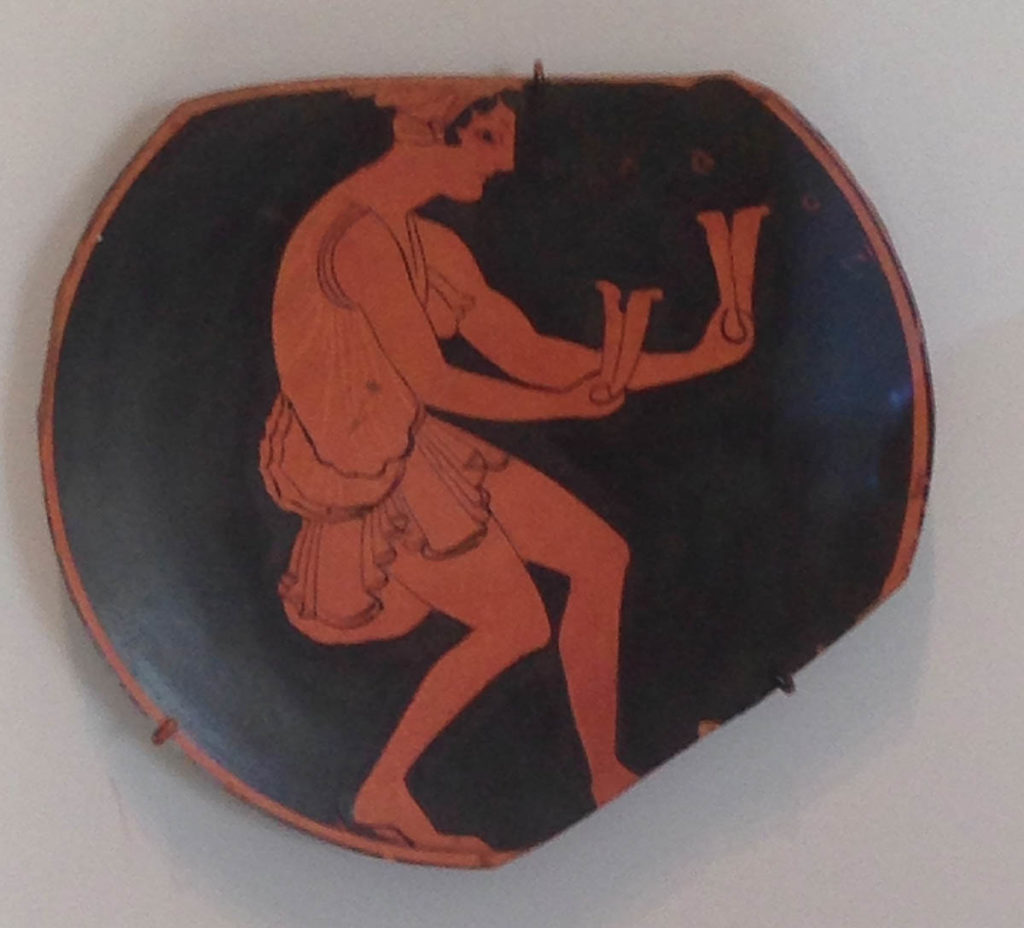
I’ve been around for a long time, and you can find versions of bones all the way back to several ancient cultures. Archaeologists have excavated bones (as instruments) from graves and tombs in prehistoric Mesopotamia and Egypt, and also discovered images of musicians playing the bones on Greek pottery. There is also evidence of the bones being played in the Roman Empire and ancient China. More recently – that is, in the 18th and 19th centuries – I came to North America with Irish and English immigrants, who used the bones as a way to keep a steady beat for their jigs and reels.

A pottery sherd with a red-figure dancer, gender unclear holding two bones-like instruments in their hands.

Fragment of a terra cotta red-figure kylix, Greek, 510-500 BC. The image is of a dancer using a bones-like instrument as part of the performance. Public domain

Are you really made from bones?

My original versions were made from animal bones, usually the rib or shin bones of sheep, cows, and sometimes horses. I’m often slightly curved, reflective of the natural shape of these bones, and I typically measure between 5 and 7 inches in length. While modern bones are still made from animal bones, you can also find ones made from wood and plastic. A variety of woods can be used, such as cherry, mahogany, walnut, and maple, with different woods producing different tones as is seen in other wooden instruments.

How are you played?

Players hold a pair of bones between their fingers with the convex sides facing one another; one is held fairly tightly and the other more loosely. By shaking the wrist, the bones hit one another, creating a loud “clack.” The connection between the two bones is carried by the momentum from the player’s arm and hand movements rather than any effort to force the bones to knock together. In North America, players tend to play with a pair of bones in each hand, while in Ireland the tradition is to play one-handed.

It’s hard to get a sense of what the movement looks like and the resulting sound by describing it, so check out Dom Flemons playing the bones. It’s actually quite amazing – and beautiful – to watch:

What type of music are you typically found in?

You can hear bones being played in a wide variety of genres, such as traditional Irish and Scottish music, blues, bluegrass, zydeco, French-Canadian music, and Cape Breton (in Nova Scotia) traditions.

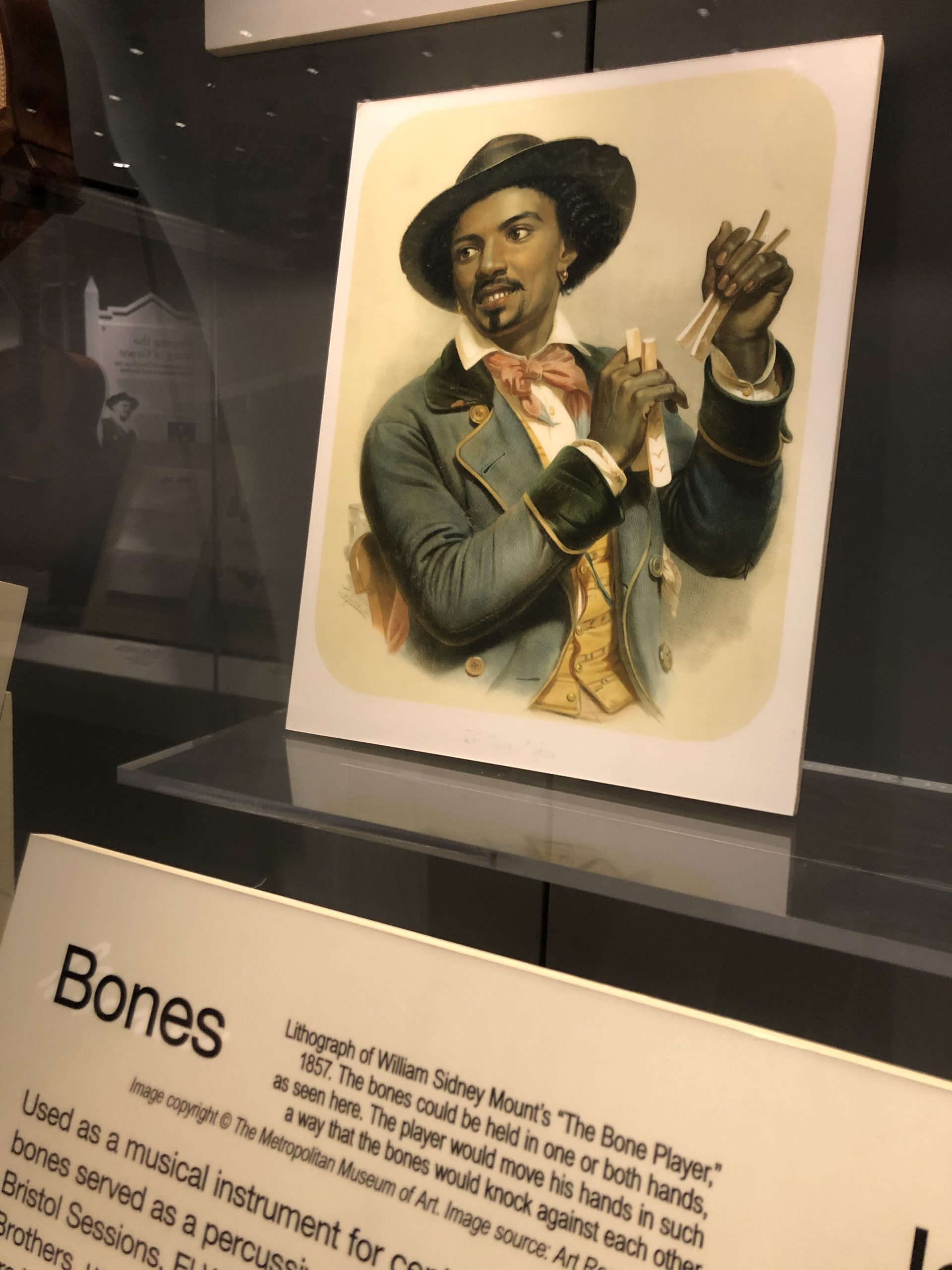
Because bones were also often used by African American musicians, they became a common facet of 19th-century minstrel shows – where white performers appeared in blackface; later Black entertainers appeared in minstrel shows too – and the bones’ popularity in the United States grew within this context. One of the first bones-playing minstrel performers was Frank Brower, and the first documentation of him playing the bones in front of an audience are from 1841 in Virginia. He played with a much larger pair of bones than is usual today – two 12-inch lengths of horse rib bones!

An image of an exhibit case with William Sidney Mount's "The Bone Player" -- a black musician wearing a hat, jacket, waistcoat, and cravat-like tie, and holding two pairs of bones in his hands.
This image of William Sidney Mount’s “The Bone Player,” 1857, is on display in the museum exhibits. © Birthplace of Country Music Museum

Are there famous musicians associated with the bones?

There are many famous bones players! Freeman Davis, known by his stage name “Brother Bones” and also as “Whistling Sam,” was born in Montgomery, Alabama, in 1902. He recorded several songs in the 1940s and 1950s, appeared in three movies, and performed at Carnegie Hall and on The Ed Sullivan Show. His most famous recording is “Sweet Georgia Brown,” which became the Harlem Globetrotters’ theme tune in 1952. He took bones playing to an intense high of four bones in each hand and even playing knives like bones!

DeFord Bailey, best known for his wonderful harmonica playing and as a regular on the Grand Ole Opry in its early days, included bones playing in his performances along with yo-yo tricks and guitar picking. He was country music’s first African American star.

John Burrill learned to play the bones in his teens during the Depression. One viewer described Burrill’s style of bones-playing as looking like his arms were upside-down windshield wipers. Over the years, Burrill played with a host of other musicians and acts, including the Brattle Street Players, Steve Baird, Clifton Chenier, Spider John Koerner, Molly Malone, and even the Infliktors, a punk band. When asked what key he played in, his reply was “the skeleton key”!

Peadar Mercier was a percussionist in the Irish band The Chieftains, playing both the bodhran and the bones. He was with them from 1966 to 1976.

Dom Flemons, one of the founding members of the Carolina Chocolate Drops and now a solo artist, is known as the American Songster, whose “repertoire of music covers over 100 years of early American popular music.” Flemons is a talented multi-instrumentalist, playing banjo, guitar, harmonica, jug, quills, fife, and, of course, the bones. He has bones made out of cow rib and shin bones that he plays in the double-handed style.

I’ve heard of someone called “the Rhythm Bones King.” Who was he?

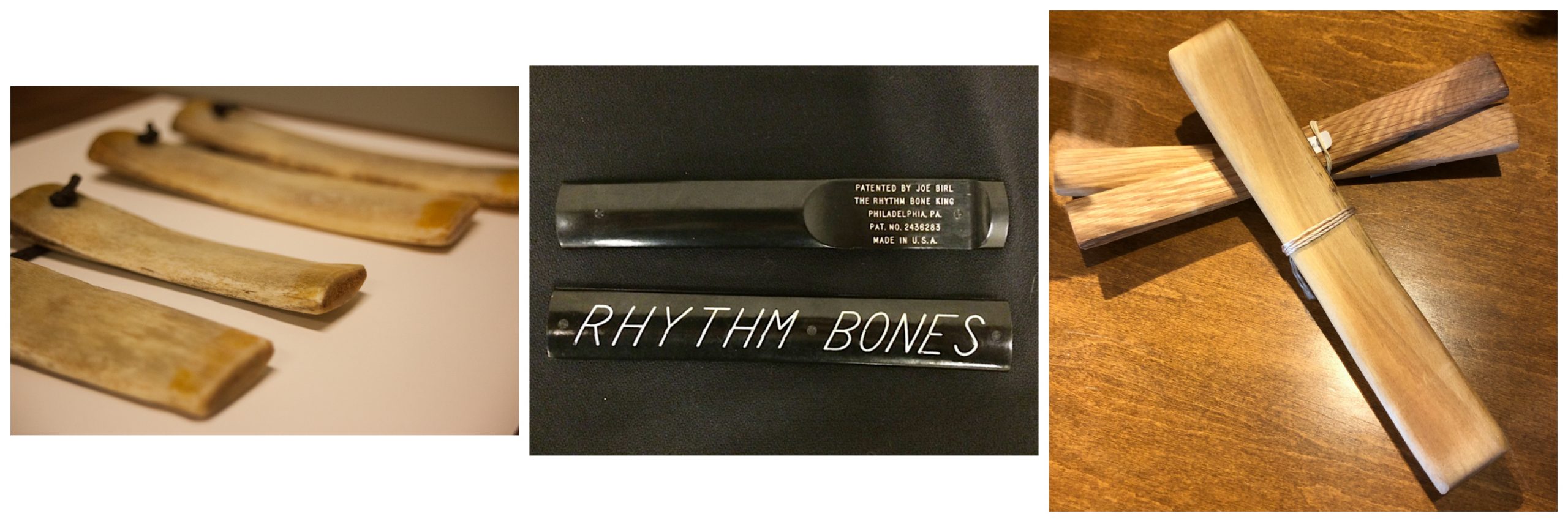
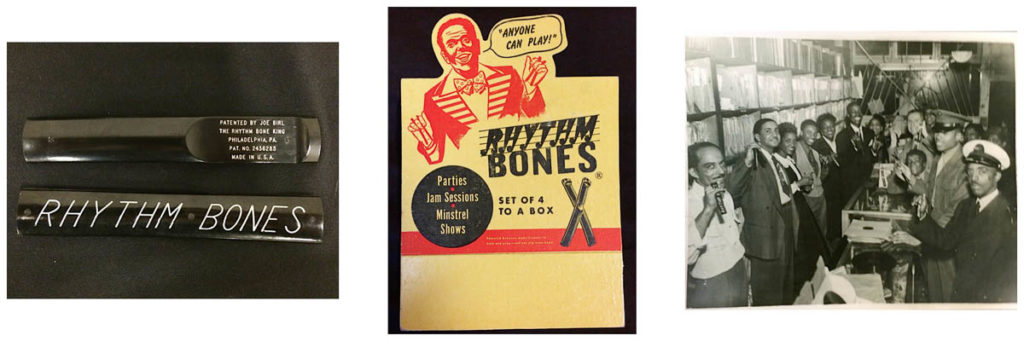
The Rhythm Bones King is a man called Joe Birl. In 1945 Birl applied for a patent for his black molded plastic bones that bore a groove to help keep the bones from slipping out of a player’s hand. Birl produced and sold around 150,000 pairs of these plastic rhythm bones. After the plastic mold broke, he made wooden rhythm bones with his patented grooved design. He passed away in 2012, and Joe Birl Jr. continued to sell bones made in his father’s design.

Left: Joe Birl’s original plastic rhythm bones; Center: A store placard advertising the sale of rhythm bones; Right: A photograph of customers holding Birl’s rhythm bones in a store. All objects from the Dom Flemons Collection at the Birthplace of Country Music Museum

Were you played at the Bristol Sessions?

I was! Black musician El Watson played me when he accompanied the Johnson Brothers on two recordings – “Two Brothers Are We” and “I Want to See My Mother (Ten Thousand Miles Away).” He also accompanied them on harmonica for their recording of “The Soldier’s Poor Little Boy,” and Charles Johnson played guitar on Watson’s two harmonica recordings, “Pot Licker Blues” and “Narrow Gauge Blues.” These are some of the earliest integrated country music and blues recordings.

Are there other instruments related to you?

There are many other types of percussive instruments that are used in a similar way to the bones. For instance, clappers – consisting of two solid pieces made of wood, metal, ivory, and even plastic that are slapped together – are found in a lot of musical traditions, from China, Japan, Korea, and Thailand to medieval France and modern Western symphony orchestras.

Castanets are made of two concave shells joined with string at one edge. They are usually made of chestnut wood, and they are played two-handed. Castanets are also used in several musical traditions, such as Spanish, Portuguese, Swiss, Moorish, Ottoman, Sephardic, and Italian.

Playing the spoons is especially common in American folk music and often seen in jug bands. Like the bones, the spoons are held in one hand and played against each other as a percussive instrument. To see some amazing spoon playing, check out Abby the Spoon Lady.

Anything else you want to share with us?

Remember singing the nursery rhyme song “This Old Man” when you were a child? Well, that song is thought to refer to bones playing! The first verse goes like this (and so on):

“This old man, he played one,

He played knick-knack on my thumb;

With a knick-knack paddywhack,

Give a dog a bone,

This old man came rolling home.”

A paddywhack is a ligament – known as the nuchal ligament – in the neck of sheep and cattle.

*Want some of your own bones? Then stop by The Museum Store where you can buy wooden bones (and spoons) made by local artisan Walt Messick of Mouth of Wilson, Virginia.

Hard Times, Silver Linings and Farm and Fun Time

Only six months ago, on March 12, 2020, I thanked our sold-out crowd at the Birthplace of Country Music Museum for joining us for another live broadcast of Farm and Fun Time. Though the show went off without a hitch, the crowd was enthusiastic, and our team delivered another top-notch show, we knew things were about to change. That would be the last show with an audience I would be involved in for many months to come.

Earlier that evening when speaking with that night’s performers – Miss Tess and Jim Lauderdale – we knew it was time to get ready for some big changes as COVID-19 was quickly spreading all over the country. Fear of an imminent nationwide shut down seemed to be closing in. In between sound checking, rehearsing my lines, and setting up, I witnessed Tess’s upcoming album release tour (kicking off with Farm and Fun Time) fall apart. In rapid succession she was getting cancellations throughout the evening. As a fellow musician it really hit home, knowing the countless hours of work and sacrifice that go into not only setting up a successful tour but also recording and releasing a new project – the work and achievements of a professional artist are really remarkable. I also knew that her experience was about to be commonplace for those within our industry. By the following week, musicians all over the country no longer had proper means of making a living. Tours were cancelled, festivals were dropping out of the schedule left and right, and venues nationally were closing their doors, including Radio Bristol and the Birthplace of Country Music Museum.

Female guitar player singing at the mic. She has medium-length brown curly hair, glasses, and is wearing a sea green sleeveless top and a white costume jewelry necklace.

Miss Tess performing at the March 2020 Farm and Fun TIme, the last taping of the show with a live audience before industry shutdown. © Birthplace of Country Music, photographer: Billie Wheeler

As we all know, the past six months have seen a complete shut down of many industries, and one of the hardest hit has been the music industry. We have all felt the reverberations of this loss and have had realizations as to what live music brings to our lives: the thrill of being up close and personal with artists, the energy exchange between performers and audience, the necessity of shared experiences in a community setting. So many aspects of live performance feed us and connect us as human beings.

With so much loss and grief over the past six months it’s difficult to find the silver linings, but it’s also been necessary. I’ve been grateful to have time at home (my first summer home in eight years), to grow a garden, and to spend a lot of time hiking, camping, and getting into better shape. I’m even learning some new instruments (piano and banjo)! Through this time, I’ve also realized the fundamental role music and performance plays in our lives in keeping us balanced and energized. Performance is a cathartic exchange. Transitioning from performing usually around 100 shows a year to 10 shows (maybe) for 2020 has been quite an adjustment to say the least.

For us at Radio Bristol there have been some silver linings as well. After six years of hard work and dedication, the fruits of our labor have really been paying off. Over the past six months we’ve watched our flagship show Farm and Fun Time evolve from a local radio show to a regional PBS syndicated television show! Thanks to our partners at Blue Ridge PBS, our host providers of the program, we have seen the Farm and Fun Time audience grow to over 18 million homes. With the help of Blue Ridge PBS we have grown our footprint not just in Southwest Virginia, but also in East Tennessee on East Tennessee PBS and throughout North Carolina on UNC-TV. We’ve also begun shooting for Farm and Fun Time Season 2. Last week we kicked off Bristol Rhythm & Roots Reunion Virtual Festival with a great show featuring 49 Winchester, The Po’ Ramblin’ Boys, and Bill and the Belles!

Three musicians -- female fiddler, male guitarist, female banjo player -- playing and singing at a mic with the male bass player behind them. There is a man with a large video camera filming them in the foreground.

Bill and the Belles taping for Season 2 of Radio Bristol’s Farm and Fun Time airing on PBS. © Birthplace of Country Music, photographer: Billie Wheeler

We are excited to see more stations pick up the show, and we will have some more announcements about syndication soon. Until then you can visit our website to learn more about when and where to tune into Farm and Fun Time on PBS. And if Farm and Fun Time is NOT playing in your area, call your local provider and let them know what they are missing!

All of this being said, if you, like me, have felt the void that has been left with the loss of live music, please make sure to help support artists during this time by purchasing their music and merch, spreading the word about their work, and letting your representatives know the importance live music holds in our hearts and communities. We want to thank all of you for your overwhelming support through these difficult times and hope you are finding some silver linings in your own lives. Stay strong, stay safe, and thanks for being a part of our Radio Bristol community!

Top left: Brown-haired woman in a cream colored outfit playing the banjo in front of a mic.
Top right: African American woman wearing a black hat and a black floral shirt singing at a mic.
Bottom left: Female guitarist, male fiddler, and male banjo player arranged in front of a mic playing music.
Bottom right: Three male guitar playerson a stage facing out towards the audience, two are playing and one is singing.

Several local performers from 2019’s Bristol Rhythm & Roots Reunion, clockwise from top left: Martha Spencer, Amythyst Kiah, Folk Soul Revival, and Empty Bottle String Band. © Birthplace of Country Music