Museum Archives - Page 31 of 34 - The Birthplace of Country Music
Listen
Play
Loading station info...

From the Vault: The Beauty and Harmony of Shape Note Songbooks

By Hannah Arnett, September 26, 2017

Want to know what’s behind our closed museum vault door? With this occasional series, we take you behind the scenes to learn more about some of the interesting objects in our museum collections. 

This Saturday, September 30, the Birthplace of Country Music Museum will be hosting a Shape Note Sing led by The Old Field Singers, an event that is free and open to the public – no singing experience necessary!

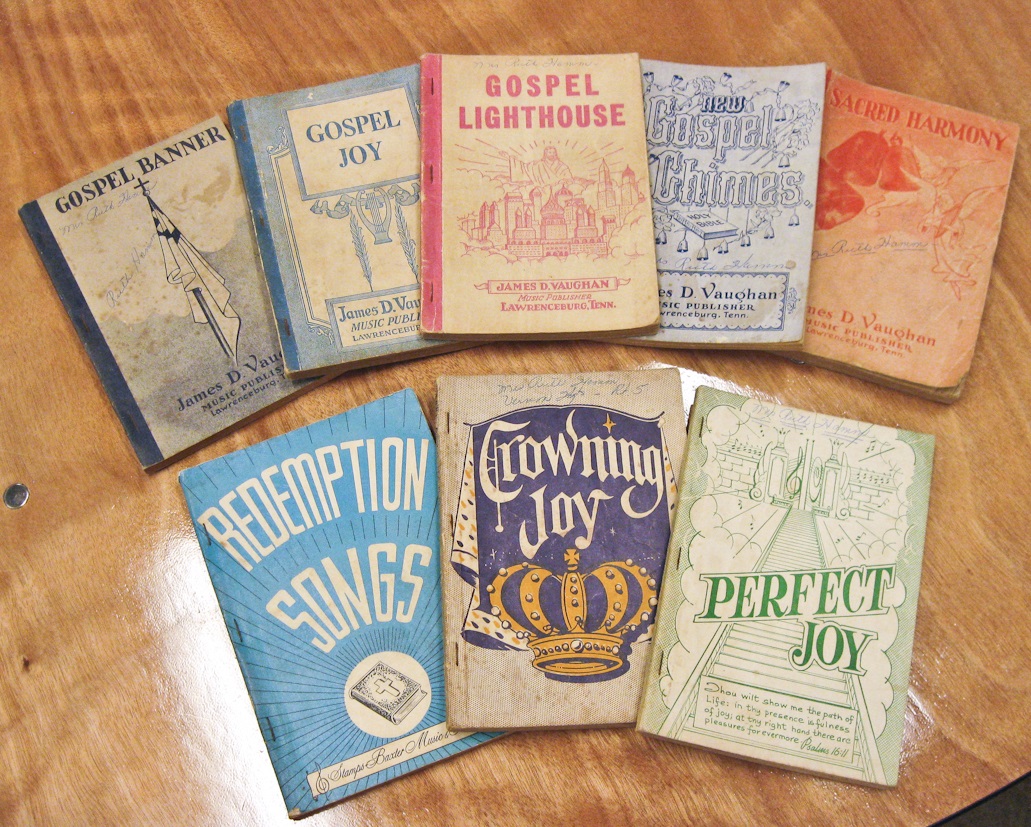
This event also provides us with a great opportunity to share part of our collection with you: shape note hymnals from the 1950s and 1960s, gifted to the museum by Dorothy Horne in memory of her mother, Ruth Hamm. I didn’t know much about shape notes before I did some research, but goodness, you don’t grow up Baptist without knowing somebody that remembers singing with shape notes. And I promise you, they’ll tell you all about it if you get them started.

The use of shape notes is rooted in the pre-Civil War South, and if you trace those roots back even further, you’ll find yourself in Great Awakening-era New England – though that’s a completely different blog post. For readers that don’t know, shape notes are a method of musical notation in which each tone is given a distinct shape and syllable to represent it. There are all sorts of shape note traditions, but Sacred Harp and Christian Harmony may be the most well known. The Sacred Harp tradition of shape note singing uses four syllables – fa, sol, la, mi – and four shapes. Christian Harmony – the tradition of The Old Fields Singers – uses seven shapes and seven syllables: do, re, mi, fa, sol, la, ti. Both schools are named for the “tunebooks” associated with them.  If you want to learn more about the particulars of shape notes, this site may be a good place to start.

A scale from Vaughn’s Up-To-Date Rudiments and Music Reader. © James D. Vaughn, 1951; photo © Birthplace of Country Music; gift of Dorothy Horne in memory of Ruth Hamm

Vaughn’s Up-To-Date Rudiments and Music Reader was one of the songbooks used by Ruth Hamm when she attended J. M. Dixon’s singing school in Kingsport, Tennessee. Mr. Dixon’s singing school was part of a larger shape note tradition. In the mid-19th century, singing schools sponsored by local singing conventions gained popularity in the south. These sorts of schools used a seven-shape system and relied on “little-books.” James D. Vaughn and Stamps-Baxter music publishing companies were popular suppliers of these kinds of songbooks. They also supplied the bulk of Mrs. Hamm’s collection!

Mrs. Hamm, according to her daughter, sang her entire life. “Mom grew up singing,” Horne remembers. “Her father sang in a quartet. She sang in a quartet, and she took us with her on the practice sessions and all of the places they sang. She later sang with the Happy Day Singers at the Senior Center here in Kingsport.” Throughout her singing career, Mrs. Hamm accumulated a variety of songbooks – 43 of which are now in our collection. They contain some of the most recognizable sacred songs in the south (and anywhere, for that matter): “Victory in Jesus,” “Rock of Ages,” and of course, “Amazing Grace,” to name only a few. Horne has a special connection with one songbook in particular. “My favorite songbook is Lasting Glory and the song I remember so much is ‘I Feel Like Traveling On,’” she recalls. “It is on page 29.  I can [still] see Mr. Dixon leading that song.”
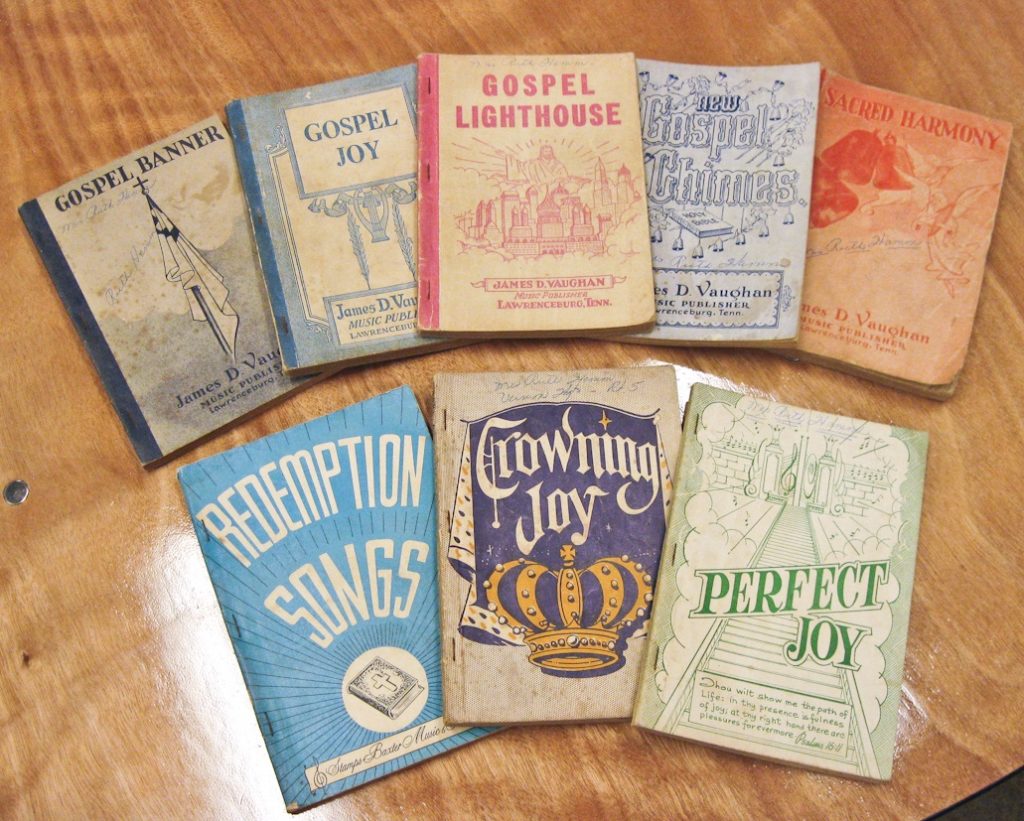
The songbooks pictured here feature some of our favorite covers – you have to love their colorful, mid-century aesthetic! Songbooks © Stamps-Baxter Music Company and © James D. Vaughn; photo © Birthplace of Country Music

Mrs. Hamm’s songbooks have been through a lot. They’ve been worn all around the edges, marked on, and creased, and some have even had a run-in with water. Those imperfections are part of what makes these songbooks so special: it’s apparent that they’ve been used over and over again. They are well loved. They tell us that singing with these hymnals was an important part of Mrs. Hamm’s life – and likewise, the lives of many that sang by shape notes throughout this region. For those that sang with shape notes, attending singing schools and community sings were once an integral part of keeping in touch with your neighbors. Some sources even indicate that the possibility of courting drew in young members – if they weren’t already “drew in” by their parents.

Community-driven shape note singing in the 1950s and 1960s saw a decline after gospel quartet performances became popular. Although the act of singing in church is still an essential part of the religious experience, there are not anywhere near as many singing schools as there once were. Don Wiley, leader of the Old Fields Singers, notes: “Although opportunities exist today, folks lead busy, even frantic lives.” Those busy days unfortunately mean that shape note singing isn’t as much a part of people’s lives now.

The social aspect of shape note singing might seem irrelevant in this age of social media, where people have more convenient ways to catch up with friends and can “court” with a few swipes on their phones. I asked Wiley what he thought the “most important” reason to continue the tradition of shape note singing was. Wiley gave me an interesting answer: “I can’t do ‘most important’…it seems that the singing itself either strikes a chord inside a person, or not.”

If you do some digging on YouTube, or better yet, join us at the Shape Note Sing on Saturday, I can almost guarantee you that the chord Wiley speaks of will resonate in you. There’s something irresistible about voices raised in gorgeous harmony, led only by a conductor and printed shapes on a page.
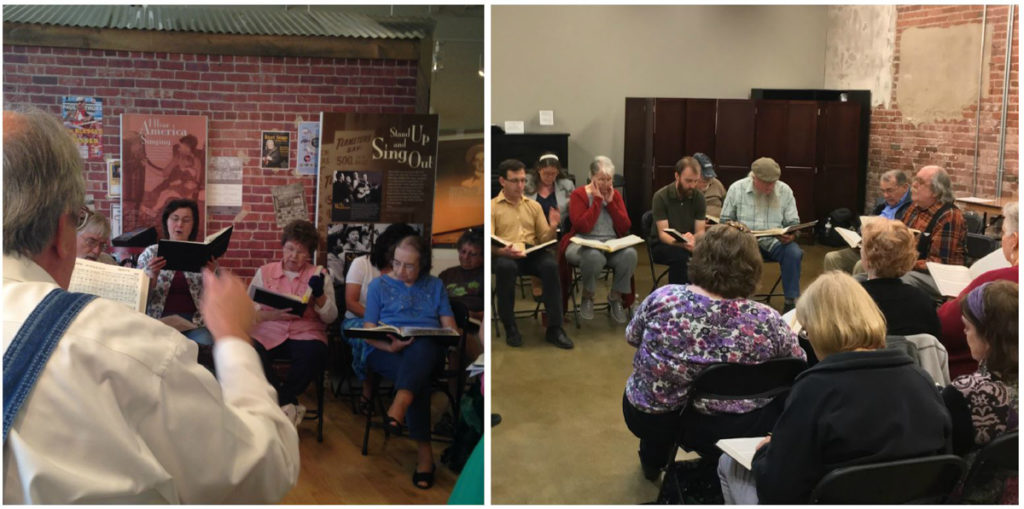
The Old Fields Singers and visitors at past Shape Note Sings in the museum. The event always includes the social aspect of a potluck lunch during the noon break! © Birthplace of Country Music

Hannah Arnett was an intern at the Birthplace of Country Music Musem in the summer of 2017. She is a senior museum studies and history student at Tusculum College, set to graduate in December 2017. You can learn more about Saturday’s Shape Note Sing here.
Live, Local, and Free: Come One, Come All to Museum Day Live!

Tomorrow the Birthplace of Country Music Museum will be filled to the brim with people – brand new visitors, regulars and old friends, people who passed by on the street and saw that there was something EXCITING going on inside, tourists who just happened to visit on one of our busiest days of the year. They all pass through our doors on Museum Day Live!

For those who don’t know, Museum Day Live! is a national event – held every September – where participating U.S. museums emulate the spirit of the Smithsonian Institution’s Washington DC-based facilities, which offer free admission every day, and open their doors for free to those who download a Museum Day Live! ticket. The event represents a nationwide commitment to boundless curiosity and the pursuit of knowledge wherever you are. Over 200,000 people downloaded tickets for last year’s Museum Day Live! event, and we had around 500 people at our museum in that single day. We are hoping for even more tomorrow!

Every year the new Museum Day Live! signage adorns our museum reception desk, our website, and social media as we reach out to as many potential visitors as possible for the event.

Despite the exhaustion that comes after Museum Day Live!, it is one of our favorite days. For one thing, the free admission means that we see visitors who might not otherwise be able to afford a museum visit. It’s always great to see whole families come through our doors ready to spend a couple of hours together exploring their local heritage and history. It also means that we see people who think country music isn’t for them but decided to come in on Museum Day Live! because it was free – more often than not, they have a great time, which means we might continue to see them as visitors in the future.

But one of the things we really love about Museum Day Live! is the opportunity it gives us to create some really fun and engaging programming for our visitors. Last year there were two Museum Day Live! events – one in March and the other during the usual September, both of which were themed around specific concepts or other events.

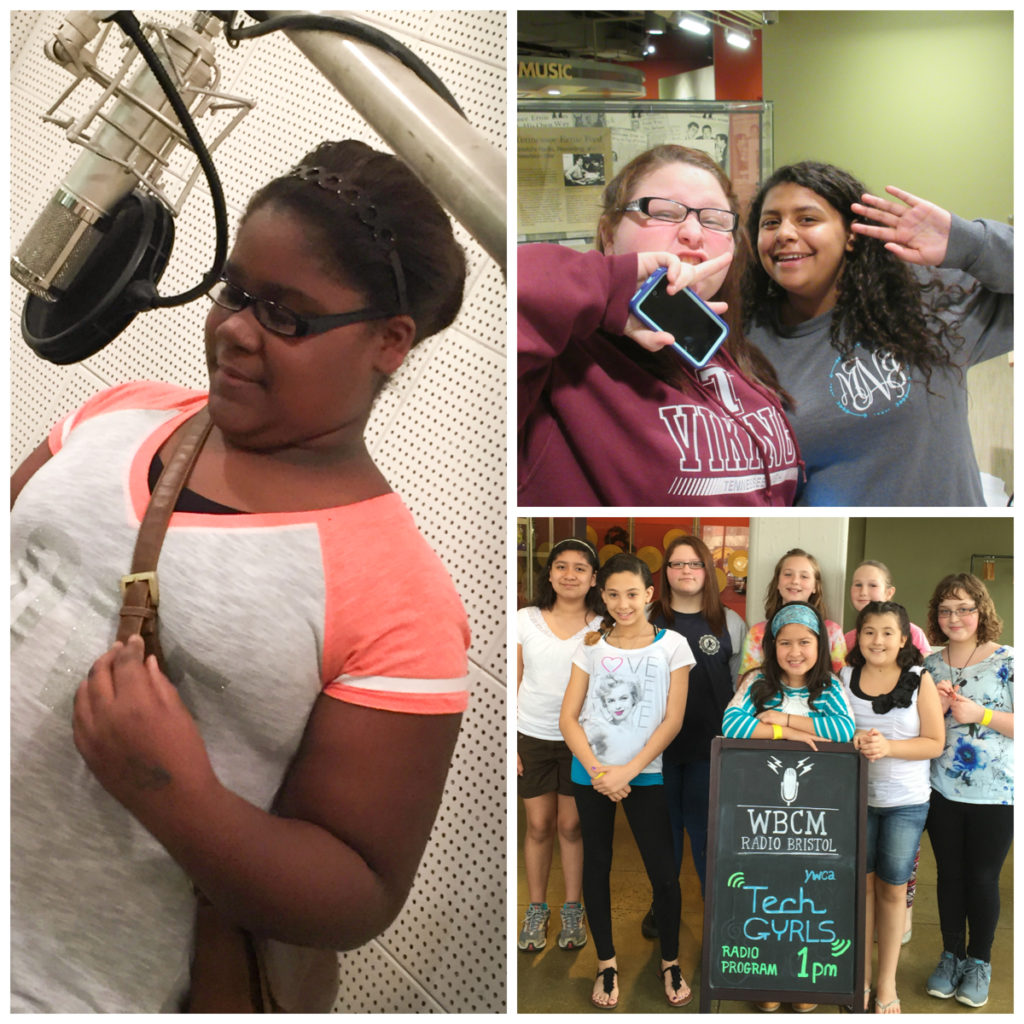
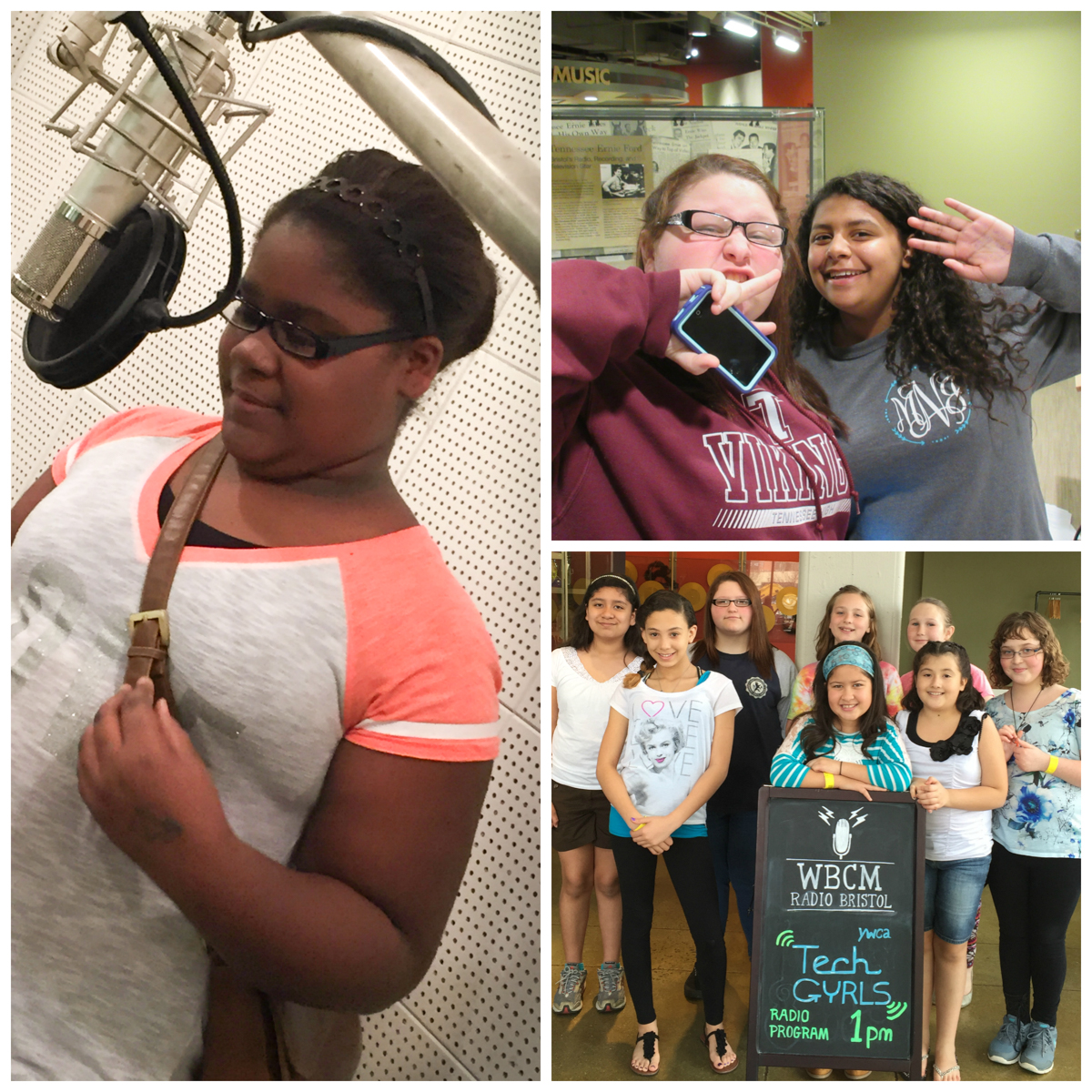
The March 2016 Museum Day Live! focused on encouraging all people – and particularly women and girls of color – to explore our nation’s museums and cultural institutions. After thinking carefully about programs that fit in with this theme, we approached the YWCA Bristol TechGYRLS, a local after-school program based on a STEM-focused curriculum and geared towards supporting girls aged 9—15 who would otherwise have limited access to and experience with technology. The goal of the partnership was to give the TechGYRLS access to a new technology and the opportunity to explore the music history of their hometown in a meaningful way through the creation of a special radio program on WBCM Radio Bristol, our in-house radio station.

From February to mid-March 2016, we hosted the TechGYRLS at the museum four times for a museum tour, to work on their radio script, to record the program, and on Museum Day Live! This project introduced the students to the museum, gave them opportunities to engage directly with radio technology and learn more about how a radio station works, and produce their very own radio program. The end result was a half-hour radio program that was played during the Museum Day Live! event at the museum, both on air and in the museum’s Performance Theater, attended by several girls and family members, along with museum visitors. It was really gratifying to see the TechGYRLS explore the museum and share their enthusiasm and learning on air. For a taste of the radio show, check out the clip here.

Our goal with this program was to create a new opportunity for an underserved group in our community, while also sharing an enjoyable learning experience that would tie into that group’s needs. Not only did this partnership accomplish that, it also resulted in many of the girls becoming advocates for our museum and for the musical heritage of our area – we have seen them as school group visitors sharing the things they learned with their friends, at our summer camp, and at special events. The experience also had a huge impact on museum staff through a wonderful feeling of pride at what the girls created and the possibilities of future partnerships with the group. This program is also now saved in our archive collection for future use. A win-win for everyone involved!

The TechGYRLS brought a lot of energy and enthusiasm to the museum and their radio show! © Birthplace of Country Music

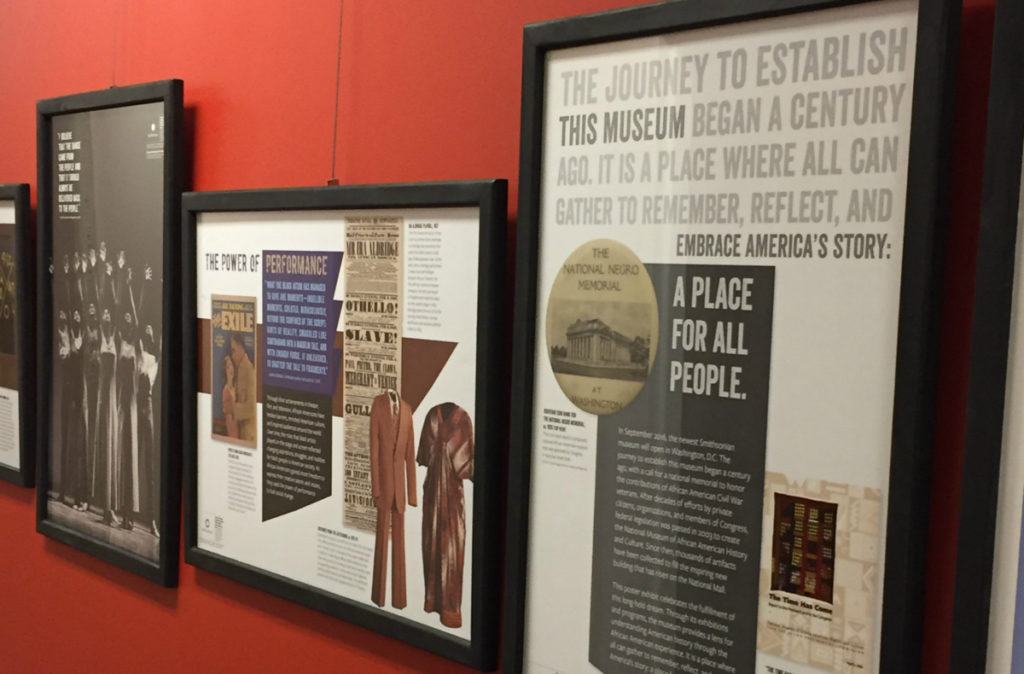
September 2016’s Museum Day Live! coincided with the opening of the Smithsonian’s National Museum of African American History and Culture (NMAAHC), which gave us the opportunity to celebrate this historic opening with them. As a Smithsonian affiliate, we got a poster exhibit that highlighted the history behind the NMAAHC’s creation and several of the artifacts and stories featured in the museum. These vibrant posters were a wonderful way to introduce our museum visitors to the new Smithsonian museum, inspiration for them to plan their own visit to DC to see it in the future!

Just a few of the posters exhibited in the NMAAHC poster exhibition. © Birthplace of Country Music

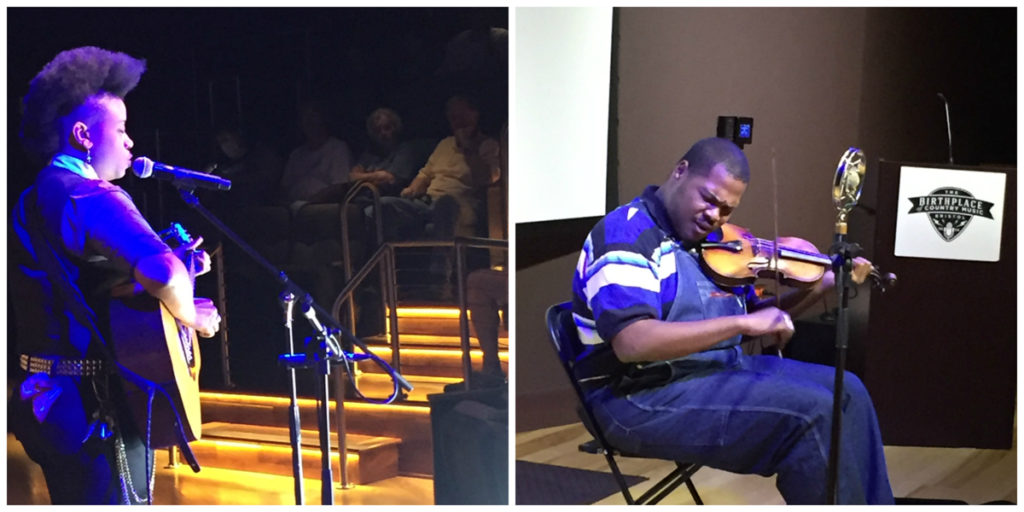
We also live streamed the NMAAHC opening ceremonies and concerts in the museum’s Performance Theater, giving people the opportunity to participate from afar as luminaries and performers from President Obama and Congressman John Lewis to Angélique Kidjo and Patti LaBelle marked the day with words and song. We had our own performance by local musician Amythyst Kiah, belting out her signature “Jolene” along with a variety of other beautiful old-time and traditional songs, and we offered regular tours of our permanent exhibits with the focus on the African Americans who contributed to the success of the Bristol Sessions recordings and the early development of “race records.”

What was particularly great about this Museum Day Live! was that it led to continued programming in the months that followed with our “Lift Every Voice” series, inspired by the NMAAHC’s “Lift Every Voice” initiative to showcase the depth and breadth of African American history and culture across the nation and around the world. With our series, we created several radio spots focused on the history of “race records,” hosted a talk by CeCe Conway on the history of the banjo followed by a wonderful performance by Jerron “Blind Boy” Paxton, and invited Dr. W. A. Johnson of Lee Street Baptist Church and Professor Jerry Jones of Emory & Henry College to lead a community conversation on the African American experience in Bristol.

Amythyst Kiah and Jerron “Blind Boy” Paxton gave crowd-pleasing performances as part of the September Museum Day Live! and related programming in 2016. © Birthplace of Country Music

And so we come now to this year’s Museum Day Live! As always it is the week after our huge music festival, Bristol Rhythm & Roots Reunion, and so we always go into it a little tired but we come back out of it re-energized by the numbers who visit and the great activities they enjoy. This year will be no different, and we are excited about the variety of things we have planned for the day. Some – like the screening of American Experience: Tesla and access to a Smithsonian Spark!Lab soundscape activity kit – are meant to go hand-in-hand with Things Come Apart, our current special exhibit from the Smithsonian Institution Traveling Exhibition Service. Others – like a performance by fiddlers Jake Blount and Tatiana Hargreaves – tie in well with our music content. All of them will bring a special Museum Day Live! experience to our visitors.

Hope to see you there!

René Rodgers is the Curator of Exhibits & Publications at the Birthplace of Country Music Museum. For more information about this year’s Museum Day Live! at the Birthplace of Country Music Museum, check out this link.


Jimmie Rodgers: Reflections on the Musical Genius of The Singing Brakeman

Today marks what would have been the 120th birthday of America’s Blue Yodeler, the Father of Country Music – Jimmie Rodgers.

Take a second out of your busy day today and listen to just one song from Jimmie Rodgers. Any song. I promise you’ll be happy you did. That’s what I’m doing right now, listening to “I’m Free from the Chain Gang Now,” a sentimental heartbreaker of a tune, a song so powerfully delivered that in the past it has moved me to tears.

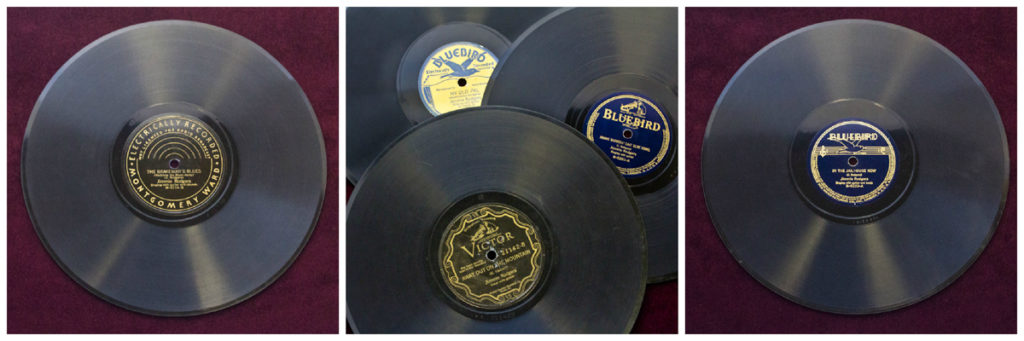
We have several Jimmie Rodgers records in the museum’s collection. As can be seen here, his songs were recorded and distributed on a variety of labels. © Birthplace of Country Music; Records are the gift of Betty Lou Dean and Roger Allen Dean, and Jim and Joyce Prohaska

It’s hard to not become immersed in the scenes Jimmie paints through his ease of delivery and phrasing, his smooth yet edgy and warbled vocals, the sincerity of a person who truly believes in what he’s singing. But what amazes me more than anything about Jimmie’s music is how relevant and fresh it still seems today. I guess many would call his music timeless, which it certainly is – but more than that, his music has a depth that has seldom been captured on record. Jimmie’s music hits you right in the gut. It has the ability to make you laugh out loud and then make you cry; it makes you yearn for the past and look forward to the future. His music is music for the heart and soul. It’s alive. Every time I put a needle to one of his records or when the sound of his signature blue yodel cuts through my car radio speakers, I can’t help but think Jimmie is giving me a wink and a nod.

As you may already know, Jimmie Rodgers is one of the most celebrated country musicians of all, and deservedly so. Possibly no other country artist has been so heavily imitated or influential. He was much more than a hillbilly artist that could yodel (though his yodel was top of the line). Jimmie was an innovator, and a walking musical juxtaposition in the most beautiful of ways. When I think of Jimmie I think of the complex and often conflicting images he portrayed through his music – the rambler, the sentimental crooner, the caring son, and the rounder, just to name a few. Many speculate that had he lived longer, and as his appeal and development as a musician continually grew, he would have been one of the most celebrated American musicians without the constraints of genre.

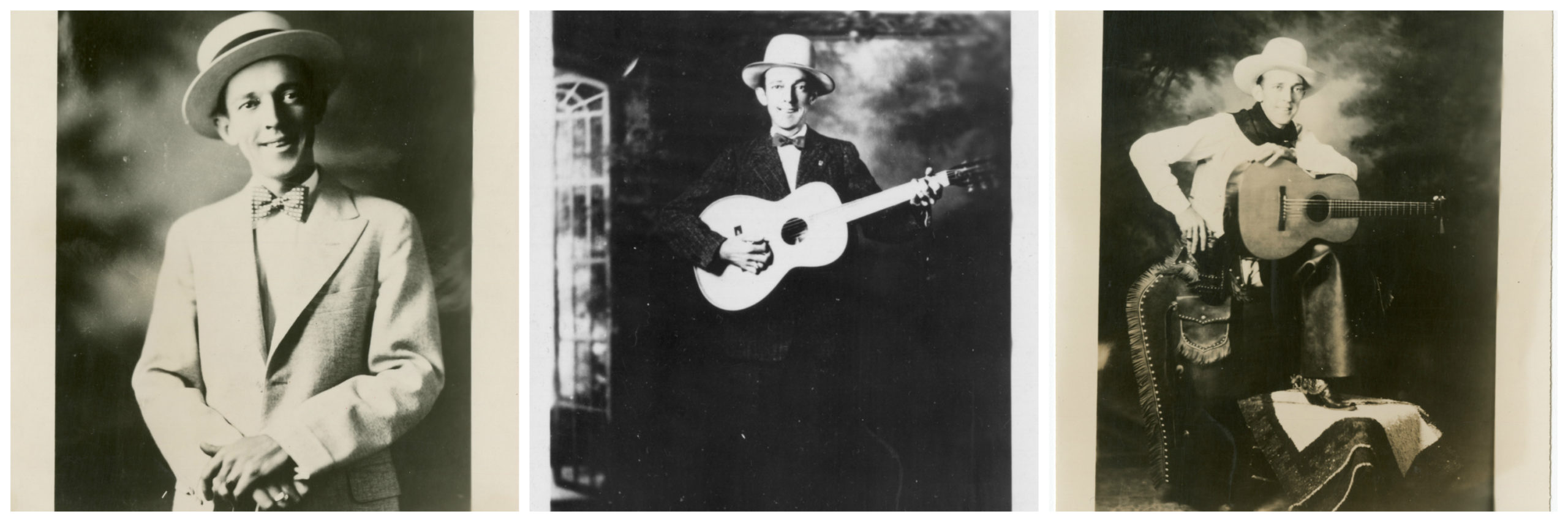
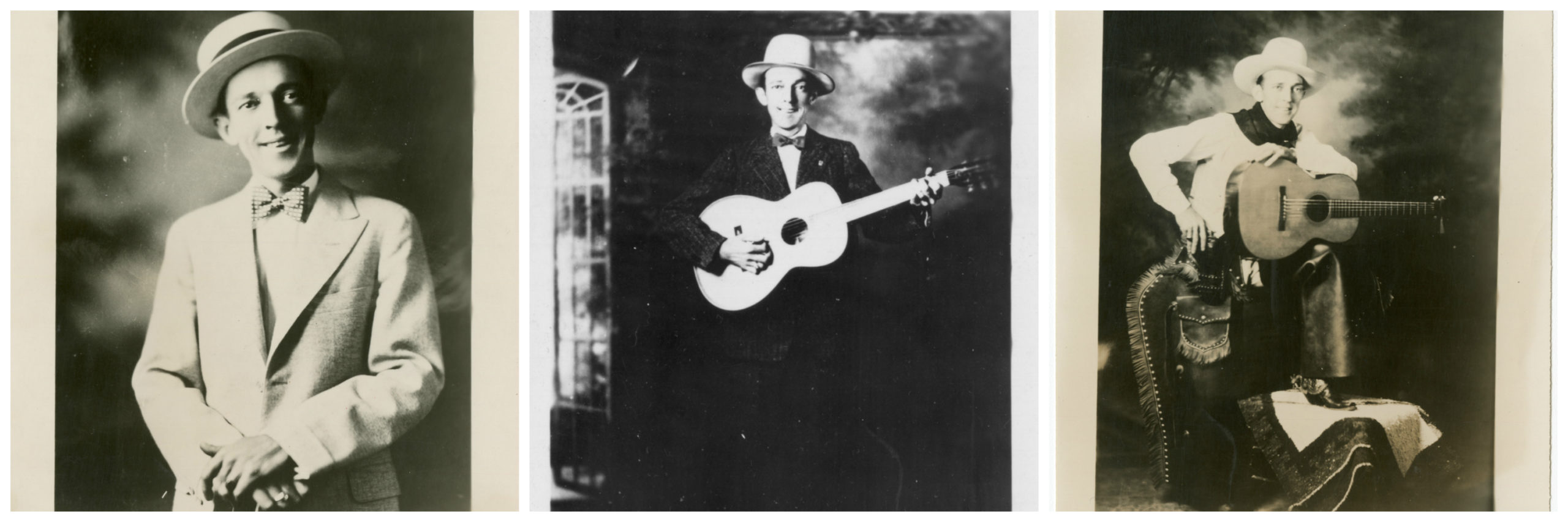
Publicity shots of Jimmie Rodgers, including one where he is in “cowboy” persona. From the John Edwards Memorial Foundation Records, #20001, Southern Folklife Collection, Wilson Library, University of North Carolina at Chapel Hill

Many of us in Bristol and central Appalachia are familiar with Jimmie’s story and his music. One of the reasons our organization, including the radio station, museum, and festival, exists is in large part due to the impact Jimmie had on the world. Of course, he had his first big break here in Bristol recording two sides: “Sleep Baby Sleep” and “The Soldier’s Sweetheart.” That record, just an average seller, was recorded on August 4, 1927, part of what would eventually become known as the celebrated Bristol Sessions.

Let’s be honest: those two sides didn’t exactly turn the world upside down upon their release. But the music that would soon follow sure did. Lucky for us Victor Talking Machine Company executive Ralph Peer had insight and vision, and he followed a hunch that Jimmie had a lot more to offer, inviting him for a follow-up session just a few months later at the Victor studio in Camden, New Jersey. Jimmie would hit his stride at the next session, which would yield a massive seller – “Away Out on the Mountain” and “Blue Yodel No. 1 (T for Texas)” – and from this point, he didn’t slow down. He even appeared in a movie short called The Singing Brakeman, released in 1929 for Columbia Pictures; this short is the only known video footage of Jimmie singing and features three of his well-known tunes: “Waiting for a Train,” “Daddy and Home,” and “Blue Yodel No 1.” His distinctive sound continued to develop up to his final recording session just a few days before his death from tuberculosis on May 26, 1933 at the age of 35.

But instead of giving you a recycled history lesson of the greatness that is Jimmie Rodgers, I thought it would be much more interesting and fitting to mark this day by talking to musicians who love his music like I do. And so in celebration of Jimmie on his 120th birthday, I asked some of today’s greatest country and roots musicians to reflect on his music, to talk a little about how Jimmie Rodgers influenced them and how he might be found in the music they create today. A huge thanks to all those musicians for taking the time to share their thoughts on the genius of Jimmie Rodgers:

Tim O’Brien 

“Jimmie Rodgers just had the juice. He guided Ralph Peer to a real sweet spot in southern music. He played the part of the rake and ramblin’ boy and may not have needed to act that much to do so. Listen to most of the other Bristol Sessions singers and you’ll hear that swagger break through the pops and crackles. Jimmie Rodgers knew he was cool, and every recording gave him a way to show everyone.”

John Lilly 

“I was initially struck by Jimmie Rodgers’s yodeling, which I still find to be amazing. As I explore his recordings, however, I am captivated with the immense variety of accompanists he recorded with and the range of musical emotions he was able to express. He sounded great whatever the setting, from a full orchestra to just his own voice and guitar.”

Jerron “Blind Boy” Paxton 

“The music of Jimmie Rodgers has gone across culture since it was introduced to the world. There are musicians all the way in India that have copied Jimmie Rodgers’s sound note-for-note. While record companies marketed him towards white and hillbilly audiences, his records often found their way into black homes. The irony that a person who was rumored to have gotten the ‘blues’ in his blue yodel from listening to Tommy Johnson as he entertained white patrons at hotel parties in Mississippi and have it repackaged and purchased by people in the black community is of a particular queerness that can only exist in America. With the conversation being had at the present time about white people playing blues and other forms of black music, I wonder if we would be having this conversation if they sounded as good as Jimmie. His respect and take on music from outside of his culture should be an inspiration.”

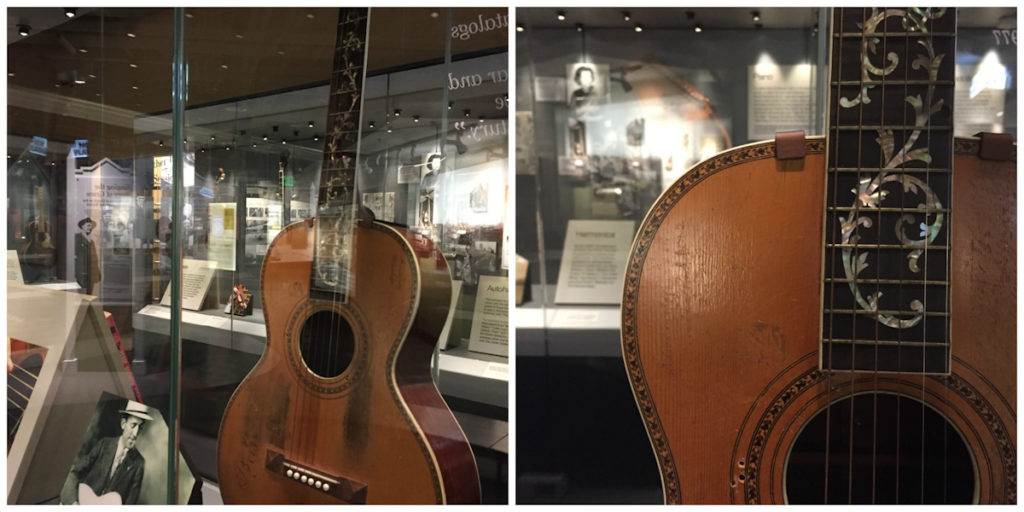
This Oscar Schmidt guitar, on display in the museum’s permanent exhibit, was owned, played, and signed (in the upper left corner, faintly legible now and not easily seen in this photograph) by Jimmie Rodgers. © Birthplace of Country Music; on loan from the collection of Joseph R. Gregory

Alice Gerrard 

“It seems as though Jimmie and his songs have been part of my musical life as long as I can remember. That bluesy voice, that yodel, and those songs…. I never much liked the Swiss type of yodeling but Jimmie’s made sense to me and was so much more accessible. Plus it had so much feeling in it.”

Roy Book Binder 

“First heard Jimmie Rodgers back in the ‘60s… I was really getting into old-time country blues…and was a fan of Emmett Miller. Jimmie Rodgers was a white guy who played and sang some blues, he was a yodeler, a singer of sentimental ballads…you name it, and he could make it his own! I admired that, he was hard to categorize! I do believe in some ways Jimmie Rodgers had an impact on my approach to building a pretty eclectic repertoire.”

David Peterson 

“Jimmie Rodgers made his way into my music most directly through Bill Monroe and his interpretation of those songs. Of course, a serious study of Rodgers himself has followed over the years. Anyone studying modern 20th-century western music will realize just what an influence Rodgers was on almost every form of popular music, including rock n roll.”

Marty Stuart 

“I think Jimmie Rodgers exists. Perhaps he’s a reclusive ghost who lives somewhere beyond the edge of the universe. Of course, proof that the Father of Country Music walked among us can be found in his Victor recordings made in the early days of the 20th century. His guitar hangs in a vault in Meridian, Mississippi. I once sat in a chair he made. I’ve held his striped railroader’s hat. I have one of his brakeman’s lanterns, and the briefcase that contained his songs and was laid inside his casket on the funeral train from New York City back to Mississippi. As his marker in Meridian reads: ‘His is the music of America.’  Although the average American doesn’t know his name, Jimmie Rodgers is an integral part of our atmosphere. He is synonymous with country music.”

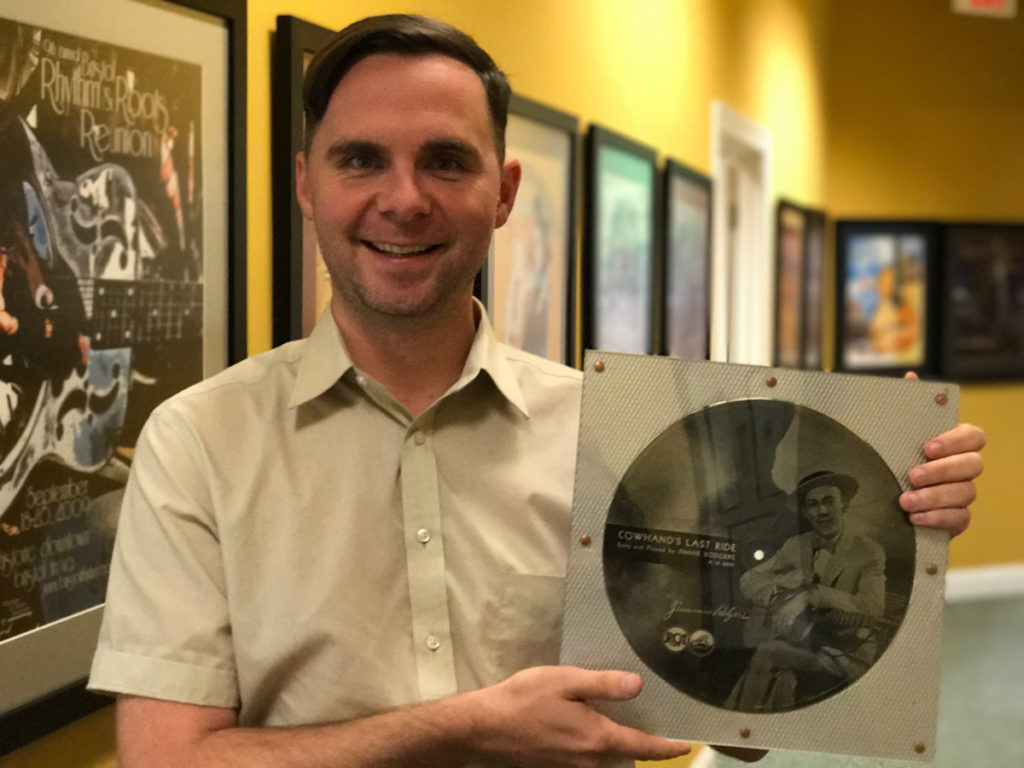
Kris holding a Jimmie Rodgers picture disc, the first disc of this type known in country music. This disc appeared at the end of Jimmie’s career – only a few hundred copies were made, and it was released after his death – and bears his recordings of two songs: “Cowhand’s Last Ride” and “Blue Yodel No. 12.” © Birthplace of Country Music

And so this brings us full circle – if you’re taking the time to read this, I urge you to spend just a few more minutes today and seek out Jimmie’s music. Listening to a Jimmie Rodgers record is much more powerful than anything I can possibly write. Seriously. Put on a song of his you’ve never heard. He has a surprisingly vast catalog for having a recording career of only five and a half years. Listen to “Gambling Polka Dot Blues” or “Prairie Lullaby” or “Blue Yodel No. 9” or “I’m Sorry We Met” or “Never No Mo” or…really any of his songs.

Take it from someone who has listened to his catalogue back and forth on repeat for years – there’s always something new to discover. And if you listen close enough, you’ll soon find the Singing Brakeman can still be heard in the voices and sounds of musicians across the country, and for that matter across the world.

Happy Birthday, Jimmie.

Kris Truelsen is the Producer at Radio Bristol. Tune in to the station today to hear Jimmie Rodgers on the hour all day long.

Fun, Fun, Fun: Families Make, Take, and Create at the Museum

At the end of the day this past Saturday we found nine marbles in the museum vault area, locked to the public, inaccessible to all but the few of us who have a key. How on earth did those marbles get there?

It sounds like a mystery or a riddle – you know like the one where you find a body in a pool of water in a locked room with a cat in the window and you have to figure out what happened.* Our story is much simpler, the result of having around 150 children and adults in the museum for our Family Fun Day maker event, held on Saturday as complementary programming to Things Come Apart, our current special exhibit from the Smithsonian Institution Traveling Exhibition Service (SITES).

We have worked hard to find cool ways to engage the public with this SITES traveling exhibit, and one of our earlier blog posts went into more detail about the planning that went into this exhibit and the related programming. Our biggest event during the exhibit has been Family Fun Day – filled to the brim with a variety of maker-type activities. Check out the pictures and videos below to get a real sense of the fun, invention, and sheer enthusiasm that kids of all ages, from 2 to 92, brought to the event – and to find out how those marbles got in the vault!

© Birthplace of Country Music; photographer: Billie Wheeler

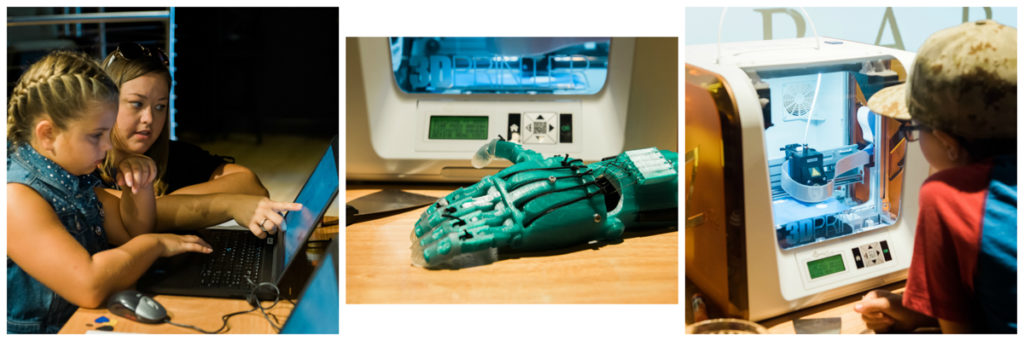
The Bristol Public Library brought their 3D printer to the museum, giving kids and adults the chance to explore the software used to create 3D designs and then see the printer in action. To illustrate the printer’s capabilities, they had a variety of printed objects on display from small hearts to a flower in a vase to a megalodon tooth – and even a prosthetic hand, made for the charity Prosthetic Kids Hand Challenge. Individual guitar picks embellished with text chosen by each person were also designed, printed, and given out – perhaps inspiration for future engineers AND musicians!

© Birthplace of Country Music; photographer: Billie Wheeler

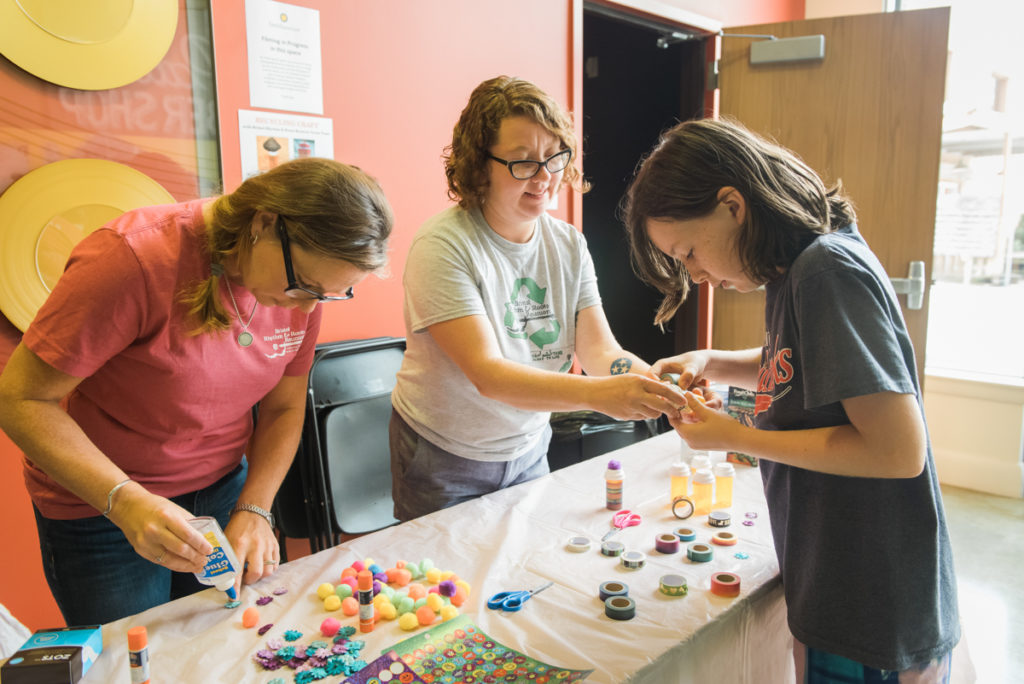
Upcycling is cool these days; all you have to do is hit Pinterest to find hundreds of craft ideas to make from common recyclables. Our Bristol Rhythm & Roots Green Team is always looking for new ways to be crafty with kids, and they brought out the washi tape, stickers galore, pom poms, and cloth flowers – plus a 5-pound bag of rice and a box of dry macaroni (because it’s never a real craft project until you use dry macaroni…) – to make old plastic bottles into maracas. There was a whole lot of shaking going on throughout the day!

Wood and metal worker extraordinaire Terry Clark, along with his wife Deb, brought items big and small with them to show our visiting families the cool and functional art you can make from a host of “found” objects. From the dragon weather vane to the lamp made from World War I helmets, the creativity on display was fantastic. And while kids got the chance to take away colorful iron spigots, I got the chance to see a steampunk spinning wheel in action.

© Birthplace of Country Music; photographers: Billie Wheeler and Rene Rodgers

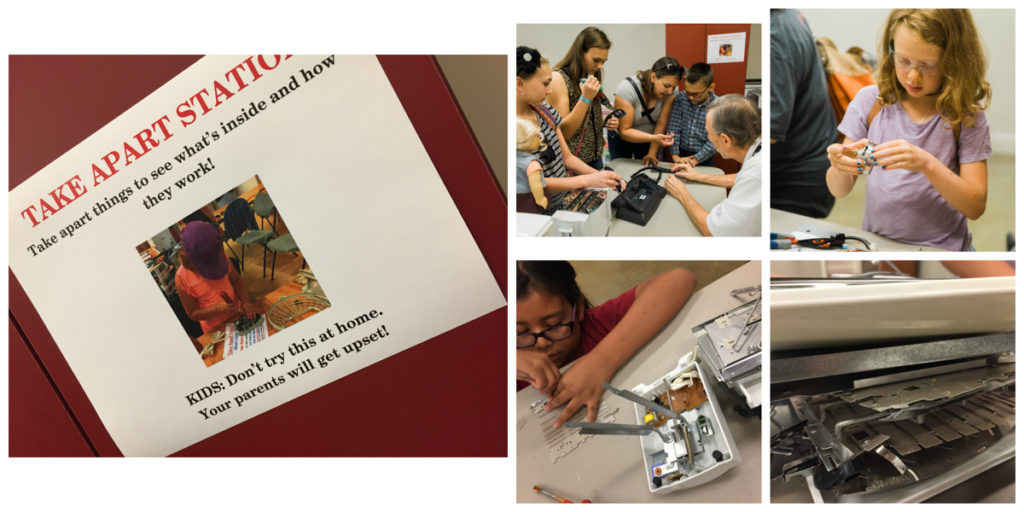
A “take apart” table proved to be one of our most popular activities. We had kids clustered round the table for the entire event, brows wrinkled, tongues sticking out, intense concentration on display as they unscrewed, pried open, pulled off layers, and took every single electronic completely and totally apart. At hour three of the day, I had to run to the local thrift store and buy some more items. Several of the kids took home bits and bobs from their taken apart objects, excited to show other members of their families and their classmates at school what they got up to at the museum over the weekend. It was wonderful to watch the excitement the kids felt as they examined the innards of all these common, everyday objects. And just in case that excitement carried over to home, we put up a sign saying “KIDS: Don’t try this at home. Your parents will get upset!”

© Birthplace of Country Music; photographer: Billie Wheeler

The Smithsonian’s Lemelson Center for the Study of Invention and Innovation’s Spark!Lab provided three activity kits with the Things Come Apart exhibit. One of these is focused on creating soundscapes by sending marbles along a variety of wooden pathways that have different methods of producing sound. This soundscape activity has proved hugely popular with all ages, from toddlers to teachers. For Family Fun Day we set up the soundscape activity kit in the gallery, not too far from where the locked doors to our vault are found. Long pathways, tall pathways, curving around on themselves pathways were built; marbles were launched; bells rang, xylophones clanged, metal clinked, and wood knocked – and marbles went absolutely everywhere. Despite our eagle eyes and unbeknownst to us, quite a few escaped, shooting through the small crack under the vault door, only to be found later by Emily, our collections manager. We might still be finding marbles for days to come.

Photograph by Jessica Turner

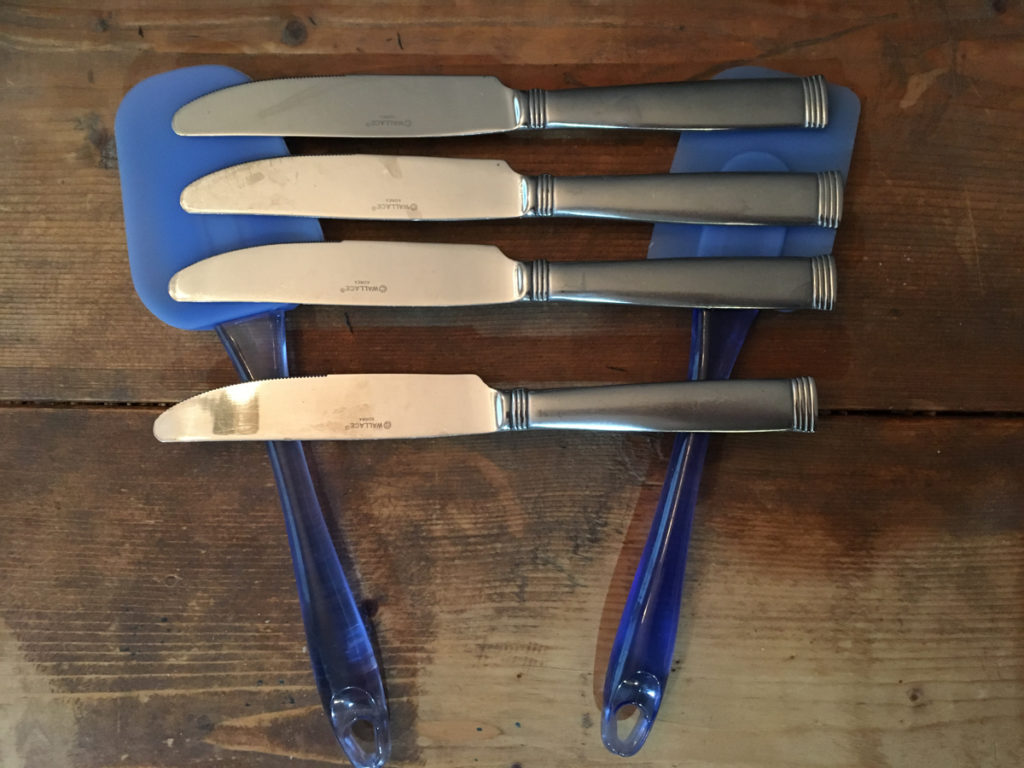
Families also got the chance to take a maker project home with them – we had a take-home instructable on how to create your own “wrenchophone,” generously shared with us by Maker Media from the book Make: Musical Inventions, DIY Instruments to Toot, Tap, Crank, Strum, Pluck and Switch On by Kathy Ceceri. This project showed kids how to make their own musical instrument at home – in the instructions, wrenches were used, but our museum director’s son Ian got creative, making his own version with butter knives and rubber spatulas. Apparently the spatulas helped to make the knives really ring out!

While all of the activities held on Family Fun Day were great, and the enthusiasm and engagement from the participants was especially wonderful, it was also really satisfying to see the other ways that kids were inspired to create and make in the museum. One of our visitors bought a small Lego kit from The Museum Store and built a small ukulele. But being in a museum meant that he didn’t stop there – he then used the plastic packaging (upcycling!) from the washi tape to create a display case for his ukulele, and wrote out his very own museum label for it to be on display during the event. A future curator perhaps!

© Birthplace of Country Music; photographer: Rene Rodgers

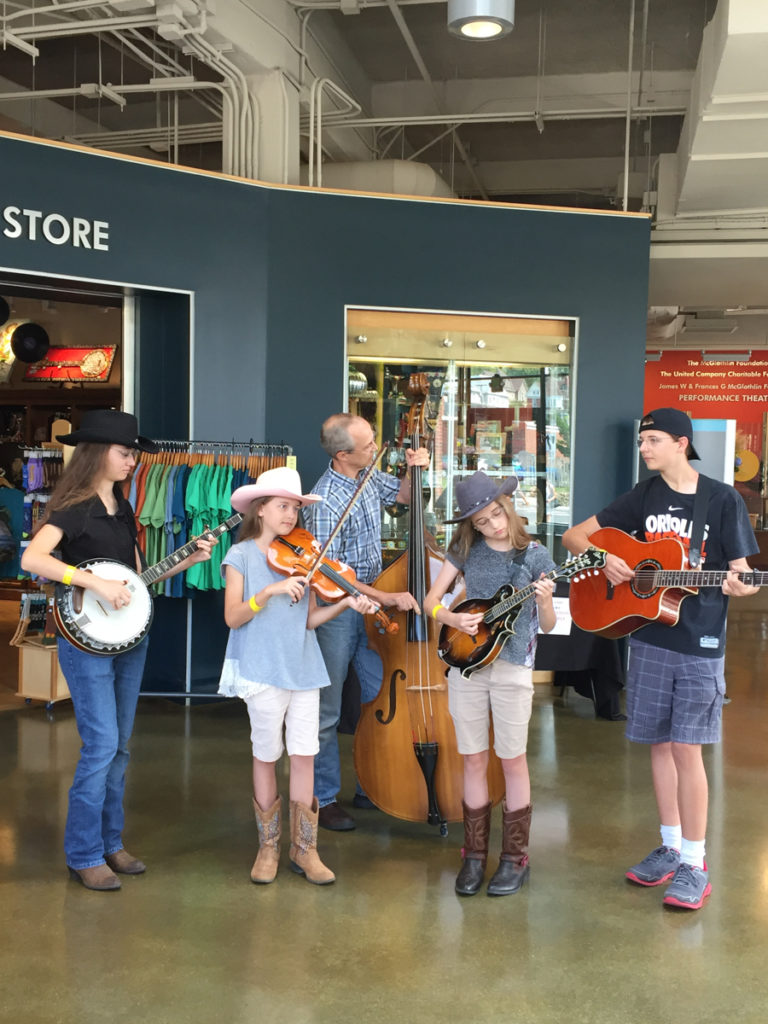
Finally, to cap it all off and to really underline that music is the center of all that we do, a family of five musicians stopped in and asked if they could share some of their tunes with our visitors. With songs from the 1927 Bristol Sessions and The Carter Family in their repertoire, it was a spontaneous and perfect end to a fun day!

René Rodgers is the Curator of Exhibits & Publications at the Birthplace of Country Music Museum.*And by the way, the answer is that the body is that of a goldfish…