Museum Archives - Page 26 of 34 - The Birthplace of Country Music
Listen
Play
Loading station info...

Let’s Make Beautiful Music Together: The Whys and Hows of Community Jams

The museum has recently started a monthly community jam, inviting budding and expert musicians alike to come to the museum and make beautiful music together.

So, what exactly is a “jam,” you might ask. A quick search of the internet will return many theories on how the term “jam” originated. My personal favorite is that after a night of shows in the early jazz clubs, members of several bands would gather or be “jammed” together on small bandstands to improvise and play as a group, and thus the jam session was born.

A better definition for jamming would be an event where musicians come together to play and sing music with and for each other. The musicians may or may not know each other and will typically have varying levels of expertise and playing ability. There could be those that just come to listen and observe, but the common goal for a jam is to have fun playing, singing, and listening to music together.
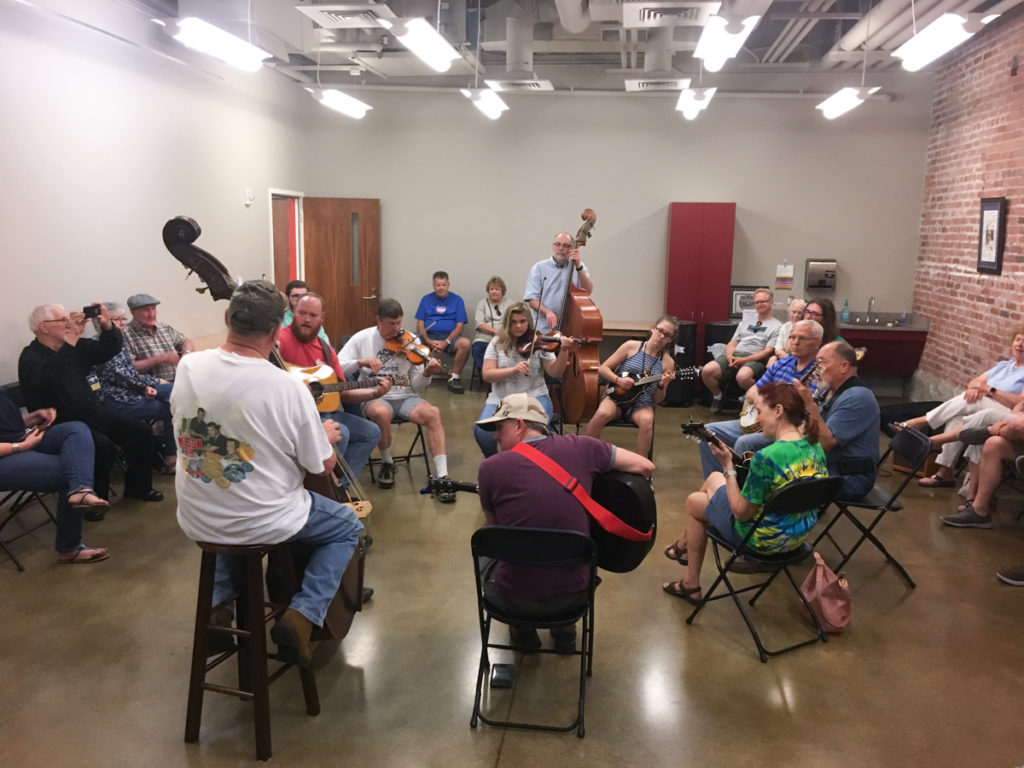
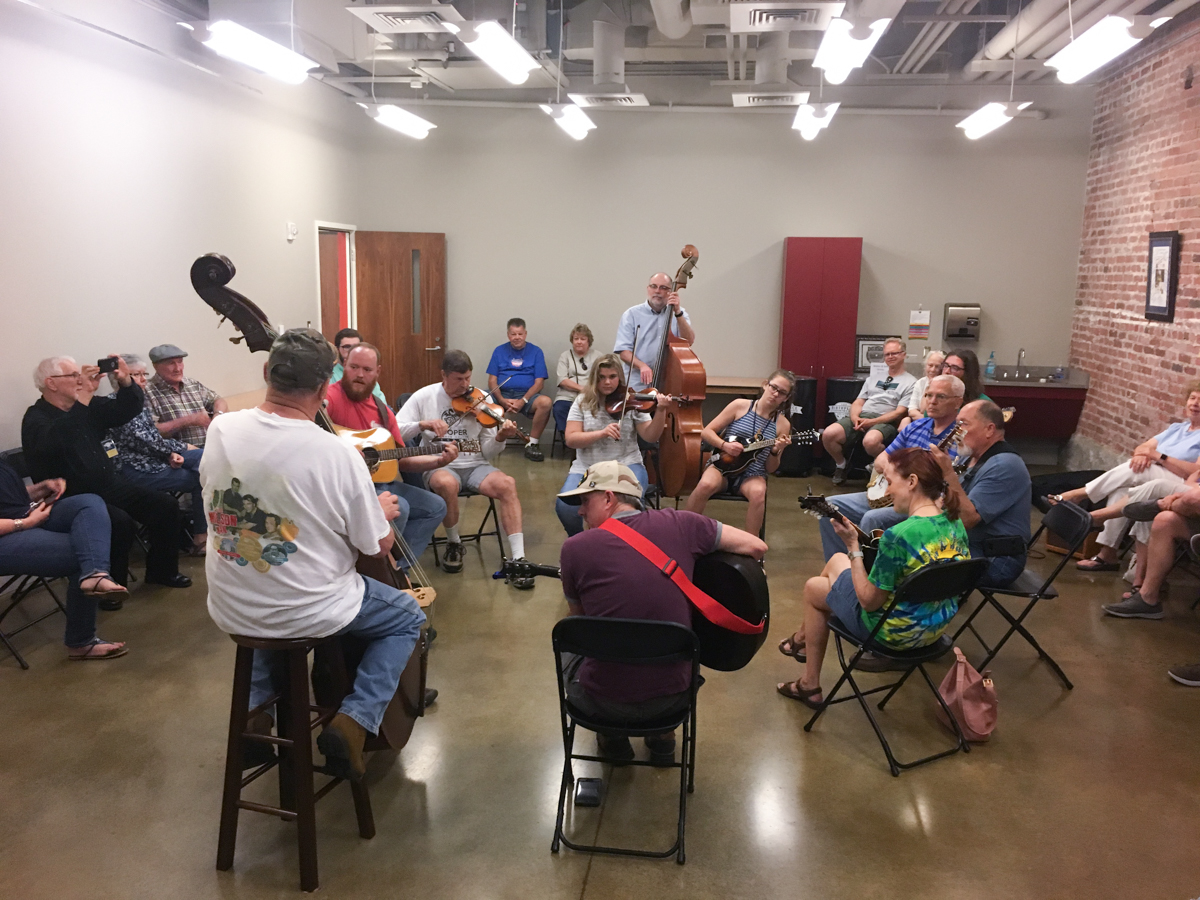
A photograph of a group of jammers in the museum's Learning Center -- they are arranged in a circle of about 10-12 musicians.
The first monthly jam session at the museum brought out a diversity of musicians and quite a few people who were there just to enjoy good music. © Birthplace of Country Music

In a jam, it helps musicians to get down to the business of playing music together if they have an idea in advance of what to expect. In other words, having a basic understanding of what is going on in a jam helps facilitate the playing and the flow of the jam. And there is a general jam etiquette that pickers try and follow, giving everybody the best opportunity to participate.

So let me act as your etiquette coach and share the important elements of what you need to know to get the most out of a jam and to be the perfect jammer!

The Three “Musts”

  1. You must be in tune. Before starting and throughout the jam, use an electronic tuner to keep yourself in tune.
  2. You must be on the right chord. Do your best to pick up on the chord changes as quickly as possible. It helps to know the common guitar chords by sight even if you don’t play guitar. You can then watch a guitar player who knows the chords and follow him or her.
  3. You must stay with the beat. Try not to rush, drag, or lose your place in the song.

The Circle

With jams, players arrange themselves in a circle so they can see and hear each other as they play. How large the circle is depends on the preferences of the players. Songs are selected and lead by individual jam members one at a time, going around the circle. The player whose turn it is selects the song and tells everyone the key he or she will sing or play it in. That person is now the leader of the song. Follow the leader!
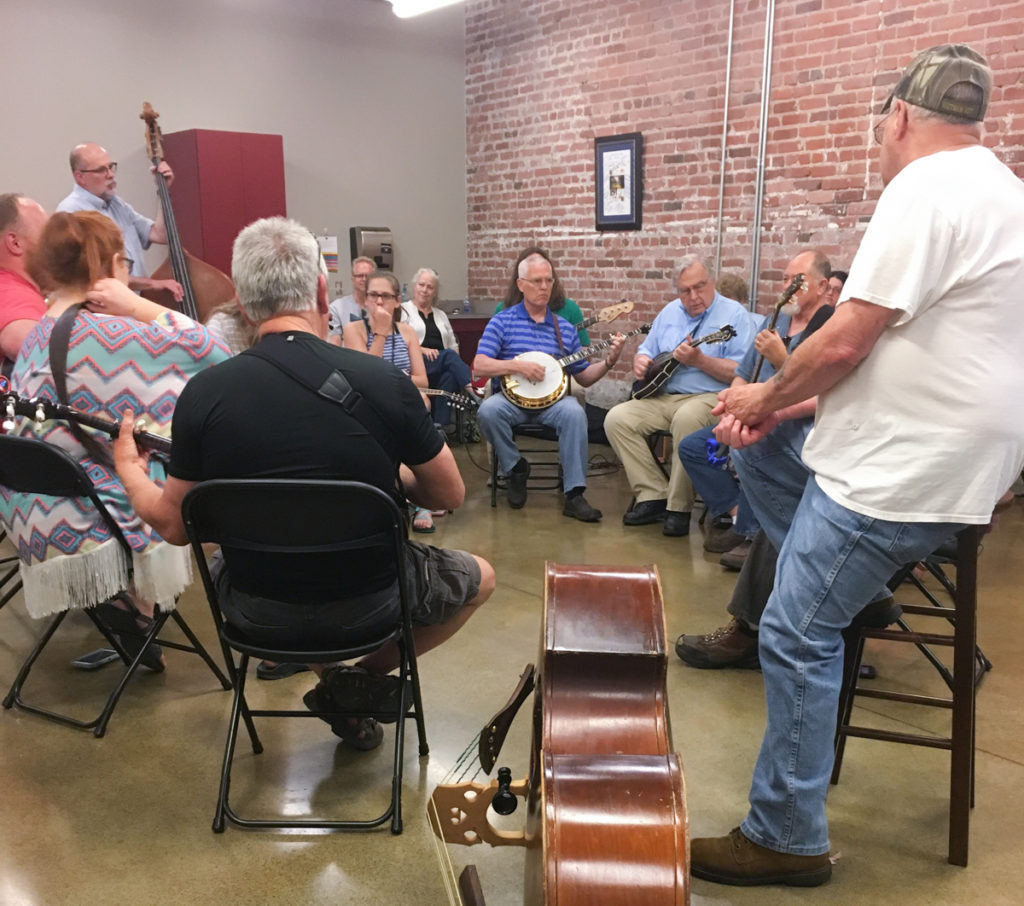
A photograph of a circle of jammers, with a bass on the floor in the foreground.
The circle of jammers may start off small, but it can grow as more join the group, or you can even have breakout groups with different musicians joining together for different songs and styles of playing. (c) Birthplace of Country Music

The Leader

Ok, it’s your turn in the circle. So what do you do? First, you need to tell everyone your song selection and the key it’s going to be played in. And then you must lead this song. This is accomplished by first briefly discussing things like how fast the song will go, who will be kicking off (starting) the song, and any other information that might be helpful to those who may not have heard or played the song before.

Playing Together

Once the leader shares the musical details, the song kicks off – and you are off and picking! A song that is sung will typically start with the kick off and a short instrumental break (solo), followed by a verse and the chorus, and then repeated with break, verse, chorus, break, verse, chorus with different instruments providing the breaks each time.

Body language and eye contact play a very important role in deciding who will play a break in a song. While the song is being sung, the leader is looking around the circle in search of those who would like to take a break (solo). Pickers that feel comfortable playing a break will also be making eye contact with the leader. After a verse and chorus have been sung, the leader will nod toward the picker he or she has chosen for the break to take the floor – the melody and chords of the verse are typically played during this solo interlude.

After the break is played, the singer will sing another verse and chorus, and another picker will be chosen for the next break. These steps are repeated until all verses are sung and everyone who wants to has had a chance to take a break. Pickers that are not comfortable playing breaks simply avoid eye contact with the leader – so keep your eyes down until you’re ready! (It makes me think of what happens at an auction – where it’s best to sit on your hands so that you don’t accidentally buy something…) However, if you make eye contact by accident and the leader should give you the nod and you don’t want the break, a simple shake of the head signals to the leader that you want to pass. After the final break has been played, another chorus is sung signaling the end of the song.

Instrumental songs are led much the same way, minus the singing, of course. After everyone has had a chance to take their break, the picker that started the song with the kick off will play the last break and signal the end of the song, typically with an outstretched leg into the circle.
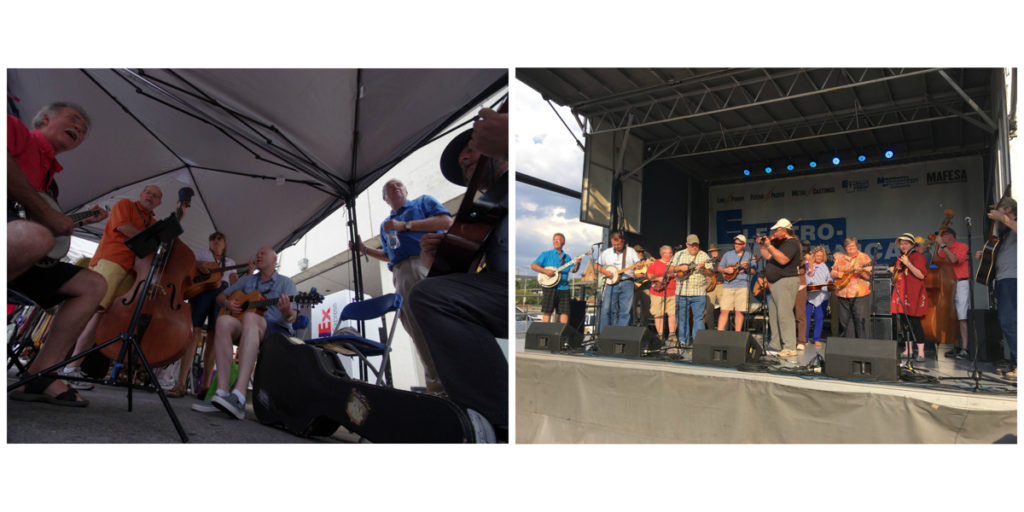
Two photographs: The left-hand photo shows a group of jammers in the Jam Tent at Bristol Rhythm & Roots Reunion festival, while the right-hand photo shows a groups of jammers performing on stage at the festival.
Besides the monthly community jams at the museum, BCM also hosts a Bluegrass Jam Camp right before Bristol Rhythm & Roots Reunion each year – and then players from the camp, and others at the festival, get the chance to make music together throughout the weekend, sometimes even on stage! © Birthplace of Country Music

Give It a Try!

The museum’s community jam is open to everyone of all talent levels. I can’t think of a better setting to sharpen your playing skills than a local jam. For the beginner, lessons are where you start but once you have mastered the chords of your instrument, the real fun begins when you get out and begin playing with others!

So mark your calendar for the third Saturday of each month from 2:00 to 5:00pm, and come join us at the Birthplace of Country Music Museum for our community jam — the next one is on Saturday, July 21. The museum is a great space for us to come together and pick, to learn from one another, and to have fun – all you need is your instrument and the courage to jump straight in. And remember listeners are also invited to attend. Come and enjoy!
How a THING Becomes an OBJECT

It’s part of my job as the museum’s Collections Manager to accession things into the collection (not to pass the collection plate – that’s the development department!). But what the heck is accessioning, anyway?

Accessioning is the process by which something donated to or purchased by the museum becomes an official Object with a capital O. Once accessioned, objects are held in the public trust in perpetuity and maintained with the highest possible standard of care. It may seem pretty straightforward on the surface – someone drops something off, we stick it on a shelf, right? But everything offered to the museum goes through a multi-step process involving much discussion, scheduling, writing tiny numbers on things, and lots and lots of data entry and paperwork. Without all of this hard work, an OBJECT is really just a THING with no story, no context, and no way to even find it in the storage room. Here’s a rundown of everything it takes to turn a thing into an object…

THE OFFER

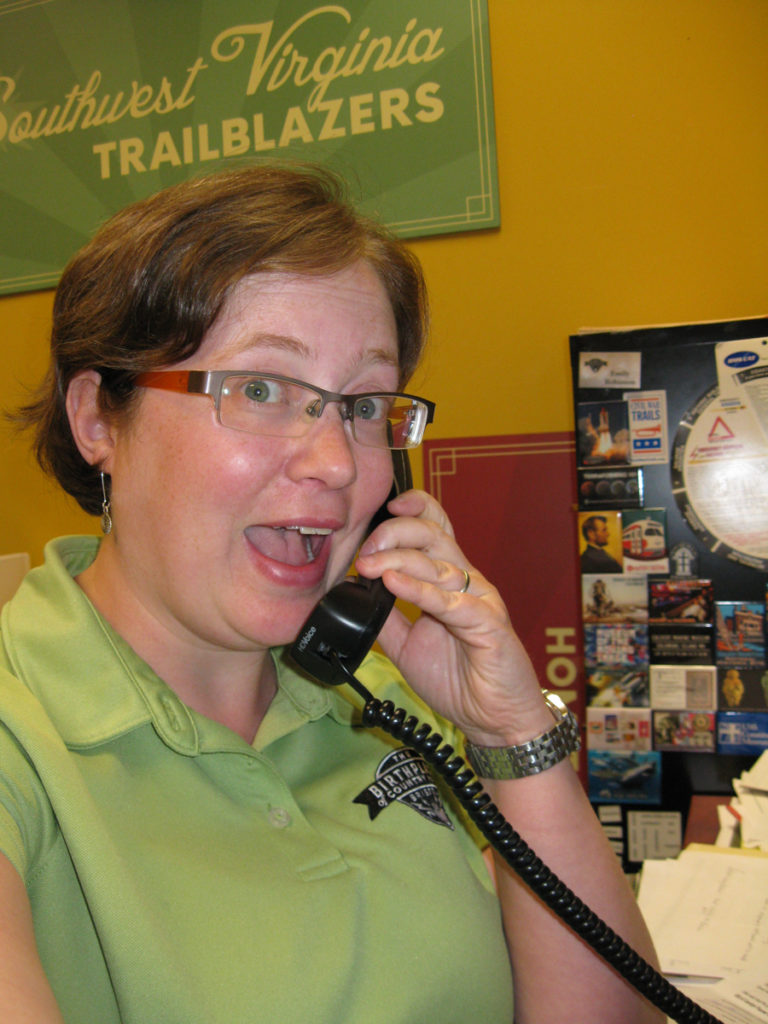
Photograph of Collections Manager Emily Robinson answering the phone and looking excited!
Collections Manager Emily receives a call about an exciting potential donation. © Birthplace of Country Music Museum

Folks contact me with offers to donate objects for the collection. I gather as much information as I can: What is it? Is it in good shape? Who used it or made it? Where did it come from? When did it come from? I place said information in a file until…

THE COMMITTEE MEETING

A poker game around a table where all the players are dogs.
Everyone loves a committee meeting. Image found on https://commons.wikimedia.org/wiki/File:A_Waterloo_Dogs_Playing_Poker_2.jpeg as a public domain image; the original of this image is in the New York Public Library Digital Collections here.

Four times a year, the curatorial staff meets to review potential donations and decide whether or not to accept them into the museum’s collection. Acceptance depends on a number of factors, but the most important questions we ask are: A) Does this help us meet our mission? and B) can we take care of this properly?

Sometimes we consult with content experts outside the organization. If we don’t accept an object, I try to suggest another institution that would be a better fit. If we do accept the object, the next step is…

THE DELIVERY

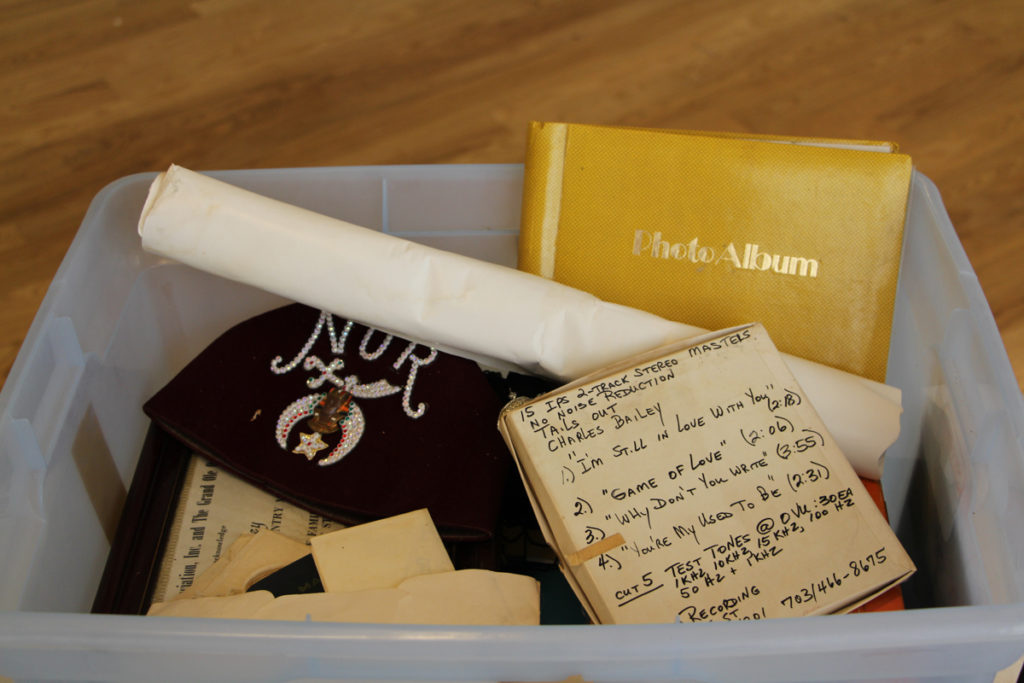
Photograph of a plastic tote filled with items from the Bailey Collection, including a photo album, various paper items, audio tapes, etc.
Things arrive in bins. And in other ways. Photograph © Birthplace of Country Music Museum; gift of the family of Charles Bailey

Sometimes donors mail their things to us, sometimes they bring them to the museum, and sometimes I pick them up. We always schedule delivery in advance because I want to be sure I am in the building and have space on the shelf! In addition to taking physical possession, there is also some paperwork to take care of at this step, such as:

  • Signing a Deed of Gift (a form that proves transfer of ownership to the museum)
  • Determine a credit line (a line of text that acknowledges the donor whenever an object goes on exhibit)
  • Writing down any additional contextual information that I learn from the donor

Getting to meet donors and talk to them about their fascinating family histories is one of the best parts about being a Collections Manager!

Finally, we get to…

THE PROCESSING

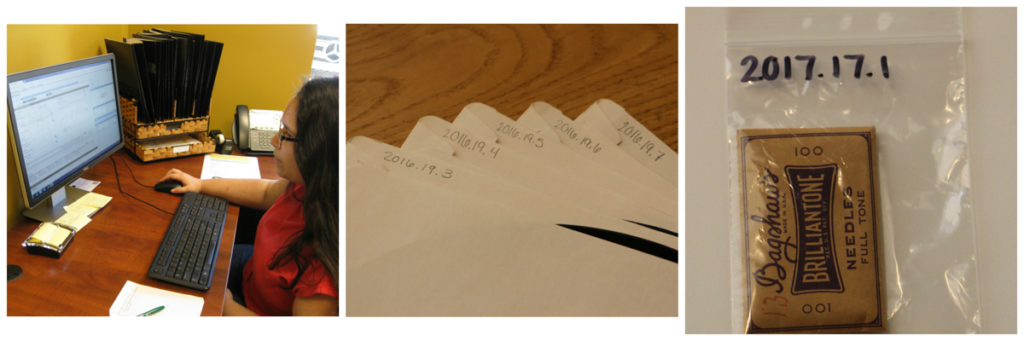
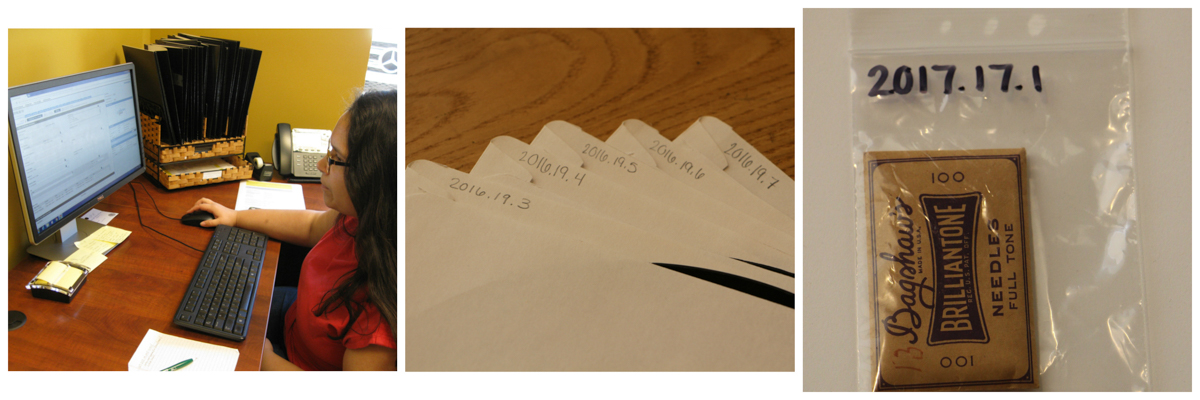
Three photos: An intern entering info into a computer database; several file folder with their accessions numbers written on them in pencil; a small bag holding phonograph needles and labeled with its accession number.
Collections intern Theresa hard at work on the database; tracking numbers on archival record sleeves; and phonograph needles in a protective polyethylene bag. Photograph © Birthplace of Country Music Museum; third image: Gift of John Bledsoe

Now the real fun begins. Processing a THING includes:

  • Cleaning it (if necessary)
  • Writing tiny tracking numbers on it
  • Putting it in a new archival quality sleeve, folder, box, or bag
  • Scanning or taking photographs of it so that we can recognize it during inventory, exhibit planning, or research
  • Recording its condition
  • Entering data about it into our collections management database
  • Placing in its new home on a shelf and recording the location in the database
  • Filing all related paperwork in archival folders and saving digital copies to a backed-up drive

TA-DA! What was once merely a THING is now…an OBJECT! It is now ready to help tell the story of our region’s music history via exhibits and publications.

Do you have anything that might make a good object? You can find out more about donating to the museum collection here!

From the Vault: The Ukelin Unveiled

Want to know what’s behind our museum vault door? With this occasional series, we take you behind the scenes to learn more about some of the interesting objects in our museum collection. 

Every museum’s permanent collection is akin to an iceberg – there are the things you see above the surface (i.e. the artifacts and objects on display), and there are the things that lie below the surface (i.e. the artifacts and objects in museum collection storage). However, even though no museum has the space to have all their collection on display at one time, it doesn’t mean we can’t share some of those behind-the-scenes objects with you here!

One of our most enigmatic objects is an instrument you might never have heard of: the ukelin. The ukelin is a Frankenstein instrument, with enthusiasts speculating that its origins can be traced via the Schwatzer bowed zither and the Hawaiian art violin. Plus you can throw a ukulele into the mix!

Hard to imagine what that might look like? Then check out the pictures below:

Various views and details of the ukelin, especially focused in on the lovely gold, red, and black decorative pattern around the bottom sound hole and the chording info on the wide neck..
This is one of two ukelins in the museum’s collection. To the left, you see the full instrument, along with its bow and turning key. The two up-close photo show the ukelin’s beautiful decorative elements and its built-in cheat sheet for the chords that can be played on the instrument. Photograph © Birthplace of Country Music; gift of Bruce Maass

The ukelin utilizes two sets of strings: one set of sixteen strings tuned to the scale of C and another set of four groups of four strings all tuned to a different chord. On the neck of the instrument, the first set of strings is akin to a violin, and there are guiding posts located on the neck to show the player where to move the bow in order to elicit the desired melody. On the body of the instrument, the accompanying chords are meant to be plucked or picked to the song being played. Here is a diagram if you are still a little confused about what in the world is going on with this instrument:

Patent document has a drawing of a ukelin, alongside several drawings of the different elements of the ukelin from its bridge to its tuning pegs.
This diagram of the ukelin and how all of its elements come together is from the patent document filed by Paul Richter in 1923 and granted in 1926. Found on the ukelin enthusiast website http://www.studiobobo.com/ukelin/ukelin.html

Clear as mud, right? If you think the diagram is convoluted and confusing, just wait until you hear about the history of this conglomerate beast!

The man who first laid claim to this invention was Paul Richter, who requested a patent for his creation in 1923, applying it to the Phonoharp Company. After merger with Schmidt International Inc., Schmidt’s traveling salespeople would go door-to-door selling these odd-ball instruments to any interested takers. Other companies sold similar instruments.

The ukelin was a novelty hit for a short time in the 1930s – the salesperson would play a few simple tunes for potential customers, convincing them that the instrument was incredibly simple to learn how to play, even for a beginner: “You could learn in a day!” Budding musicians were often persuaded to buy with the offer of a “bargain” price that could be paid off in installments, and once the sale was done, they were left with the ukelin, instructions of how to play by number, and sheet music.

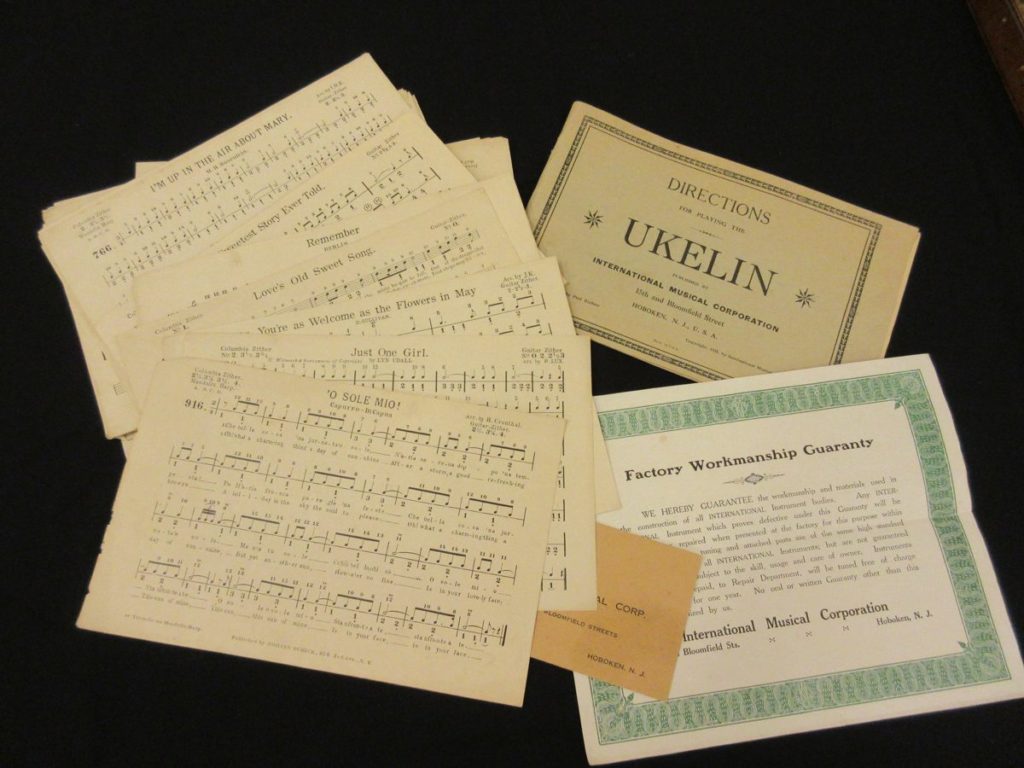
Several pages of sheet music for the ukelin, along with directions on how to use it and the Factory Workmanship Guaranty certificate.
Sheet music and instructions were included with the ukelin, ready to help the player get up to speed with this unusual instrument. © Birthplace of Country Music; gift of Bruce Maass

So, bow in hand, instrument and provided sheet music on the table, the new ukelin owner would sit down to learn their hip new instrument in just a day as the salesman had promised. However, the new ukelin owner would soon discover that the instrument was in fact too hard to play for a novice musician – two sets of strings, plucking, and bow action proved to be too difficult for the casual player. Perhaps too much like rubbing your tummy and patting your head at the same time!

Plus, once the new owner would haphazardly try to play their new instrument all day and the instrument needed tuning, it was nearly impossible to tune back. And, so the Frankenstein creation was tucked away into attics and other such forgotten places for grandchildren to find years later and try their hand at the instrument all over again.

Check out a couple more recent ukelin players to get a sense of the process of playing:

While ukelin enthusiasts are trying to bring ukelins back into mainstream culture with renditions of contemporary songs like “Sweet Caroline” and “Come Sail Away,” the true sound of the ukelin is not reaching its full potential in these videos. Professional musicians like Chris Sayre have tried to master this obscure instrument in an effort to produce the truly haunting and beautiful sound that can be elicited from the complex sets of ukelin strings.

The beautifully bizarre ukelin clearly demonstrates that the possibilities of music and musical instruments know no bounds, but also that what looks pretty complex often is!


Giving the Dame Her Due: Olive Dame Campbell and the History of Ballad Collecting

Olive Dame Campbell appears sometimes as a ghostly figure in the world of folk music: half champion, half a forgotten footnote. She came to our attention by different routes. While undertaking her PhD in Ethnography in Newfoundland, Wendy met her as a strong feminist icon doing great work; Jack discovered her as we prepared to teach ballads and folktales at the John C. Campbell Folk School in Brasstown, North Carolina, a few years ago. Olive had established the school in memory of her late husband, and they had both been involved in establishing settlement schools in Appalachia in the early 1900s.

Olive first encountered Appalachian ballads and fiddle tunes as she and John began their good works, and a little sidetracking goes a long way – Olive was the first to start collecting the old mountain ballads that had migrated from Scotland and England via the Scots-Irish pioneers, and she also created a manuscript collection of words and music. Experts debate how her work came to the attention of the famous English folk song enthusiast Cecil Sharp, who came to the Appalachians to do similar work in 1916 to 1918 and, with his secretary Maud Karpeles, built on the collecting work done by Olive. Eventually this combined work would be published as English Folk Songs from the Southern Appalachians; however, since its publication, the collection has mostly been referred to as Sharp’s work – rarely do we see Olive given much credit beyond her name in small print on the book’s title pages.

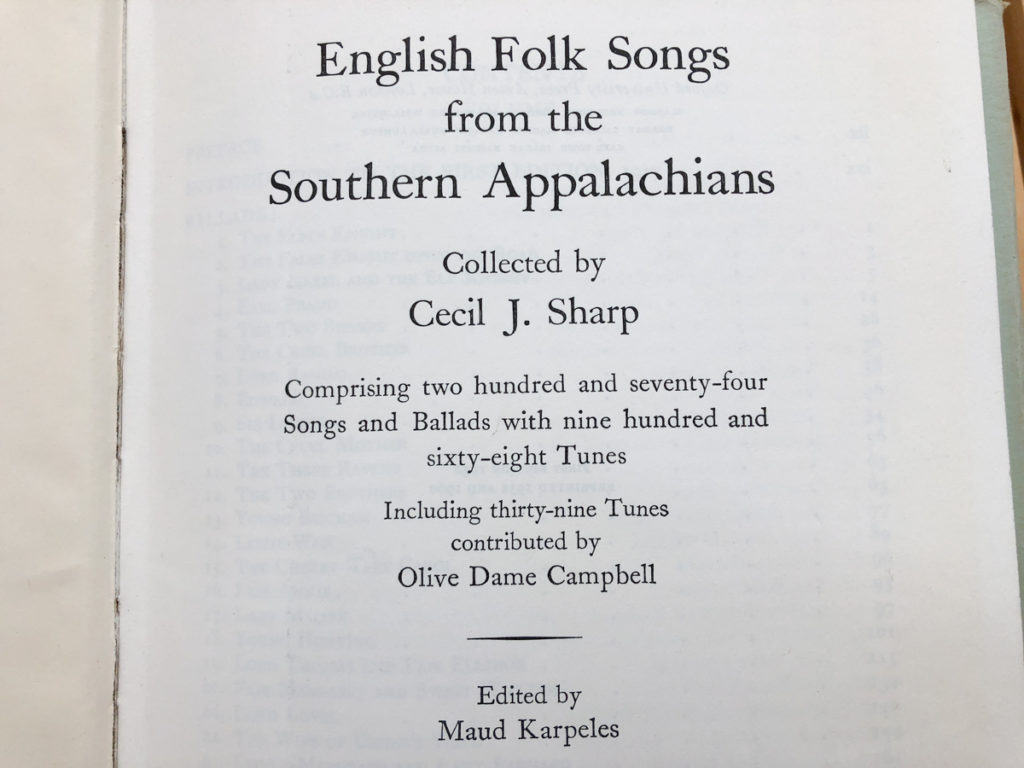
Title page from 1932 edition of English Folk Songs from the Southern Appalachians. It reads as: Collected by Cecil J. Sharp...Including thirty-nine tunes contributed by Olive Dame Campbell
This version of English Folk Songs from the Southern Appalachians, published in 1932, relegates her to a contributor role. Photograph © Birthplace of Country Music Museum

Until Hollywood got hold of the story, that is….

The lead character of a movie called Songcatcher was loosely based on Olive Dame Campbell. The film focuses on the mountain music of Appalachia and uses many very fine local musicians in supporting roles, including Sheila Kay Adams and Phil Jamieson. In the final scene, as the ballad collector heads down the mountain to conquer city life with her new Appalachian family, they meet an English gentleman headed up. He is obviously based on Cecil Sharp.

It was seeing Songcatcher that rekindled our interest in someone we felt should be better known. It may be that she was rather sidelined simply because she was a woman carrying out studies at a time when men were seen as more ‘serious’ academics. It’s certainly interesting how difficult finding information about her song collecting can be. Internet searches divert to information about her husband or Sharp. She does have a page on Wikipedia, but once again it’s mostly about the men in her life.

When we make musical presentations, we like to point out that most tradition bearers are women, in music and song as well as in story and dance. Women are frequently the sources of the ballads, the stories, the recipes, the remedies, etc. How often has an archived recording of home visits featured a male source breaking down in the middle of a ballad, only for the sister, wife or mother to shout the next line from the kitchen where she is preparing food for the guests who have come to record the singer?

The series of books that we lent to the museum for its current exhibition, The Appalachian Photographs of Cecil Sharp, span 1700–1950. All are published by men, although their song and ballad sources are mostly women. Sir Walter Scott got the majority of his ballads from ‘Mrs Brown of Falkland’ – a clergyman’s wife, who was famously scathing in her condemnation of his alterations to her texts. She was an educated intelligent woman but she didn’t have the connections or reputation that Scott had. Like Olive, she became a footnote and an amusing story to tell about how charming source behavior can sometimes be.

That being said, we don’t condemn the many fine male folk-song collectors and scholars within this field, from David Herd to Bertrand Bronson. They produced important collections during times when women weren’t expected – nor allowed the opportunities – to do other than shout the next line from the kitchen. And when we think about that, perhaps Olive Dame Campbell actually did blaze a trail by getting her name with Cecil Sharp’s on the title page of the first edition of English Folk Songs from the Southern Appalachians.

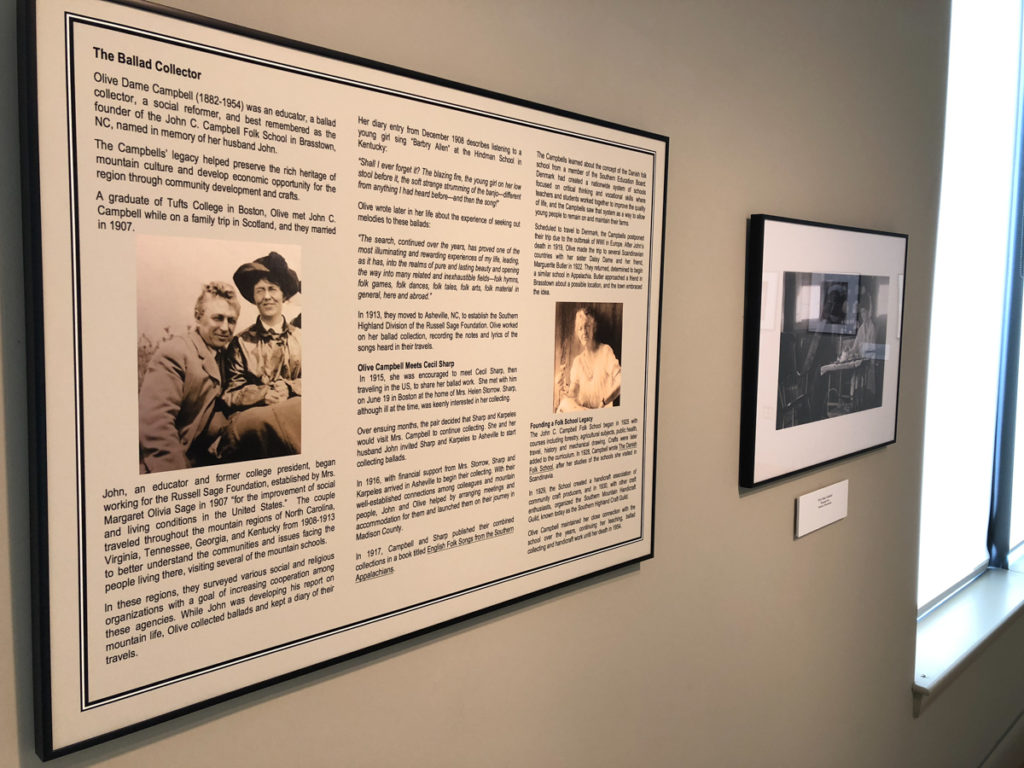
Photograph shows the panel from the Cecil Sharp exhibit focused on Olive Dame Campbell beside a photograph of Campbell.
It is good to see that Olive Dame Campbell’s significant role in this song collecting history is recognized in the Cecil Sharp exhibit on loan from the Country Dance and Song Society and currently on display in the museum’s Special Exhibits Gallery. Photograph © Birthplace of Country Music

What’s sad for us is that her truly pioneering work, which predated Sharp by years, seems to have often been systematically sidelined. Sharp on his collecting travels throughout Appalachia was accompanied by his “secretary” Maud Karpeles, who in these more enlightened times has come to be recognized as more important than Olive Dame Campbell. Olive has faded, a ghost whose power and influence are as yet unsung. We have hope and confidence that future scholars will fill out her life and recognize her contributions to preserving and perpetuating the songs we still sing today.

Thank you to our guest bloggers Jack Beck and Wendy Welch, who wrote this blog post about Olive Dame Campbell, the perfect post to accompany our current special exhibit, on display through May 31, 2018.

Jack was born in Dunfermline, Scotland, and lived most of his life there. A founding member of Heritage, one of the seminal traditional Scottish bands of the 1970s and 1980s, he was also the musical partner of Barbara Dickson. Awarded an honorary lifetime membership in the Traditional Music and Song Association for his services to Scottish traditional music, he spent five years as external examiner in Scots Traditional song at the Royal Scottish Conservatoire in Glasgow. Jack has lived for the last twelve years in Big Stone Gap, Virginia with his wife Wendy Welch, in the heart of Appalachia and old-time mountain music. Wendy is the author of four books, the most recent Fall or Fly detailing effects of the opioid crisis on foster care. She has a PhD in Folklore, is book editor for the Journal of Appalachian Studies, and was founding director of a storytelling non-profit in Scotland. Together they run a bookstore – Tales of the Lonesome Pine – the subject of Wendy’s memoir The Little Bookstore of Big Stone Gap from St. Martin’s Press.