

Museum Archives - Page 24 of 34 - The Birthplace of Country Music
Listen
Play
Loading station info...

The Great Golden Gathering: African-Americans Living History through School Traditions

The Great Golden Gathering celebrates the 14 former African-American elementary and high schools in upper East Tennessee, Southwest Virginia, and the surrounding areas that all closed for integration in 1965. Formed in 2015, the Great Golden Gathering reunites all of the alumni, bringing them together every two years to relive friendships, camaraderie, and their shared heritage.

Two alumni hold a large white banner with gold lettering announcing the Great Golden Gathering 2015.
Banner welcoming the participants to the first Great Golden Gathering in 2015. Photograph courtesy of Calvin Sneed

The 14 former African-American schools are:

Austin High School, Knoxville, Tennessee
Arty-Lee High School, Dante, Virginia
Bland High School, Big Stone Gap, Virginia
Douglass High School, Bristol, Virginia
Douglas High School, Elizabethton, Tennessee
Douglass High School, Kingsport, Tennessee
George Clem High School, Greeneville, Tennessee
Langston High School, Johnson City, Tennessee
Morristown West High School-Morristown College, Morristown, Tennessee
Nelson-Merry High School, Jefferson City, Tennessee
Prospect Elementary School, Gate City, Virginia
Slater High School, Bristol, Tennessee
Swift High School-Swift College, Rogersville, Tennessee
Tanner High School, Newport, Tennessee

While many of the individual school alumni associations occasionally hold their own get-togethers, the idea of a universal mega-reunion was introduced in 2015 as a way to celebrate former football and basketball rivalries between schools in the all-black former Tri-State Athletic Conference. Through those competitions, young African-American children got to know their neighbors in nearby cities pretty well. The rivalries quickly grew to include academic competitions like spelling bees, art competitions, and high school band and choral concerts.
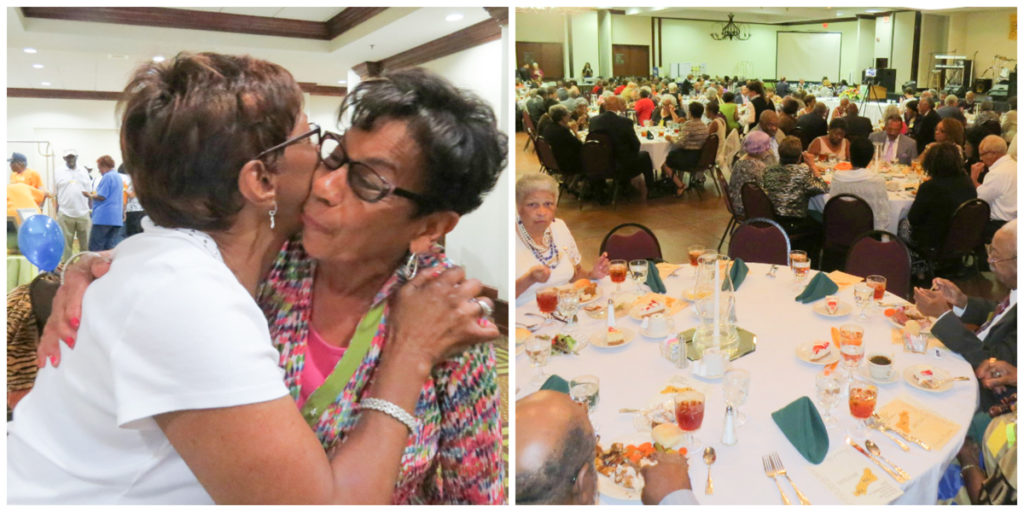
Left pic: Two alumni greet each other with a hug; right pic: Several tables of alumni fill a room for the Great Golden Gathering banquet.
At the Great Golden Gathering in 2015, alumni greeted each other for the first time in years and came together for a celebratory banquet. Photographs courtesy of Calvin Sneed

The relationships forged years ago live on during the Great Golden Gathering, as alumni celebrate their connected histories and the legacies of the schools they attended.

“After all, we have always been really good friends,” says Langston High School graduate Bill Coleman. “By attending the Great Golden Gathering, we are celebrating the opportunity to come together one more time while we still can.”

The first Great Golden Gathering was held in Bristol, Virginia in 2015 on the 50th anniversary of the schools closing for integration. Alumni came from several states to renew friendships, laugh, joke, and rekindle – with good humor – old rivalries. It was also a chance to share displays from the alumni associations and to recognize achievements.
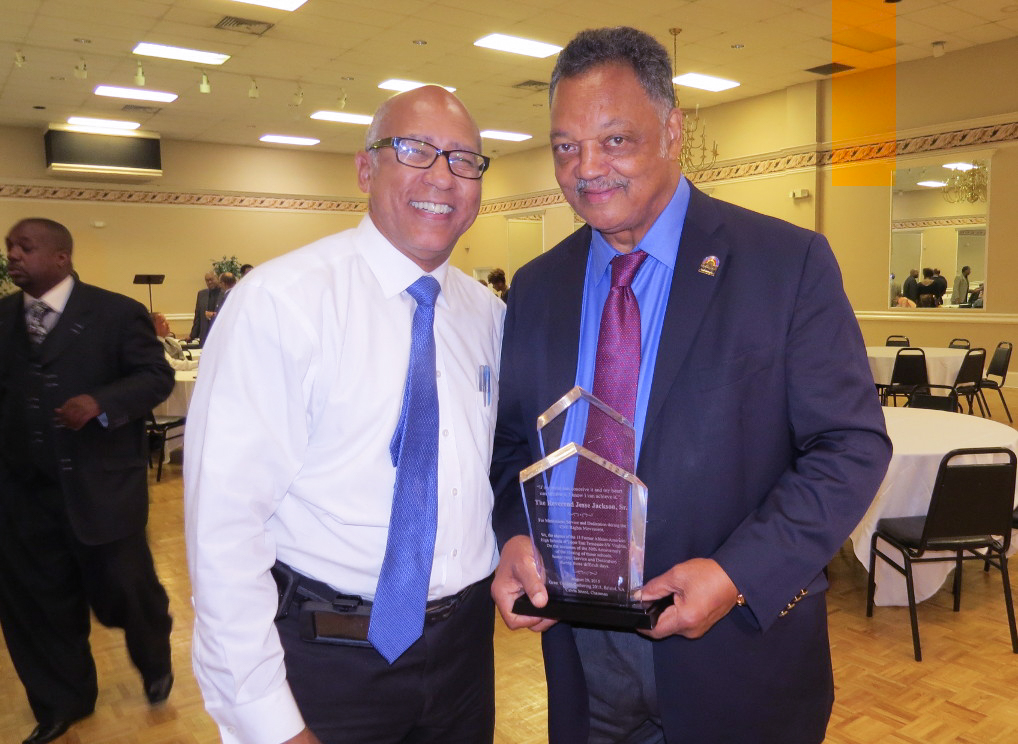
Calvin Sneed poses with the Reverend Jesse Jackson, who holds a clear plaque honorarium.
Great Golden Gathering President Calvin Sneed presenting an honorarium to Reverend Jesse Jackson. Photograph courtesy of Calvin Sneed

The Reverend Jesse Jackson, noted statesman and founder of Rainbow/PUSH, sent a video message to the group banquet, commemorating the Gathering’s purpose and congratulating the participants for keeping the spirit of their schools alive. The 2015 guest speaker was Ms. Gloria Sweet-Love, president of the Tennessee NAACP. Both received honorariums from the alumni for their service to the cause of civil rights. Enthusiasm was so high among the alumni at the inaugural event, that they all agreed to schedule a Gathering every other year, as many individual African-American school alumni associations do.
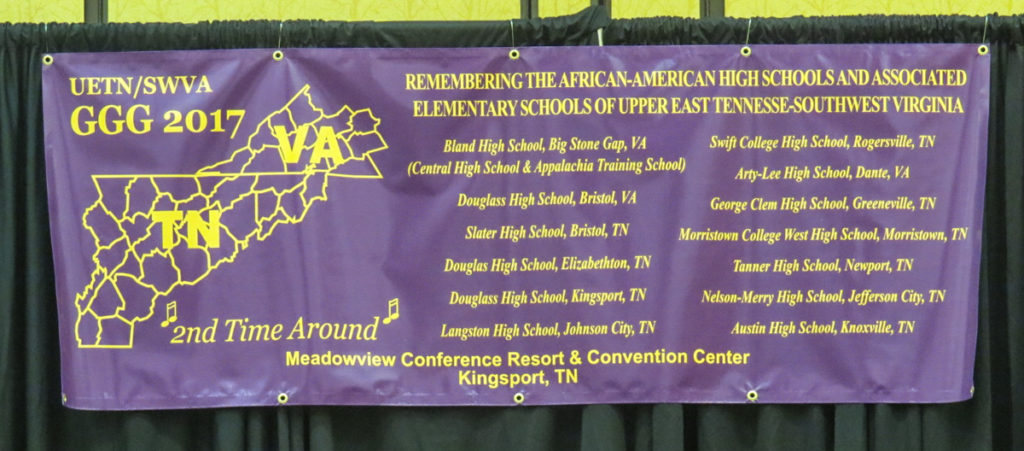
Purple Great Golden Gathering 2017 banner with yellow lettering including the names of the schools and a map of upper east Tennessee and southwest Virginia.
Welcoming banner for the 2017 Great Golden Gathering. Photograph courtesy of Calvin Sneed

The Great Golden Gathering 2017 was held in Kingsport, Tennessee, with the goal of “keeping all of the visiting alumni so busy, that they would forget they were tired”! After many activities, alumni were spellbound by the banquet speech of Tennessee State Representative Johnnie Turner of Memphis, a soldier in the Civil Rights movement of the 1950s and 1950s for which she was also given an honorarium from the group. Her speech on the struggles of African-Americans during segregation and integration was a familiar story, one that everyone identified with and understood.

“Each Great Golden Gathering is a good fellowship with people that you love,” says Douglass-Kingsport graduate Douglas Releford. “We’d had folks on walkers, in wheelchairs, and on canes attending the Gatherings, and some of them bring their grandchildren and great-grandchildren with them. We always have activities for them, and through displays, they can learn about the heritage of the schools their ancestors attended.”

“It’s not just our history,” he continues. “It’s their history, too.”
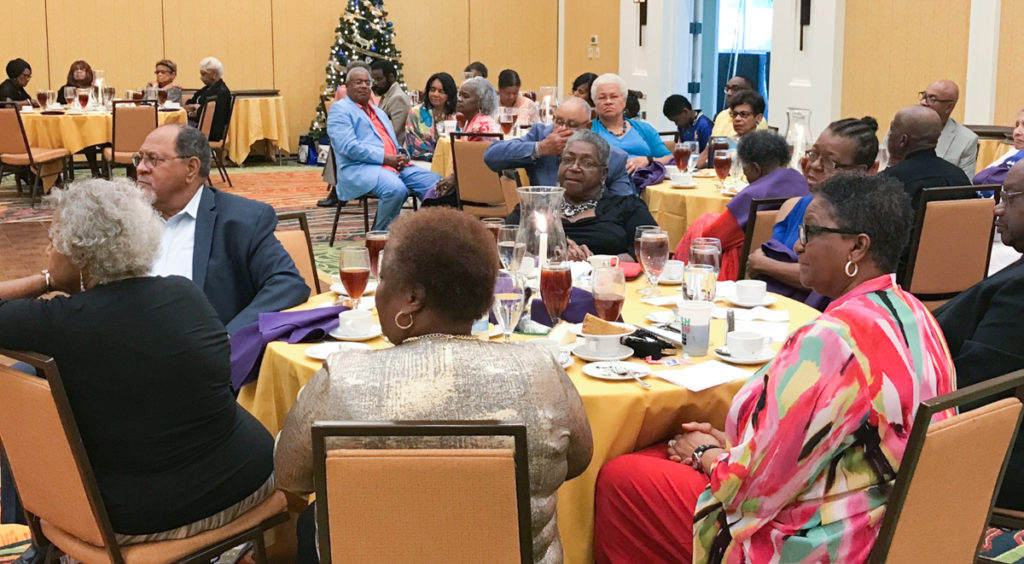
Several tables filled with alumni at the Great Golden Gathering banquet in 2017.
The second Great Golden Gathering in 2017 in Kingsport, Tennessee. Photograph courtesy of Calvin Sneed

Many Gathering attendees have lamented the fact that their collective histories are vanishing with the passing of alumni, and when that history is gone, it could be gone forever.

Larry Bell, who graduated from Slater High School, told the Bristol Herald Courier at the first Gathering reunion that in the past, many younger African Americans would respond in disbelief when he told them he “grew up in an era when blacks and whites attended separate schools. They could not understand that at one point in our history, blacks could not sit at the same lunch counters as whites, use the same restrooms, or drink from the same water fountains.”
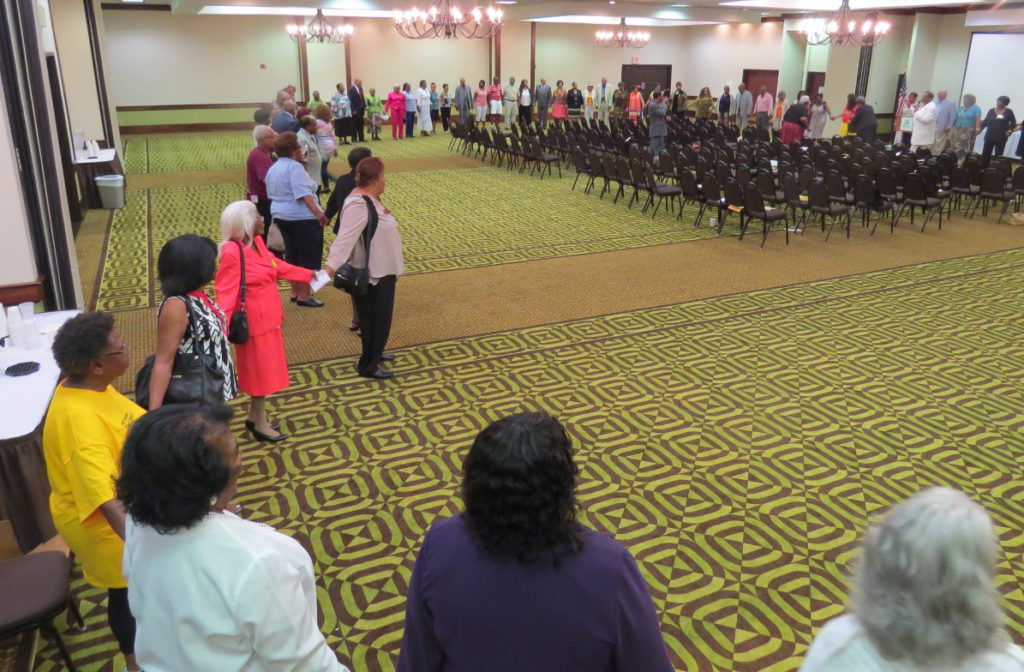
A line of alumni hold hands as they gather together in prayer at the Great Golden Gathering.
School alumni forming a Prayer Chain after the Great Golden Gathering’s Memorial Prayer Service. Photograph courtesy of Calvin Sneed

I know that how we overcame those inequities is wrapped in the histories and legacies of these wonderful schools that taught us that we are people too. It is the single most important thing that we as alumni can pass on to our descendants through the Gathering. Along with reading, writing and arithmetic, life itself was taught to us in our schools, as integration loomed ahead. We were taught how to survive outside segregation.

And so there is an urgency to the Great Golden Gathering mega-reunions. Our numbers are deteriorating fast, and we don’t want to not be able to see each other – and of course, there’s going to be a time when we want to see each another and cannot. That’s why we have got to enjoy each other now, the hugs and laughter as we once did, right now, because tomorrow is not promised.
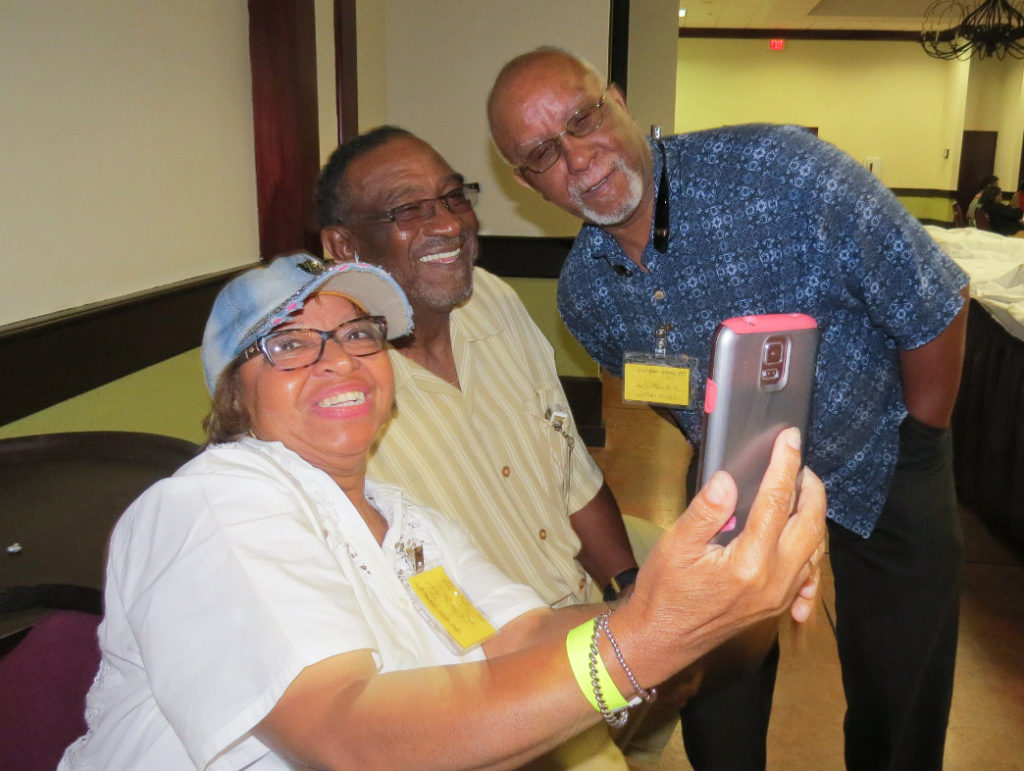
Three alumni post for a selfie together.
School alumni saying goodbye after the Great Golden Gathering Memorial Prayer Service in 2017. Photograph courtesy of Calvin Sneed

The next Great Golden Gathering is scheduled for Johnson City, Tennessee, in 2019. The idea is to rotate each Gathering among the schools’ alumni bases. You can learn more about a few of the African-American schools in this area at the Birthplace of Country Music Museum’s current special exhibit, For All the World to See: Visual Culture and the Struggle for Civil Rights, which includes a supplementary display on Slater and Douglass schools in Bristol, Tennessee-Virginia.
The Devil Has All the Best Tunes

You may have heard that A. P. Carter could play the fiddle, but refused to do so on record because it was “the devil’s box.” And just about everyone knows Charlie Daniel’s 1979 hit song “The Devil Went Down to Georgia” about a demonic fiddling contest. But here’s the question: Out of all the instruments, why is the devil so taken with the fiddle? Why not the accordion? The saxophone? I mean, surely the kazoo was born from hellfire, right?

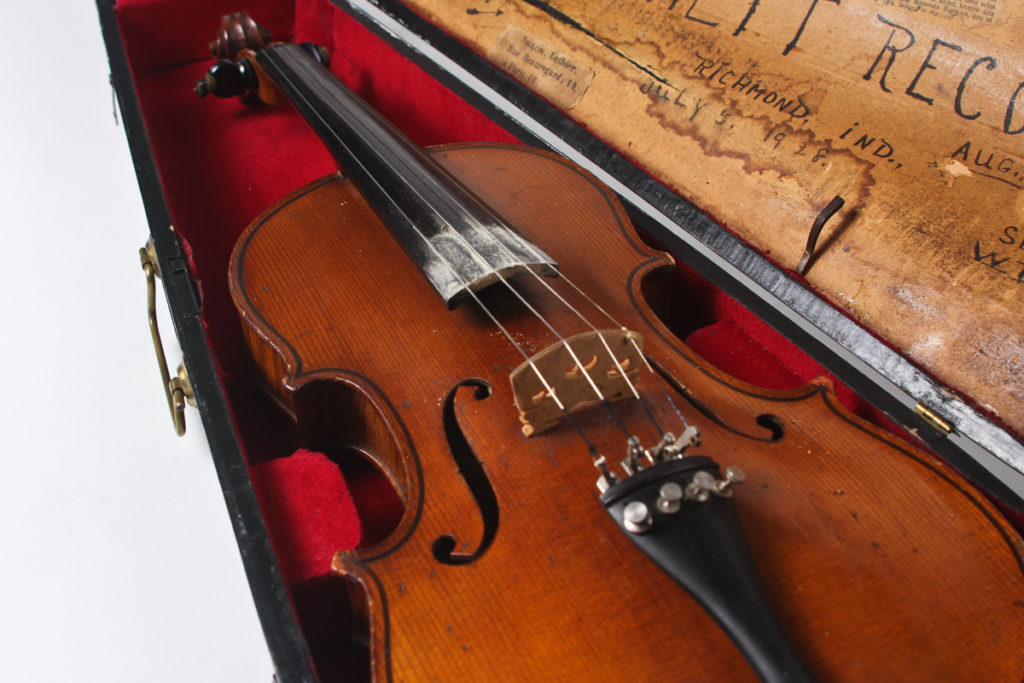
Close up of fiddle in its case.
This fiddle from our collection looks pretty free of fire and brimstone… © Birthplace of Country Music; Photographer: Haley Hensley. Gift of Ruth Roe

Where there is fiddle music, though, there is often dancing, and where there is dancing, the devil is surely at play. I have stories of this in my own family – my grandmother’s Uncle Willard was very musical, but Grandma and her sisters would only dance to his music when their very religious Aunt Eugie wasn’t around to see them. The link between dancing and the devil is an old one in fact. Way back in the 4th century, St. John Chrysotom said that “where dance is, there is the devil.” Countless preachers over the centuries have espoused the same.

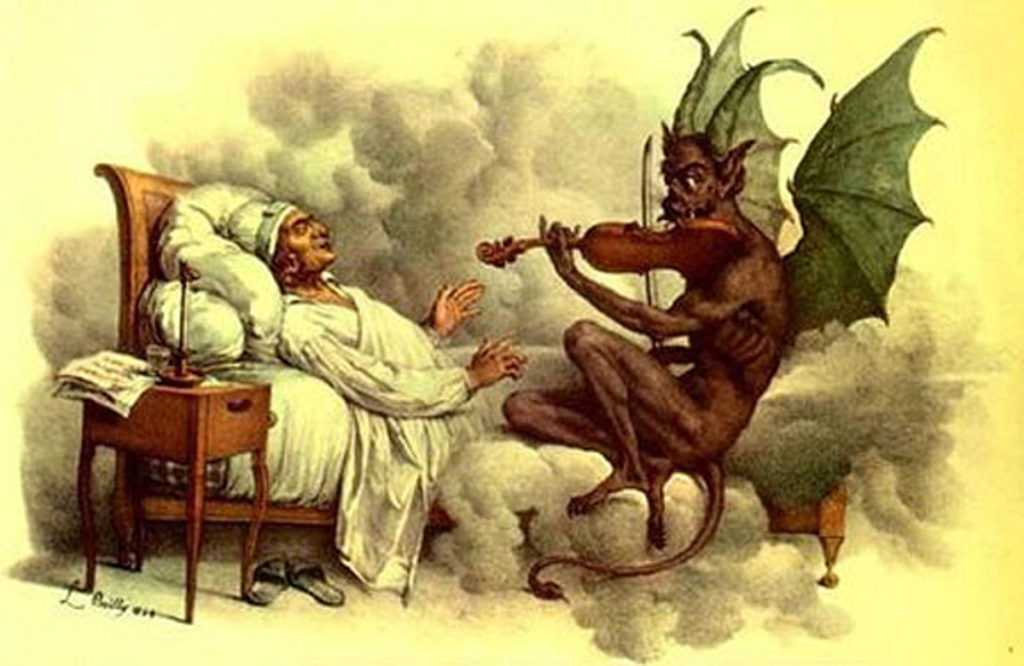
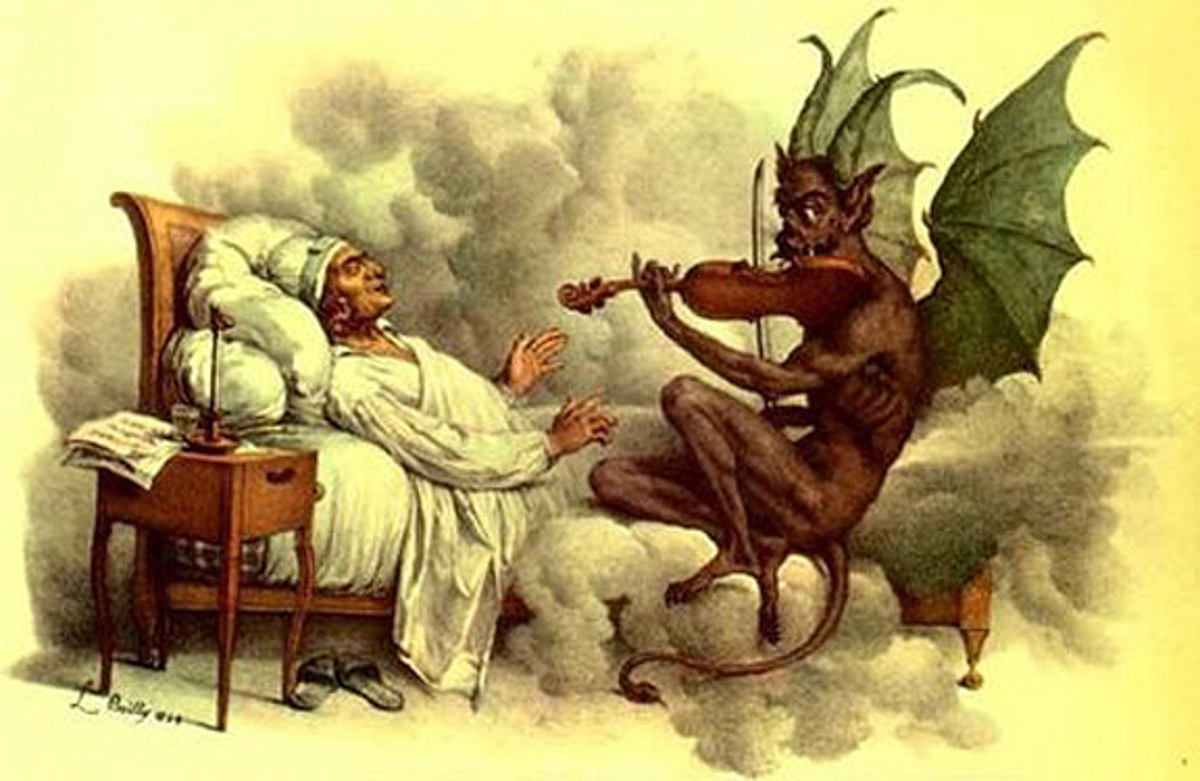
While the fiddle and its link to dancing was seen by many as the devil at play, the devil’s prowess with a fiddle and bow also brought inspiration. In the early 18th century, the Italian composer and violinist Giuseppe Tartini claimed that his most famous work, the “Devil’s Trill Sonata,” was delivered to him by the devil in a dream. This, of course, led to some imaginative depictions of what that might have looked like…

Illustration shows a man asleep in bed with the devil seated at the foot of the bed playing the fiddle.

Illustration of the legend behind Guiseppe Tartini’s “Devil’s Trill Sonata.” Public domain image from Wikimedia Commons

Scotland’s favorite poet, Robert Burns, wrote “The Deil’s Awa Wi’ The Excise Man” a few decades later, in which the devil fiddles into town and dances off with the tax collector. The townsfolk react thusly:

We’ll mak our maut, and we’ll brew our drink,

We’ll laugh, sing, and rejoice, man,

And mony braw thanks to the meikle black deil,

That danc’d awa wi’ th’ Exciseman.

In case your Scots dialect is a bit rusty…basically everyone extends their grateful thanks to the devil, for with the tax man gone, they can booze it up all they want and have a big time!

With that rollicking party in mind, here are a handful of the most devilish tunes I know:

“The Devil’s Dream”

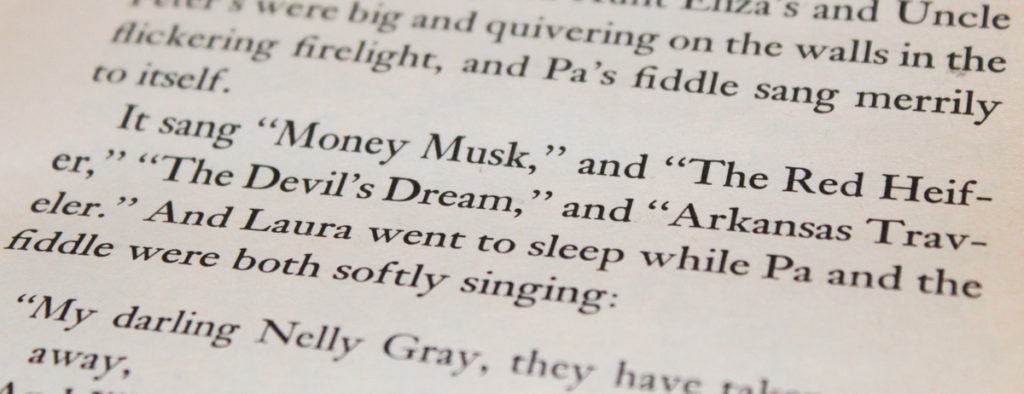
“The Devil’s Dream” is a standard Appalachian fiddle tune. Laura Ingalls Wilder remembers hearing this tune as a child in the 1870s, so it’s probably safe to assume that it was also a familiar one to fiddlers in our region at the time of the Bristol Sessions. It originated in Scotland as “The De’l Among the Tailors,” and it was also noted in an English folk tale from the early 1800s. It is played here by the Whitetop Mountain Band (featuring Radio Bristol DJ Martha Spencer and family).


Detail of text describing Laura hearing her Pa play "The Devil's Dream" and other tunes on the fiddle.
Laura Ingalls Wilder remembers her Pa playing “The Devil’s Dream” in Little House in the Big Woods. Photograph courtesy of Emily Robinson

“Did You Ever See the Devil, Uncle Joe?”

“Did You Ever See the Devil, Uncle Joe?” is another good fiddle tune. Fiddlin’ Cowan Powers and his family, who play it here, were the first family string band to record commercially…three years before the 1927 Bristol Sessions! I learned this tune as “Hop High Ladies,” and some may know it as “Miss MacLeod’s reel” – another import from the British Isles. Click on this link for an extra treat: Pipe Major Willie Ross playing both of these tunes in the early 20th century!

“Never Let the Devil Get the Upper Hand”

Speaking of the 1927 Bristol Sessions, here’s another devil-fueled tune recorded a decade later by Bristol Sessions artists The Carter Family: “Never Let the Devil Get the Upper Hand” – which just seems like good all-round advice! Spoiler alert, however: the devil DOES get the upper hand of the young man in this song and convinces him to murder his lover. This story might sound familiar if you’ve ever heard the old murder ballad “Knoxville Girl.” It’s basically the same tale, though the latter adds a lot more gruesome detail.

“The Old Lady & the Devil”

In contrast, a woman gets the upper hand of Old Scratch – and her husband! – in “The Old Lady & the Devil,” recorded by Johnson City Sessions artists Bill & Bell Reed. In this tune, a farmer happily lets the devil carry off his wife, but she raises so much hell in Hell that the devil brings her back home again. Dave Rawlings included a fantastic version of this song on his 2017 album Poor David’s Almanackthough he shortens the chorus and leaves out the bit where the woman whacks her husband with the dasher from the butter churn.

That gives you just a few of the devilish tunes out there, but I hope the music and the links between the devil and the much-loved fiddle get you in the mood for a very Happy Halloween!

When All the Parts Become a Whole: Working Together to Create a Museum

I believe in the power of collaboration, a constant factor in the long process of bringing the Birthplace of Country Music Museum to life and to its grand opening in 2014.

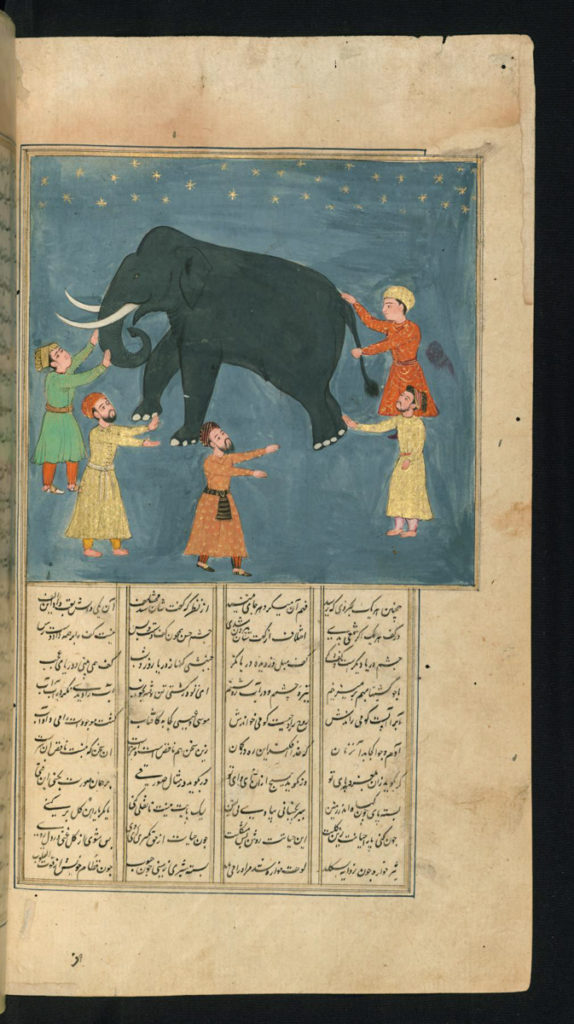
Recently a segment I heard on an NPR program caught my attention and got me thinking again about collaboration. I must have been listening “out of one ear,” because I can’t remember the topic of the segment. What I do recall is the parable the speaker employed to illustrate his topic. It involves a group of men describing an elephant by touch in a dark room, although even here my memory is muddled. So I have turned to Google (as one does) for help. It turns out that there are many versions of the parable, but a poem by Rumi, the 13th-century Persian poet, scholar, and mystic is closest to the story paraphrased on NPR.

Here is Rumi’s poem, as translated by Coleman Barks:

Elephant in the Dark

Some Hindus have an elephant to show.
No one here has ever seen an elephant.
They bring it at night to a dark room.

One by one, we go in the dark and come out
saying how we experience the animal.
One of us happens to touch the trunk.
“A water pipe kind of creature.”

Another, the ear. “A very strong, always moving
Back and forth, fan-animal.”

Another, the leg. “I find it still,
like a column on a temple.”
Another touches the curved back.
“A leathery throne.”

Another, the cleverest, feels the tusk.
“A rounded sword made of porcelain.”
He’s proud of his description.

Each of us touches one place
and understands the whole in that way.
The palm and the fingers feeling in the dark are
how the senses explore the reality of the elephant.

If each of us held a candle there,
and if we went in together,
we could see it.

A page from a manuscript showing several villagers examining an elephant by touch with script below the picture.
A 17th-century Persian manuscript illustrating Townspeople, Who Have Never Seen an Elephant, Examine Its Appearance in the Dark. Source: Walters Art Museum, acquired by Henry Walters

The elephant identification story predates Rumi by millennia, and occurs in many variations, cultures, and religions, but the moral is similar in all versions. According to Wikipedia, “at various times the parable has provided insight into the relativism, opaqueness, or inexpressible nature of truth, the behavior of experts in fields where there is a deficit or inaccessibility of information, the need for communication, and respect for different perspectives.”

In my decades as an architect, I have valued the principles of open-mindedness, good communication, and the certainty that there are more ways than one to solve a problem. These principles are the essence of collaboration.

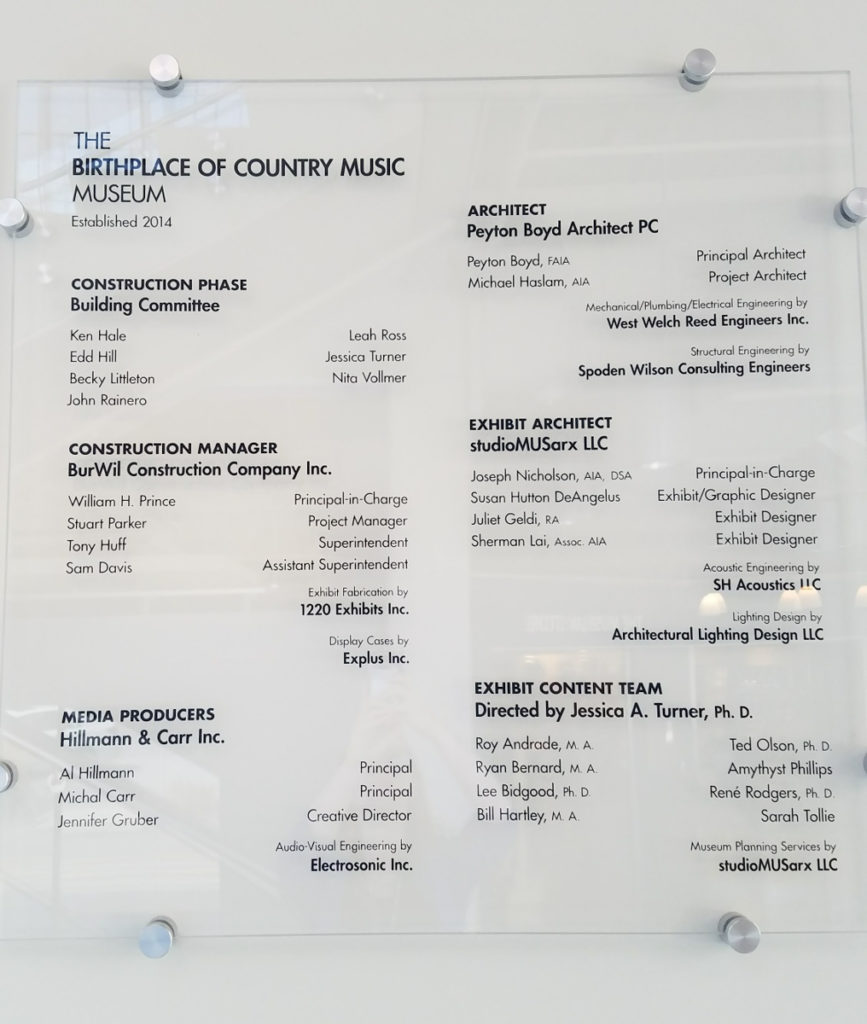
My firm had the privilege of working with a remarkable “brain trust” assembled by the Birthplace of Country Music to help bring the museum to fruition. A plaque in the museum lobby recognizes these creative individuals and firms, each contributing in their own way to the whole. In addition to an exhibit content team of musicologists, academics, and musicians, the group included exhibit designers and museum planners, lighting and acoustical consultants, media producers, and the construction manager. Each of these was on a mission to make their particular area of influence the best it could be, and each knew that the realities of budget, scheduling, space limitations, historic preservation, and other constraints would require concessions and cooperation. These interactions were the norm, not the exception. We spent a lot of time talking and planning, debating different points, sometimes disagreeing, but always finding the best path together.

The museum signage listing all of the team members in the museum construction.
The signage in the museum listing the collaborators on the museum’s content and construction teams. Courtesy of Toni Doman

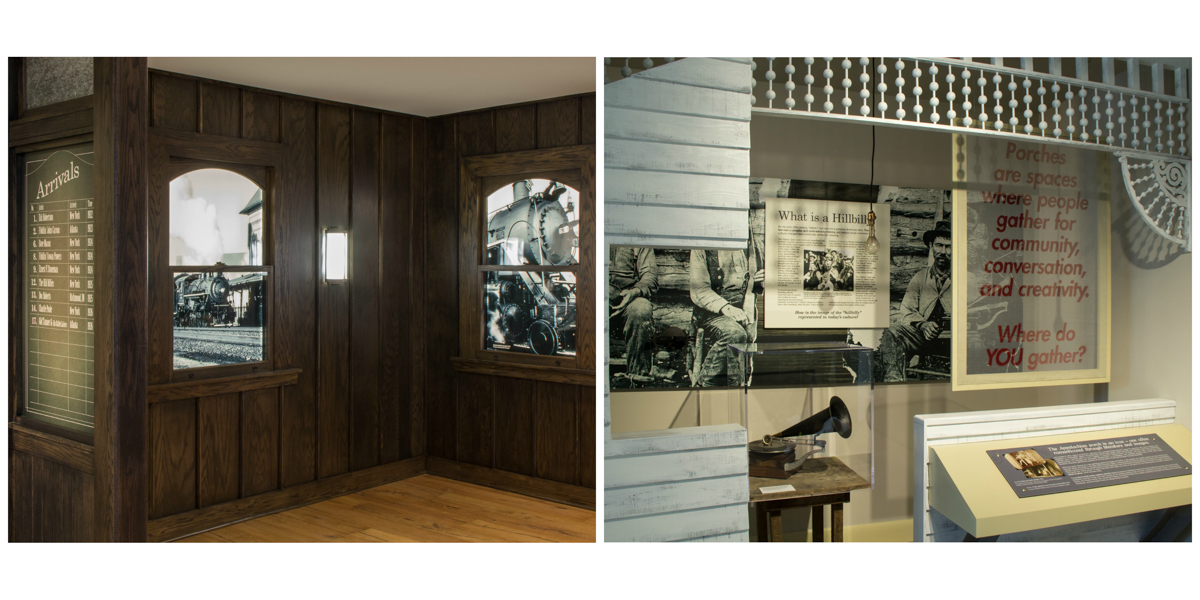
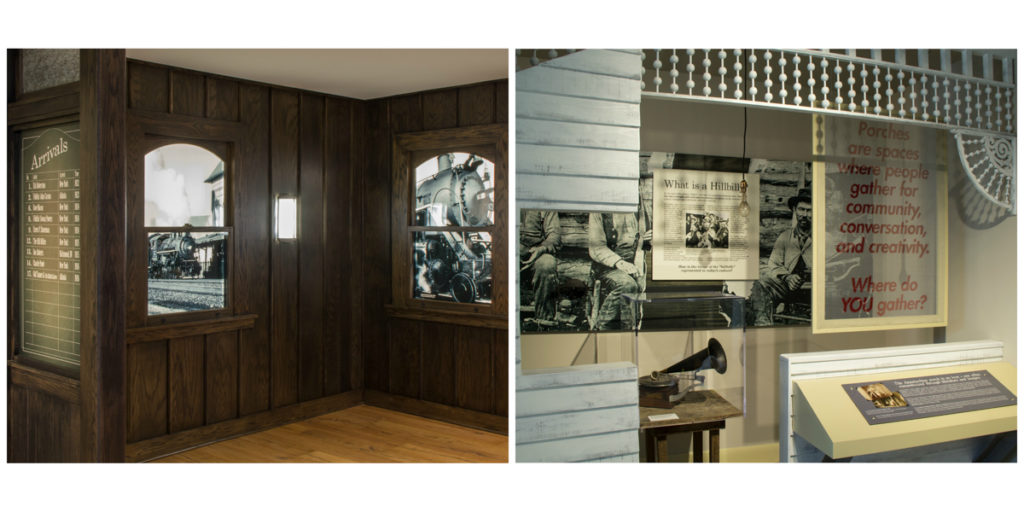
A few of those collaborative efforts, visible now to our visitors and central to their experience, come to mind. For instance, in an early design concept, the area outside of the Orientation Theater in the upstairs atrium was conceived as a front porch in a rural setting. However, as the content team developed the “story” to be told by the museum, the romantic notion of a hillbilly strumming a guitar on a cabin porch gave way to something more related to 1920s Bristol: a train station setting. We gave exhibit architect Joe Nicholson of studioMUSarx a tour of the Bristol Train Station, which was built in 1902 and in use in the 1920s, and worked with his design team to style the space as a passenger waiting room, with references to the materials and details found in our local landmark. This space illustrates the mode of travel for some of those who participated in the 1927 Bristol Sessions, but it also acts as a marker to tell the wider context of the recording sessions that came before those held in Bristol.

Left: Train station waiting area with wooden paneling and floors, "windows" with a view out to the trains, and the arrivals board listing several pre-1927 recording sessions. Right: Front porch area with white clapboard, a phonograph, and signage related to the hillbilly term and gathering spaces.
The train station “waiting area” gives visitors the impression of looking out at the arriving and departing trains, while the arrivals board lists earlier recording sessions of hillbilly music and, on the back of the board, discusses this context pre-1927 Bristol Sessions. While the porch concept changed through content team conversations, we maintained a small porch exhibit as a place to address the hillbilly term and to ask visitors to consider where they gather together for community – and music! © Birthplace of Country Music; photographer: Neil Staples

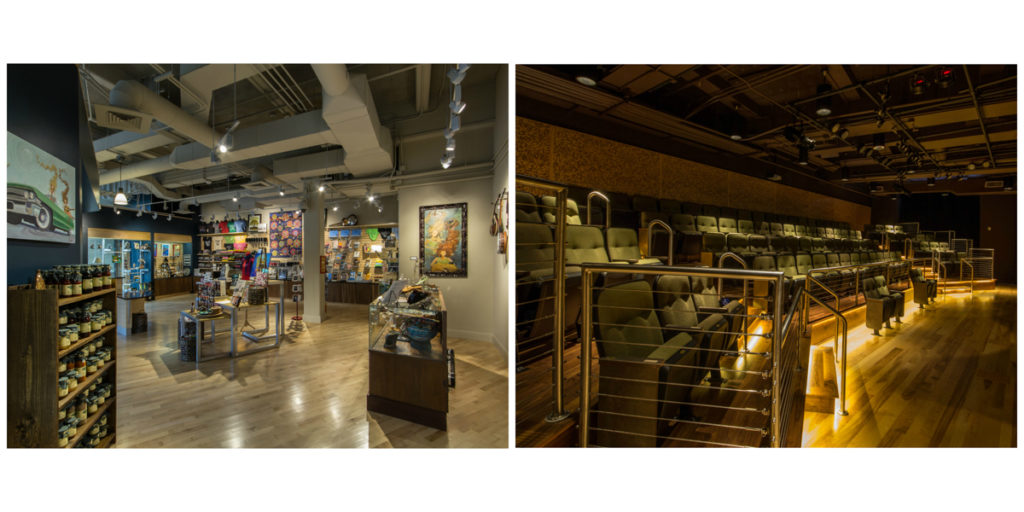
Another great example is the wood that was used in various areas in the museum. Several years before we began our detailed design work, a local purveyor of curly maple used in solid body guitars (Gibson guitars, in fact!) offered a gift of “seconds” of this wood for use in the museum. Fortunately, his offer was still on the table when we began to specify finish materials, and there was enough material for flooring in The Museum Store. Architect Michael Haslam, my former associate, developed a scheme to use curly maple and other “tone woods” – species used in the creation of musical instruments such as walnut or ash – for flooring and other finishes throughout the museum. While on the outside this design may just look attractive, the connection to woods used for musical instruments means that these details have deeper meaning, and our visitors are always interested to hear about these elements in the museum design.

Left: A view into The Museum Store showing the pale maple wood flooring and various retail displays. Right: A view into the Performance Theater showing the seating and different wood finishes.
The various tone woods used in The Museum Store and the museum’s Performance Theater can be seen in these photographs. © Birthplace of Country Music; photographer: Neil Staples

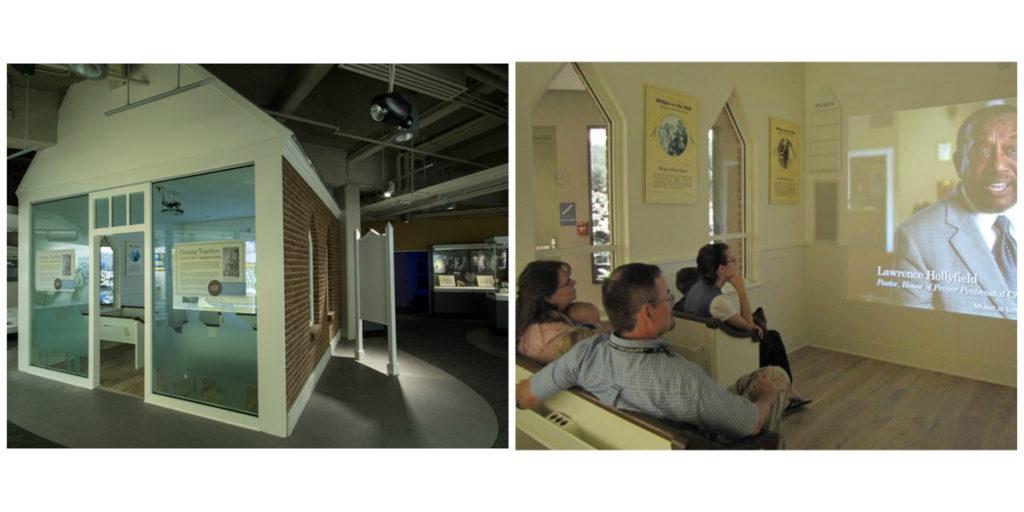
The chapel setting in the permanent exhibits was originally conceived as a trompe l’oeil interior where a video projection created the illusion of a larger interior space showing congregants seated in rows facing a group of shape-note singers. A single pew would provide limited seating for museum visitors at the back of the setting. Two elements of the chapel design changed as the content conversations developed: the film and the setting. The creation of the film didn’t just involve filming the groups performing gospel and sacred music – the artists also shared their thoughts about how this music expresses and celebrates their belief in God, an important parallel to the sacred songs of the 1927 Bristol Sessions. Some of the artists, such as the New Harvest Brothers, also sat in on meetings once filming had ended to help us shape the film and its focus – a true collaborative effort. We wanted to share the voices of the musicians who are performing in this gospel tradition today in a respectful way and give them the opportunity to tell the story of their faith and music.

The chapel setting also changed. First, it evolved from a virtual space to a “real” one. The church that comes to mind for most people when they think about traditional sacred music is a small, white clapboard church with a steeple. There are many wonderful churches of this type in Appalachia. But this is not the only type of church architecture found in this area, and when we looked at some of the churches associated with different Bristol Sessions artists, we found a brick model that worked well for our exhibit. The Tennessee Mountaineers, a group made up of a church congregation, didn’t have their own home church at the time of the Sessions, but they later built a small brick church in Erwin, Tennessee, patterned after a brick church seen in Bristol, and it is that church that inspired the design of the museum’s small chapel exhibit. A serendipitous find by a member of the exhibit design team also resulted in the donation of antique church pews. One round trip to Philadelphia later, the pews were in Bristol ready for refurbishing, and once finished, the acoustic designer placed speakers under the pew seats to provide a physical as well as aural sensation from the soundtrack on the video.

Left: A view of the chapel exhibit from outside of it. Right: A view of the chapel exhibit from the inside with several patrons seated in the pews watching the film.
The chapel setting and its film. Left: © Birthplace of Country Music; photographer: Neil Staples / Right: © Hillmann & Carr

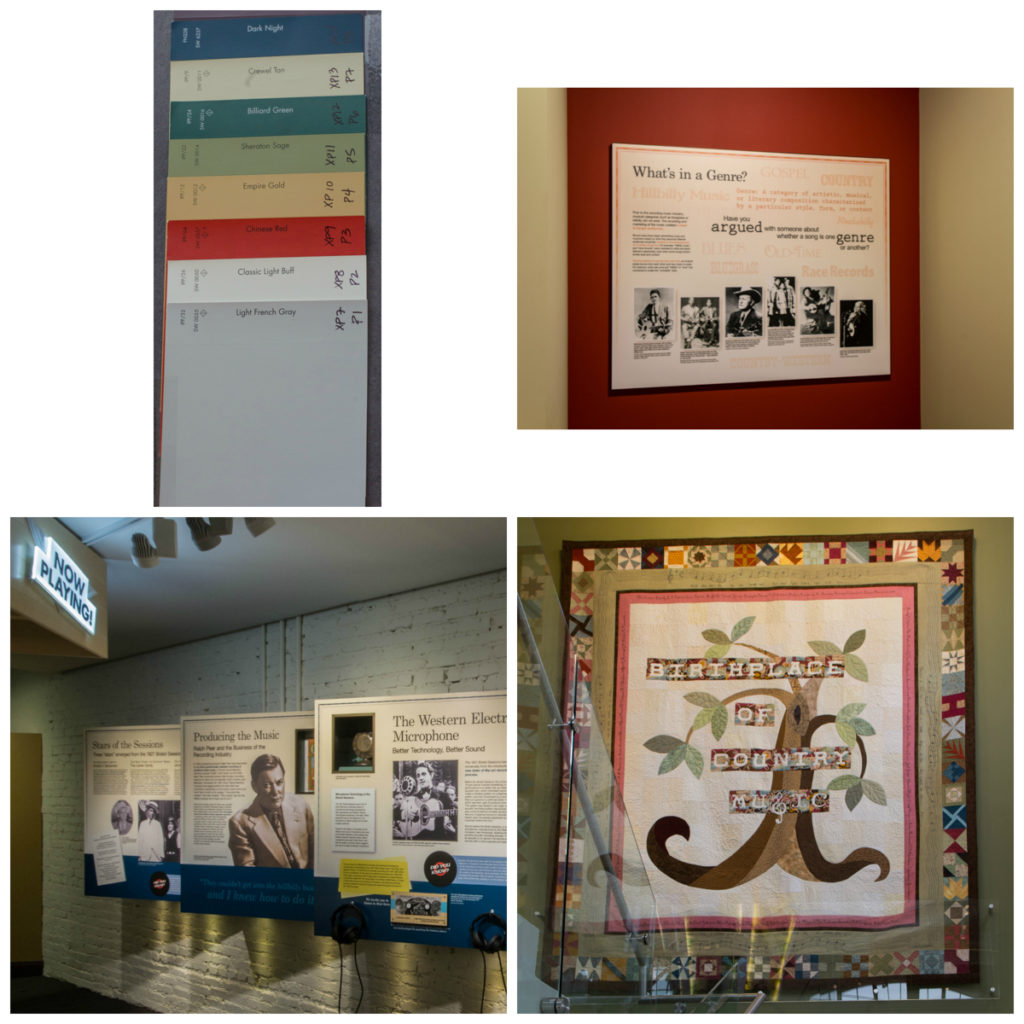
Another great detail, again pulled together after much discussion amongst the team, is the coordinated color scheme used throughout the museum. Developed by the exhibit designers for graphics, panels, and other exhibit components, the color scheme used for walls and other architectural elements was inspired by the ideas of home and comfort, an important facet of the lives of the 1927 musicians and their audience. The designer turned to reference images on American quilt making, seeing many quilts with amazing colors made from the fabrics related to the clothes, blankets, and meals (flour sacks with labels, etc.) of these quilt makers. From these connections to the past, she was able to create a color palette for use in the museum that addressed the needs of the architectural spaces in harmony with the exhibits. The Bristol TN/VA Chapter of the Embroiderers’ Guild of America also successfully employed the colors for the thread and fabrics in the beautifully crafted quilt that graces the main stairway, again tying the small details together.

Top left: Picture of the color swatches used in the museum; top right: View of the genre panel on a red wall; bottom right: View of the quilt hanging in the stairwell; bottom left: View of several panels using the blue and yellow colorways from the museum's color scheme.
The color scheme developed by the designer: the various colorways that she chose can be seen in the two exhibit spaces in the museum seen here and the quilt hanging in the museum stairwell. Top left: Courtesy of René Rodgers / All other images: © Birthplace of Country Music; photographer: Neil Staples

There are many more examples of fortuitous collaboration that helped create the Birthplace of Country Music Museum, and we are grateful to hear from our visitors every day that this hard work produced an amazing experience for the eyes, ears and heart. And we are grateful for the experience of working together as a team on such an interesting project. As Joe Nicholson said: “We really ended up with a seamless integration of the building with the exhibits and full owner participation throughout. I wish I could do one of these projects every year!” I couldn’t agree more.

Instrument Interview: The Creole Bania, the Oldest Existing Banjo

“Instrument Interview” posts are a chance to sit down with the instruments of traditional, country, bluegrass, and roots music – from different types of instruments to specific ones related to artists, luthiers, and songwriters – and learn more about them. Ten questions are posed, and the instruments answer! Today we talk with the Creole bania.

What ARE you?

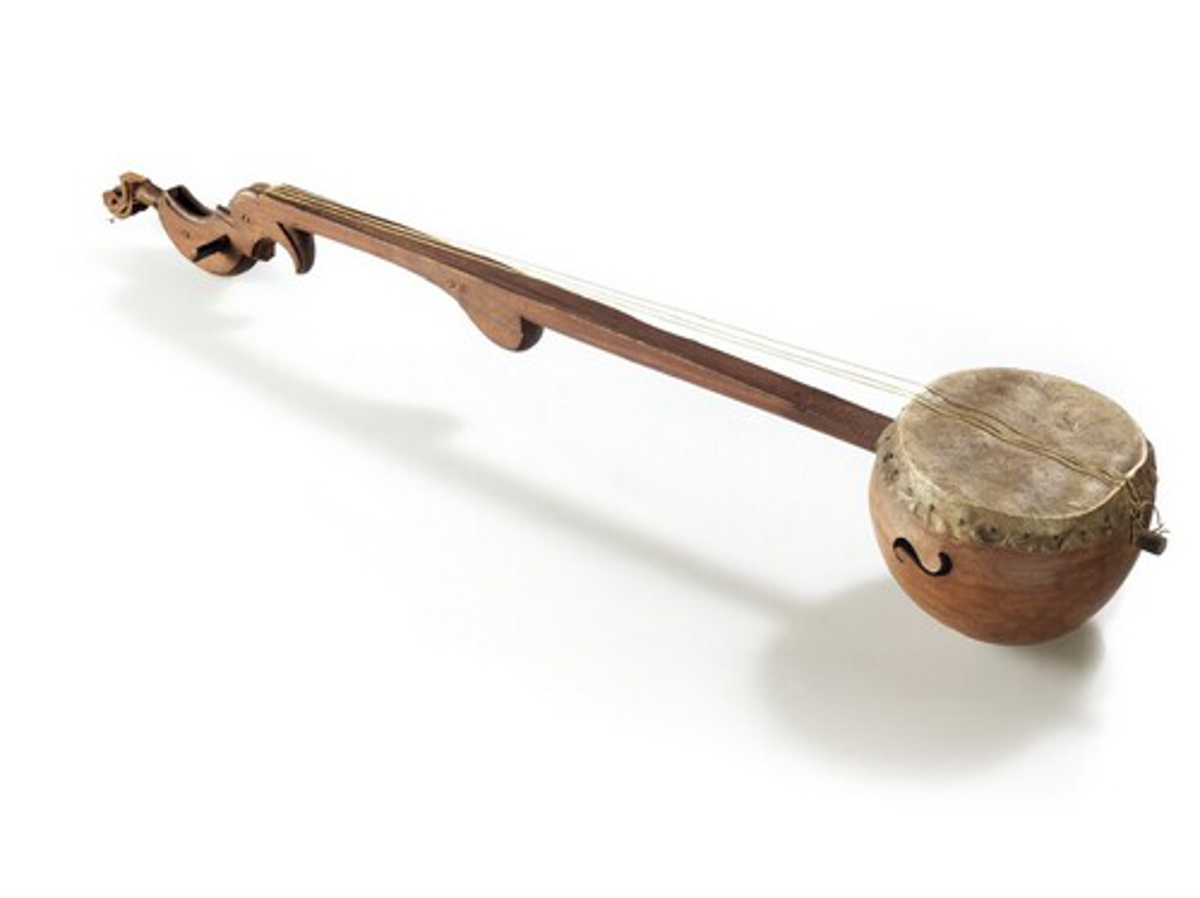
I’m a banjo! I know I don’t exactly look like the banjos you think of today, but I’m actually the earliest known banjo that still exists. I was made sometime before 1777, and at that time, banjos were made of gourds and calabashes.

Since you’re so different from the banjos we know today, describe yourself to us.

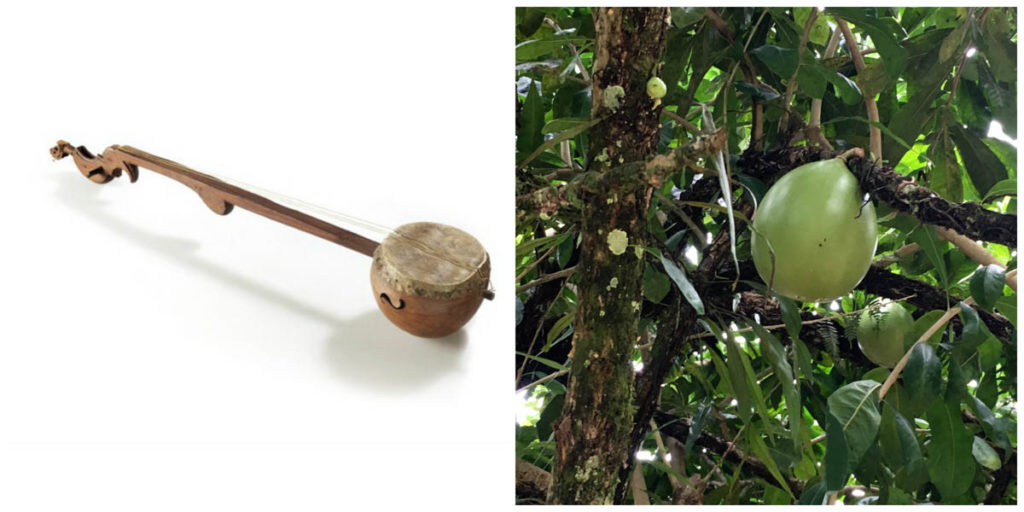
My body is a calabash, and my drumhead is made of animal skin held on with wooden pins. I have two S-shaped sound holes (kind of like a fiddle). I also have three long strings and one short string and a very nicely carved peghead. My neck is thinner than banjos today, and it is made of wood.

Left pic: A creole bania as described in the text, made of a calabash with a skin drumhead, charged peghead, and strings. Right pic: A globular green calabash growing on a tree.
The image to the left is a picture of me, where you can see the details I describe above. To the right is a picture of a calabash, a type of fruit that grows on trees; banias are also made from gourds, which grow on vines on the ground. Left: Creative Commons, https://hdl.handle.net/20.500.11840/609575; Right: Photograph courtesy of Kristina Gaddy

Where did you come from?

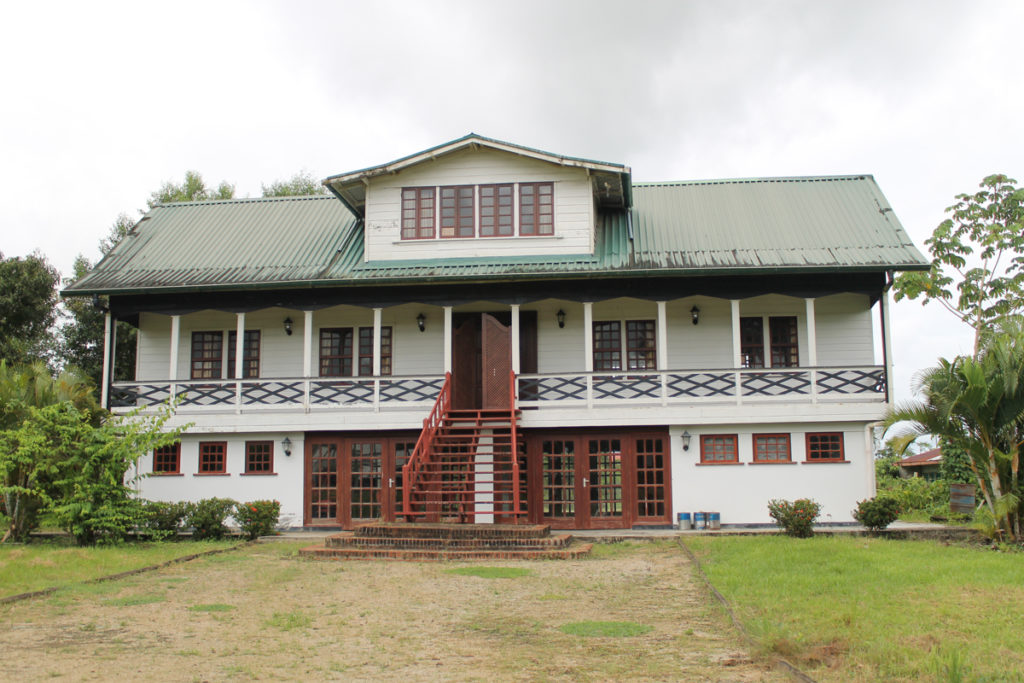
I came from the country that is known as Suriname. Located on the northern coast of South America, Suriname is actually a part of the Caribbean, even though it’s not an island. In the 1770s, Suriname was a Dutch colony, known for the brutal conditions that enslaved Africans and people of African descent faced working on sugar and coffee plantations.

A two-storey, with gable, plantation house, reconstructed. It is white with red stairs and doors on the ground floor, and a green roof.
A reconstructed plantation house at Stichting Openluchtmuseum Fort Nieuw Amsterdam (SOFNA), an open-air museum in Paramaribo, Suriname.
Photograph courtesy of Kristina Gaddy

Wait! I think of banjos as a North American instrument, but you say you’re from South America?

Actually, we’re not just found in North America. Banjos were observed all over the Caribbean, too. In fact, the first record of a banjo is from about 1687 in Jamaica! Instruments similar to me had lots of different names, including bania, banya, banjo, banger, banza, and panja, and were observed in New York, the Carolinas, New Orleans, Cuba, Haiti, St. Vincent, and Barbados, among other places. If you want to know more, you should check out Dena Epstein’s Sinful Tunes and Spirituals. Yours truly is mentioned, but she has accounts of my relatives from all over.

Check out this video of Seth Swingle playing a reproduction of the Haitian banza, a banjo collected in Haiti around 1840. Pete Ross studied the original and now makes reproductions for players and museums.

Who made you?

Almost 300,000 people were forcibly taken from Africa and enslaved in Suriname, and I was made by one of those enslaved people, who based my design on the instruments he or she had in Africa. I wish I could tell you more about the person who made me, but the man who collected me, John Gabriel Stedman, didn’t tell anyone more than that.

Tell me more about this Stedman guy.

Captain John Gabriel Stedman arrived in Suriname to fight formerly enslaved people who had escaped to live in the jungle. Stedman was there to stop two tribes – the Saamaka and Njuka – from attacking plantations. Stedman kept a diary while he was in Suriname, which eventually became a very popular book, and he even drew a picture of me in it! That was when he named me “Creole Bania.”

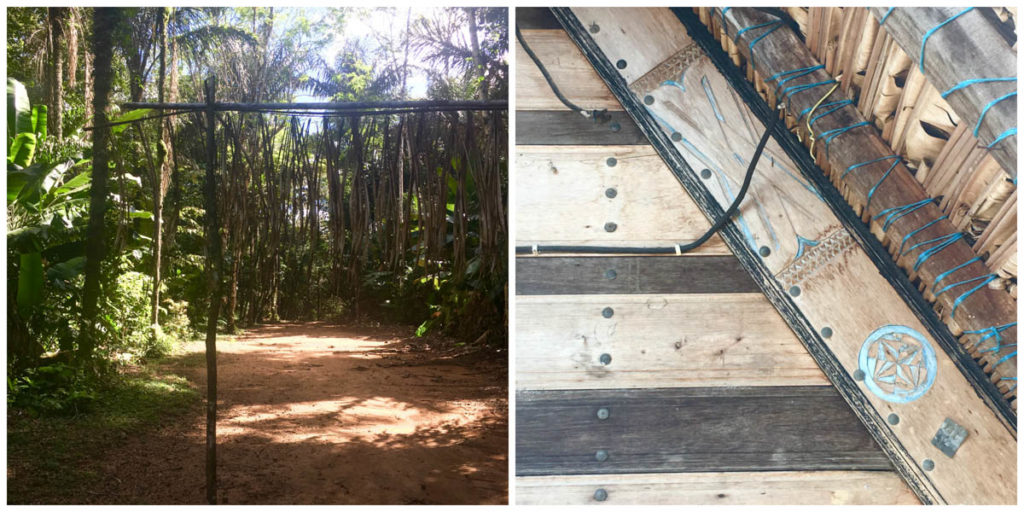
Left: A earthen path marked with a horizontal wooden branch with hanging elements on it to mark the entrance to a village; right: boards from a house (looks like a ceiling), including carved elements.
Left: The entrance to a Saamaka village in Suriname; right: Detail of a carving on a home in a Saamaka village. Photographs courtesy of Kristina Gaddy

Where are you now?

I live at Tropenmuseum in the Netherlands. For many years I was in the storerooms, but I’ve recently been put on permanent display in an exhibit about slavery in the Dutch colonies, including Suriname.

Ok, so you’re the oldest banjo, but are there any other banjos like you?

Yes! I have a friend from Suriname who lives at the Ethnologisches Museum in Berlin, Germany. That banjo is known as the panja (pronounced pan-ya), and it was collected sometime before 1850. We are very similar in construction, and this panja has a really beautiful peghead.

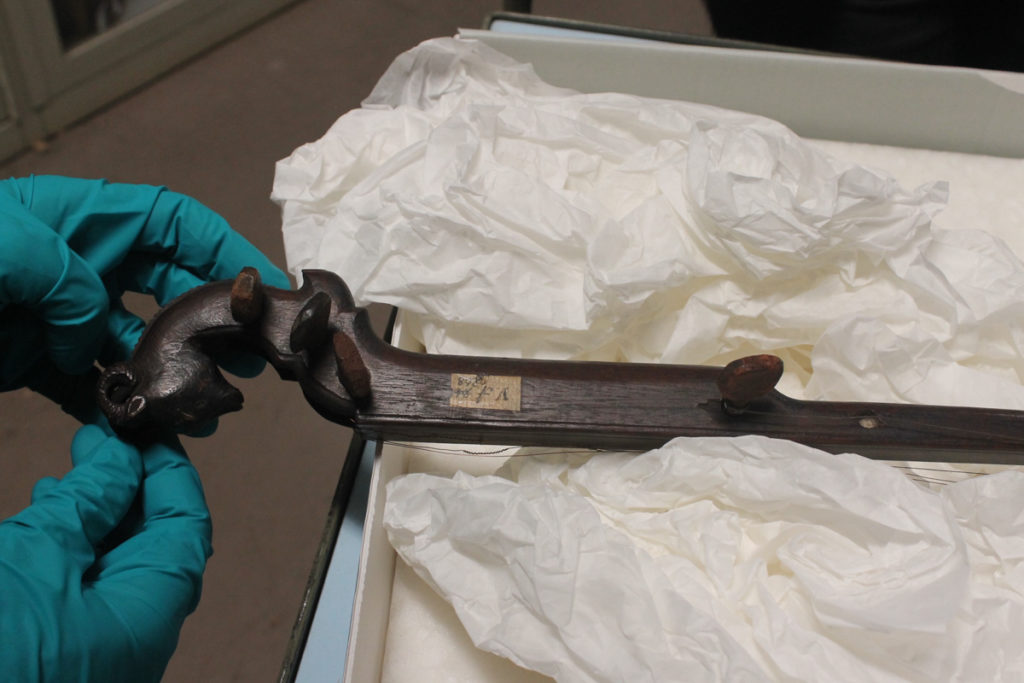
The panja's dark wood peghead, intricately carved with what looks to be a goat head, in the museum archive.
The peghead of the panja at the Ethnologisches Museum in Berlin, Germany. Photograph courtesy of Kristina Gaddy

Do we know any more about the panja?

No. In fact, for many years, U.S. banjo scholars didn’t know about the panja at all! It was rediscovered by a banjo researcher named Schlomo Pestcoe, and now a couple of people have even been by to visit it.

What type of music did you and the panja play?

Alas, something else we don’t remember! No one wrote down the music that was played on banjos in Suriname, but a note about the panja does give a bit of a clue. The collection note says: “Panja, 4-stringed strummed instrument, particular to death celebrations and to the song Ananhitori.” Recent research suggests that the banjo was a central part of a spiritual/cultural ritual across the Americas. I hear if you want to find out more about this, you should come to this year’s Banjo Gathering at the Birthplace of Country Music Museum in November!