Museum Archives - Page 20 of 34 - The Birthplace of Country Music
Listen
Play
Loading station info...

A Hot Summer Night in the City of Bristol at August’s Farm and Fun Time

August’s Farm and Fun Time showcased some of the best in contemporary bluegrass! Thanks to our sponsor Eastman Credit Union, Radio Bristol was able to bring Farm and Fun Time to not only those in the audience or tuned in to WBCM-LP, but to viewers far and wide via Facebook Live. Be sure to like WBCM – Radio Bristol on Facebook to tune in every month!

Host band Bill and the Belles started the show on this summer evening with the sunny Roger Miller classic, “Walking in the Sunshine.” Following their always fun and lighthearted performance, things got corny – cream corny that is! – as Charles Parker shared an old family recipe for cream corn for Farm and Fun Time’s “Heirloom Recipe.” A champion of local Southwest Virginia food and the chef at Abingdon’s Southwest Virginia Cultural Center & Marketplace, Parker learned to love local produce and utilize it in his dishes from his grandma. An important part of Appalachian foodways is canning, and Parker recalls preparing cream corn to can. In honor of the labor that goes into this recipe, Bill and the Belles sang a new song: “The Corn Shuckin’ Song.”
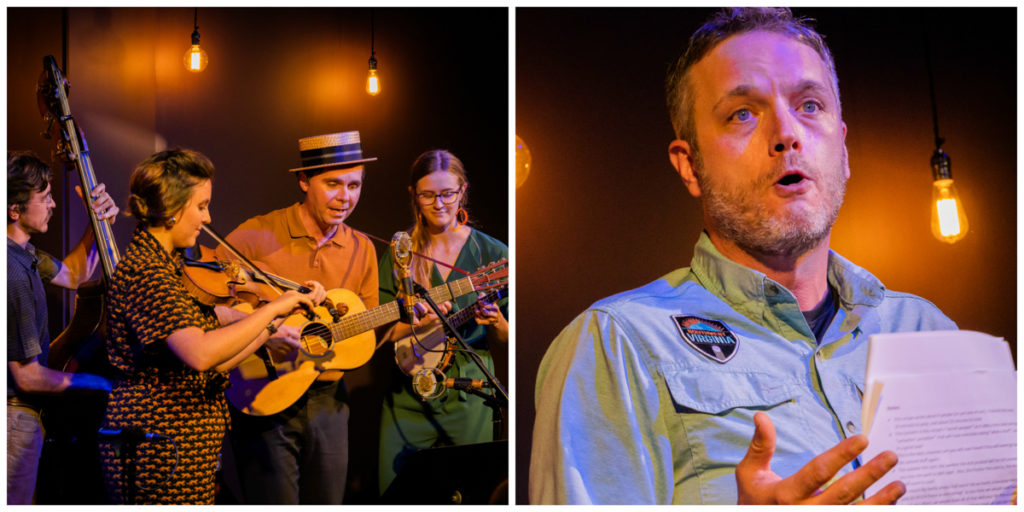
Left: Bill and the Belles -- Andrew Small on bass, Kalie Yeagle on fiddle, Kris Truelsen on guitar, and Helena Hunt on banjo -- gather round the mic. Right: Charlie Parker telling the story of his family's cream corn recipe with the audience.
Bill and the Belles welcomed the Farm and Fun Time crowd with a sunny tune, while Charles Parker’s cream corn recipe got people’s mouths watering! © Birthplace of Country Music; photographer: Billie Wheeler

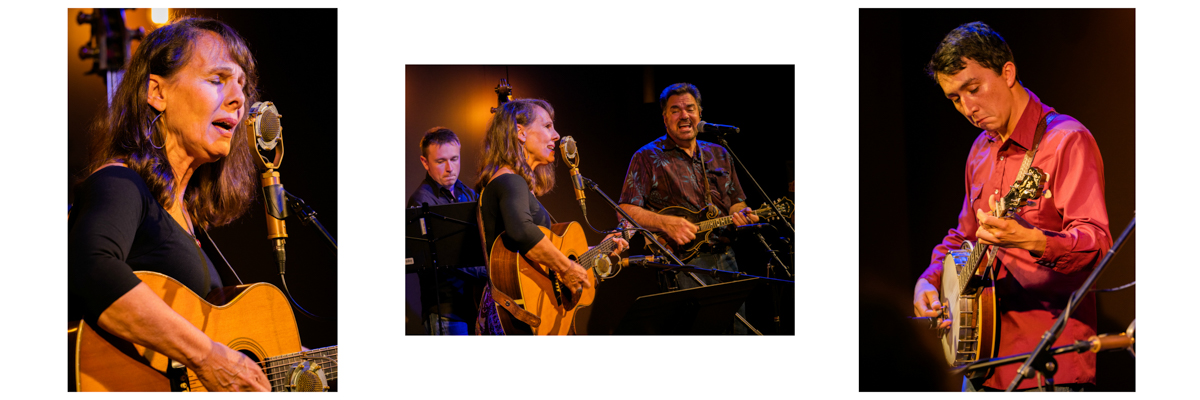
Our evening’s first musical guest was Irene Kelley. With a songwriting career that spans the past three decades, she’s had songs recorded by Alan Jackson, Loretta Lynn, Ricky Skaggs, and a score of other Nashville stars. However, Irene has maintained a strong following in her own right, and for August’s Farm and Fun Time, she performed songs off her recent project, Benny’s TV Repair. Singing about trains and home and even paying homage to Native Americans, Kelley’s strong songwriting captivated our audience, and her capable band brought these timeless stories to life.
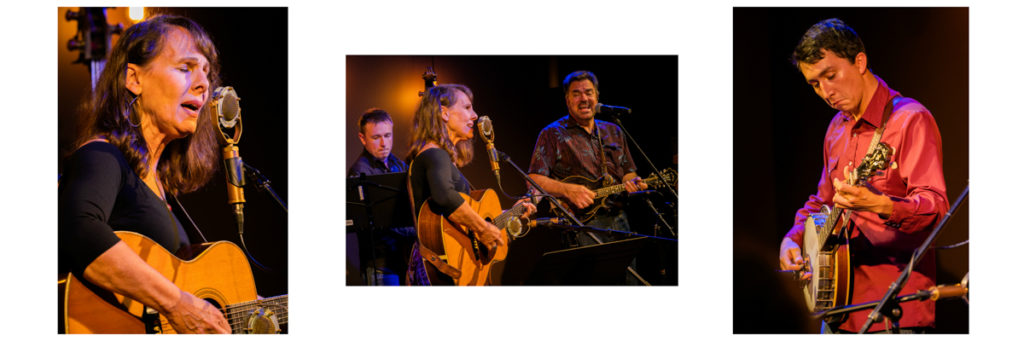
Left: Close up of Irene Kelley singing with her eyes closed and playing the guitar at the mic. Center: Irene Kelley with the bass player in the background and the mandolin player to her side. Right: Irene Kelley's banjo player in a red shirt.
Irene Kelley and her band performed songs filled with storytelling and nostalgia from her recent album. © Birthplace of Country Music; photographer: Billie Wheeler

This month’s “Radio Bristol Farm Report” showcased Chuckey, Tennessee’s own Greene Hemp Company. Our visit to the Ole Appalachian Hemp Farm was an informative experience where we learned about this sustainable and versatile product! Here’s a video from our visit:

For the Farm and Fun Time team and our live and on-air audiences, it was a great pleasure to have the Lonesome River Band, one of the longest running and most influential bluegrass bands on the scene today. Founded 37 years ago, Lonesome River Band has been bringing a fresh take on the traditions of bluegrass music with their distinct drive and high-energy performances. Performing a mix of original songs and classics, the Southwest Virginia- based group brought down the house with soulful singings and hard-driving playing. In the 1940s, the bluegrass bands that performed on WCYB’s original Farm and Fun Time were pushing the boundaries of what was then simply country music. With Lonesome River Band as a group that has perpetuated the innovation of those groups, it was a full circle moment to have them on the stage for our continuation of the WCYB show’s legacy.
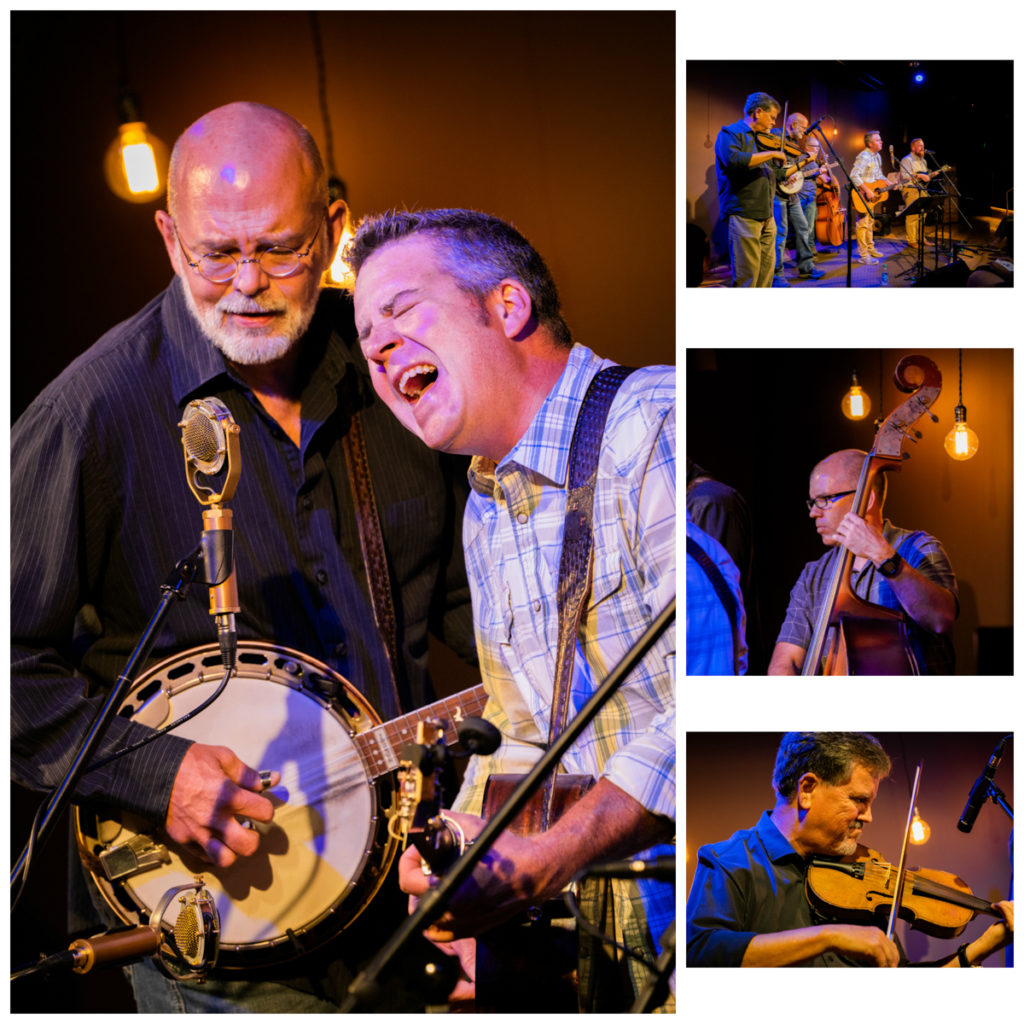
Left: Close up of the banjo and guitar players singing and playing at the mic; Top right: The full band on the Farm and Fun Time stage; Middle right: Close up of the bass player; Bottom right: Close up of the fiddle player.
The musicians from the Lonesome River Band brought a great mix of bluegrass tunes to the Farm and Fun Time audience. © Birthplace of Country Music; photographer: Billie Wheeler

Thanks to everyone who came and helped make August’s Farm and Fun Time another successful evening of fun and music! September’s show will be part of Bristol Rhythm & Roots Reunion, so stayed tuned for a special announcement. Tickets are on sale for October’s Farm and Fun Time featuring Chatham County Line, Jeff Scroggins & Colorado, and host band Bill and the Belles. We hope to see you there!
Radio Bristol Book Club: The Ballad of Tom Dooley

Welcome to Radio Bristol Book Club! Readers from BCM and the Bristol Public Library are coming together each month to celebrate and explore one book inspired by our region’s rich Appalachian cultural and musical heritage. We invite you to read along and then listen in on the fourth Thursday of each month at 11—11:30am when we will dig deep into the feelings and questions raised by the books, learn more about the authors, and celebrate the joys of being a bookworm!

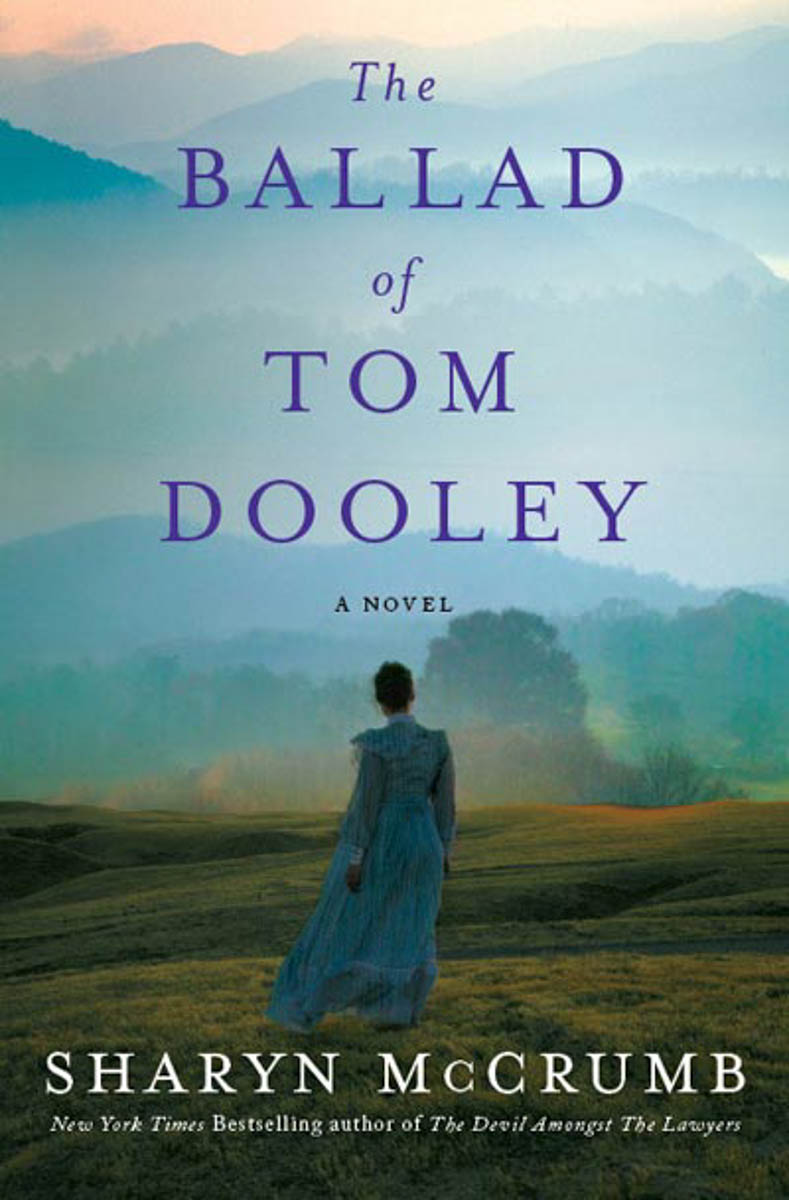
The book for August is The Ballad of Tom Dooley by Sharyn McCrumb, and we will be discussing this fictional re-telling of the real-life murder of Laura Foster in 1865 in North Carolina. Join us as we discuss The Ballad of Tom Dooley on August 22 at 11am on Radio Bristol – locally on 100.1 FM or via the website or app.

The Ballad of Tom Dooley cover shows a woman in 1800s dress from the back -- she is standing in a field looking towards the mountains in the distance.
Cover of The Ballad of Tom Dooley from www.sharynmccrumb.com.

Upon returning home from the Civil War, Tom Dula finds himself on trial for the murder of his lover, Laura Foster. Dula is convicted and hanged for his crime, but there is much more to this story than just one of star-crossed lovers and scorned women. With this book, Sharyn McCrumb set out to write a fictionalized version of the events that were made famous by the song “Tom Dooley,” with the most well-known version by The Kingston Trio. However, her research helped to find a missing piece of the story that changed everything everyone thought they knew about Laura’s murder.

Sharyn McCrumb, who lives and writes in the Blue Ridge Mountains of Virginia, has published over 25 novels, along with short stories and contributions to non-fiction works. McCrumb’s books celebrate the beauty and tragedy of Appalachian history and culture. Her stories, particularly in her Ballad series, are rich and full of the legend and richness that we know Appalachia to have. The Ballad of Tom Dooley has all of this richness and more, and has often been called an Appalachian Wuthering Heights.

We cannot wait to share our thoughts on The Ballad of Tom Dooley with all of our listeners at Radio Bristol Book Club! We hope you can join us as we discuss this beautiful and tragic story of love and betrayal. You can pick up a copy at your favorite local bookstore or stop by the Bristol Public Library and check out a copy today! The librarians at the Bristol Public Library will be happy to help you find a copy of the book in any format that suits you best, from book to audiobook, and even e-books.

Make plans to join us at 11am on Thursday, August 22 for Radio Bristol Book Club!

The Ballad – From There to Here with Wayfaring Strangers

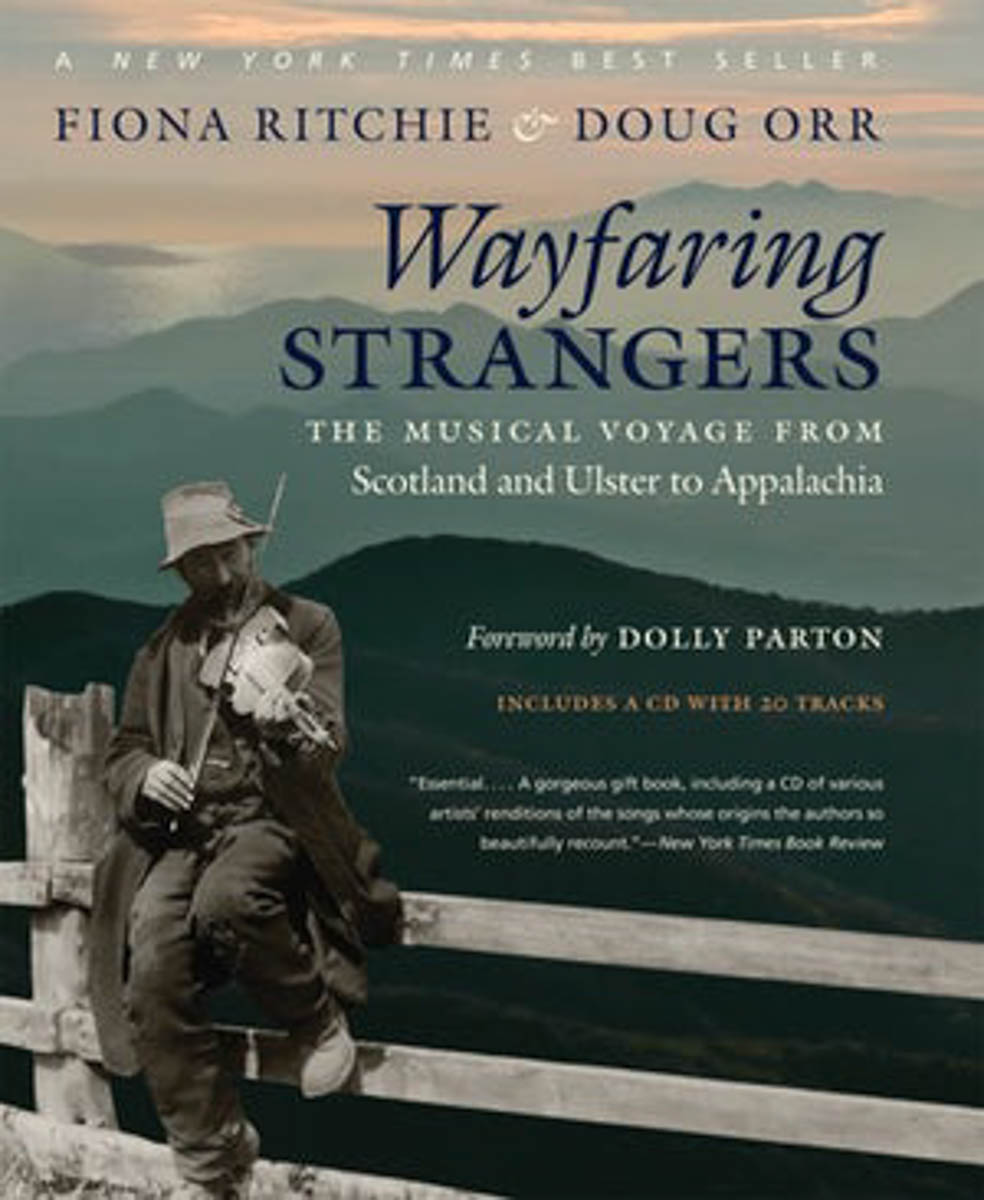
There is a book on the shelves in the museum’s Blue Stocking Club Learning Center that I come back to time and time again – Wayfaring Strangers: The Musical Voyage from Scotland and Ulster to Appalachia by Fiona Ritchie and Doug Orr. This wonderful book chronicles the history of the ballad from its origins to its place in our very own Appalachian Mountains. Beautifully written, with equally beautiful artwork and photographs, it tells the story in a meandering manner, taking the reader down old and new roads, mimicking the ballad journey itself.

The cover of Wayfaring Strangers shows hill upon hill of the Appalachian Mountains, with a superimposed photograph of a Scottish fiddler to the left side of the cover image.
The cover of Wayfaring Strangersfeatures the rolling peaks and valleys of the Appalachian Mountains and a traveling Scottish fiddler.

The story of ballads is greater than what can be covered in a blog post, but I want to share what I have learned from Wayfaring Strangers, giving readers a small glimpse into that history in a fairly simplistic and straightforward manner. However, I encourage you to also read this book to learn more; it captured my heart – and it is sure to capture your heart too!

Ballads go further back in pre-recorded history than initially thought, to the seafaring civilizations sharing cultures via storytelling and music. There is no one single point of ballad origin; rather points as disperse as Scandinavia, Germany, Western Europe, Scotland, Ireland, England, and the Mediterranean all had a role to play. For example, there is an old-style epic narrative performed in Connemara, Ireland that is nearly identical to a Bedouin style.  

Scottish poet, folklorist, and songwriter Hamish Henderson called the ballad journey the “carrying stream,” a perfect analogy for its meandering ways through ages, cultures, and configurations. Ballads were an oral tradition for disparate, often illiterate populations wherein stories, news, commerce, commentary, protest, and dance could be part of the delivery. As they traveled, ballads were subject to many influences and variations, both to their words and music, and often the same ballad may have different tunes or one tune may be associated with several different ballads. Over time and space, it was the best lyrics and tunes that continued along the carrying stream.

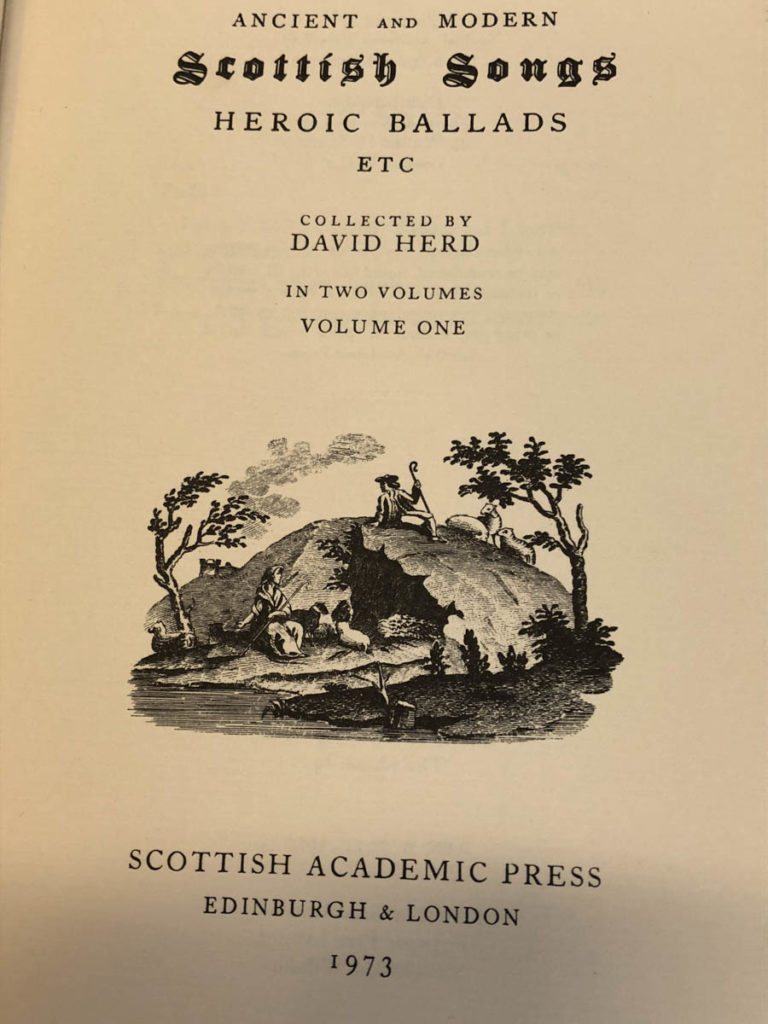
The title page of David Herd's book shows the title and publication information, along with a lithographic illustration of a shepherd with his flock on a hillside.
This edition of David Herd’s Ancient and Modern Scottish Songs, Heroic Ballads, &c is from 1973, but the original book was published in 1776. It was on loan from Jack Beck and Wendy Welch during The Appalachian Photographs of Cecil Sharp, 1916 to 1918 special exhibit in 2018.

As to the Scots-Irish ballad tradition that is quite familiar in the Appalachians, it begins with a Nordic-Baltic influence arriving early on the Scottish shores. Northeast Aberdeenshire is considered the cradle of Scottish balladry with distinct language, customs, and folklore created out of isolation and seafaring influences. Western Scots and Irish people shared their traditions as well via the short sea route between them, and the Scottish and English border counties added further influences, all contributing to the oral-to-written evolution.

The ramifications of politics and palace intrigue over the course of the ballad history were many and varied, and the resulting diaspora impacted the story. One such dispersing was the Scots to Ulster Ireland and then on to the American colonies. It is this carrying steam that brought the ballad tradition to our mountains. The majority of these immigrants arrived at various ports northward and traveled down the Wilderness Road to the Appalachian Mountains. The pioneers settled in valleys and coves throughout the mountains, bringing their musical heritage with them – a heritage that merged with other traditions, styles, and songs found in the Appalachians including those of Native Americans, enslaved peoples from Africa, and other ethnic groups. It is this mixing that eventually evolved to be recognized as old-time country music. 

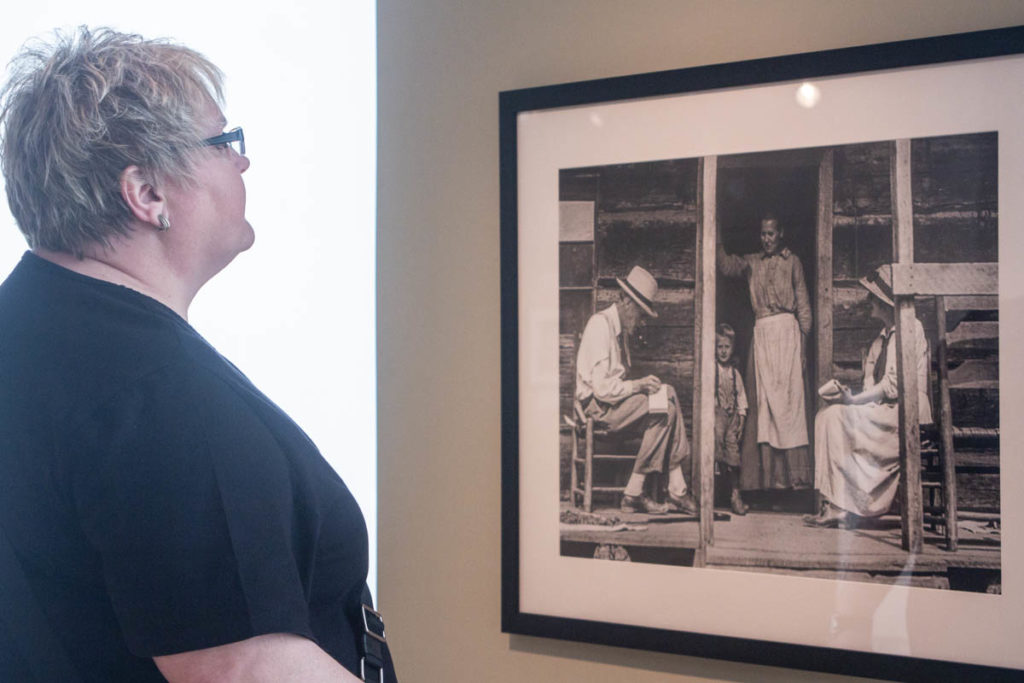
A visitor looks at a photograph of Cecil Sharp and his assistant recording the words/lyrics of an Appalachian woman on her porch. A small child stands in the doorway with her.
The 2018 Cecil Sharp special exhibit featured photographs of the many singers Sharp met on his Appalachian song-collecting trip in 1916 to 1918. He transcribed the lyrics and music of numerous ballads and songs that still had strong ties to their Old World origins. © Birthplace of Country Music

As Wayfaring Strangersnotes: “Music provided the social fabric, creating a sense of community amid isolation and reinforcing identity. That said, while the Scots-Irish origin is clearly the dominant one, it is the braiding and weaving of European, African and indigenous American influences that creates the unique tapestry of Appalachian music.”

The long tradition and the evolution of ballads is further underlined by Bascom Lamar Lunsford, western North Carolina Minstrel of the Mountains,  when he tells us “… that though the words changed from country to country, and generation to generation, even from valley to valley in the same range of hills, the essence of the music changed not at all.  It formed a link, unbroken, back through time, tying to the past.”  

Music was – and still is – reward at the end of a long day’s work, something to share in front of a winter fire or on a summer porch, and an act of community as voices are raised together at barn raisings, harvests, market days, and other events and occasions. And, of course, this included the teaching of these traditions to succeeding generations of children and grandchildren.  

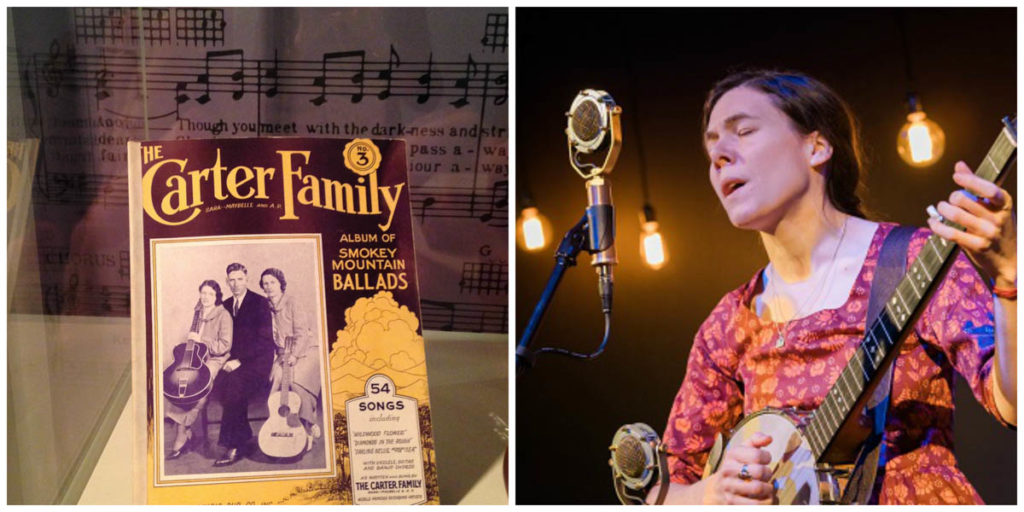
Left: The cover of the Carter Family songbook bears a photograph of them with their instruments and a drawn rural image. Right: Elizabeth LaPrelle, wearing a red dress, plays the banjo and sings into the mic on the museum's Performance Theater stage.
The museum’s Carter Family exhibit in 2014 showcased The Carter Family’s songbook of Smokey Mountain ballads. The ballad tradition is honored and continued by musicians like Elizabeth LaPrelle, who performed at the January 2019 Farm and Fun Time and in concert in March 2019 at the museum. Left: © Birthplace of Country Music; Right: © Birthplace of Country Music; photographer: Billie Wheeler

This ballad heritage was found at the Bristol Sessions in some of the songs, which were then shared through the recordings on a much wider scale. This music was a continuation of the carrying stream, and that musical migration continues through today’s carriers and tradition bearers – they too are immersed in the carrying steam. And old-time country music and the storytelling it is a part of, along with music festivals the world over and our museum visitors from every state and over 44 countries, all testify to that continuing journey.  

Radio Bristol Book Club: The Journal of Jesse Smoke, A Cherokee Boy

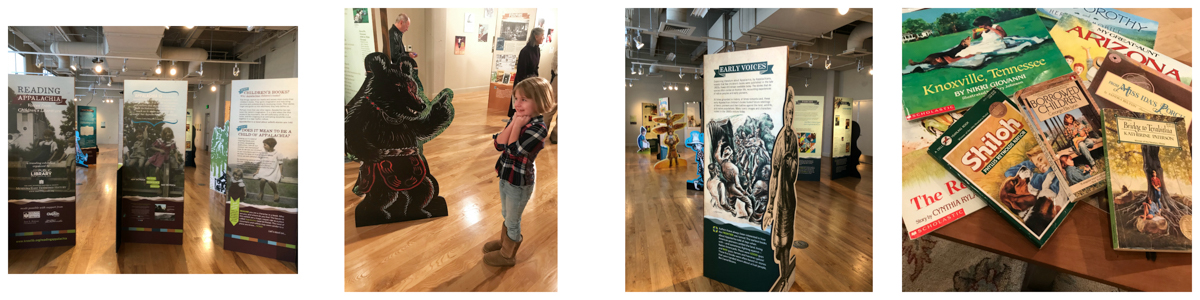
Welcome to Radio Bristol Book Club! Inspired by the museum’s current special exhibit – Reading Appalachia: Voices from Children’s Literature – readers from the Birthplace of Country Music and the Bristol Public Library are coming together each month to celebrate and explore one book featured in the exhibit. We invite you to read along and then listen in on the fourth Thursday of each month at 11—11:30am when we will dig deep into the feelings and questions raised by the books, learn more about the authors, and celebrate the joys of being a bookworm!

The Reading Appalachia special exhibit is a wonderland of characters and stories for kids and adults alike, and it has given us a whole host of books to choose from for book club! © Birthplace of Country Music

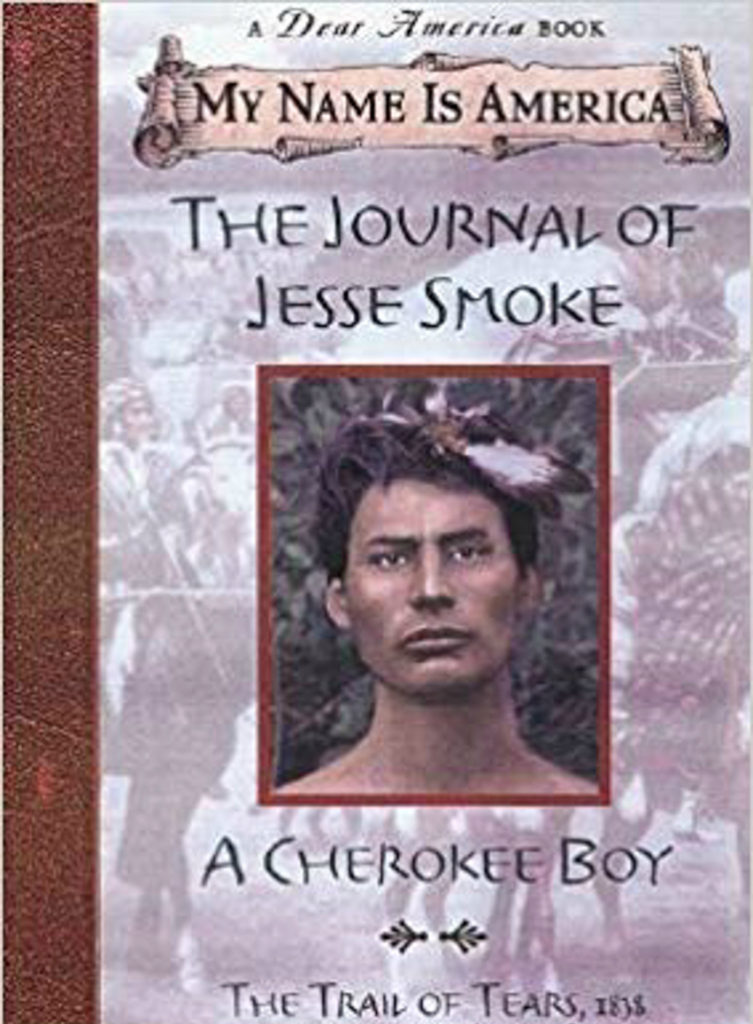
The book for June is The Journal of Jesse Smoke. A Cherokee Boy by Joseph Bruchac, and we will be discussing this novel on June 27 at 11am live on Radio Bristol.

The Journal of Jesse Smoke is part of book series published by Scholastic Books, each historical novel written in the form of a diary or journal by a boy or girl during an important period of American history. Jesse Smoke is a Cherokee boy living in Tennessee who chronicles the final debate over the fate of the Cherokee nation and then their harrowing days on the Trail of Tears in 1838. The story – from the loss of their homes and land to the cruelties and the prejudice they faced, and sprinkled throughout with historical facts, Cherokee words and traditions, and the stories of other members of his tribe – is made even more real through its telling in the teenage voice of Jesse. The book serves as a poignant and powerful view into this tragic chapter in American history.

The cover of The Journal of Jesse Smoke, A Cherokee Boy

Joseph Bruchac is a member of the Nulhegan Abenaki tribe. He lives in the Adirondack Mountains of New York, where he works with other family members to preserve the native culture of the region. Bruchac has written over 120 books for both children and adults, along with hundreds of articles, poems, and stories, and he has won numerous awards including the Cherokee Nation Prose Award and a Lifetime Achievement Award from the Native Writers Circle of the Americas in 1999. 

We cannot wait to bring Joseph Bruchac’s The Journal of Jesse Smoke to Radio Bristol Book Club! We hope you can join us as we discuss this wonderfully detailed historic novel. Stop by the Bristol Public Library and check out a copy today – the librarians will be happy to help you find the book!

Make plans to join us at 11am on Thursday, June 27 for Radio Bristol Book Club! You can tune in locally at 100.1 FM or listen via the website or app.