Museum Archives - Page 13 of 34 - The Birthplace of Country Music
Listen
Play
Loading station info...

Museum Store Artisan Spotlights: Johnny Glass, Paula Kahn & Anne Vaughan

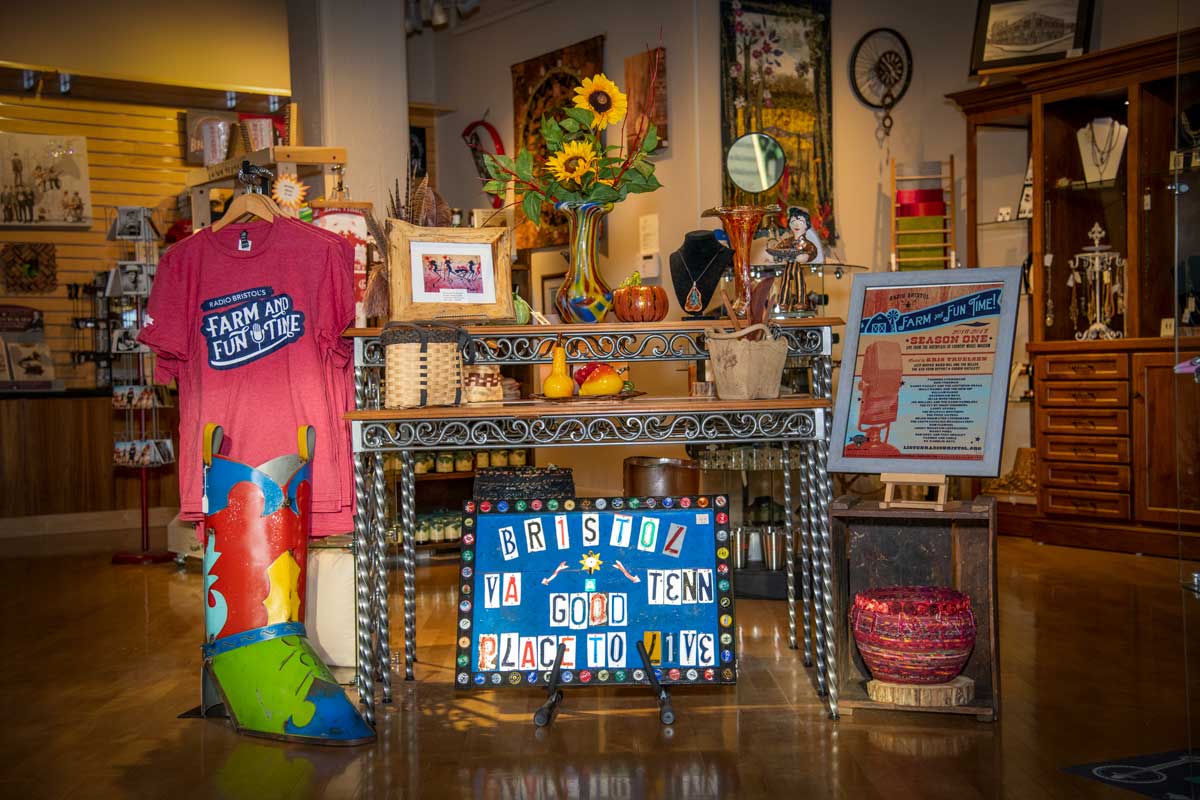
A look inside The Museum Store at the Birthplace of Country Music Museum featuring WBCM Radio Bristol Farm and Fun Time t-shirts and framed poster, a colorful metal sculpture that doubles as a giant cowboy boot and umbrella stand, artwork made from the letters of car license plates that mimic the famous Bristol Sign that reads "Bristol VA - Tenn A Good Place to Live," glass fruit and vases, pottery, and baskets.
The Museum Store in the Birthplace of Country Music Museum.
© Birthplace of Country Music; photographer: Earl Neikirk

The Birthplace of Country Music Museum prides itself on its world-class exhibits, but did you know that attention to detail also carries over into The Museum Store? The goal: To create a gallery-like shopping experience for visitors by offering one-of-a-kind crafts and goods handmade by local and regional artisans. From sculptural, glass-blown collectibles to intricately beaded music-themed handbags, great care is taken to choose pieces that elevate the status of your typical souvenir. The majority of these bespoke items are destined to become treasured keepsakes and family heirlooms.

In this edition of our blog, and in future blogs, we will highlight many of the juried artisans we have commissioned to sell work in The Museum Store. And their work is a joy to behold. To paraphrase the words of Asheville, North Carolina photographer Tim Barnwell‘s book Hands in Harmony: Traditional Crafts and Music in Appalachia, “Traditional music and handcrafts are both expressions of the creative mind and the accomplished hand.”
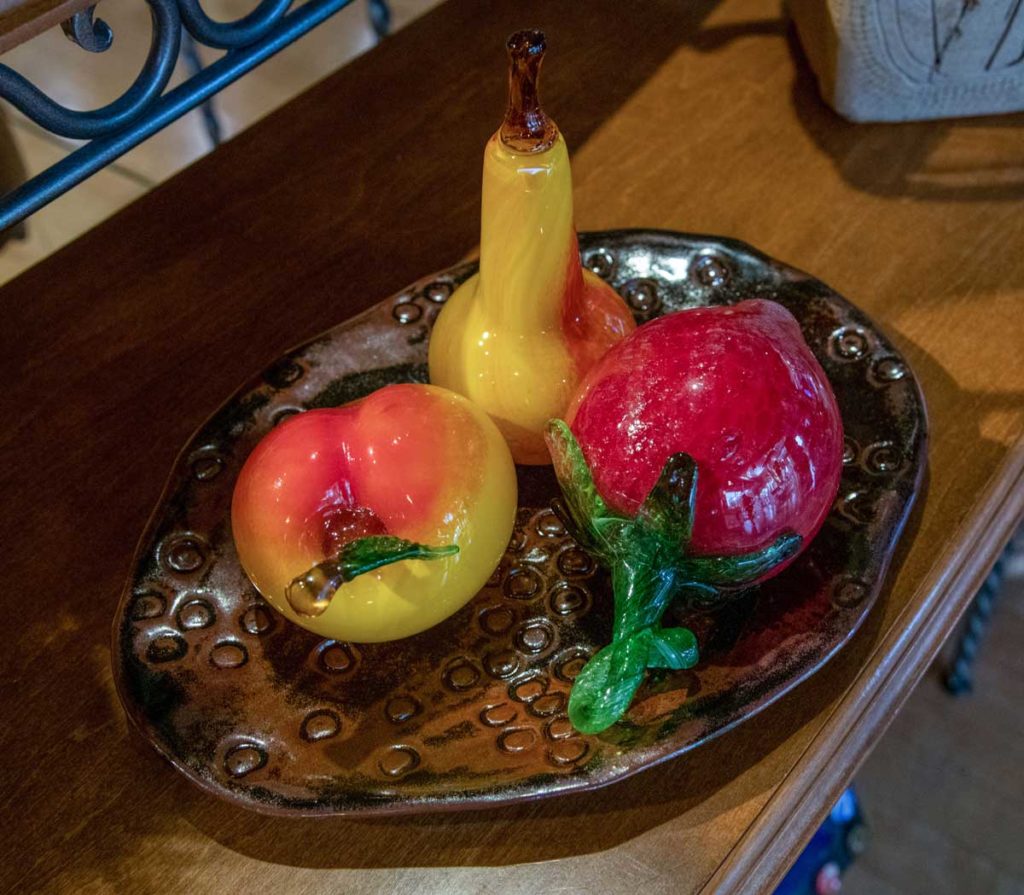
A ceramic tray holding a blown glass peach, pear, and strawberry made by Glass by Glass Studios.
Glass fruit by Glass by Glass Studios in The Museum Store at the Birthplace of Country Music Museum.
© Birthplace of Country Music; photographer: Earl Neikirk

Johnny Glass: Glass by Glass Studios

Perhaps his name was a self-fulfilling prophecy as Johnny Glass is a master creator of hand-blown glass. Based in Knoxville, Tennessee, and Los Angeles, California, Johnny travels cross-country demonstrating his art at various craft shows and venues in a mobile studio he custom designed and built himself. He is so self-sufficient, in fact, that he can bring his full glassblowing studio to any location and have it fully operational within 12 hours to serve as a classroom in which to teach others or to provide demos.

A native of Knoxville, Tennessee, Glass earned his undergraduate degree at Tennessee Tech, going on to study under some of the best-known glass artists in the country both in California and Washington. Glass is currently working on his Masters in Fine Arts at Tulane University in New Orleans where he has earned a full scholarship. He works part time at the college’s extensive glass studios taking care of the facilities and their six furnaces.

Johnny’s mission is to bring awareness and renew interest in the art of glass, and his life’s ambition is to teach what he’s learned at a major university. At The Museum Store, you’ll find his signature pumpkins in addition to paperweights, mugs, vases, Christmas trees, and much more.
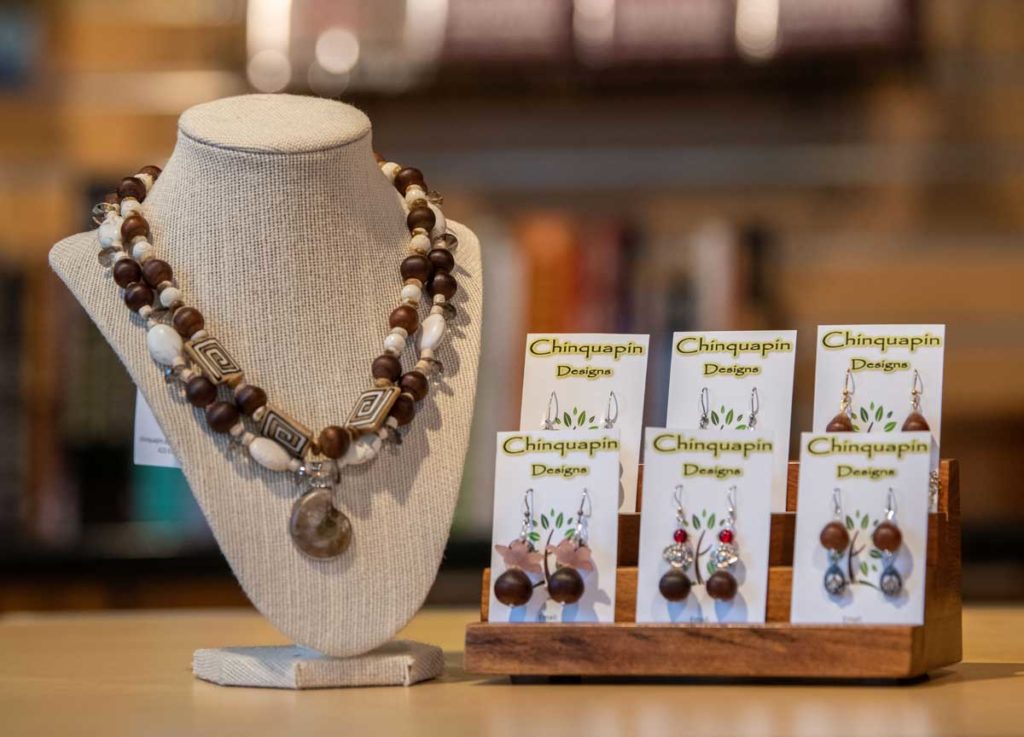
A lovely chinquapin beaded necklace interlaced with white beads and a fossil pendant on a display form beside a smaller display of long chinquapin beaded earrings by Chicuapin Designs.
Handcrafted jewelry by Chinquapin Designs at The Museum Store in the Birthplace of Country Music Museum.
© Birthplace of Country Music; photographer: Earl Neikirk

Paula Kahn: Chinquapin Designs, LLC

Since childhood, Franklin, North Carolina native Paula Kahn has always enjoyed playing with chinquapins – those smooth, mahogany-colored bead-sized nuts found in the center of prickly burrs.

“When I was little, we used to string them and wear them to school as necklaces,” said Paula, and with that inspiration, she has incorporated her fascination with these tiny tree pearls into her own line of jewelry.

“You boil the chinquapins, you dry them in an attic under a screen, and you drill them one at a time to make a bead.”

Paula now lives in Abingdon, Virginia, working on her unique jewelry with the help of her husband and her 90-year-old father. The chinquapins she uses come from trees on her farm, trees that have a family pedigree as they were imported from her father’s former farm near Franklin, North Carolina, where she grew up. She creates to bring awareness, as she puts it, to younger generations who may not have an inkling of how popular the chinquapin nut once was.

One of The Museum Store’s original juried artisans, Paula has recently started combining the chinquapins with geodes, fossils, and gems she acquires from Franklin, which is known as the “Gem Capital of the World.” This has resulted in a significant increase in sales of her creative jewelry in The Museum Store and elsewhere.
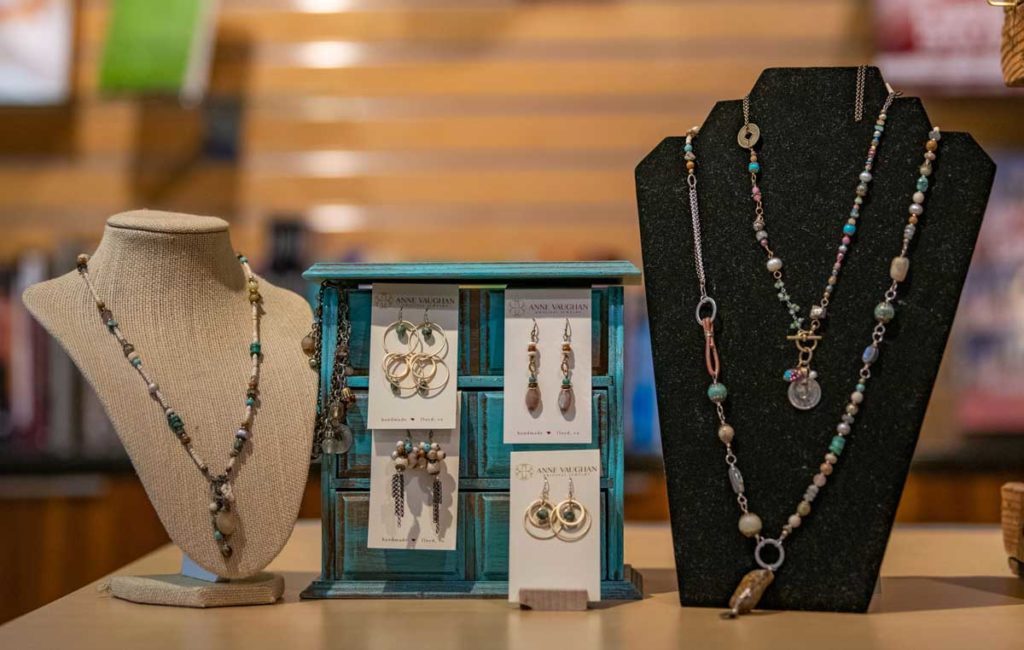
Two display forms adorned with colorfully beaded chains with stone and coin pendants and a smaller display of long earrings that coordinate with the necklaces.
Handmade jewelry by Anne Vaughan Designs at The Museum Store, Birthplace of Country Music Museum.
© Birthplace of Country Music; photographer: Earl Neikirk

Anne Vaughan Designs

Anne Vaughan began creating jewelry in her home back in 2006 after the birth of her second child, leaving her career in education behind to forge a new path. In the beginning she made one piece per day from the basement of her home in Floyd, Virginia, increasing exponentially to a total of around 60,000 pieces of jewelry made up to today. Her business has grown so much that she now employs four local women part-time to help with jewelry assembly. Today her jewelry can be purchased in dozens of art galleries, museums, festival booths, and high-end boutiques across the country.

Anne uses a diversity of production techniques along with quality gemstones, handmade flower clusters, vintage and repurposed jewelry parts, and multi-colored pearls in her work, with new lines being created every couple of weeks to keep things new and fresh for her sellers.

“Operating a small business is so challenging, but you learn so much,” said Vaughan. “I am always searching out new techniques and methods that I can incorporate into my work.”

Each of these artisans, along with around 50 others, are featured in The Museum Store at the Birthplace of Country Music Museum. Museum admission is not needed when visiting The Museum Store, and it’s a great destination for holiday shopping.

*Note: There’s perhaps nothing more personal than a gift of the arts, so be sure and stop by the museum on #ArtistsSunday November 29 and support our local artisans and small businesses! The day is dedicated to encouraging consumers to shop with artists and give something special, unique, and handcrafted this holiday season.
Radio Bristol Book Club: Woman Walk the Line

Welcome to Radio Bristol Book Club! Each month, readers from BCM and the Bristol Public Library come together to celebrate and explore one book inspired by our region’s rich Appalachian cultural and musical heritage. We invite you to read along and then listen to Radio Bristol on the fourth Thursday of each month at 11:00am when we will dig deep into the feelings and questions raised by the books, learn more about the authors, and celebrate the joys of being a bookworm!

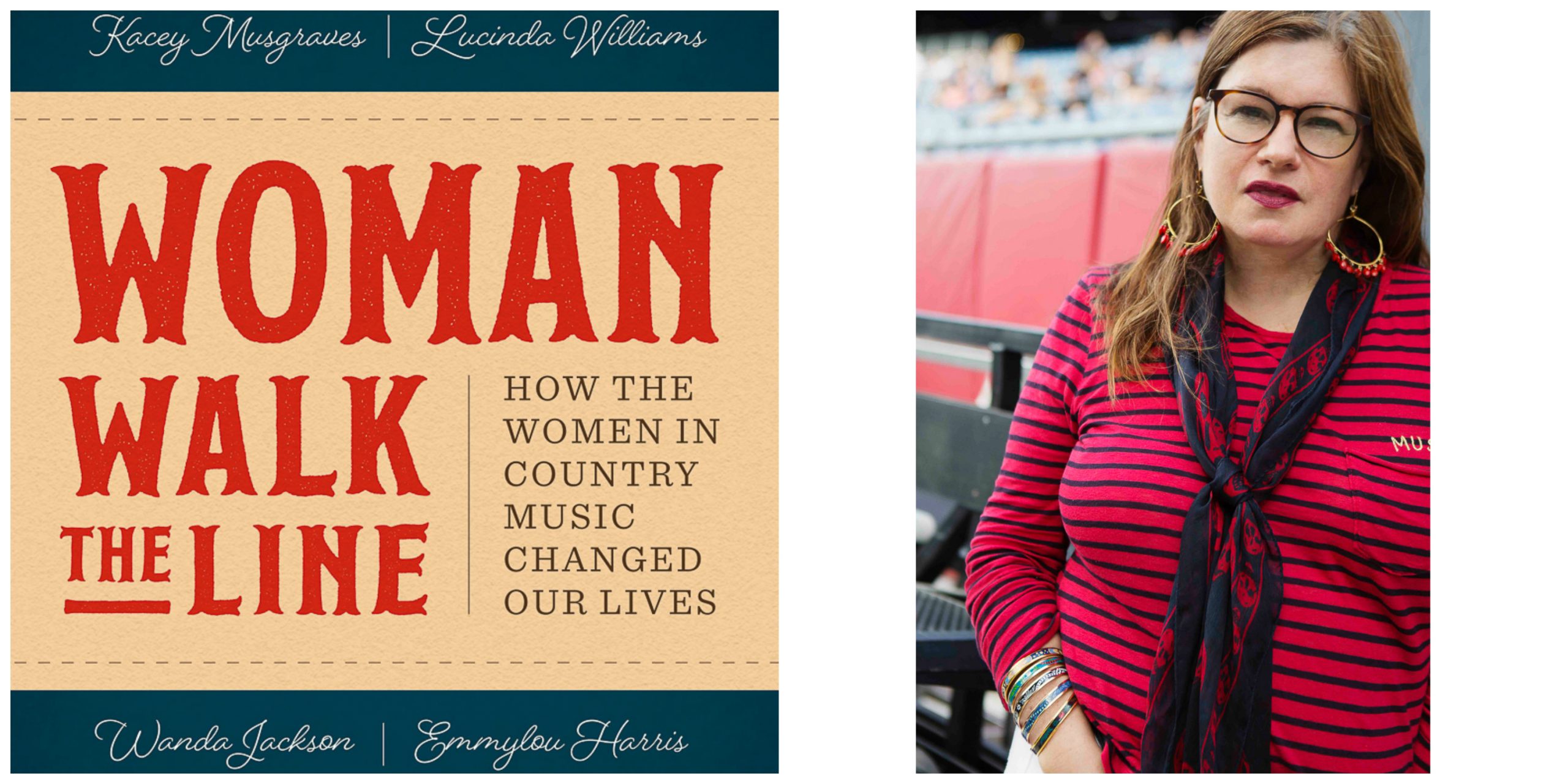
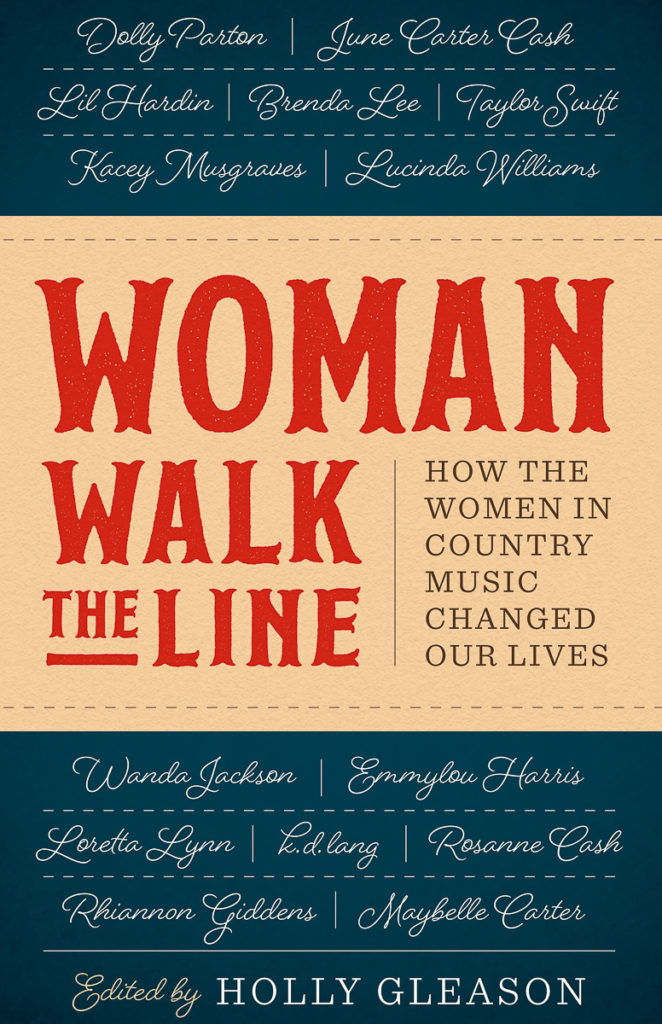
The cover of the book is blue and cream with the main title in red. Several female country musician's names are written in cursive font on the blue part of the cover.
The cover of Holly Gleason’s Woman Walk the Line gives an inkling of the many women who are represented within its pages.

Our book for November is Woman Walk the Line: How the Women in Country Music Changed Our Lives edited by Holly Gleason. Full-tilt, hardcore, down-home, and groundbreaking, the women of country music speak volumes with every song. From Maybelle Carter to Dolly Parton, k.d. lang to Taylor Swift, these artists have provided pivot points, truths, and doses of courage for women writers at every stage of their lives. Whether it’s Rosanne Cash eulogizing June Carter Cash or a seventeen-year-old Taylor Swift considering the golden glimmer of another precocious superstar, Brenda Lee, it’s the humanity beneath the music that resonates.

Woman Walk the Line is a collection of deeply personal essays from award-winning writers and musicians – from Holly George Warren and Madison Vain to Grace Potter and Patty Griffin – on country music’s femme fatales, feminists, groundbreakers, and truth tellers. The book speaks to the ways in which artists mark our lives at different ages and in various states of grace and imperfection – and ultimately how music transforms not just the person making it, but also the listener.

Holly Gleason is a Nashville-based writer and artist development consultant. She’s written for Rolling StoneThe Los Angeles Times, The New York TimesOxford American, No Depression, PASTE, Lone Star Music, Texas Music, Spin, Musician, CREEM, Interview, PLAYBOY, The Palm Beach Daily News, The Vineyard Gazette, Tower Pulse, Request, Rockbill, Bam, Rock & Soul, and Mix. She loves songwriters, roots music, country, R&B and very early rap, as well as life moments, fame and its impact on who we are. Her book Woman Walk the Line was published in 2017 and has become a favorite read of a variety of country stars!

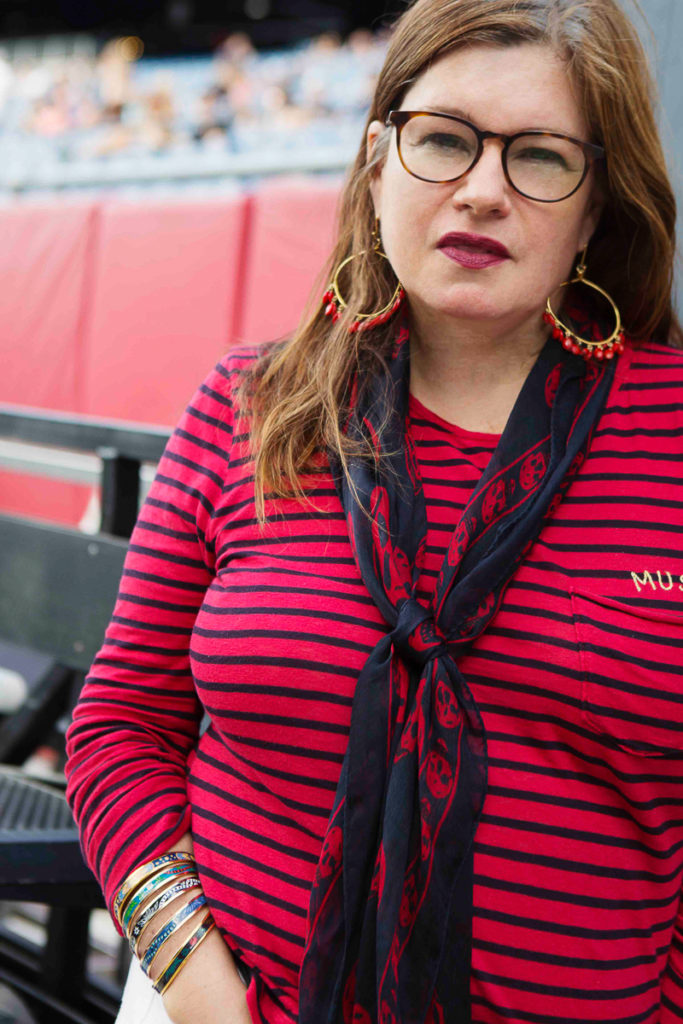
Picture of woman with long reddish brown hair, wearing glasses, a red and blue striped top, scarf, and big hoop earrings.
Author Holly Gleason. © Allistair Ann

Be sure to tune in on Thursday, November 19 at 11:00am – a week earlier than normal due to Thanksgiving the following week – to hear the book club discussion about Woman Walk the Line, followed by an interview with the author. You can find us on the dial at 100.1 FM, streaming live on Radio Bristol, or via the Radio Bristol app. And be sure to pick up a copy and read it ahead of time. We look forward to sharing our thoughts on this wonderful musical journey!

Looking ahead: Our book pick for December is Mama, Me, and the Holiday Tree by Jeanne G’Fellers, which we’ll be discussing on Thursday, December 17 (a week early due to Christmas Eve). Happy reading!

Pick 5: The 1928 Bristol Sessions

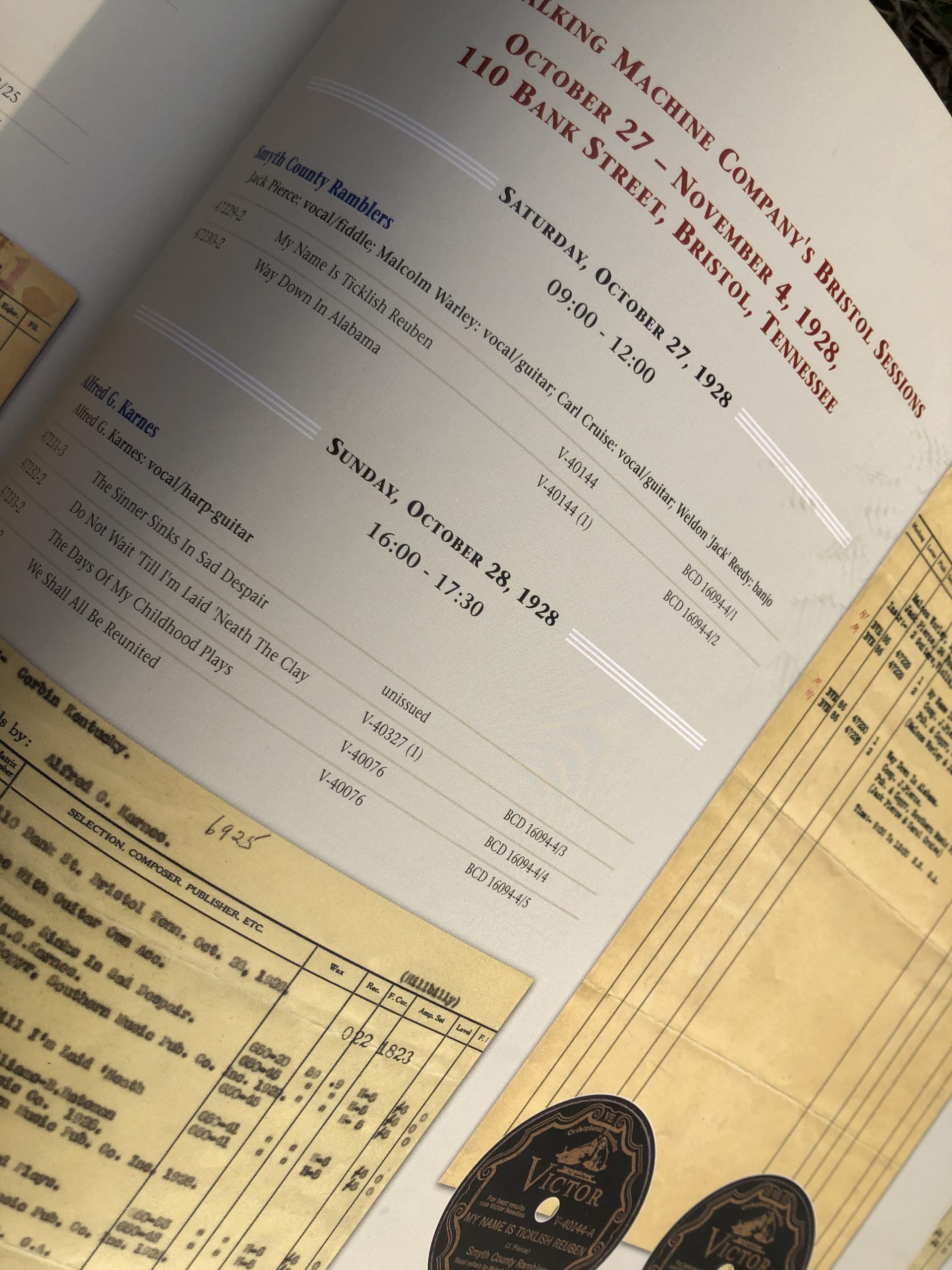
If you are reading this blog post, you are probably familiar with why Bristol is considered by many to be the Birthplace of Country Music. During late July and early August of 1927, Ralph Peer of the Victor Talking Machine Company recorded several artists and acts at the Taylor-Christian Hat Company building – two of these became known as the “first family of country music” (The Carter Family) and the “father of country music” (Jimmie Rodgers). And Rodgers also became one of the best-selling and most influential country acts of all time.

Eager to repeat the previous year’s success, Peer returned to Bristol in the fall of 1928 to record more regional artists. Though none of the recorded performers from the 1928 Bristol Sessions achieved the fame and influence of the The Carter Family or Jimmie Rodgers, these sessions yielded a fascinating body of work that is overshadowed by the storied 1927 sessions. Both casual and hardcore fans of country music owe it to themselves to check out the 1928 Bristol Sessions – and here are a few choice cuts to get you started:

“Angeline the Baker,” Uncle Eck Dunford

Uncle Eck Dunford of Galax, Virginia, came to Bristol with Ernest Stoneman in 1927. A comedian who recorded several spoken word skits, Dunford’s musical selections were lighthearted as well. A song from the pen of Stephen Foster, “Angeline the Baker” – often called “Angelina Baker” – has become a standard in acoustic music circles, but Dunford’s recording is the sole recording of the song in the pre-war country music discography.

“Unknown Blues,” Tarter and Gay

Stephen Tarter and Harry Gay were the sole African-American act to record at the 1928 Bristol Sessions. A rare glimpse into the scene of bluesmen who were active around Kingsport, Tennessee, before the Second World War, this record leaves me wanting more than the two sides the duo recorded. Featuring clear vocals and two guitars playfully intertwined, it is no surprise this duo was a hit with audiences across the Tri-Cities.

“Goodnight Darling,” Clarence Greene

Cranberry, North Carolina’s resident master musician Clarence Greene made the trek across the mountains to record in Bristol in 1928. A fiddler who is often associated with Clarence “Tom” Ashley, Greene plays the guitar and sings on this side of his sole Bristol Sessions release.

”I’ll Be Happy,” The Stamps Quartet

The Stamps Quartet was established in 1924 as part of the Stamps Music Publishing Company (Dallas, Texas), a company that sold hymnals. It is a bit of an oddity that a non-regional group recorded in Bristol in 1928, but this recording highlights the beautiful gospel quartet singing that is often overlooked as a significant part of early country music.

“I Truly Understand, You Love Another Man,” Shortbuckle Roark and Family

The 1928 Bristol Sessions and Columbia’s 1928 Johnson City Sessions were recorded so close geographically and timewise that it is no surprise some artists appeared on recordings by both labels. George “Shortbuckle” Roark is one such musician, and both sessions yielded absolute classics in the old-time music cannon. I’ve also shared a bonus selection from the Johnson City recordings below – “I Ain’t A Bit Drunk,” George Roark

https://www.youtube.com/watch?v=l6gZUBHc1iY

Instrument Interview: The Bones

“Instrument Interview” posts are a chance to sit down with the instruments of traditional, country, bluegrass, and roots music – from different types of instruments to specific ones related to artists, luthiers, and songwriters – and learn more about them. Ten questions are posed, and the instruments answer! Today we talk with the bones.

What are you?

I am a type of percussive instrument known as a “concussion idiophone,” which refers to me being made of up of similar objects that make a sound when struck together. I’m also called the “rhythm bones,” which gives you a clue to the role I play in music.

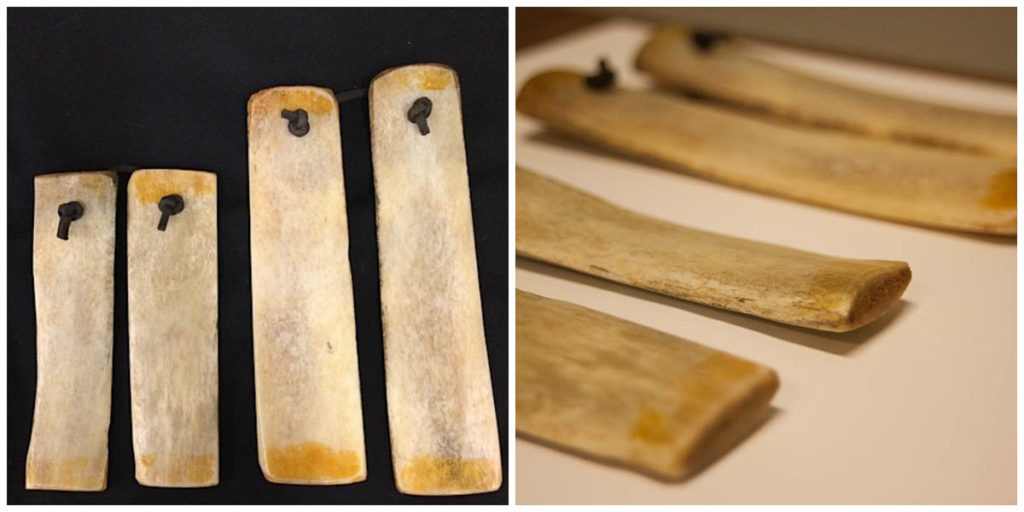
Two views of two sets of bones, made of animal bones. One is larger than the other, and they are each connected by a leather cord.
The Birthplace of Country Music Museum has two sets of circa 1927 bones in our collection, donated by Dom Flemons in 2015.

Where do you come from?

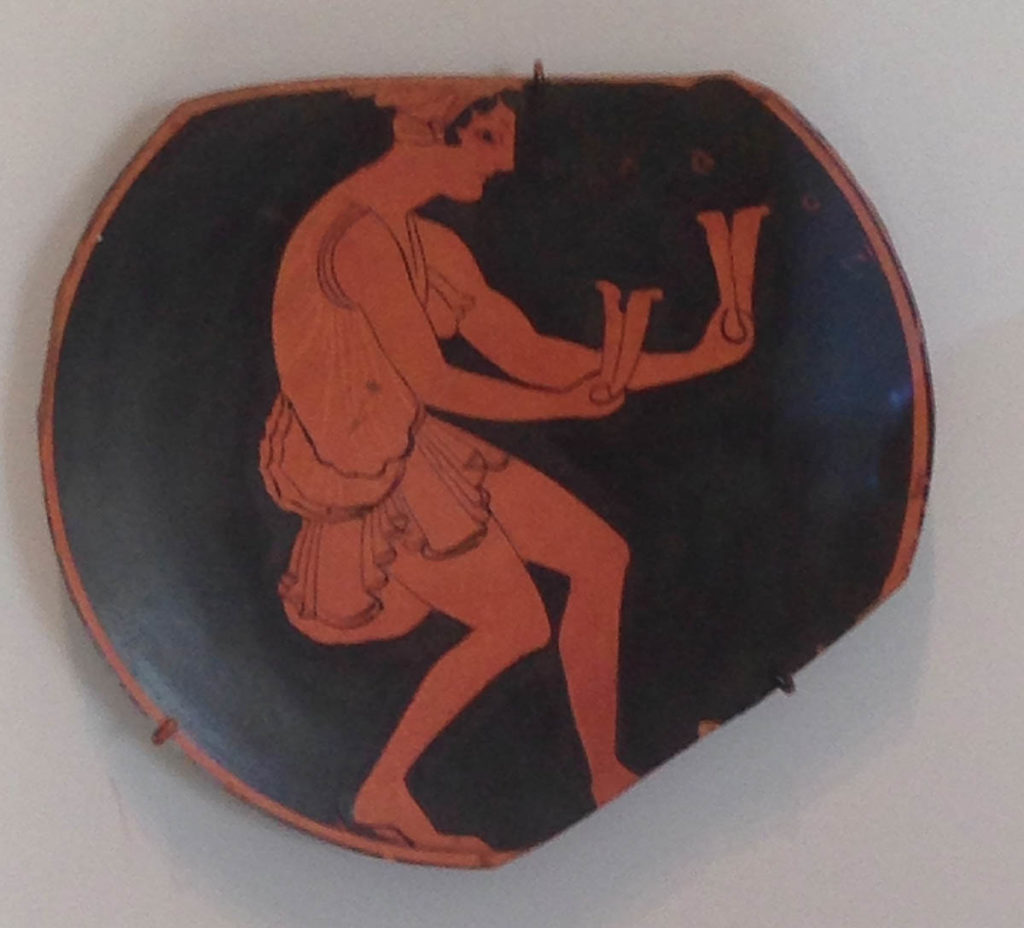
I’ve been around for a long time, and you can find versions of bones all the way back to several ancient cultures. Archaeologists have excavated bones (as instruments) from graves and tombs in prehistoric Mesopotamia and Egypt, and also discovered images of musicians playing the bones on Greek pottery. There is also evidence of the bones being played in the Roman Empire and ancient China. More recently – that is, in the 18th and 19th centuries – I came to North America with Irish and English immigrants, who used the bones as a way to keep a steady beat for their jigs and reels.

A pottery sherd with a red-figure dancer, gender unclear holding two bones-like instruments in their hands.

Fragment of a terra cotta red-figure kylix, Greek, 510-500 BC. The image is of a dancer using a bones-like instrument as part of the performance. Public domain

Are you really made from bones?

My original versions were made from animal bones, usually the rib or shin bones of sheep, cows, and sometimes horses. I’m often slightly curved, reflective of the natural shape of these bones, and I typically measure between 5 and 7 inches in length. While modern bones are still made from animal bones, you can also find ones made from wood and plastic. A variety of woods can be used, such as cherry, mahogany, walnut, and maple, with different woods producing different tones as is seen in other wooden instruments.

How are you played?

Players hold a pair of bones between their fingers with the convex sides facing one another; one is held fairly tightly and the other more loosely. By shaking the wrist, the bones hit one another, creating a loud “clack.” The connection between the two bones is carried by the momentum from the player’s arm and hand movements rather than any effort to force the bones to knock together. In North America, players tend to play with a pair of bones in each hand, while in Ireland the tradition is to play one-handed.

It’s hard to get a sense of what the movement looks like and the resulting sound by describing it, so check out Dom Flemons playing the bones. It’s actually quite amazing – and beautiful – to watch:

What type of music are you typically found in?

You can hear bones being played in a wide variety of genres, such as traditional Irish and Scottish music, blues, bluegrass, zydeco, French-Canadian music, and Cape Breton (in Nova Scotia) traditions.

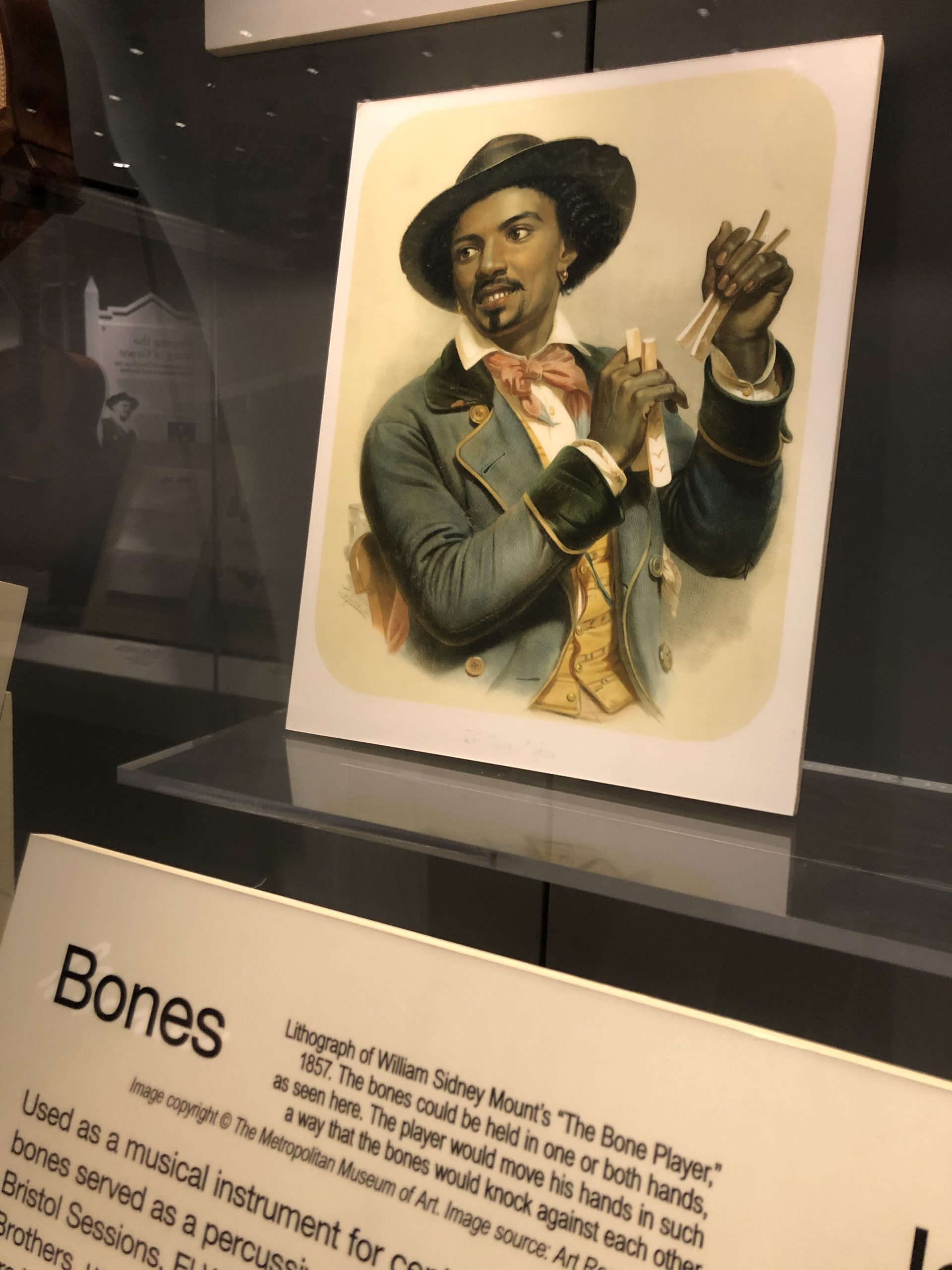
Because bones were also often used by African American musicians, they became a common facet of 19th-century minstrel shows – where white performers appeared in blackface; later Black entertainers appeared in minstrel shows too – and the bones’ popularity in the United States grew within this context. One of the first bones-playing minstrel performers was Frank Brower, and the first documentation of him playing the bones in front of an audience are from 1841 in Virginia. He played with a much larger pair of bones than is usual today – two 12-inch lengths of horse rib bones!

An image of an exhibit case with William Sidney Mount's "The Bone Player" -- a black musician wearing a hat, jacket, waistcoat, and cravat-like tie, and holding two pairs of bones in his hands.
This image of William Sidney Mount’s “The Bone Player,” 1857, is on display in the museum exhibits. © Birthplace of Country Music Museum

Are there famous musicians associated with the bones?

There are many famous bones players! Freeman Davis, known by his stage name “Brother Bones” and also as “Whistling Sam,” was born in Montgomery, Alabama, in 1902. He recorded several songs in the 1940s and 1950s, appeared in three movies, and performed at Carnegie Hall and on The Ed Sullivan Show. His most famous recording is “Sweet Georgia Brown,” which became the Harlem Globetrotters’ theme tune in 1952. He took bones playing to an intense high of four bones in each hand and even playing knives like bones!

DeFord Bailey, best known for his wonderful harmonica playing and as a regular on the Grand Ole Opry in its early days, included bones playing in his performances along with yo-yo tricks and guitar picking. He was country music’s first African American star.

John Burrill learned to play the bones in his teens during the Depression. One viewer described Burrill’s style of bones-playing as looking like his arms were upside-down windshield wipers. Over the years, Burrill played with a host of other musicians and acts, including the Brattle Street Players, Steve Baird, Clifton Chenier, Spider John Koerner, Molly Malone, and even the Infliktors, a punk band. When asked what key he played in, his reply was “the skeleton key”!

Peadar Mercier was a percussionist in the Irish band The Chieftains, playing both the bodhran and the bones. He was with them from 1966 to 1976.

Dom Flemons, one of the founding members of the Carolina Chocolate Drops and now a solo artist, is known as the American Songster, whose “repertoire of music covers over 100 years of early American popular music.” Flemons is a talented multi-instrumentalist, playing banjo, guitar, harmonica, jug, quills, fife, and, of course, the bones. He has bones made out of cow rib and shin bones that he plays in the double-handed style.

I’ve heard of someone called “the Rhythm Bones King.” Who was he?

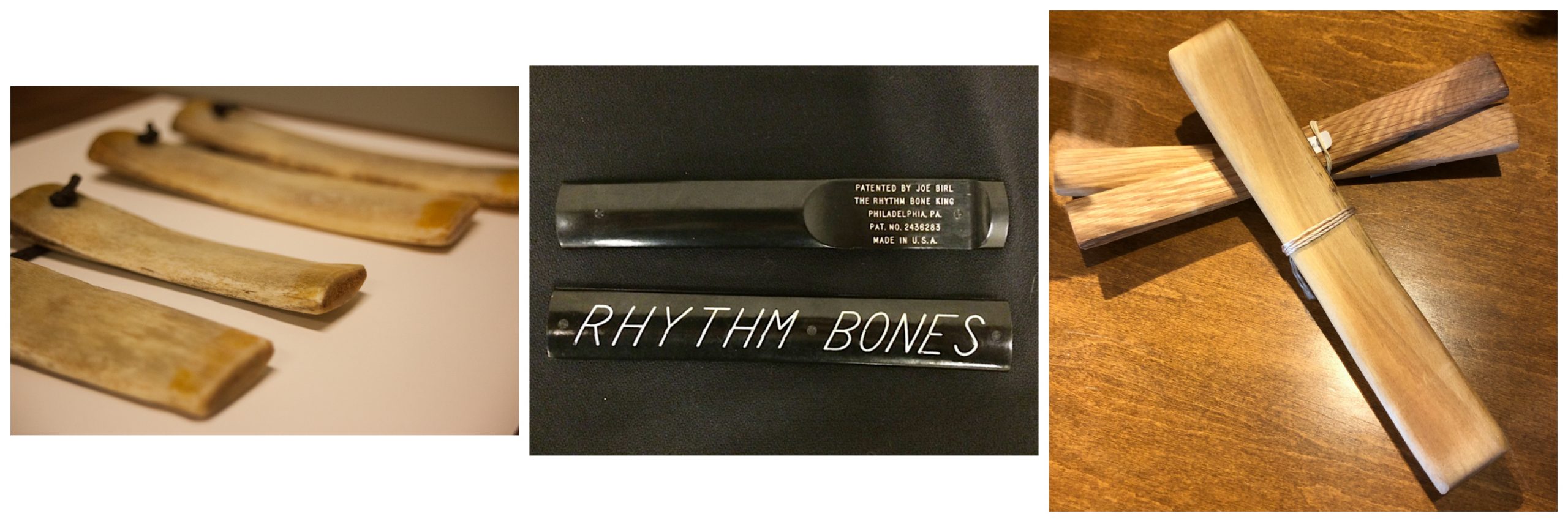
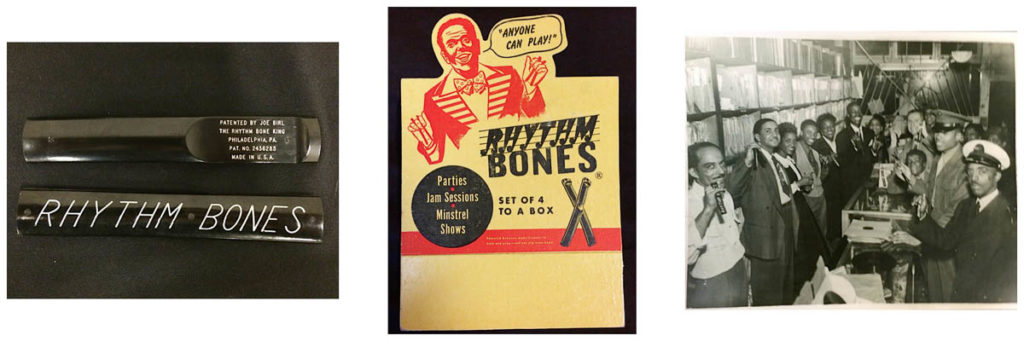
The Rhythm Bones King is a man called Joe Birl. In 1945 Birl applied for a patent for his black molded plastic bones that bore a groove to help keep the bones from slipping out of a player’s hand. Birl produced and sold around 150,000 pairs of these plastic rhythm bones. After the plastic mold broke, he made wooden rhythm bones with his patented grooved design. He passed away in 2012, and Joe Birl Jr. continued to sell bones made in his father’s design.

Left: Joe Birl’s original plastic rhythm bones; Center: A store placard advertising the sale of rhythm bones; Right: A photograph of customers holding Birl’s rhythm bones in a store. All objects from the Dom Flemons Collection at the Birthplace of Country Music Museum

Were you played at the Bristol Sessions?

I was! Black musician El Watson played me when he accompanied the Johnson Brothers on two recordings – “Two Brothers Are We” and “I Want to See My Mother (Ten Thousand Miles Away).” He also accompanied them on harmonica for their recording of “The Soldier’s Poor Little Boy,” and Charles Johnson played guitar on Watson’s two harmonica recordings, “Pot Licker Blues” and “Narrow Gauge Blues.” These are some of the earliest integrated country music and blues recordings.

Are there other instruments related to you?

There are many other types of percussive instruments that are used in a similar way to the bones. For instance, clappers – consisting of two solid pieces made of wood, metal, ivory, and even plastic that are slapped together – are found in a lot of musical traditions, from China, Japan, Korea, and Thailand to medieval France and modern Western symphony orchestras.

Castanets are made of two concave shells joined with string at one edge. They are usually made of chestnut wood, and they are played two-handed. Castanets are also used in several musical traditions, such as Spanish, Portuguese, Swiss, Moorish, Ottoman, Sephardic, and Italian.

Playing the spoons is especially common in American folk music and often seen in jug bands. Like the bones, the spoons are held in one hand and played against each other as a percussive instrument. To see some amazing spoon playing, check out Abby the Spoon Lady.

Anything else you want to share with us?

Remember singing the nursery rhyme song “This Old Man” when you were a child? Well, that song is thought to refer to bones playing! The first verse goes like this (and so on):

“This old man, he played one,

He played knick-knack on my thumb;

With a knick-knack paddywhack,

Give a dog a bone,

This old man came rolling home.”

A paddywhack is a ligament – known as the nuchal ligament – in the neck of sheep and cattle.

*Want some of your own bones? Then stop by The Museum Store where you can buy wooden bones (and spoons) made by local artisan Walt Messick of Mouth of Wilson, Virginia.