

Museum Archives - Page 10 of 34 - The Birthplace of Country Music
Listen
Play
Loading station info...

Tintype Photography: A Bridge from the Past to the Present

In our current special exhibit, Our Living Past: Platinum Portraits of Southern Music Makers, Timothy Duffy of the Music Maker Relief Foundation uses a photographic technology that was most popular in the late 19th century to photograph roots musicians today. The method he uses is most commonly called tintype photography, a form of wet-collodion photography that is quite complicated compared to modern photographic methods. So why does Duffy use this historic technique instead of a modern process?
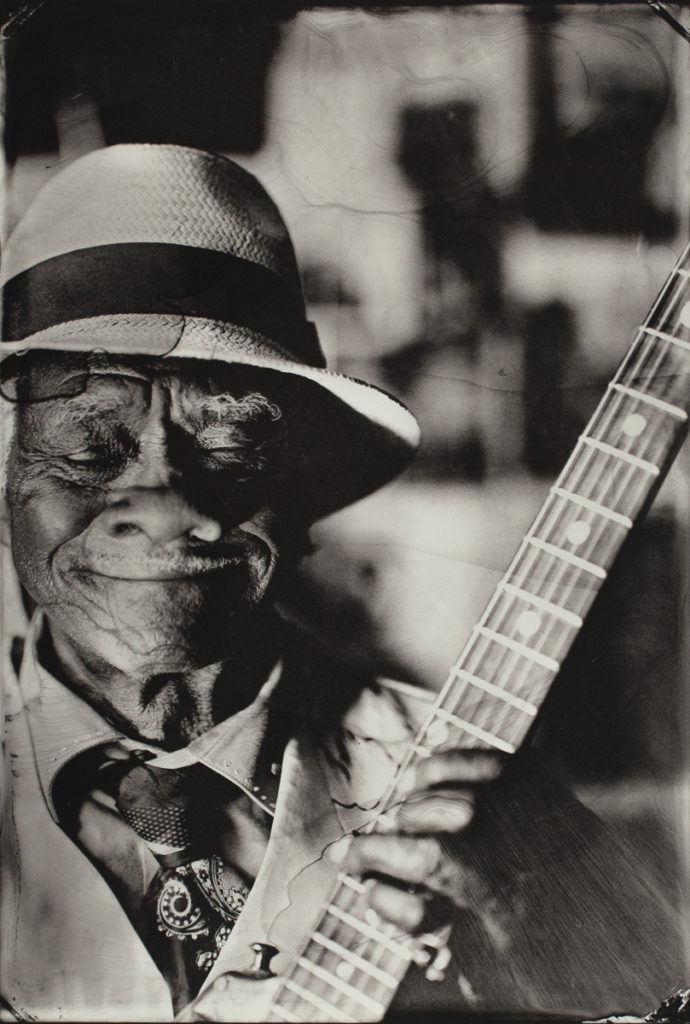
A Black man is wearing a light colored fedora-style hat with a black sash on it; he also wears a light-colored suit and a tie decorated with paisleys. He has one hand on the neck of a banjo. His eyes are closed and he has a beautific smile on his face.
Little Freddie King. Photograph by Tim Duffy, courtesy of Music Maker Relief Foundation

Before we try to answer that, let’s explore what a tintype photo is and how it is made. Tintype, also called ferrotype, is one of the earliest forms of photography. Developed in the 1850s, this wet-collodion process requires a very large camera, a dark space, a plate, and a good understanding of chemistry. Once exposed, a direct positive image is created on a sheet of metal. This means there are no negatives of the image to make copies from, and so each tintype is completely unique!

Making a tintype is a complicated multi-step process where minor variations such as drying too quickly, light oversensitivity, or slight ripples in the surface of the chemistry can create errors in the final image. However, these “mistakes” are often what give these images their unique beauty. Many modern artists like Duffy sometimes intentionally play with these “mistakes” to create uniquely interesting photos!
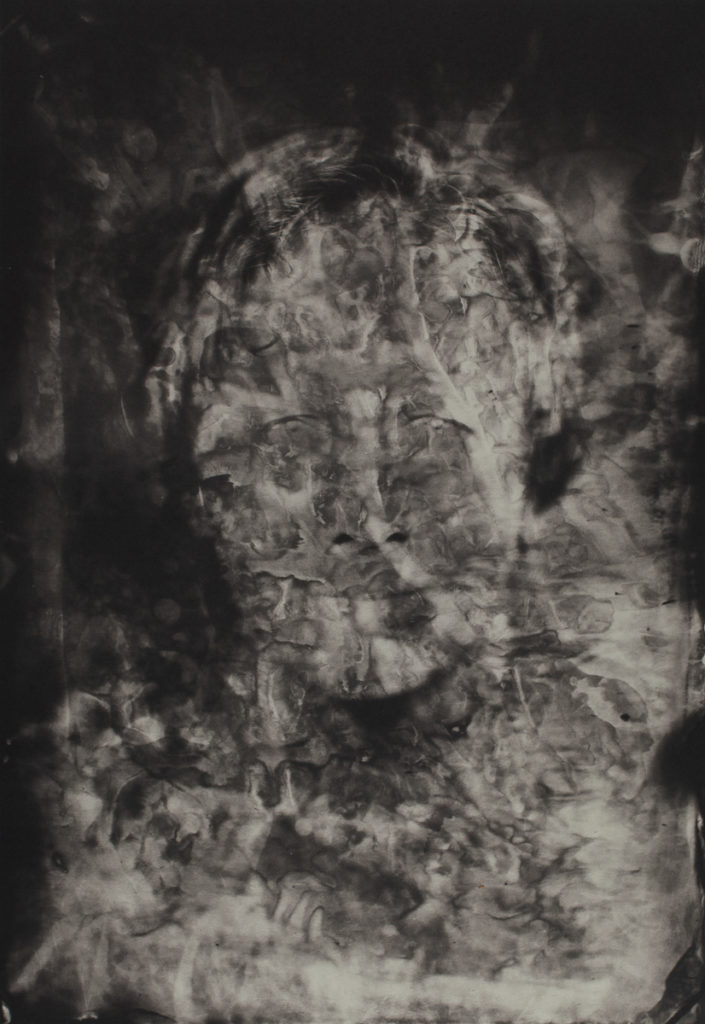
Through a haze of black, grey, and white ripples you can see the face of a white man with light-colored hair. This self-portrait has been manipulated so it is not wholly realistic.
Self-Portrait. Photograph by Tim Duffy, courtesy of Music Maker Relief Foundation

What made tintypes stand out compared to other photographic methods of the age, such as ambroytypes or daguerreotypes, was the use of an iron plate instead of a glass one. The iron plate is where the name ferrotype comes from. Though the resulting images weren’t made of tin as the name would suggest, the term was commonly used, based on the cheap or “tinny” feeling of the photos that eventually became the primary identifier of the method. Because tintypes use an iron plate they are much more durable than images printed on glass. They were also less expensive to produce, and the finished product did not require additional, often expensive, protective casing.

In addition to their durability and affordability, tintypes were faster than previous methods. From start to finish the entire chemical process had to be completed in 15 minutes! These three features – speed, durability, and affordability – quickly helped tintypes become the most popular form of photography in the late 19th century. 

For the first time photographers could easily travel and take instant photographs for customers at events such as fairs and in both rural and urban settings. Photographers traveled out west where they recorded images of cowboys and covered wagons. They documented the Civil War, shocking the country with horrific images from battlefields as well as preserving the memory of individual soldiers for loved ones.

These special characteristics also made photography more accessible to a wider range of people. The popularity of tintype photography also coincided with the Emancipation Proclamation and end of the Civil War, meaning that for the first time African Americans were able to have their photographs taken in large numbers. 
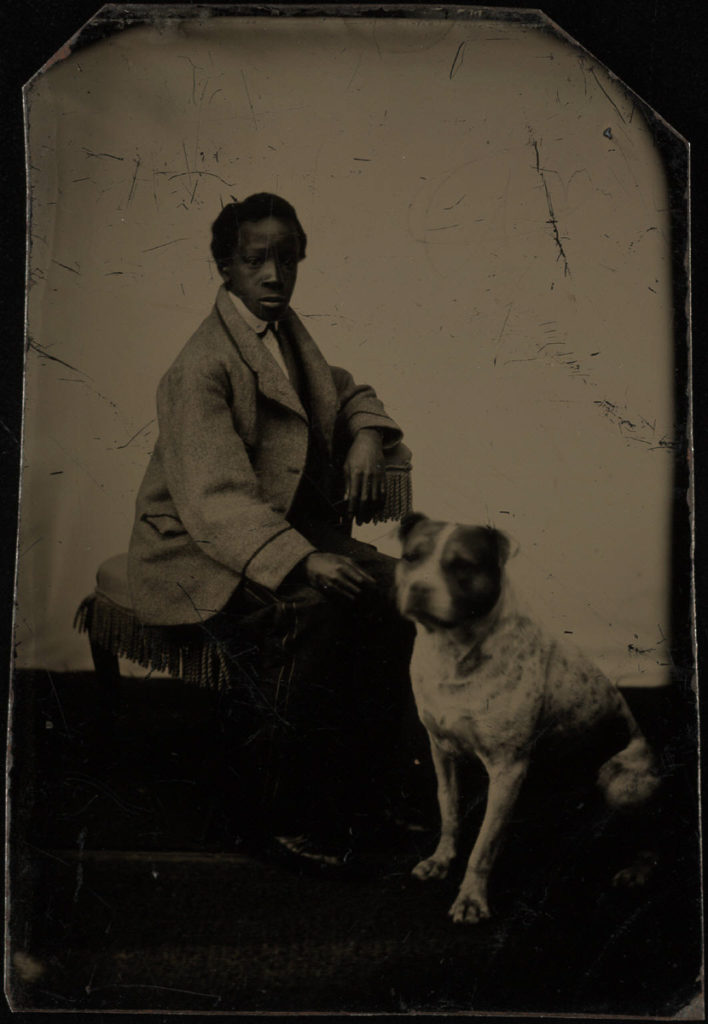
A young Black boy wearing a large light-colored jacket and dark pants sits on a velvet chair or ottoman. A dog that resembles a Staffordshire or pit bull terrier sits at his feet.
Young boy with dog, circa 1870.
Photograph courtesy of Yale Collection of American Literature, Beinecke Rare Book and Manuscript Library

Unfortunately, the same characteristics that encouraged widespread use also encouraged a lack of record-keeping. Because they could be created in a single sitting and given to the sitter or their loved one without excessive packaging, tintypes were frequently not documented with the name of either the sitter or the photographer. This means that although there are a large number of surviving tintype images that remain today, the stories behind them have all too often been lost.

Today, most of the people Duffy photographs are not what we would regard as famous within our celebrity-driven society. Often the sitters for his images are known within their communities but perhaps not far outside of them. However, they all have stories with deep roots and stories that beg to be shared. These musicians want to be remembered, and Duffy strives to ensure they will be. His tintypes take a small step toward correcting the past by documenting the present using a method that has historically given so many underrepresented people their first opportunity to document themselves for posterity.
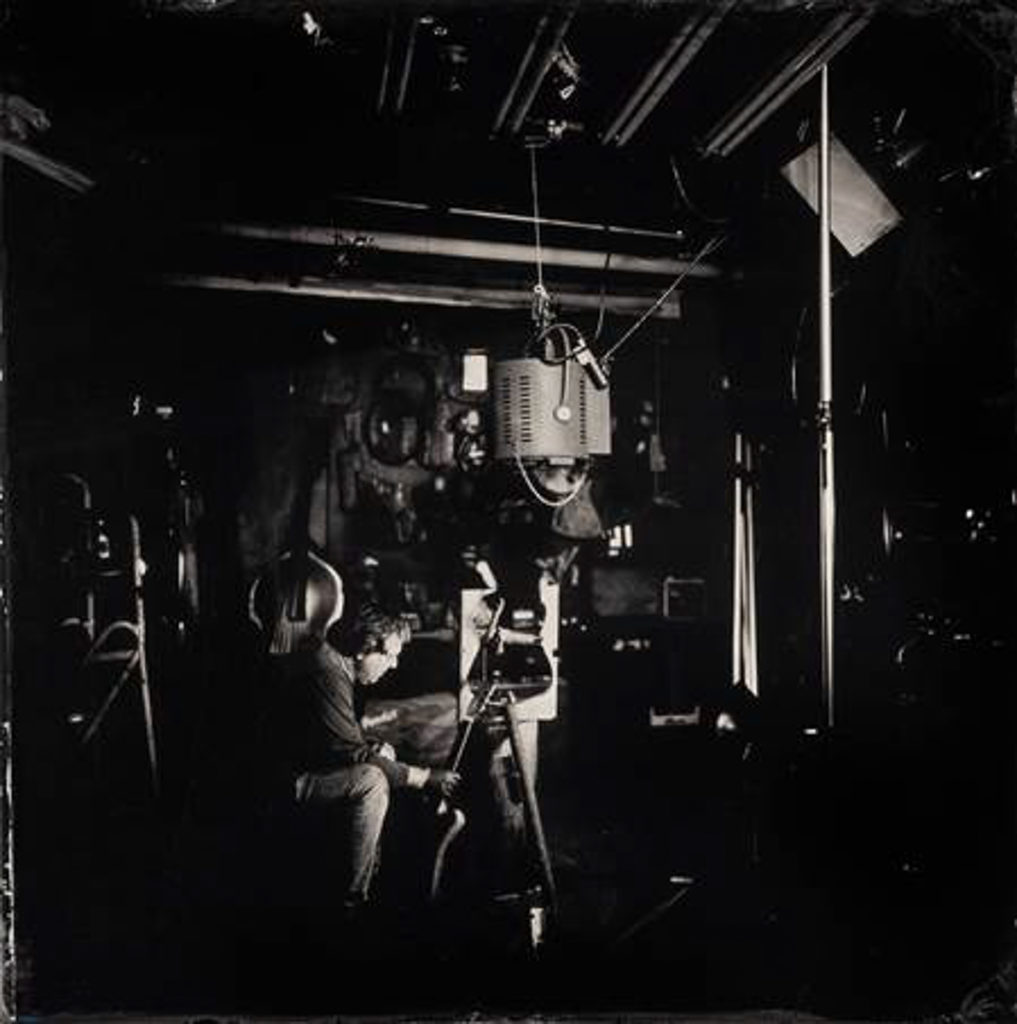
A dramatically lit black-and-white photo showing a white man sitting in front of some large camera equipment. In the background, you can see several stringed instruments leaning against and hanging on the wall.
Tim Duffy at work in his studio. Photograph courtesy of Music Maker Relief Foundation

Duffy’s process is not just taking a photograph – it’s also a theatrical event! Modern cameras can take hundreds of photographs in a minute. Duffy takes an hour to properly get just one photograph. Once he has his shot set up, the moment is captured instantly, and it cannot be retaken easily. In addition to the stress of getting it right on the first try, the studio itself can be intimidating. The giant camera glares at the sitter, and when combined with an extended blinding light, it can feel like the world has stopped for a moment. But these musicians do not shy away from the lenses. They are true performers and are not intimidated by the camera but rather seem to confront it and come out triumphantly.
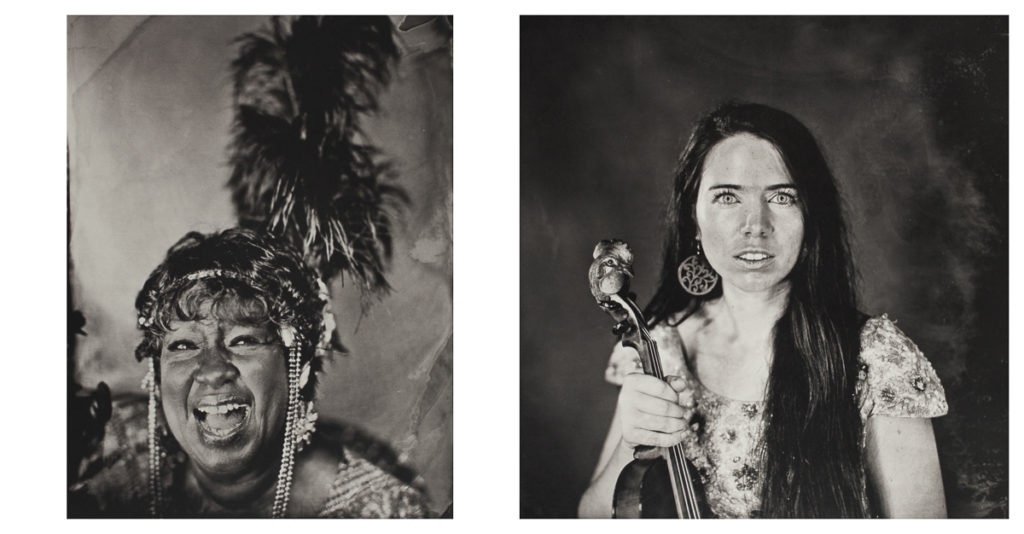
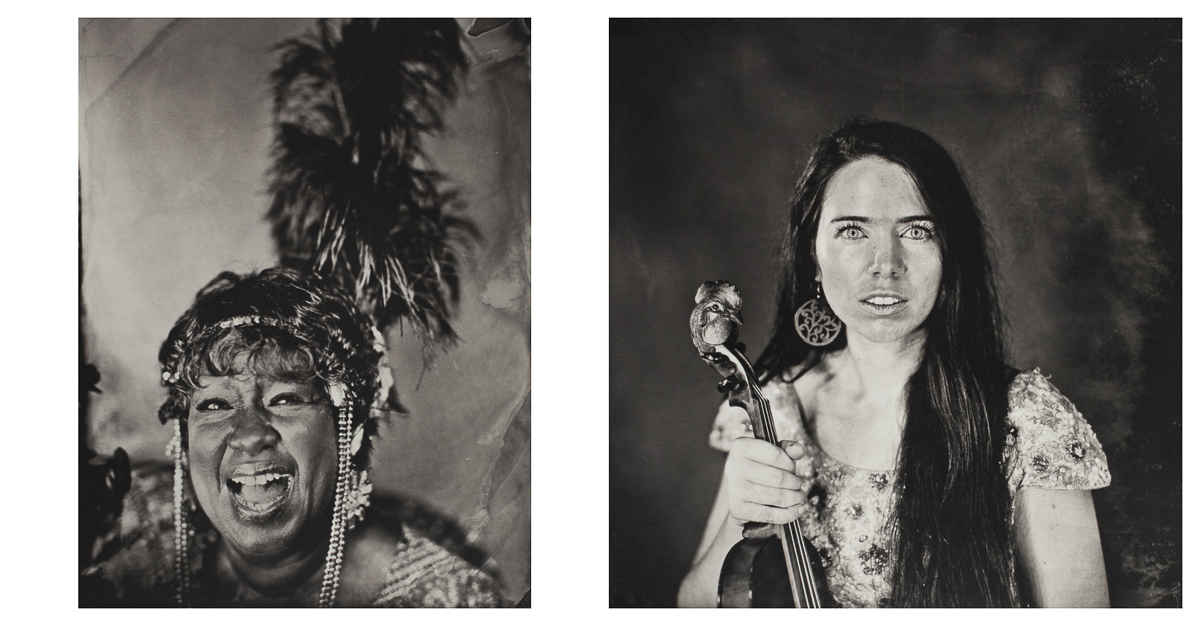
Left: Black-and-white image of a Black woman shown from the shoulders up. She is wearing a feathered headdress with hanging pearls and beads, and she has an exuberant look on her face.
Right: A white woman with long dark hair and intense blue eyes seen from the chest up. She is wearing big circular earrings and a sparkly top/dress, and she is holding a fiddle  with a rooster's head carved on the top of its neck.
Left: Pat “Mother Blues” Cohen. Right: Martha Spencer. Photographs by Tim Duffy, courtesy of Music Maker Relief Foundation

Roots musicians connect us to the past through music by carrying on these traditions and skills. Modern tintypes do something similar by challenging our sense of time visually. Duffy bridges this gap by using one to propel the other, and in the process, he shows us a new side to both.

The Our Living Past special exhibit will be on display at the museum through September 30, 2021. We are also hosting a concert performance by Pat “Mother Blues” Cohen on Saturday, September 25 at 7:00pm.

Erika Barker is the museum’s Curatorial Manager.
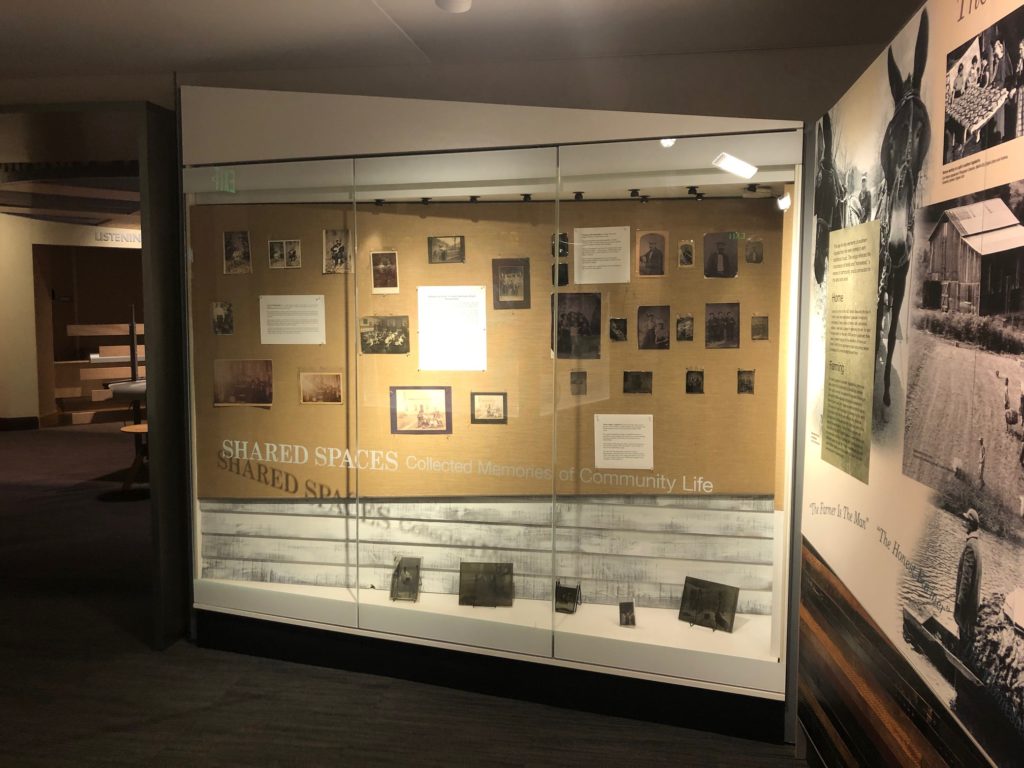
Image shows the Community Case where several photographs are displayed across the back wall of the case, along with explanatory text. Four original glass-plate negatives are arranged in the base of the case, along with a small tintype.
Our summer interns Gracie and Julia created a display on historic tintypes and other examples of early photography in the museum’s Community Case. Be sure to check it out if you visit the museum!
© Birthplace of Country Music Museum; photographs on loan from Nina Rizzo
From The Vault: The 1927 Sears, Roebuck Catalogue

Want to know what’s behind our closed museum vault door? With “From the Vault,” we take you behind the scenes to learn more about some of the interesting objects in our museum collections. 

Long before the invention of the internet and being able to purchase goods online, you would have to travel to the nearest store or market to get the items you wanted, or even make them yourself. But that all changed with the introduction of mail-order shopping – and today being National Mail-Order Catalog Day makes it the perfect time to dive into that history and our collection to explore this history more!

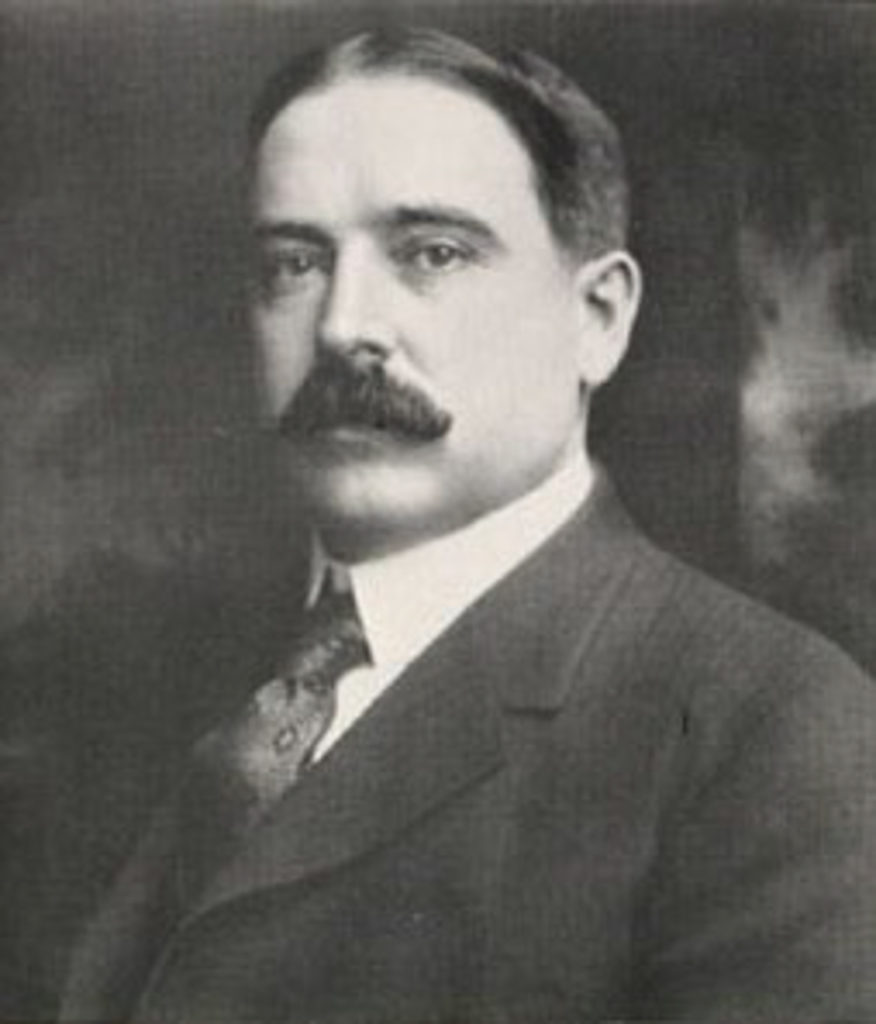
Back in the 1800s, the railroads were hugely important in America, used for passenger travel, freight transport, and within specific industries like timber and coal. For Richard Warren Sears, the railroad was also his way of life. He worked as a railway station agent in North Redwood, Minnesota, which is also where Sears got into the merchandise industry. One day, he bought a shipment of watches after its delivery was refused by a jeweler. Sears then sold the watches to other station agents for a low price, making a profit for himself in the process. He had so much success with this initial foray into retail that he soon created his own company called R. W. Sears Watch Company.

A black-and-white portrait of a white man with dark hair and a big moustache. He is wearing a dark suit and patterned tie.
Richard Warren Sears. From Wikimedia Commons

In 1887 Sears met Alvah C. Roebuck, a watch repairman, and they moved the company to Chicago. In the same year, they also sent out their first mail-order catalog, which sold jewelry, diamonds, and of course, watches. Together in 1893, they created a new mail-order business that they called Sears, Roebuck and Company, and they began selling even more types of goods. The railroad again played a role in Sears’ business as trains, as well as the postal service’s Pony Express, helped to transport the merchandise they sold.

This advent of mail-order catalogs was transformative for customers. As the Sears, Roebuck Catalogue expanded and the goods for sale continued to grow, you could buy anything from jewelry and watches to musical instruments and houses! In 1897 – 30 years prior to the 1927 Bristol Sessions – customers could order an Edison phonograph from the Sears, Roebuck Catalogue, and the guitar that Maybelle Carter used on those Bristol recordings was also from the catalog. Besides guitars, the Sears, Roebuck Catalogue also sold violins (or fiddles), banjos, ukuleles, mouth organs (harmonicas), accordions, cornets, trombones, saxophones, trumpets, mellophones (French horns), clarinets, piccolos, flutes, drums, cymbals, triangles, tambourines, pianos, and all the accessories you could ever need for your instruments!

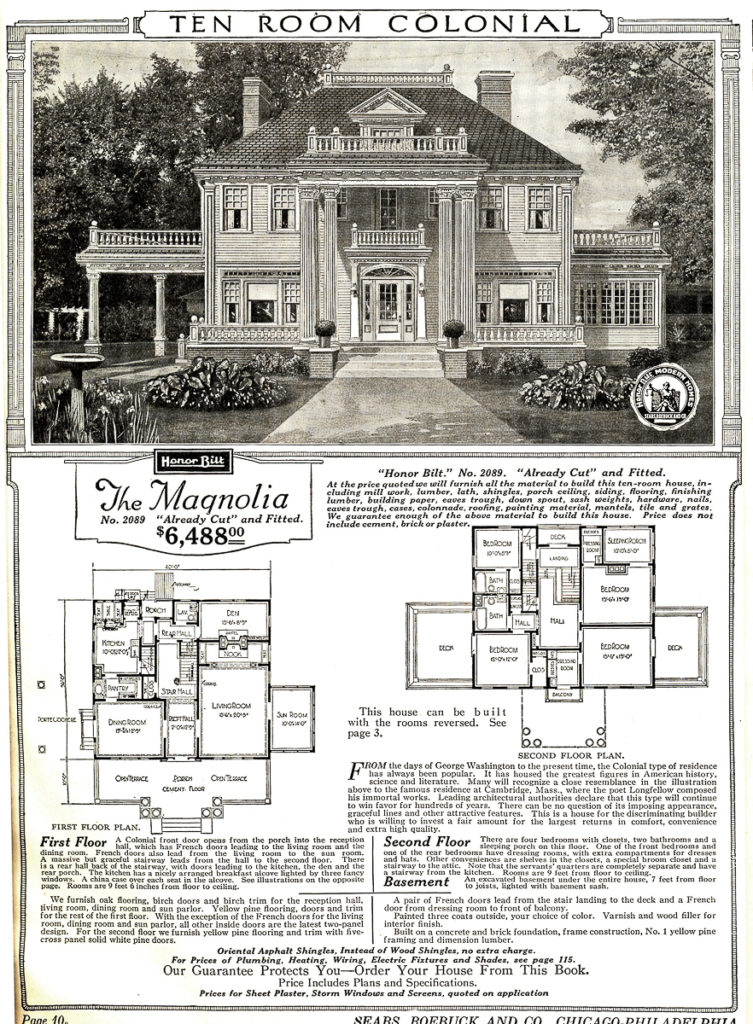
A catalog page for a 10-room Colonial style house showing a drawing of the front elevation of the house with manicured gardens in front. Below the drawing is a plan of both floors, along with a textual description of what can be found in the house.
An illustration and plan for a Colonial-style house for sale in the 1921 Sears Modern Homes Catalogue. Public domain image

Here at the Birthplace of Country Music Museum, there is a facsimile of the 1927 Sears, Roebuck Catalogue on display in the permanent exhibits, along with other copies in the museum vault. As a museum intern this summer, I focused on the museum’s collections, which gave me the chance to thoroughly inventory the vault, and this catalog always seemed to draw me in. I grew up in the age of the internet, where you can buy everything and anything – to me, the Sears, Roebuck Catalogue seems like the past version of Amazon!

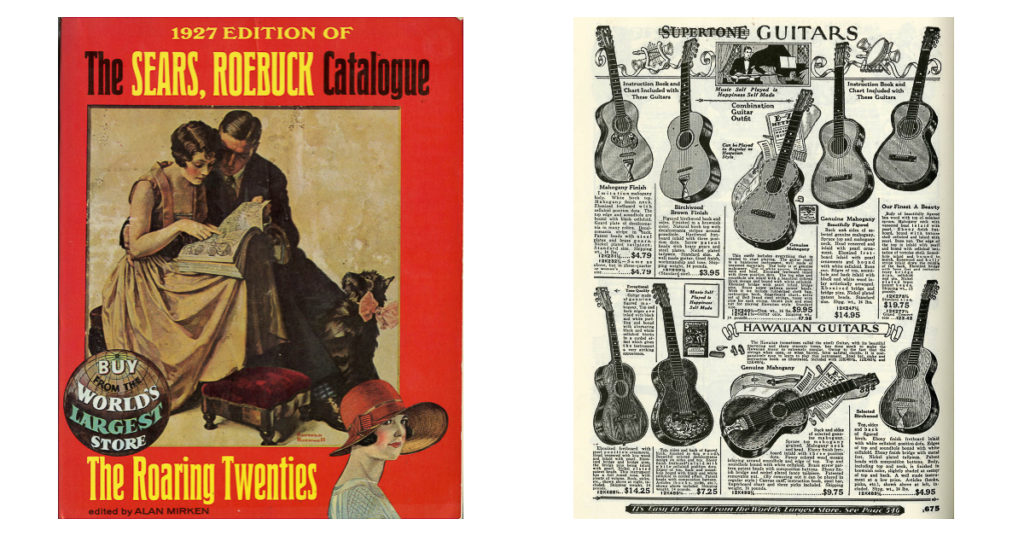
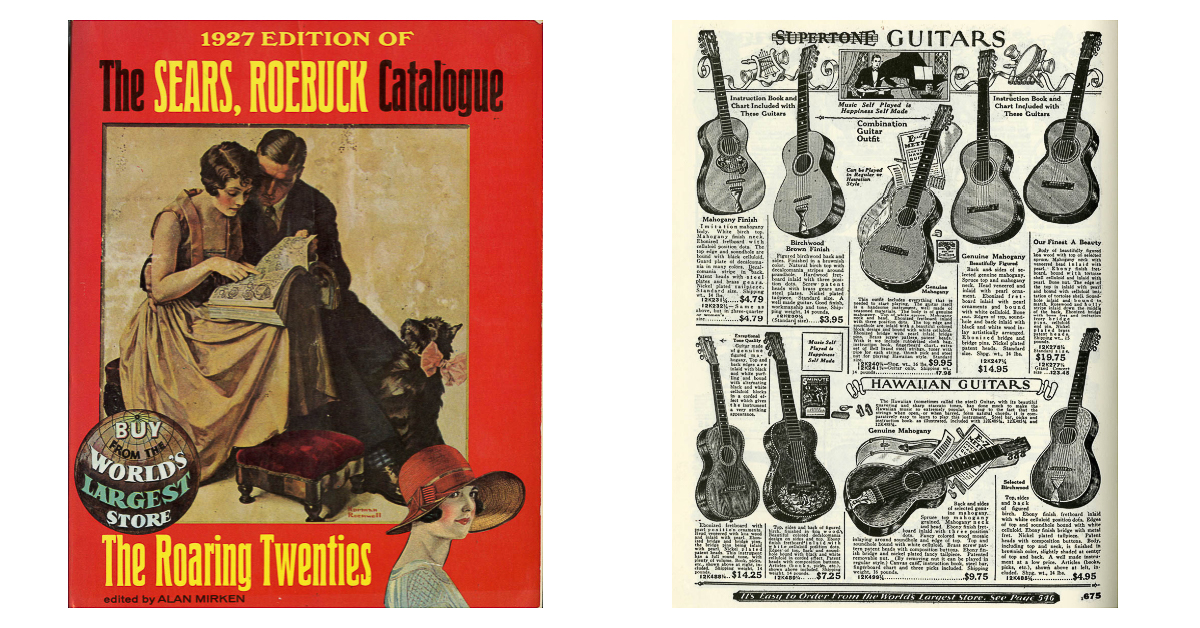
Left image: Catalog cover is red with a picture of a man and woman sitting close togethe poring over the Sears catalog in the woman's lap. A black terrier dog with a pink box is at their feet. A globe proclaims "Buy from the World's Largest Store" in the bottom left corner, and a woman's head (with a fashionable hat) and shoulders is seen in the bottom right corner.
Right image: A page with the heading Supertone Guitars shows 7 guitars of different sizes and embellishments with written descriptions and prices over most of the page, and there are then two Hawaiian-style guitars in the bottom right of the page.
Cover and instrument page from the 1927 Sears, Roebuck Catalogue. Like Maybelle, many musicians in the 1920s and 1930s got their instruments from these pages, where they could find a wide range of affordable options. Birthplace of Country Music Museum Collection

Even though the Sears, Roebuck Catalogue was discontinued before I was born, I have many memories of my grandparents, aunts, uncles, and parents telling me about receiving these catalogs, especially right before the holidays. The Christmas holiday issue in particular – called the Sears Wishbook – would include even more products than normal, especially toys and other gifts. My relatives would always tell me that they would circle the items that they wanted, and their parents would plan their present shopping from there.

The Sears, Roebuck Catalogue is a great example of a collections item that on first glance doesn’t seem to be about music – or even history – but that connects to the 1927 Bristol Sessions story and also reveals historical and economic context to the time in which the artists from those recordings lived.

Julia Underkoffler is a senior at Shepherd University in West Virginia, majoring in Historic Preservation and Public History. She was a Birthplace of Country Music Museum intern this past summer, when she worked on the museum collections, within the museum’s frontline team, and on various other curatorial tasks.

Radio Bristol Book Club: Trampoline

Welcome to Radio Bristol Book Club where readers from BCM and the Bristol Public Library are coming together each month to celebrate and explore books inspired by our region’s rich Appalachian cultural and musical heritage! We invite you to read along and then listen to Radio Bristol on the fourth Thursday of each month at 12:00 noon when we will dig deep into the themes and questions raised by the books, learn more about the authors, and celebrate the joys of being a bookworm!

Trampoline is the story of 15-year-old Dawn Jewell, her life with her family in eastern Kentucky, and the struggles that she faces. Dawn is sarcastic, takes issue with authority, and is laboring over the concept of who she is versus who she wants to become. So, a fairly typical teenager – but, as everyone knows, those times feel anything other than normal. Compounded by her choice to join her Mamaw’s social fight against the already economically strapped area’s main industry “Big Coal,” thus finding herself a persona-non-grata in her own town, comfort is hard to come by for our protagonist. Though Trampoline features Gipe’s perfectly complementary drawings, this is no comic book and certainly more novel than graphic. This work is written in a traditional sense that will appeal to those who relate to the setting as well as those who may be passing through. Will Dawn stay and find her way through, or choose flight over fight and abandon the mountains that need her possibly more than she needs them? Read Trampoline with us and find out!

The cover of the book is a black-and-white pen drawing showing a young girl with dissheveled hair, glasses, and a graphic t-shirt. She looks to the side.
The cover of Robert Gipe’s Trampoline with his distinctive drawing style.

Author Robert Gipe was born in Kingsport, Tennessee. He now resides in Harlan County, Kentucky, where he directed the Southeast Kentucky Community & Technical College Appalachian Program (1997 to 2018). He is also a producer of the Higher Ground community performance series, has directed the Southeast Kentucky Revitalization Project, coordinated the Great Mountain Mural Mega Fest, co-produces the Hurricane Gap Community Theater Institute, and advises on It’s Good To Be Young in the Mountains, a youth-driven conference. He formerly worked for the Appalshop Art Center in Whitesburg, Kentucky, as well. In 2015 Gipe won the Weatherford Award for outstanding Appalachian novel for Trampoline, his very first novel. This volume is now accompanied by second (Weedeater, 2018) and third (Pop, ​2021) books as a series, all three of which are published by Ohio University Press.

The author is a white man with strawberry blond hair and beard. He is wearing a grey t-shirt with two green snakes in the central design and a pair of black-rimmed glasses. He is seated on some steps surrounded by potted plants, including tomatoes.
This portrait of author Robert Gipe was taken by Amelia Kirby.

Please make plans to join us on Thursday, May 27 at 12:00pm for the book discussion, which will be followed with an interview with author Robert Gipe! You can find us on the dial at 100.1 FM, streaming live on Radio Bristol, or via the Radio Bristol app. The book is available at the Bristol Public Library so be sure to pick up a copy and read it ahead of time. The librarians will be happy to help you find the book. We look forward to sharing our thoughts on this book’s interesting story and engaging format. And if you have thoughts or questions about this book that you would like to share with our readers, you can email info@birthplaceofcountrymusic.org (Subject line: Radio Bristol Book Club) – and your book insights might appear on air with us!

Looking ahead: Our book pick for June is Satan is Real: The Ballad of the Louvin Brothers by Charlie Louvin; we’ll be discussing it on Thursday, June 24. Check out our full list of 2021 Radio Bristol Book Club picks here, where you can also listen to archived shows!

1927: From Babe Ruth to Country Music

Today is National Babe Ruth Day!

Did you know that the summer of 1927 saw a whole host of important historic and cultural milestones, including Babe Ruth’s home run record and, of course, the 1927 Bristol Sessions? Author Bill Bryson’s book One Summer: America, 1927 explores that amazing summer in his usual charming and fact-fueled style, and – along with today’s celebration of Babe Ruth – serves as inspiration for this April 27 blog post, which goes down rabbit holes and tangents to explore other 1927 connections!

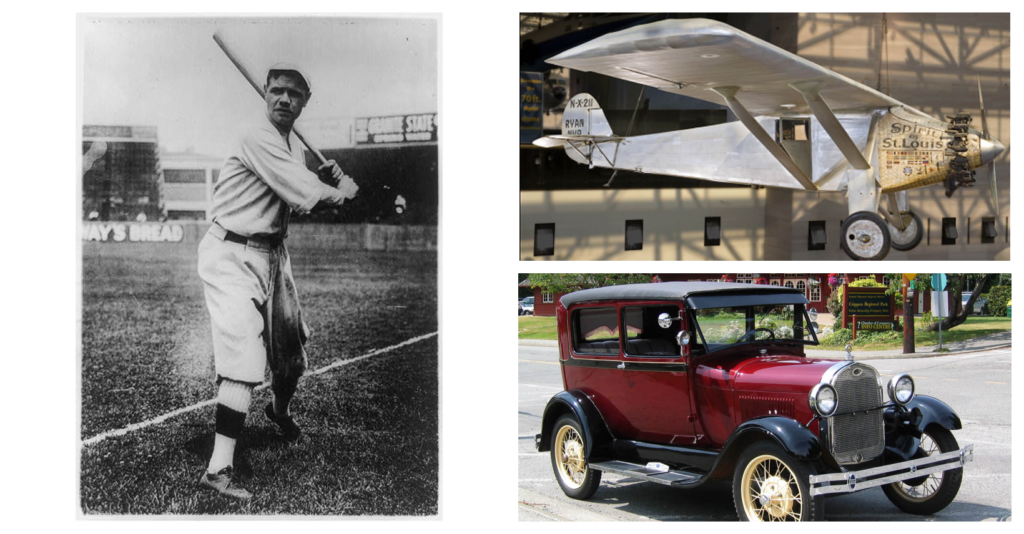
But first, what does Bryson’s book cover? Charles Lindbergh’s transatlantic flight from New York to Paris in the Spirit of St. Louis on May 20—21 is one of the topics, along with Calvin Coolidge’s presidency and his decision not to run for a second full term in 1928 and the Great Mississippi Flood, which had its beginnings in 1926 and ended up covering 27,000 square miles in water and displacing thousands of people from their homes and land. Bryson also tackles the controversial trial and execution of Nicola Sacco and Bartolomeo Vanzetti, anarchists accused of armed robbery and murder; the introduction of Ford’s new Model A car; and the release of the first talkie, The Jazz Singer. And then, of course, Bryson shares the story of the New York Yankees’ achievements on the baseball diamond in the summer of 1927 – with 110 wins and 44 losses, a sweeping victory in the World Series against the Pittsburgh Pirates, and Babe Ruth hitting his 60th home run of the season on September 30, setting a record that wouldn’t be broken for 34 years.

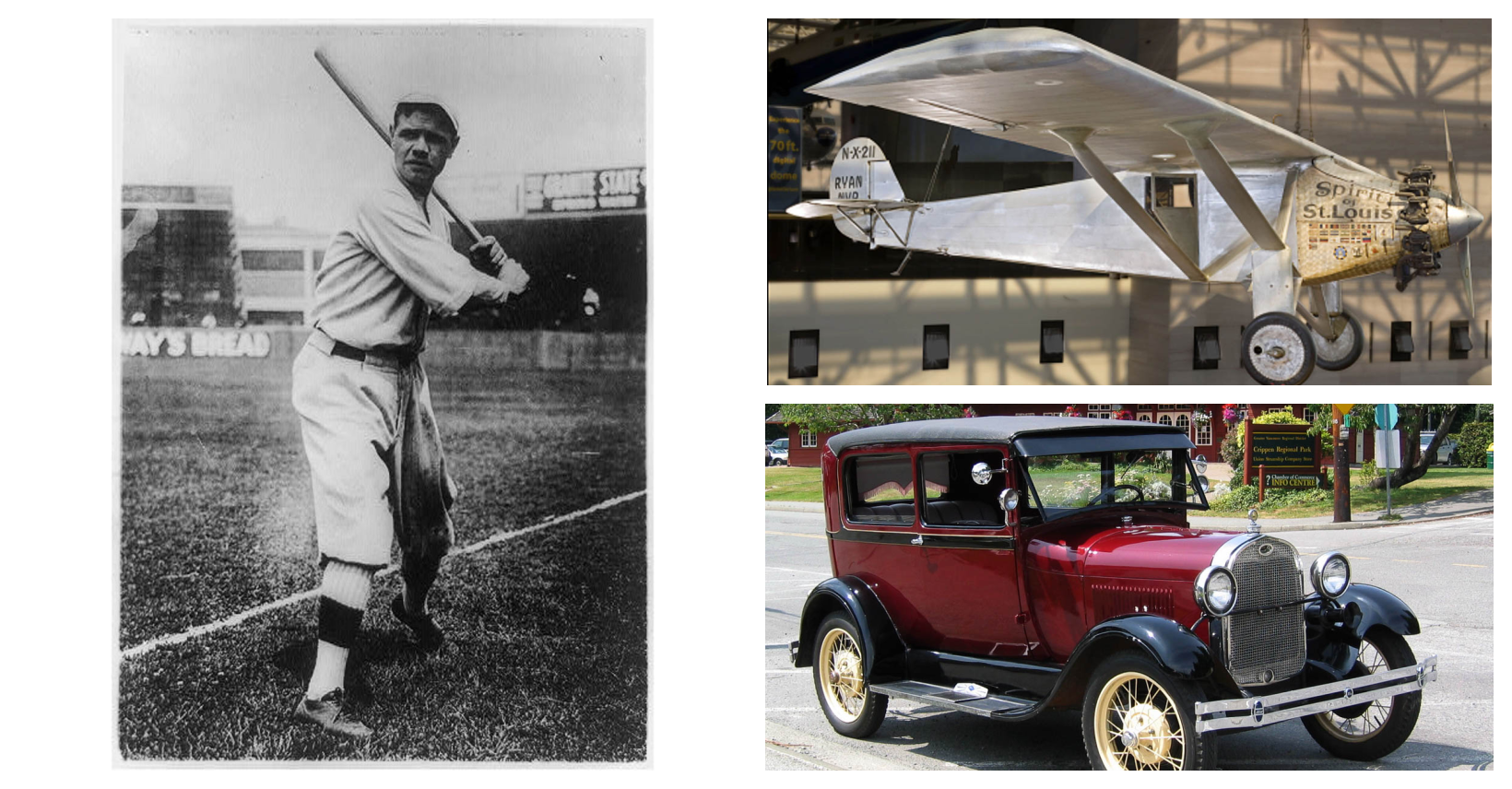
Left: Black-and-white image of Babe Ruth -- a large man -- standing in a baseball stance with the bat on his shoulder. The baseball stadium is in the background.
Top right: The small silver Spirit of St. Louis is suspended from the ceiling of the museum. It's name is written on the airplane's nose.
Bottom right: A red old-fashioned looking car.

Babe Ruth photographed in his batting stance (National Photo Company Collection, Library of Congress); the Spirit of St. Louis on display at the Smithsonian’s National Air and Space Museum in Washington, D.C.; and a Ford Model A car (Wikimedia Commons).

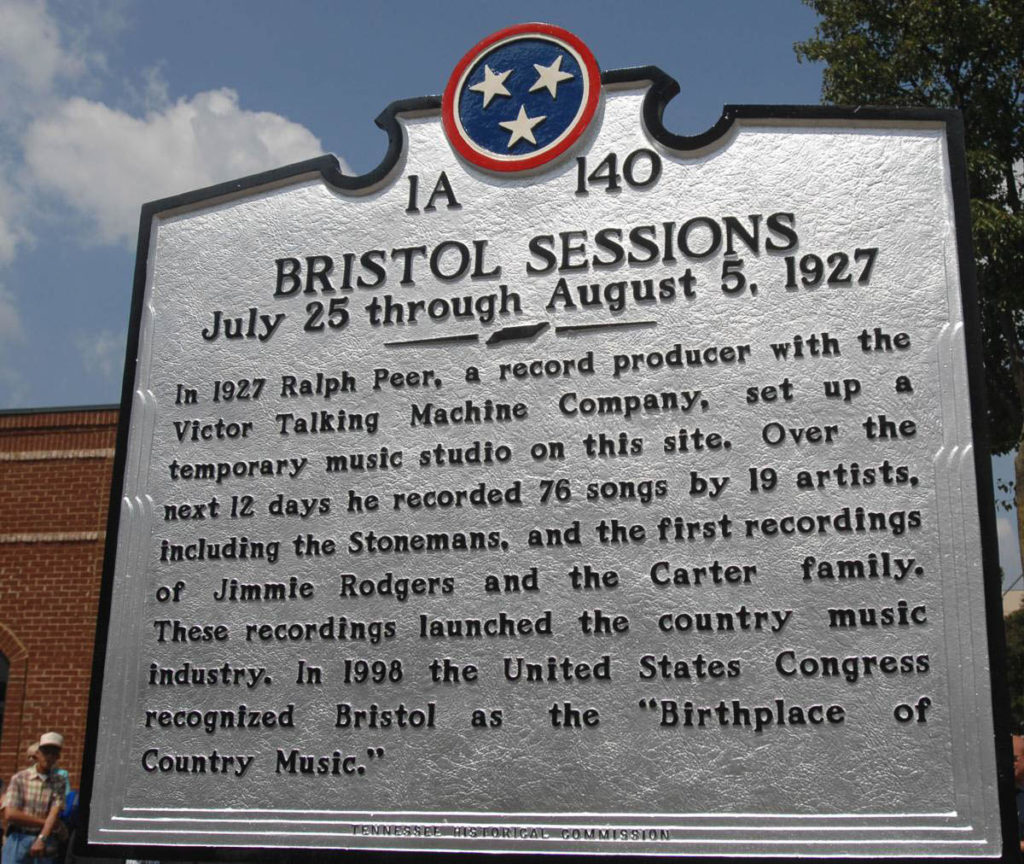
So what about country music? Well, of course, the summer of 1927 also saw the Bristol Sessions being recorded between July 25 and August 5. With performers like Ernest Stoneman – an experienced and prolific musician in the burgeoning hillbilly music industry – and hugely impactful newcomers like The Carter Family and Jimmie Rodgers, along with a host of other interesting artists and recordings, the 1927 Bristol Sessions became known as “the big bang of country music.” Sadly, the Sessions did not make it into Bryson’s book – maybe they’ll make an appearance in a later edition, fingers crossed! – though the Library of Congress has recognized them as among the 50 most significant sound recordings of all time.

Large metal historic marker with the Tennessee symbol of three stars on a blue background with red border at the top. The words briefly describe the Bristol Sessions. A brick building can be seen in the background.

This historic marker about the 1927 Bristol Sessions is located next to the Birthplace of Country Music’s offices at 416 State Street, the former site of the Taylor-Christian Hat Company building where the 1927 Bristol Sessions were recorded. © Bristol Herald Courier

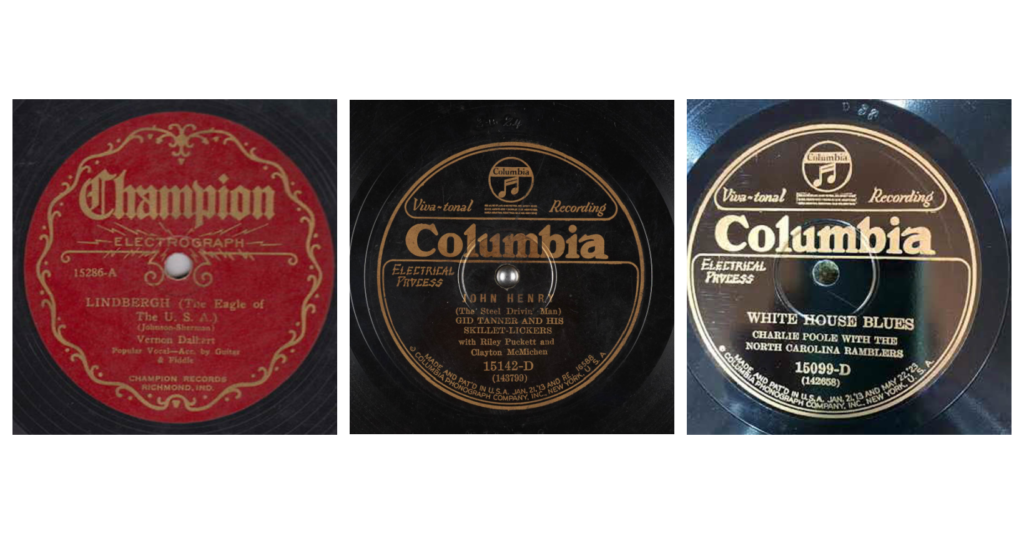
But are there other country music stories to be found in 1927? Interestingly, we can connect Charles Lindberg to country music through two 1927 recordings by Vernon Dalhart: “Lindbergh (The Eagle of the USA)” and “Lucky Lindy!” Both of these records sold well, and a couple of other hillbilly performers also had big hits in 1927 – Gid Tanner and His Skillet Lickers with “John Henry (Steel-Drivin’ Man)” and Charlie Poole & The North Carolina Ramblers with “White House Blues.”

Three record labels:
Left, red label for Champion Records detailing the title and performer's name.
Center, black Columbia label detailing the title and performer's name.
Right, black Columbia label detailing the title and performer's name.

Record labels for Vernon Dalhart’s “Lindbergh (The Eagle of the U.S.A.),” Gid Tanner’s “John Henry (Steel-Drivin’ Man),” and Charlie Poole’s “White House Blues.”

There were also several country and bluegrass stars born in 1927:

  • Bluegrass legend Ralph Stanley (February 25)
  • Carl Smith (March 15), known as “Mister Country” and once married to June Carter
  • Charlie Louvin (July 27), part of the Louvin Brothers and a member of the Grand Ole Opry
  • Nudie-suited performer and TV personality Porter Wagoner (August 12), who introduced Dolly Parton to the world in 1967 via The Porter Wagoner Show
  • Jimmy C. Newman (August 29), country music performer and Cajun singer-songwriter
  • Songwriter Harlan Howard (September 8)
  • Leon Rausch (October 2), known as “the voice” of Bob Wills and His Texas Playboys
  • Patti Page (November 8), crossover pop and country artist
  • Bob Ferguson (December 30), a musician and producer who was instrumental in establishing Nashville as country music’s center

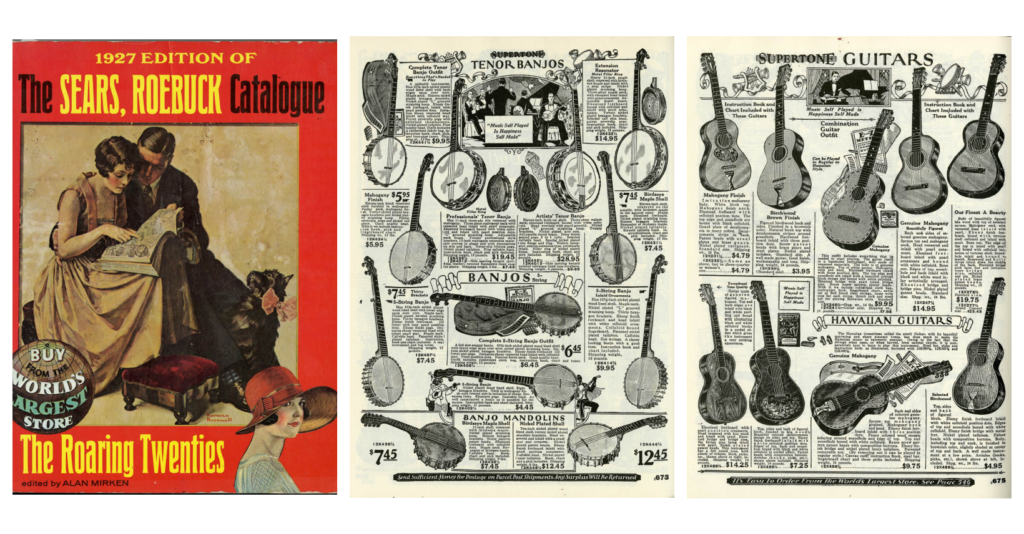
For a few more musical connections to 1927, first take a look at the pages from a 1927 Sears Roebuck catalog. While these catalogs were produced yearly and so this isn’t unique to 1927, it is a great insight into what kinds of instruments you could buy from Sears Roebuck and what the 1927 prices were! And then there were two milestones in American radio history that are tied to 1927. The U.S. Federal Radio Commission (later known as the FCC) began to regulate radio frequencies on February 23, 1927. And on September 18 of that year, the country saw the debut of CBS, which went on air with 47 radio stations, later becoming a powerhouse in the new technology of television.

Three images of Sears Roebuck 1927 catalog:
Left, the catalog cover shwoing a man and woman poring over the catalog together, with a dog or cat at their feet. A woman in a big hat is in the corner of the cover, and the words The Roaring Twenties are seen at the bottom.
Center: A page filled with different banjos with descriptions and prices.
Right: A page filled with different guitars with descriptions and prices.

This facsimile of the 1927 Sears Roebuck catalog is in the museum’s collections and on display in our permanent exhibits. © Birthplace of Country Music

These are just a few of the stories and historical or cultural moments from 1927 – there are many, many more beyond my primary focus here on music connections. And so to finish this post off, why don’t you go down your own rabbit hole? The Smithsonian, always a great source of information on any and all topics, can get you started with a trove of treasures that all connect to the year 1927, some discussed above, some more obscure, but all interesting. You can check out these objects and images here.