History Archives - Page 24 of 25 - The Birthplace of Country Music
Listen
Play
Loading station info...

In Search of Lesley Riddle

What I wouldn’t give to have met Lesley Riddle.

Credited as having influenced one of the world’s most prominent families in country music history, Lesley Riddle’s legendary interactions with The Carter Family offer a glance at the messy realities of musicians making a living in the 1920s and 1930s. This history shows that black and white musicians came together in ways that made the music richer, more complicated in its honest reflection that defied the genre catalogs of the industry.

A. P. Carter met Lesley Riddle in the late 1920s in Kingsport, Tennessee. This meeting was the beginning of a musical interaction that would impact The Carter Family’s music, as Riddle traveled with Carter to collect songs throughout the region and helped shape Maybelle’s guitar techniques. Sadly, Riddle never made his living in music himself; however, it is his contribution to country music for which he is most remembered.

From this history, I also wish I could have met Lesley Riddle and A. P. Carter together. Riddle having lost a leg in an accident and Carter with a constant tremor, the two men stand as an odd couple in the canon of country music history, almost a tragic comedic duo looking a segregated South (and a segregated music industry) straight in the face as they traveled the hills of northeast Tennessee and southwest Virginia to hear and learn the songs that were being sung. At a minimum, it’s inspirational that the two rambled forth together; however, if their partnership was a non-issue in the hollers where they traveled, it invites even more consideration.

Born on June 13, 1905 in Burnsville, North Carolina, Riddle spent much of his childhood with his paternal grandparents near Kingsport, Tennessee. After a cement factory accident robbed him of his right leg, Riddle took an interest in the guitar and mandolin. The Traditional Voices Group of Burnsville, North Carolina’s Mountain Heritage Center has compiled a full bio of Riddle if you want to read more about his life.
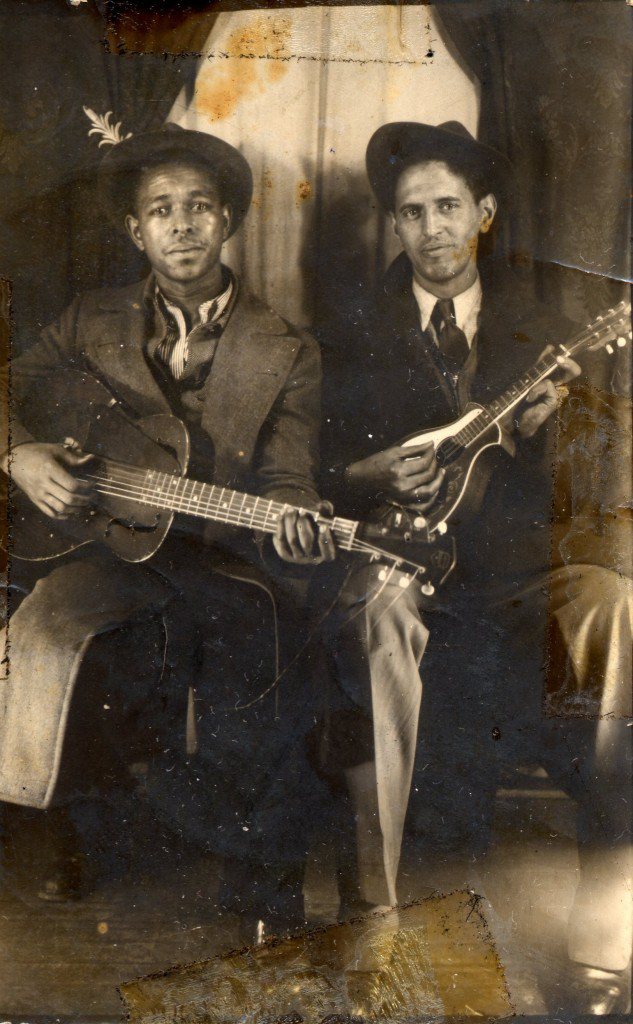
 

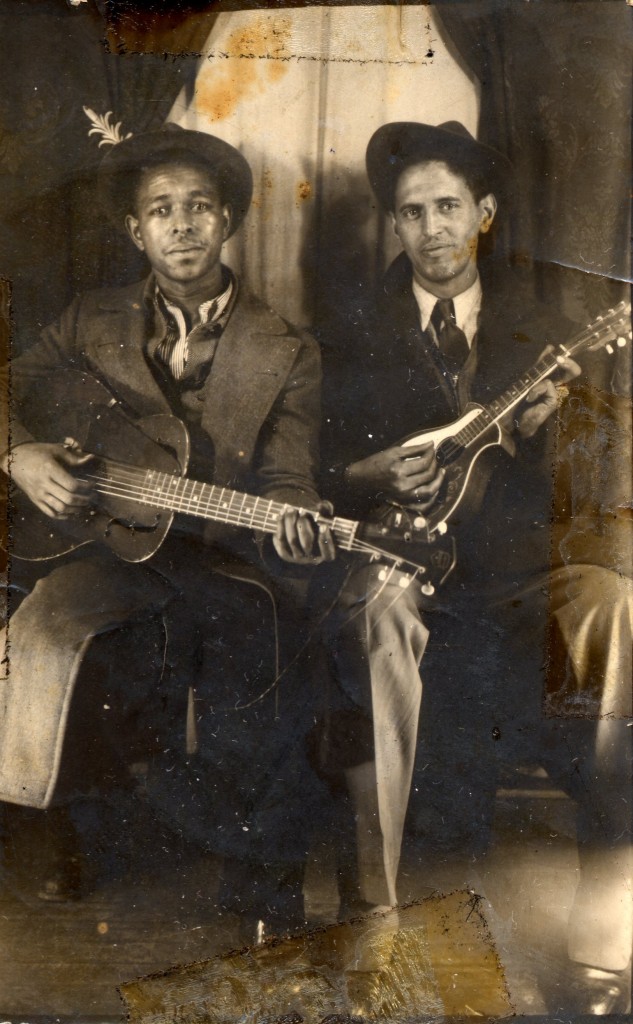
Brownie McGhee (left) and Lesley Riddle played together when both men lived in Kingsport, Tennessee. © Lesley Riddle Family and courtesy of the Mountain Heritage Center’s Traditional Voices Group, Burnsville, North Carolina

Riddle met other musicians during his time in Tennessee, and he was soon a regular in the area’s music scene, especially with other black artists including Steven Tarter, Brownie McGhee, and John Henry Lyons. It was Lyons who introduced Riddle to Carter, and he soon became fast friends with the family, staying with them at their home in Maces Springs, Virginia, for weeks at a time and accompanying Carter on his song collecting trips.

Maybelle Carter credited Riddle with teaching her the “bottleneck” style of guitar picking, in which the index finger plays the melody while the thumb keeps the rhythm on the bass strings. Of Maybelle’s playing, Riddle said: “You don’t have to give Maybelle any lessons. You let her see you playing something, she’ll get it – you better believe it.” Riddle taught The Carter Family such songs as “The Cannon Ball,” “I Know What It Means to Be Lonesome,” “Coal Miner Blues,” and “Let the Church Roll On.” In 1942, Riddle and his wife moved to Rochester, New York, and lost touch with both The Carter Family and music. A few years later he sold his guitar.

In the mid-1960s, Mike Seeger met Riddle, and he interviewed and recorded him on several occasions during the 1960s and 1970s. With Seeger’s influence, Riddle performed at such venues as the Smithsonian Folk Festival and the Mariposa Folk Festival, as well as the Carter Family Fold before he passed away in 1980.
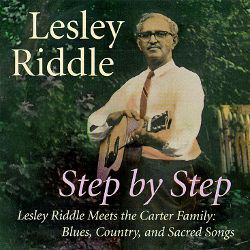
Cover of Step by Step, a recording released by Rounder Records that came out of Riddle’s work with Mike Seeger. © Rounder Records

Some of Seeger’s interviews capture the organic nature of the encounter between A. P. Carter and Lesley Riddle. “I played a couple of songs for him [A. P.] and he wanted me to go back home with him right then and there,” said Riddle in one interview. “I went over to Maces Springs with him and stayed about a week. We got to be good friends and for the next three or four years I continued going over to his house, going where he wanted to go. I went out about 15 times to collect songs.” Riddle continued: “He was just going to get old music, old songs, what had never been sung in sixty years… He was going to get it, put a tune to it, and record it.”  Lucky for us, the materials related to Riddle are available to researchers as part of the Mike Seeger Collection at the Southern Folklife Collection at UNC-Chapel Hill – the collection houses a whopping 70,000+ items in total!

Riddle’s participation was a vital part of Carter’s work to collect traditional songs for the record producers he was working with. “If I could hear you sing, I could sing it too,” said Riddle. “I was his tape recorder. He’d take me with him and he’s get someone to sing the whole song. Then I’d get it and learn it to Sara and Maybelle.”

So while we might not get the chance to meet Lesley Riddle now, his legacy lives on, and if you’re around Burnsville you may meet him in some fashion. Last year a North Carolina Highway Historical Marker was placed to honor Riddle’s work in country music along Burnsville’s Highway 19. And on June 30 of this year, Traditional Voices will present the annual Riddlefest in honor of the music of Lesley Riddle. Riddlefest 2017, featuring David Holt and Josh Goforth with guest Roy Andrade joining Holt for a special seminar, will be the 10th anniversary of this annual concert event.
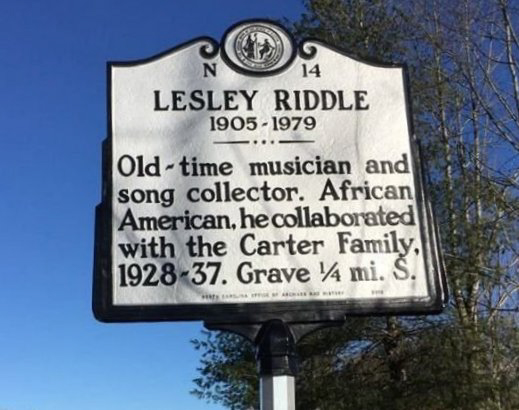
Lesley Riddle marker along Highway 19 in Burnsville, North Carolina. © North Carolina Department of Historic Resources, North Carolina Highway Historical Marker Program

Jessica Turner is the Director of the Birthplace of Country Music Museum.
Shiny Shoes, Big Hair, and Riding the Comeback Train

In the Technicolor rearview mirror of my childhood, Bristol circa 1970s, I fondly recall shopping downtown on State Street almost exclusively. There was Christy’s Shoes where I’d pine for the shiny black patent leather Mary Janes with ribbons, begging my mother to buy them. “Not today,” she’d say, “you need shoes for school.” She’d select a sensible pair and then I’d be fitted by an actual salesperson who would measure my feet with a Brannock Device before disappearing into the back of the store to find my size. Upon return, a shoehorn was used to gently glide the deeply scorned option over my heels – and I’d inwardly swear that when I grew up, I’d own every pair of shiny shoes in that store.

Sometimes we’d go to Ball Brothers Furniture where a friendly salesman would hand you a small glass bottle of Coca-Cola when you walked in the door. In retrospect it seems risky to hand a kid a pop in a showroom filled with gorgeous furniture, but on a hot day I’d gulp down the whole thing before taking more than two steps. The belching that ensued would embarrass my mother and leave my little brother and I in a heaping pile of giggles that generally followed us throughout the store.

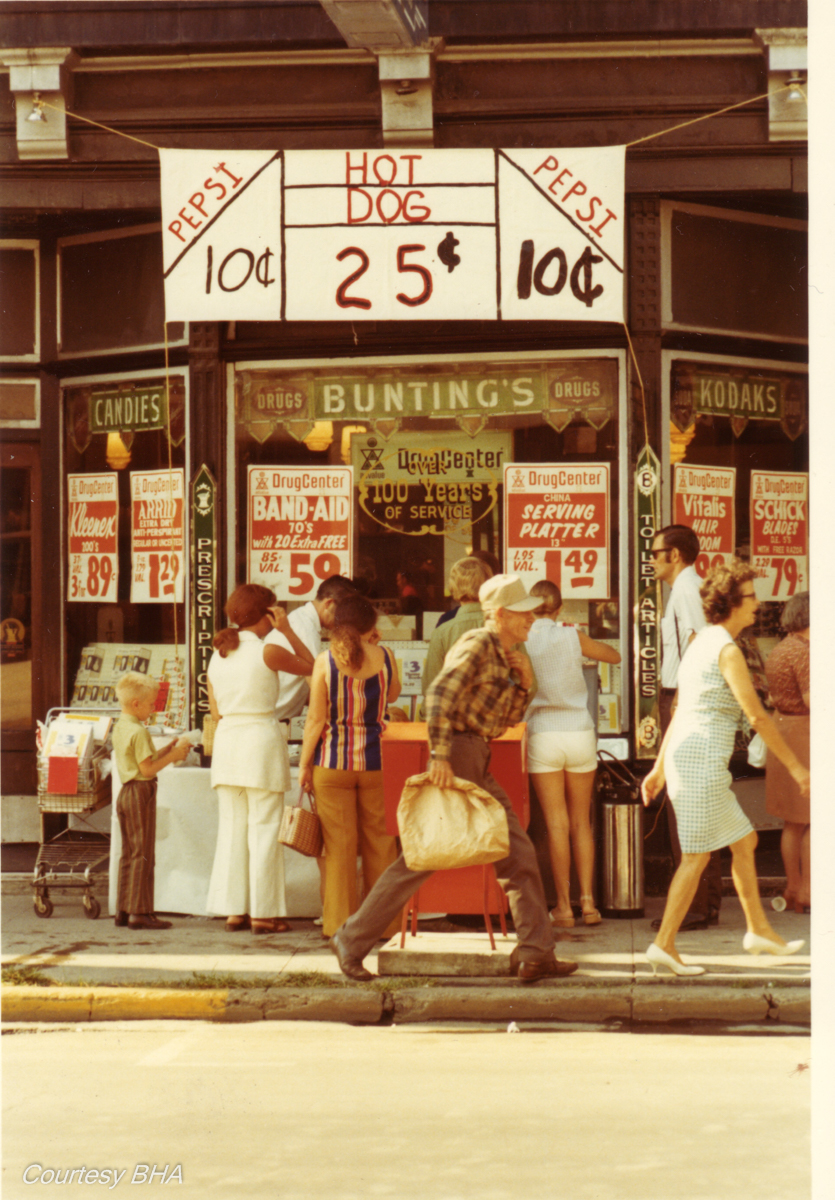
After shopping, we’d usually end up getting hot dogs and root beer floats at Bunting’s Drug Store or stop by the lunch counter at…was it H. P. King’s? The place had banquettes, turquoise counter tops, and black silhouettes of people hung high up on the walls. It’s all a little hazy now, but I do know that – at some point – it all ended. Seemingly overnight, we just stopped going downtown.

Bunting’s Drug Store in the 1970s, a wonderland of lotions, potions, and root beer floats. Reproduced with permission from the Bristol Historical Association

By the 1980s, mall culture had swept the nation – as did crispy hairstyles. Some say it was the lowest point in fashion history, yet the rise of the “mall claw” wasn’t our nation’s greatest tragedy. The real casualty was Downtown, USA. As the trend toward shopping malls, big box stores, and retail chains became more valued than mom-and-pop businesses, downtowns everywhere literally crumbled before our eyes. The emergence of Reaganomics, BMWs, and giant shoulder pads ushered in yuppies with new money that seemingly held little regard for anything of historic value. Behemoth shopping malls became the air-conditioned havens of leisure for shoppers and loiterers alike – and the place for teenagers to ward off boredom. I would spend many a weekend sipping Orange Julius, noshing Italian Village pizza, and playing Pac Man at The Gold Mine in The Bristol Mall – and not one salesperson ever fitted my shoes again.

I wasn’t properly reintroduced to downtown until my 20s. Back then State Street mainly consisted of abandoned buildings, antique stores, the newly renovated Paramount Center for the Arts, the library, and a cute little eatery called K. P. Duty. Then there was a teeny little dive bar on 7th Street that offered live music.

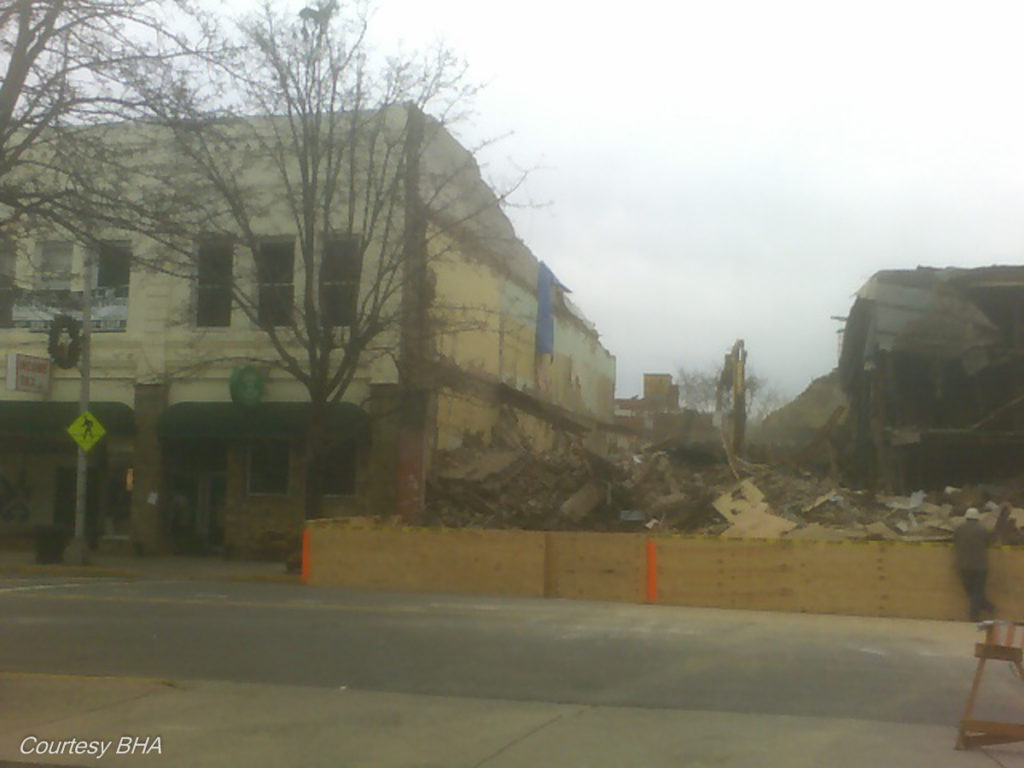
Modernization and “improvement” meant that many of Bristol’s downtown historic buildings – and the once-vibrant businesses housed in them – disappeared or were left empty in the 1970s and 1980s. Reproduced with permission from the Bristol Historical Association

Let me preface to say I’m the daughter of a musician, so it was only natural that I would gravitate toward our local music scene. Many thanks to Fred Bartlett for opening The Offshore Café and for being among the first to invest in live music downtown. With a wide range of local and regional talent playing across genres, The Offshore opened up a whole new world to me and many others. I saw a ton of great bands in that tiny little place: Brian & The Nightmares, Punchin’ Judy, Trailer Park Picassos, the Wandering Zulu Brothers, Thin Line, Janie Gray, Würm, Redstone, H. B. Beverly, Blue Mother Tupelo, Lightnin’ Charlie, The Goody’s – the list is long and distinguished. By the time I was performing there in my own band, The Offshore had changed hands several times but still offered a variety of live music.

Fast-forward several years and I was working at WCYB TV, the NBC/Fox/CW affiliate in Bristol. One of my jobs was producing promotional spots for nonprofits as part of the station’s public service. During that time, I worked a variety of regional events and with several nonprofits including the former Birthplace of Country Music Alliance and the Paramount. This is what led me to Bristol Rhythm & Roots Reunion in 2002. The cities of Bristol turned over organization of the event after the first two festivals; I soon became a board member and continued to volunteer until the opportunity to become an employee presented itself in 2010.

To this day I credit the explosive growth of Bristol’s musical awakening to the people I met on the board of Bristol Rhythm & Roots Reunion and to the folks from the former Birthplace of Country Music Alliance. Though separate at the time, they started that train steamrolling down the track, and I am so grateful to them for their vision and for preserving Bristol’s music history.

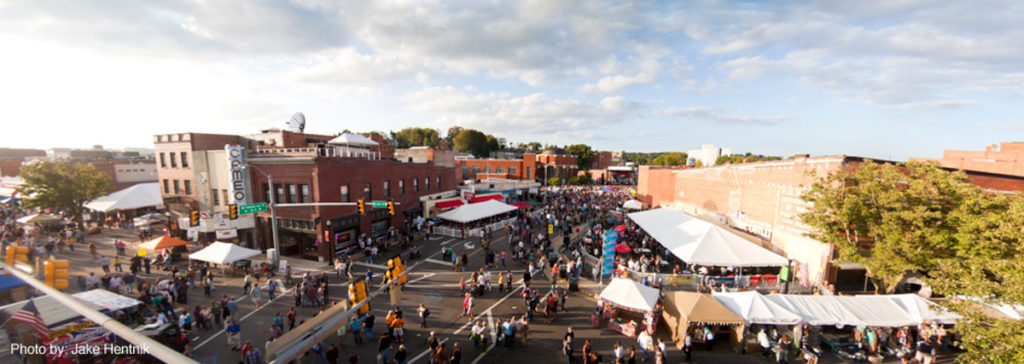
Festivalgoers at Bristol Rhythm & Roots Reunion – the festival has grown exponentially since its beginnings in 2001, and each year it celebrates the musical heritage of Bristol and this region. © Birthplace of Country Music; photographer: Jake Hentnik

Coincidentally, both cities of Bristol were working to increase investment interest and foot traffic downtown. We were fortunate to have members from both city councils on the festival board, and the vision they had for downtown has truly come to fruition.

Then there is Believe in Bristol, our small Main Street organization that works to improve downtown in other ways. They bring groups and businesses together, help with beautification projects, and continue to help make Bristol an even better place to live. Together, we have become a force. It truly takes a village, people!

Today, the Birthplace of Country Music (the “Alliance” was dropped during the 2012 merger with Bristol Rhythm & Roots Reunion) is the parent organization for the Birthplace of Country Music Museum, Bristol Rhythm & Roots Reunion, and Radio Bristol. Visitors from all over the world have been to visit our festival and our museum, and those who have yet to visit can listen to the music of our region via our radio station online and on its app. This has been made possible because of the love and support of this community. I am blessed to have been a tiny cog in the wheel of this fine, music-making machine.

Today I am really proud to take my daughter Callie downtown for nearly every event imaginable. We do the Caterpillar Crawl, Pumpkin Palooza, Border Bash, the Downtown Open House, and Full Moon Jams. She loves Mountain Empire Comics and Top Hat Magic the most, takes the occasional art class at A Work of Art Gallery, and has been enrolled at Bristol Ballet since she was three years old.

We could have breakfast, lunch, dinner, and dessert at any number of fancy or casual places on and around State Street and still have the occasional hot dog and root beer float if we want. And yes, there’s shoe shopping downtown, and yes, Callie gets the shiny ones!

Bristol is proof that great things happen when we work together. Bristol, though crossing the boundary of two states, truly shares one state of mind.

Charlene Tipton Baker is a Marketing Specialist at the Birthplace of Country Music.

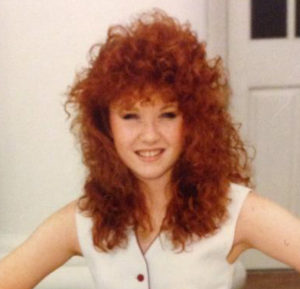
A remembrance of the big hair from my past…

Southwest Virginia’s Favorite Uncle: Celebrating the Birthday of Uncle Eck Dunford

Meeting Uncle Eck Dunford must have been quite an experience. While there aren’t many accounts of his life and times, the ones I’ve found – and the stories I’ve been told – point to a man who was full of character and personality.

He was born Alex Dunford on May 30, 1875 in Ballard Branch near Galax, Virginia; interestingly he has two recorded birth dates – 1875 and 1878 – but the 1875 one is from his tombstone and therefore that’s the one I’ve picked! Several sources tell us that Uncle Eck was a bit of an eccentric, wearing an overcoat and overshoes in all seasons, no matter the weather, and adding pink earmuffs when the temperatures turned cold. He also spoke in a distinctive voice, one that has been attributed to a possible Scots-Irish dialect. He was known for his jokes, but he also stood out from others in the Galax area when he frequently quoted Shakespeare and Robert Burns, pointing to a man who took the time and the interest to read and educate himself.

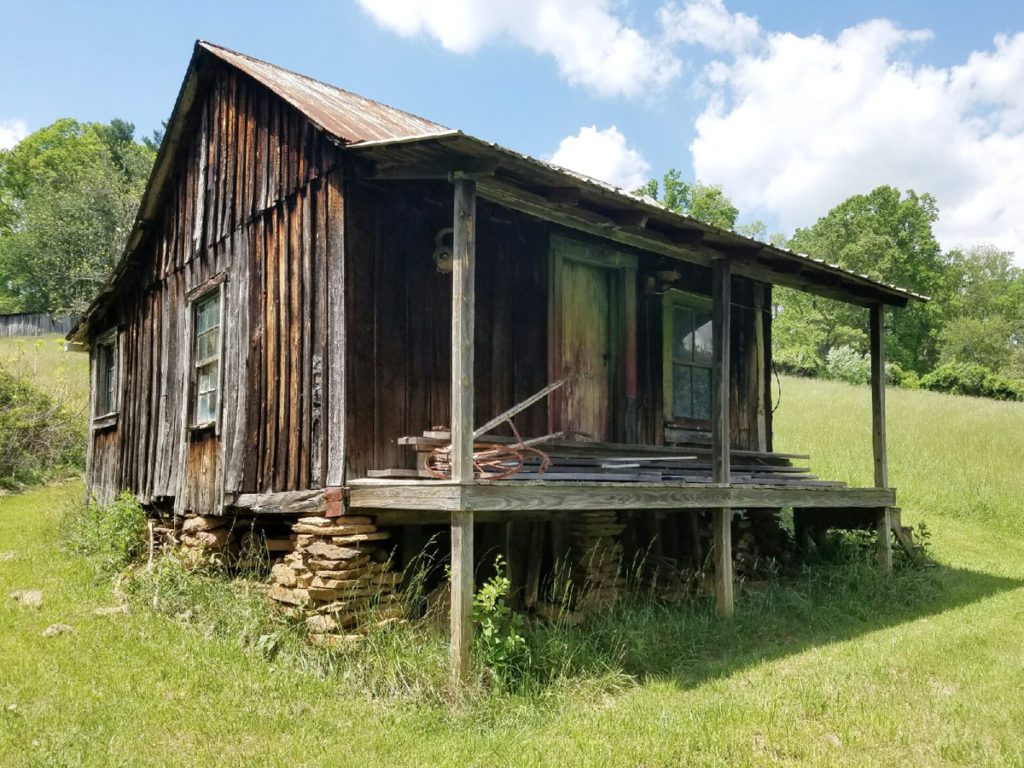
At the turn of the 20th century, Uncle Eck built a cabin in Galax made up of one big room and a kitchen out back, and this was his home until he passed away in 1953. A large number of pictures – on glass plate negatives – were found in his cabin after his death, along with a tripod and other photographic equipment; unfortunately many of these photographs have now been lost. As an amateur photographer, Uncle Eck seemed to focus on pictures of the everyday life around him in Galax, though it’s not known whether he took photographs to sell or simply for pleasure. One of his photographs of a logging group was used on a County Record label; another picture – this time of several Galax musicians – was used by Mike Seeger and John Cohen on the cover of The New Lost City Ramblers Song Book. Uncle Eck also worked as a shoe cobbler, and a Singer leather sewing machine was also found in the cabin.

Uncle Eck’s cabin is still standing. © Lynn Delp

However, Uncle Eck is really known for music. He was a highly skilled fiddler, guitarist, and storyteller, and he played with a host of other musicians and bands. He is especially known for his musical connections with Ernest “Pop” Stoneman; he even married into the family when he wed Callie Frost, a relative of Hattie Stoneman’s. The first time that Uncle Eck recorded was in 1927 at the Bristol Sessions, and he sang or played (or both) on several sides with different Stoneman configurations – “Mountaineer’s Courtship” with Irma Frost and Stoneman, several sides including “Are You Washed in the Blood” and “I Am Resolved” with Ernest Stoneman & His Dixie Mountaineers, “What Will I Do, For My Money’s All Gone” with Hattie, “Barney McCoy” with Stoneman, and “Old Time Corn Shuckin’” with the Blue Ridge Corn Shuckers. Uncle Eck also recorded two sides by himself – “The Whip-poor-will’s Song” and the familiar children’s tune “Skip to Ma Lou, My Darling,” with the 1927 recording being its first commercial outing.

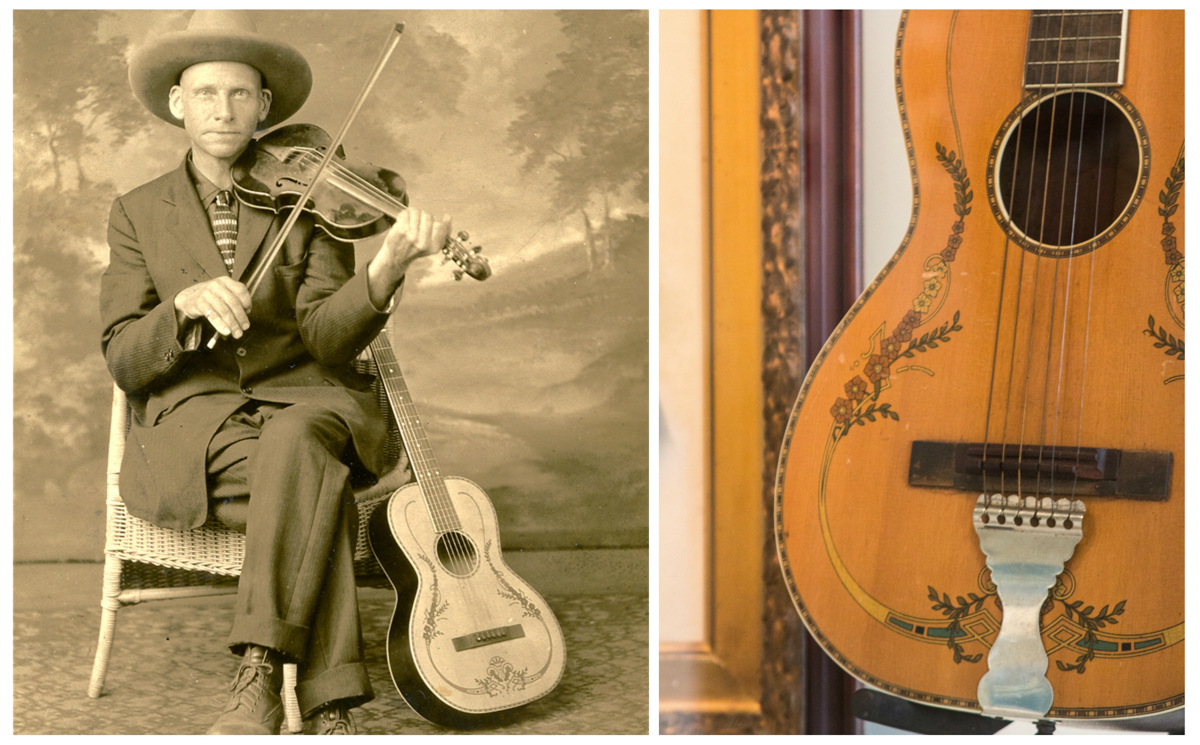
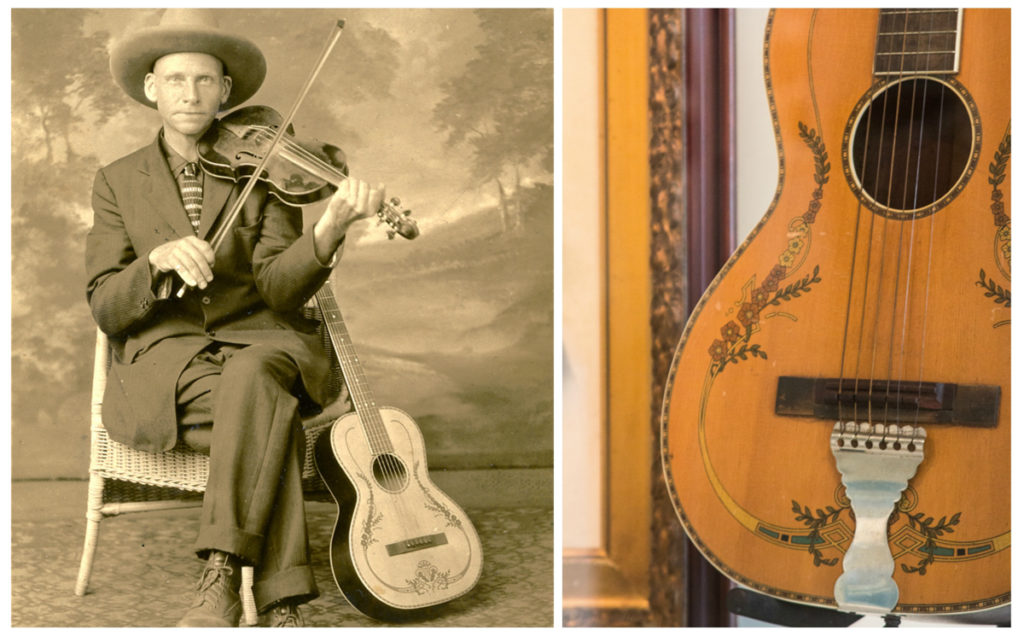
There is some speculation that this picture of Uncle Eck Dunford was a self-portrait. The portrait highlights his musical instruments, including a guitar he bought in 1912 from Sears Roebuck and which he played on most of his recordings. The guitar is currently on loan from Doris Brown and on display in our Hometown Stars: Southwest Virginia’s Recording Legacy, 1923—43 special exhibit, open through June 4, 2017. Portrait courtesy of Doris Brown; guitar image © Birthplace of Country Music

His appearance on the “Old Time Corn Shuckin’” song with and his unusual way of speaking brought his comedic talent to the fore. Based on this, Ralph Peer invited Uncle Eck to Atlanta later that year to record four comic monologues, including two that were listed as original compositions – “Sleeping Late” and “The Taffy Pulling Party.” Well-written lyrics obviously make a song skit funny, but Uncle Eck’s language, his timing and delivery, and the emphases he put on certain words underlined their comic value. He recorded two other skits with Stoneman in February 1928, again in Atlanta. One of these – “Possum Trot School Exhibition” – detailed the misadventures during a Southwest Virginia mountain school’s activity day. In October 1928, Uncle Eck was back in Bristol with the Stonemans when they recorded “Going Up the Mountain after Liquor,” amongst others, another song where Uncle Eck’s comedic talents were heavily featured.

Uncle Eck was part of several other recording sessions with Stoneman, and he recorded a couple more solo numbers at the 1928 Bristol Sessions – “Old Shoes and Leggings,” which was later featured on Harry Smith’s Anthology of American Folk Music, and “Angeline the Baker,” an Appalachian standard. But he also played fiddle and guitar with other local groups in the 1920s and 1930s including the Bogtrotters and the Grayson County Railsplitters, and there were probably other instances where he was never listed as one of the band members.

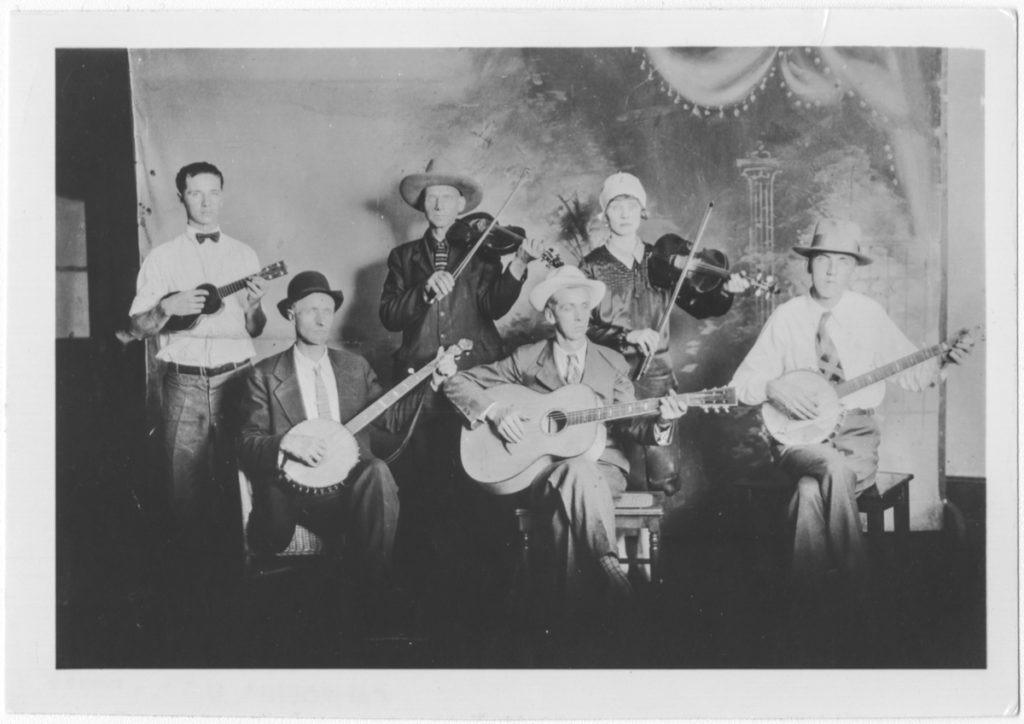
Uncle Eck can be seen in the back row holding his fiddle. This configuration of musicians was known as the Blue Ridge Corn Shuckers and the Dixie Mountaineers at different times. Image from the John Edwards Memorial Foundation Records, #20001, Southern Folklife Collection, Wilson Library, University of North Carolina at Chapel Hill

Oscar Hall, an organizer of the Galax Old Fiddlers’ Convention, knew Uncle Eck in his later years – his wife’s parents were family friends and took care of him until he died on June 26, 1953. Towards the end of his life, Mr. Hall says Uncle Eck was still playing his guitar, and playing it pretty well, and he even got the chance to play with him some.

Learning about Uncle Eck for this post has obviously underlined his musical talents, but learning about Uncle Eck the man has been the most interesting part. A final story told to me by Mr. Hall is definitely my favorite. According to Mr. Hall, whenever Uncle Eck headed back over the hill to his cabin after a visit with his wife’s parents, their goose would follow him home, flying back once the trip home was finished. And that’s the picture I now have in my mind: of Uncle Eck walking home, perhaps to play a bit of music, with a goose following close behind him.

René Rodgers is the Curator of Exhibits & Publications at the Birthplace of Country Music Museum. Special thanks to Roddy Moore at the Blue Ridge Institute & Museum in Ferrum, Virginia, and Doris Brown and Oscar Hall of Galax, Virginia, for their help with this post.
Fateful Freight: Trains and the Tunes They’ve Carried

Today Bristol is celebrating Bristol Train Station Celebration Day, an event highlighting trains and local railroad history through educational programming, arts and crafts, and music.

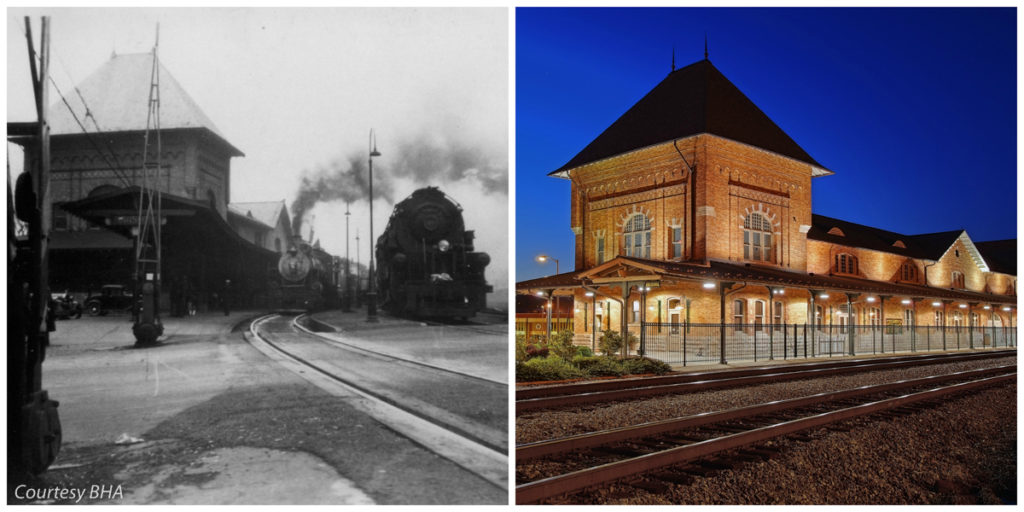
Bristol’s present-day train station was the fourth on its site. It was built in 1902 by John P. Pettyjohn & Company of Lynchburg, Virginia, and the brickwork was laid by John J. Fowler, a local African American master bricklayer. Bristol’s train station primarily dealt with coal and freight traffic, but passenger trains passed regularly through Bristol – and brought Ralph Peer and the Victor engineers to Bristol in 1927, along with some of the musicians who recorded here during the Sessions.

The Bristol train station in the 1920s and today. Archive image reproduced with permission from the Bristol Historical Association; present-day image © Malcolm J. Wilson/humansofcentralappalachia.com

These days, the railroad has lost much of its mystique – visions of crowded commuter trains come to mind – but back when the railroads were first being constructed and rail travel was developing, trains were iconic. And they were especially iconic in music.

Trains and railroads were common subjects in songs during the 19th and early 20th centuries, in a variety of genres from popular music to blues and hillbilly tunes. These songs covered a wide variety of subjects within the train and railroad theme, including railroad construction and specific trains, rail travel and its excitements and dangers, train bandits, the wandering hobo living life on the rails, and even as a spiritual metaphor within sacred and gospel music.

In all likelihood, the first American song about the railroad was a tune composed by Arthur Clifton and copyrighted on July 1, 1828. Known as “The Carrollton March,” it celebrated the ground-breaking ceremony at the construction of the first public railway for the Baltimore and Ohio Railroad Company. This event served as inspiration to another songwriter, Charles Meineke – he copyrighted his song “Rail Road March” two days later and dedicated it to the directors of the same railroad company.

It would be easy to write a piece as long as “The Longest Train I Ever Saw,” and certainly there are whole books on the depictions of railways and trains in song – for instance, Norm Cohen’s Long Steel Rail: The Railroad in American Folksong is a wonderful source. However, this post will touch on a particular type of train song within the hillbilly genre, and one of the most evocative types: songs about train wrecks.

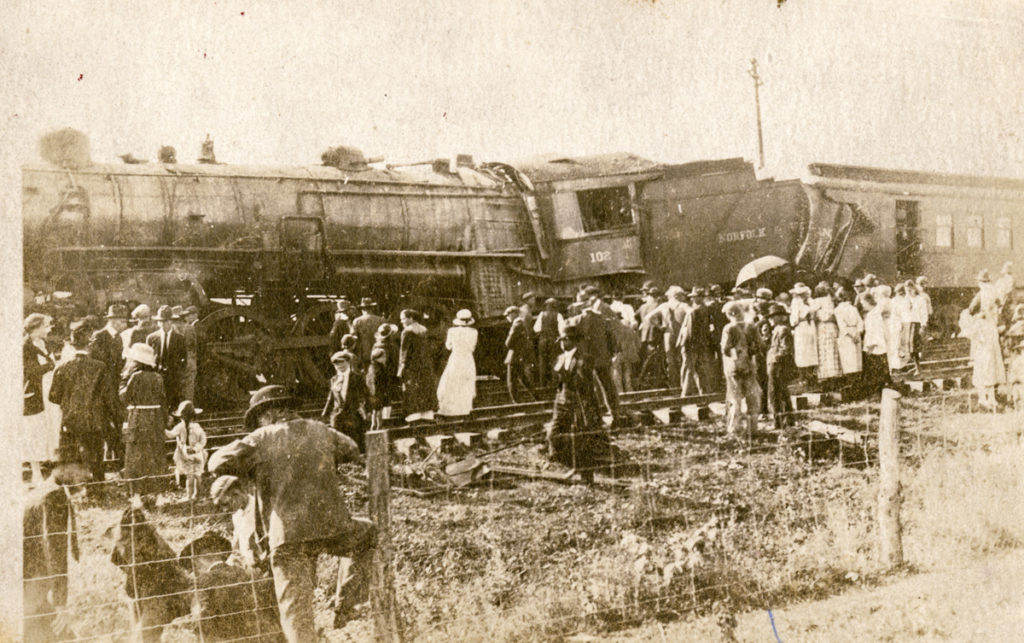
Train wrecks were a common facet of life in the late 19th and early 20th centuries, and this was reflected in a lot of songs from the period. While some of these songs lamented passengers who lost their lives, most of them memorialized the crewman killed in the line of duty on the rails. Two of the songs at the 1927 Bristol Sessions chronicled train accidents – “The Wreck of the Virginian,” sung by Blind Alfred Reed, and “The New Market Wreck,” sung by Mr. and Mrs. J. W. Baker. You can read more about the former song here; the latter was based on the 1904 Southern Railway crash of two passenger trains near New Market, Tennessee, where at least 56 people died. Family lore tells us that Sara Dougherty was playing autoharp and singing “Engine 143” when A. P. Carter turned up at her family home selling fruit trees; her singing voice convinced him that she was the woman for him. “Engine 143,” also known as “The Wreck on the C & O,” tells the story of engineer George Alley who was badly injured when his train hit a rock slide on the tracks, later dying from his wounds. This was a particularly popular folk song with over 70 different versions known; the Carter Family version recorded for Victor sold over 90,000 copies and was the most influential, and later artists like Johnny Cash and Joan Baez also put their own stamp on the song.

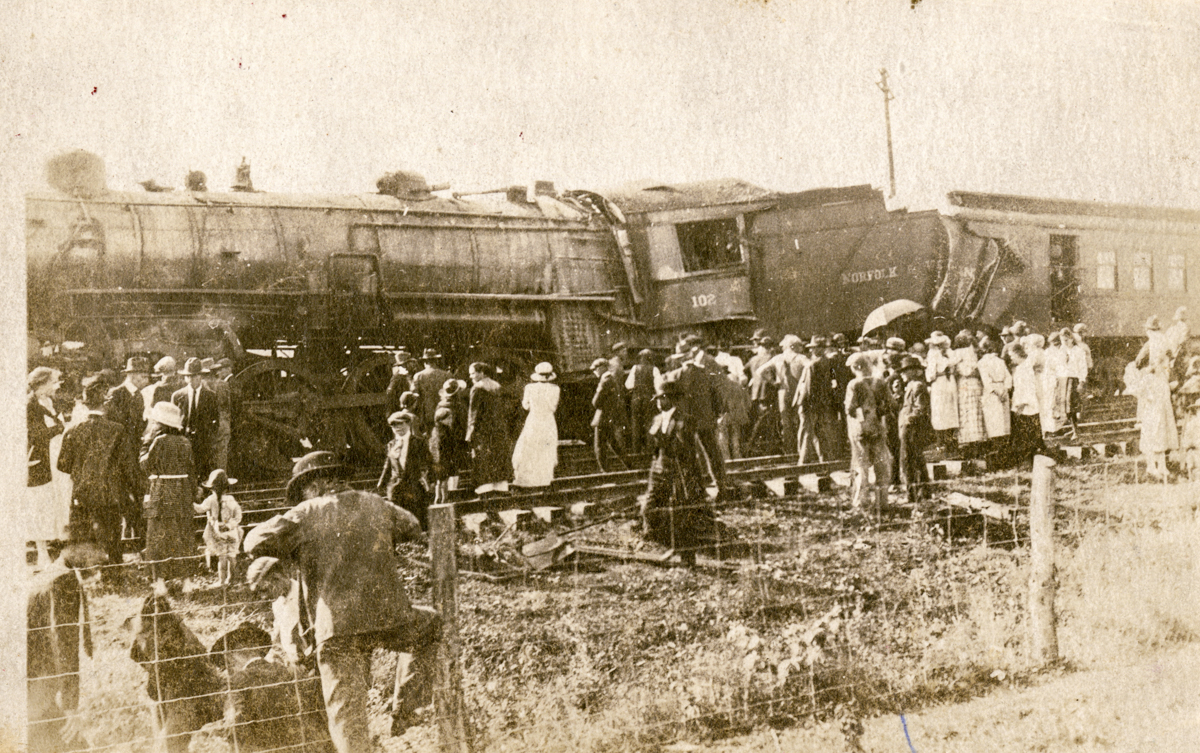
This train wreck is possibly from the 1910s based on the clothing worn by the spectators. Courtesy of Gene Williams

A train wreck ballad written by preacher Blind Andy Jenkins fell into the more unusual category of songs that focused on the passengers rather than the crew. His song records the collision between two Southern Railway trains – the song’s namesake and the Ponce de Leon – in December 1926. Attributed to an error amongst the crew of the Ponce de Leon, the crash resulted in 19 dead and 123 injured, most from the train that caused the accident. Within two months of the wreck, Jenkins had composed “The Wreck of the Royal Palm,” and it was recorded by popular musician-turned-hillbilly singer Vernon Dalhart for Columbia in January 1927 – this quick release reflects the common practice of rapid production and distribution of “current event” songs on hillbilly records during this time period. Dalhart’s version of the song sold around 36,000 copies. Jenkins also wrote the train wreck song “Ben Dewberry’s Final Run,” which was recorded by Jimmie Rodgers in November 1927.

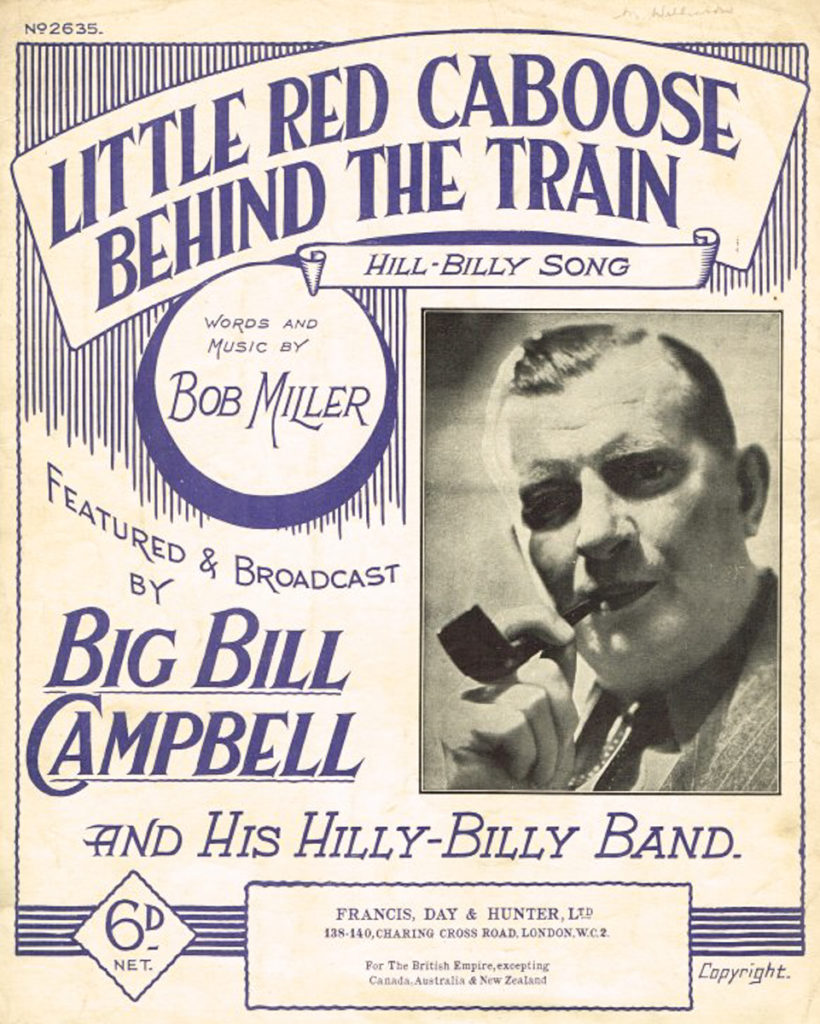
A version of “The Little Red Caboose Behind the Train” by Bob Miller, copyrighted in 1928 and recorded by him in 1930, is a train wreck song that is probably not based in a real happening. Instead, it uses the train wreck as a vehicle to tell a sad and sentimental story – that of a conductor, now old and grey, whose new bride was killed in a wreck on their honeymoon as she rode in the little red caboose behind the train. The song’s last verse delivers home the tragedy of the tale:

“They placed her in the graveyard beside the railroad track,
He still works in the sunshine and the rain;
And the angels all are sober as he rides all alone,
In that little red caboose behind the train.”

Another version of this song copyrighted by John Lair in 1935, however, tells a different story, this time about the loss of the brakeman as the train’s crew tried to prevent a wreck; its details imply that this musical account might be based on a real event.

This sheet music of Miller’s “Little Red Caboose Behind the Train” highlights its performance by Big Bill Campbell, a Canadian entertainer who had a BBC radio show featuring cowboy and western music in England in the 1930s to 1950s. Image
source: theopendoorway.co.uk (2017), https://goo.gl/jtmvWI

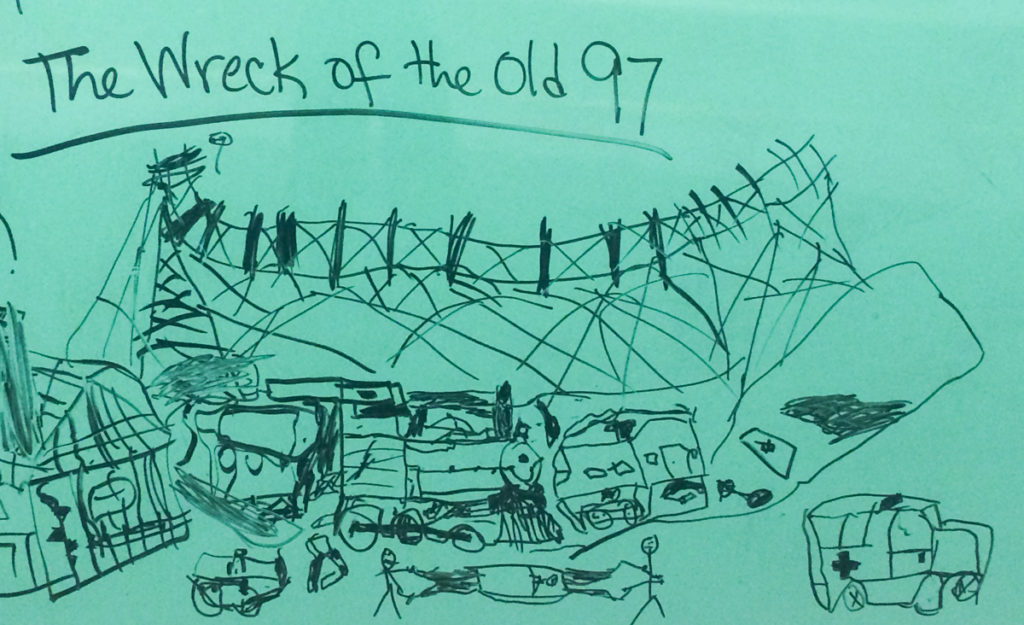
One of the most famous wreck songs is “The Wreck of the Old 97.” The Old 97 was a mail express train that flew off the tracks at a railway trestle near Danville, Virginia, in September 1903, crashing in the ravine below – the engineer Joseph A. Broady had pushed the train to a faster-than-normal speed to make up lost time and then wasn’t able to use his air brakes as the train approached the trestle. The wreck inspired several ballads, one of which was first recorded by Henry Whitter with G. B. Grayson for OKeh Records in December 1923. It was later recorded by Dalhart and released by Victor Talking Machine Company in October 1924 (after he first recorded the song for Edison earlier that year). The Victor version has been heralded as the first million-selling country record in the United States.

However, the tragedy of Old 97’s crash is not the only drama associated with the song. It was also part of a major battle over copyright. The song was first credited to spectator Fred Jackson Lewey (his cousin was killed on the train) and Charles W. Noell, but it was later claimed by David Graves George, who sued Victor saying he was the original writer of the ballad. The case was tied up in court for several years, with the decision favoring both sides at different times; George died before ever collecting the $65,000 in damages he was awarded.

Michael, an Anderson Elementary School 4th-grader, loves anything and everything about trains. He drew “The Wreck of the Old 97” on the museum’s Green Board during a school visit and then told us exactly which details were accurate and which ones were drawn with artistic license! © Birthplace of Country Music

René Rodgers is the Curator of Exhibits & Publications at the Birthplace of Country Music Museum.