Exhibits Archives - Page 3 of 7 - The Birthplace of Country Music
Listen
Play
Loading station info...

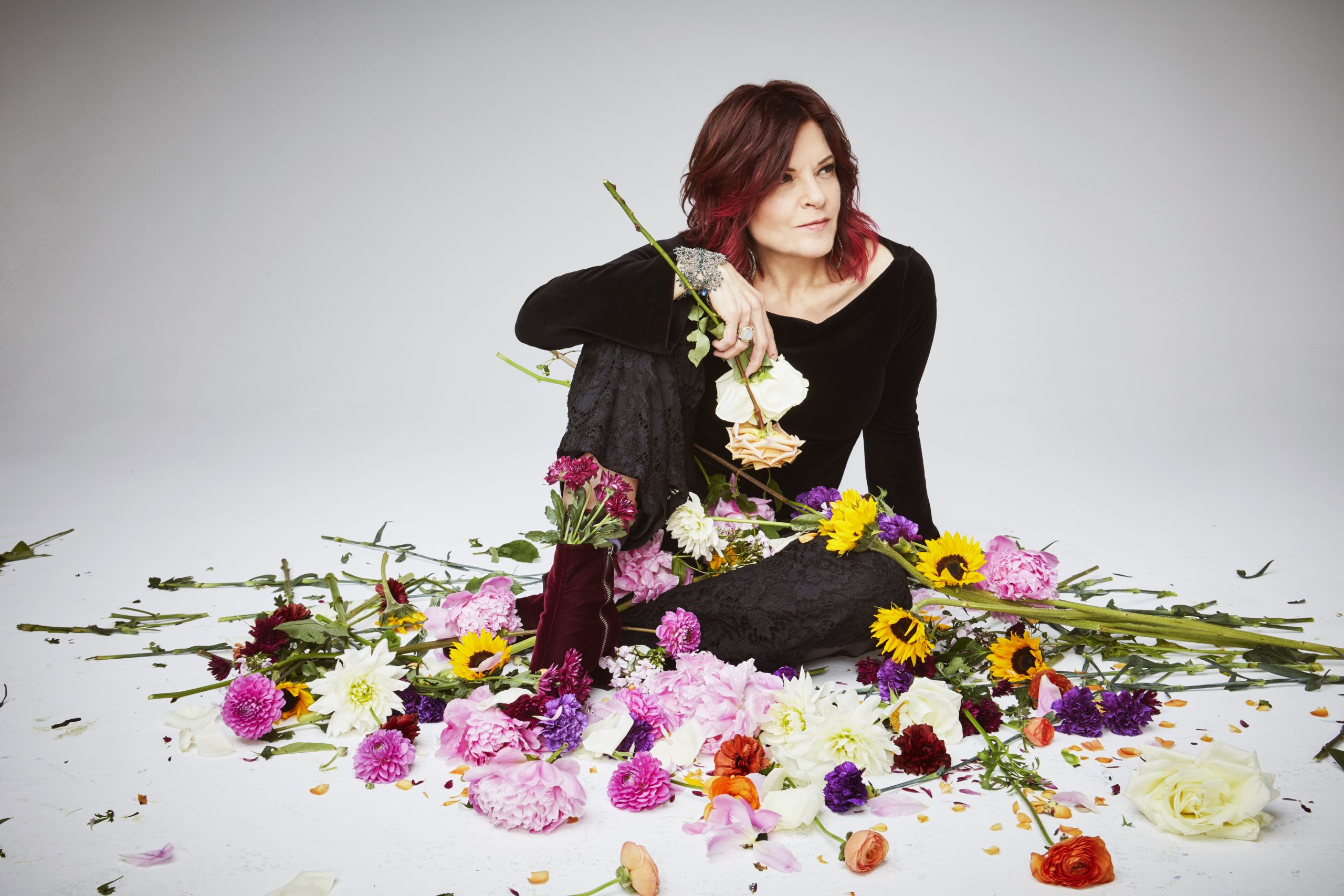
Rosanne Cash: Americana’s Renaissance Woman

Voice Magazine for Women, a free, monthly publication distributed regionally in Northeast Tennessee and Southwest Virginia to 650 locations, partners with the Birthplace of Country Music to promote our annual music festival, Bristol Rhythm & Roots Reunion. In August and September of each year, Voice generously allows us free rein to produce cover stories for the magazine highlighting upcoming acts performing at the event. With their permission, we have duplicated the cover article for this month – we hope you enjoy it! To read this month’s issue in its entirety, click here.

Voice Magazine for Women
Rosanne Cash: Americana’s Renaissance Woman
A Q&A on Family Ties to Southwest Virginia, Her First Trip to Bristol, and Fun Stuff You Didn’t Know and Would Likely Never Ask
By Guest Contributor Charlene Tipton Baker
Photo Credits: Michael Lavine

Rosanne Cash is one of the most revered artists in Americana music. At 67, she has an amazing career as a multi-GRAMMY Award-winning songwriter and performer. A born writer, Cash was inducted into the Nashville Songwriters Hall of Fame in 2015 and is a bestselling author and poet. Her fiction and essays have appeared in The New York Times, Rolling Stone, and Oxford-American, among others, and she is frequently invited to teach classes in English and Songwriting at various colleges. Additionally, Cash is an advocate for creators’ rights and children’s causes, including education and gun violence prevention.

This September, Rosanne Cash headlines Bristol Rhythm & Roots Reunion on the 95th Anniversary of the legendary 1927 Bristol Sessions recordings. Rosanne’s familial connection to our region’s music heritage makes her visit extra special; she is the eldest daughter of country music legend Johnny Cash and his first wife Vivian. She also enjoyed a close, loving relationship with Johnny’s second wife, June Carter Cash. June is the daughter of Mother Maybelle Carter of the Carter Family, the “First Family of Country Music.” The 1927 Bristol Sessions included the very first recordings of The Carter Family and Jimmie Rodgers, the “Father of Country Music,” and catapulted country music into the mainstream.

Ralph Peer recorded the 1927 Bristol Sessions in the Taylor-Christian Hat & Glove Company building on the Tennessee side of State Street. The building was long gone by the summer of 1971 when Johnny and June traveled to Bristol, alongside Maybelle Carter, Sara Carter Bayes, and other members of the Carter clan, to dedicate a monument to the 1927 Bristol Sessions at the site where they took place. Ralph Peer II (son of Ralph Peer) and members of Jimmie Rodgers’ family were also present. Thousands of people from the community gathered for the occasion. On that day, Johnny expressed to them how he would love to see a museum dedicated to the music history that had been made in Bristol.

Decades later in 2001, the annual Bristol Rhythm & Roots Reunion music festival was established to honor the legacy of those seminal recordings. The Birthplace of Country Music Museum, an affiliate of the Smithsonian Institution, opened its doors to the public in August 2014. One year later, WBCM Radio Bristol went live on the air, broadcasting from the museum.

I relayed the story above to Rosanne’s manager, Danny Kahn, along with a request for this interview and extended an invitation for the artist to tour the museum while she is in town for the festival. He quickly replied, “Rosanne realizes how significant her visit to Bristol is. She has never been. She wants to do as much as possible regarding your requests.” From everything I had read, I was not at all surprised by her generosity.

So much has been written about Rosanne Cash and by her, so in this interview I chose to focus on her ties to our region’s music heritage, while adding a few trivial zingers à la Bop and Tiger Beat to satisfy my inner, pre-teen geek. Rosanne: if you are reading this, my apologies for that – but thank you for kindly playing along! I’m so grateful for the opportunity to make this connection for my hometown, and excited for you to experience Bristol and the festival. I hope you love them both as much as I do.

Below are my questions answered by the artist via e-mail:

This will be your first time performing at Bristol Rhythm & Roots Reunion and your first time visiting the museum. Knowing that your dad’s dream of having a museum dedicated to the legacy of the 1927 Bristol Sessions is now a reality, what are your thoughts?

He was right. I’m grateful that he spoke those words that day, and that a ripple of enthusiasm went out and planted the seed to create the museum, although, honestly, it seems like it was destined! Such a historic moment and location in the cultural makeup of our country deserves to be forever immortalized. I’m thrilled to be going to perform in Bristol and see the museum for the very first time. I’ve actually sent people there, but never been myself!

When tourists come to visit the museum in Bristol, we make it a point to encourage them to visit the Carter Family Fold in Hiltons, VA. We consider it hallowed ground, and it is poignant that your dad’s final performance was there. In the beautiful eulogy you wrote for June Carter Cash after her death in 2003, you mention that Johnny hosted a “grandkids weekend” for June on her birthday one year someplace in Virginia on the Holston River. Do you have any more memories of visiting there growing up?

In 2001, we visited the Maybelle and Ezra Carter house in Maces Springs, where June grew up, and which she and my dad owned in their later years. We went canoeing on the Holston River and had a celebration for June’s birthday on the property. All the children and grandchildren had to give her something that was not a physical gift— a song, a story, a wish of some kind. I remember I sang “The Winding Stream.” We visited A. P.’s grave and sang together on the porch. It was a wonderful weekend. When I was young, I remember going with Dad and June to visit some of her kin in the Valley and eating the best biscuits I’ve ever had.

This year is the 95th Anniversary of the 1927 Bristol Sessions, which many consider to be the most influential country music recordings in history. The themes in those old songs are universally timeless. Given your family ties, it makes sense that the music of the Carter Family would impact your own music, and in the past, you have cited them as an influence. Can you point to a particular Carter song – or songs – that most resonate with you?

Helen Carter spent a lot of time with me, teaching me the Carter Family canon, when I was 18 and 19 years old. It was an invaluable education. I loved “Black Jack David,” “Hello Stranger,” “I Never Will Marry,” “Sinking in the Lonesome Sea,” “Banks of the Ohio,” “Bury Me Beneath the Weeping Willow”— all classic and essential songs— but most of all, I loved “The Winding Stream.” I recorded that, and I also recorded “Bury Me Beneath the Weeping Willow” on my album “The List.” I still perform that song in concert and will be singing it with added poignancy in Bristol!

I once ran across an old video of a Carl Perkins concert from the 1980s.The Stray Cats were his backing band, and there you were – along with Eric Clapton, Dave Edmunds and George Harrison and Ringo Starr. You were the only woman on that stage, and you absolutely rocked “What Kinda Girl.” You have collaborated with so many amazing artists over the course of your career. What is it like to meet your heroes and to be respected as a peer among them?

As a pre-teen and teen Beatles obsessive, absolutely in love with and deeply affected by the Beatles, I couldn’t, in my wildest dreams, imagine being on a show with George Harrison, or becoming friends with Elton John, and singing for him at his birthday party, or so many other instances where I met the heroes of my youth, or a contemporary artist who inspires me. At some point, as a musician, after 40 plus years, you seem to run across everyone who is out there doing the same thing as you, like a person in a multi-national corporation who meets her colleagues in other branches of the company. 😉

You have been a big advocate for change on many issues, including artists’ rights to get paid fairly for the use of their music by tech companies like Spotify and Apple Music. You serve on the board of Content Creators Coalition, an artist-run nonprofit advocacy group for musicians. You have testified before the House Judiciary Committee in defense of artists rights on behalf of the Americana Association, as your dad had done in 1997 in support of the Digital Millennium Copyright Act. With so many artists, artists unions, and political leaders pushing to enact reform, do you see change coming any time soon? Does more need to happen?

The Content Creators Coalition dissolved and morphed into the Artist Rights Alliance, on whose board I serve. Change comes, change is slow. I realize I’m working in a garden I may never see bloom, but we do have some small successes piled up lately, and intellectual property rights’ issues seem to have bipartisan support in Congress, which is hopeful.

The pandemic and the political climate in the U.S. for the past several years has forced many of us to re-evaluate our lives and careers. Artists were forced to get creative to keep their audiences engaged and are only just starting to recover from months of not touring. What effect has the pandemic had on you personally and as an artist?

I wrote—both songs and essays— and I enjoyed being at home. I realize I’m very privileged to be able to say that. I thought a lot about what I want to do in the next phase of my life—less touring, more strategic, important events, more writing, more staying put. I got Covid on the road, and it’s become an occupational hazard for touring musicians. It’s not just that, however— it’s that the lifestyle is not sustainable for me. I love the audience so much, and the community and connection, but the other 22 hours of the day are hard!

I follow you on Twitter and you are brilliant at it. You have an amazing sense of humor; your barbs are witty and razor sharp. It takes skill to effectively diss in a concise and timely manner and you nail it. When are you going to take the plunge to Tik Tok? You don’t have an account, but you are definitely in that space – people from all walks of life are dancing and singing to “Seven Year Ache” and “Tennessee Flat Top Box.” It’s a beautiful thing. Search your hashtag and give me your thoughts. I’ll wait…

Oh wow. My daughters send me Tik Toks all the time, and I enjoy them, but… it will be a learning curve for me, and also… how much time does one give to social media before it starts taking back from you…??

Because I rarely get the opportunity to fully embarrass myself in front of my heroes, I’m gonna go ahead and ask the hard-hitting questions nobody but me really cares about:

You’re alone in the house and it is on fire. You can only grab one thing before fleeing. What do you take?
Irreplaceable photos of my kids that aren’t digitized and family scrapbooks. It would be hard to leave behind my guitars and diamond earrings, but….

If you could have one superpower (that you don’t currently possess), what would it be?
Heal the trauma of every child in the world. (Then… play guitar like my husband.)

What is your recurring dream?
Giant waves are coming toward me.

What book are you reading right now?
“One Hundred Years of Solitude” by Gabriel Garcia Marquez

What music is in your current rotation?
Wilco, the Avett Brothers, and Annie Lennox

What do you always keep in your purse?
A guitar pick, lipstick, and Pepcid.

What is your least favorite household chore? Favorite?
Emptying the dishwasher is my least favorite. I love sweeping and cleaning out drawers.

What is your favorite movie?
Hmmm… probably “All About Eve.”

Are you a cat person or a dog person?
I have a cat I love, but I like dogs better, generally.

Do you believe in ghosts? Aliens?
The jury is still out. Ghosts…not traditional-type ghosts, but energy that survives, and the resonance of people and places that survive death or destruction. I believe that because energy doesn’t die. Aliens…? It’s a statistical impossibility that we are alone in the universe, but I have no idea what form that takes.

Marvel or D.C. Comics?
Ooh. I don’t know. Not my area.

Toilet paper rolled out or under?
No opinion on that.

What is your spirit animal?
The ocean.

Favorite toy as a kid.
Chatty Cathy doll

You really are a Renaissance woman. You continue to accomplish so much and seem to have a deep well of creative reserves. What’s next for Rosanne Cash?

I’m the lyricist on a new musical called “Norma Rae,” based on the bio of the real woman who became Norma Rae in the film starring Sally Field. We are staging a workshop with full cast in September, and I’m excited. I love working collaboratively like this.

Thank you so much for your time and consideration! I really appreciate this opportunity!
See you in Bristol!

I highly recommend reading Rosanne Cash’s memoir, “Composed,” and “Bodies of Water,” a collection of short fiction stories. Catch her performance on the State Street Stage on Sunday, Sept. 11 at 5:15 p.m. EDT during Bristol Rhythm & Roots Reunion. The Stage is located right beside the monument to the 1927 Bristol Sessions on the “Tennessee side” of State Street. Bristol Rhythm & Roots Reunion is scheduled for September 9-11, 2022, on State Street in Historic Downtown Bristol. Visit BristolRhythm.com for lineup and ticket information.
 

Tintype Photography: A Bridge from the Past to the Present

In our current special exhibit, Our Living Past: Platinum Portraits of Southern Music Makers, Timothy Duffy of the Music Maker Relief Foundation uses a photographic technology that was most popular in the late 19th century to photograph roots musicians today. The method he uses is most commonly called tintype photography, a form of wet-collodion photography that is quite complicated compared to modern photographic methods. So why does Duffy use this historic technique instead of a modern process?

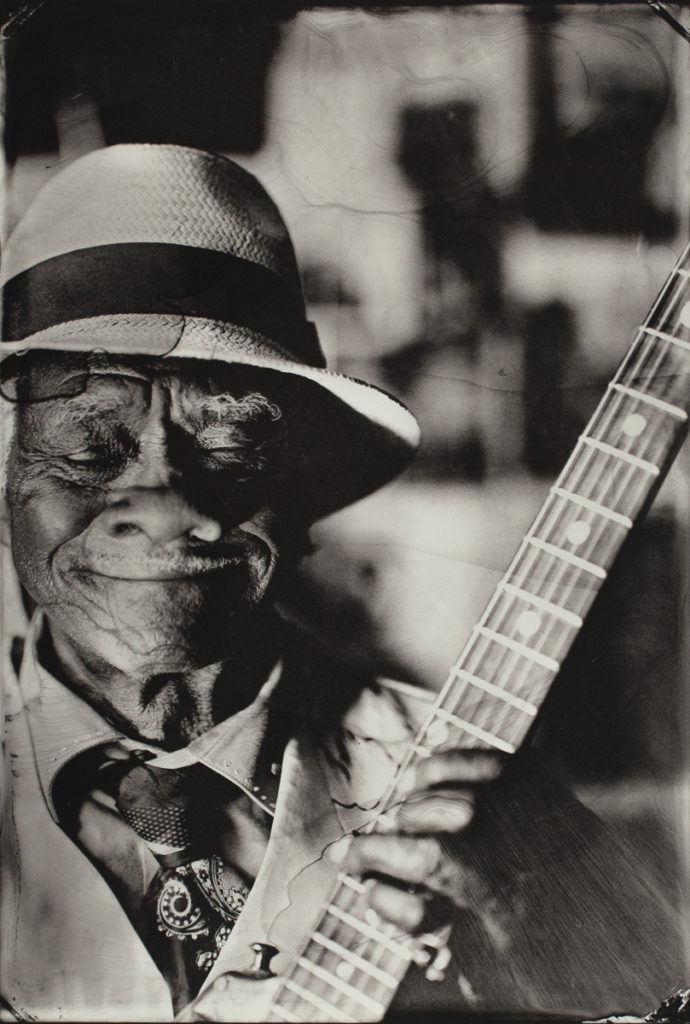
A Black man is wearing a light colored fedora-style hat with a black sash on it; he also wears a light-colored suit and a tie decorated with paisleys. He has one hand on the neck of a banjo. His eyes are closed and he has a beautific smile on his face.
Little Freddie King. Photograph by Tim Duffy, courtesy of Music Maker Relief Foundation

Before we try to answer that, let’s explore what a tintype photo is and how it is made. Tintype, also called ferrotype, is one of the earliest forms of photography. Developed in the 1850s, this wet-collodion process requires a very large camera, a dark space, a plate, and a good understanding of chemistry. Once exposed, a direct positive image is created on a sheet of metal. This means there are no negatives of the image to make copies from, and so each tintype is completely unique!

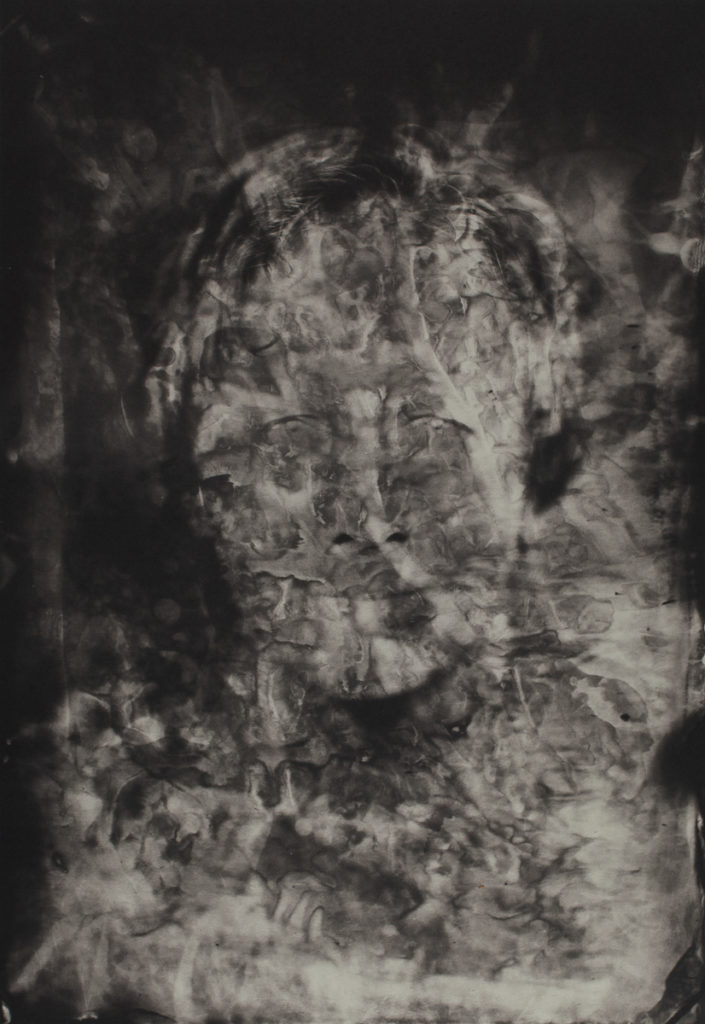
Making a tintype is a complicated multi-step process where minor variations such as drying too quickly, light oversensitivity, or slight ripples in the surface of the chemistry can create errors in the final image. However, these “mistakes” are often what give these images their unique beauty. Many modern artists like Duffy sometimes intentionally play with these “mistakes” to create uniquely interesting photos!

Through a haze of black, grey, and white ripples you can see the face of a white man with light-colored hair. This self-portrait has been manipulated so it is not wholly realistic.
Self-Portrait. Photograph by Tim Duffy, courtesy of Music Maker Relief Foundation

What made tintypes stand out compared to other photographic methods of the age, such as ambroytypes or daguerreotypes, was the use of an iron plate instead of a glass one. The iron plate is where the name ferrotype comes from. Though the resulting images weren’t made of tin as the name would suggest, the term was commonly used, based on the cheap or “tinny” feeling of the photos that eventually became the primary identifier of the method. Because tintypes use an iron plate they are much more durable than images printed on glass. They were also less expensive to produce, and the finished product did not require additional, often expensive, protective casing.

In addition to their durability and affordability, tintypes were faster than previous methods. From start to finish the entire chemical process had to be completed in 15 minutes! These three features – speed, durability, and affordability – quickly helped tintypes become the most popular form of photography in the late 19th century. 

For the first time photographers could easily travel and take instant photographs for customers at events such as fairs and in both rural and urban settings. Photographers traveled out west where they recorded images of cowboys and covered wagons. They documented the Civil War, shocking the country with horrific images from battlefields as well as preserving the memory of individual soldiers for loved ones.

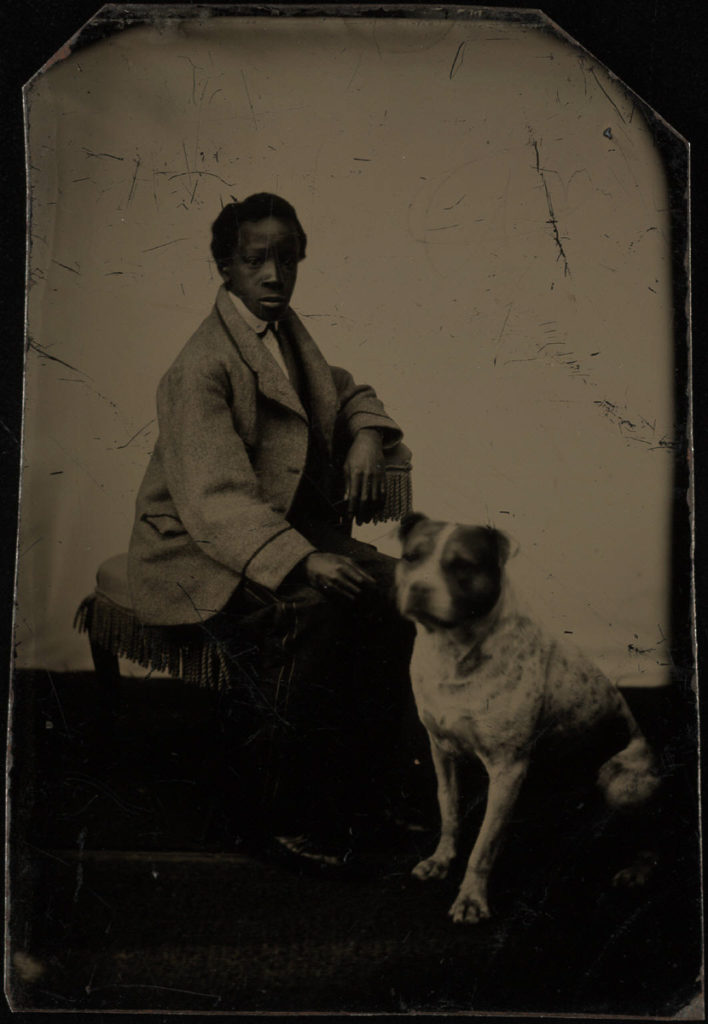
These special characteristics also made photography more accessible to a wider range of people. The popularity of tintype photography also coincided with the Emancipation Proclamation and end of the Civil War, meaning that for the first time African Americans were able to have their photographs taken in large numbers. 

A young Black boy wearing a large light-colored jacket and dark pants sits on a velvet chair or ottoman. A dog that resembles a Staffordshire or pit bull terrier sits at his feet.
Young boy with dog, circa 1870.
Photograph courtesy of Yale Collection of American Literature, Beinecke Rare Book and Manuscript Library

Unfortunately, the same characteristics that encouraged widespread use also encouraged a lack of record-keeping. Because they could be created in a single sitting and given to the sitter or their loved one without excessive packaging, tintypes were frequently not documented with the name of either the sitter or the photographer. This means that although there are a large number of surviving tintype images that remain today, the stories behind them have all too often been lost.

Today, most of the people Duffy photographs are not what we would regard as famous within our celebrity-driven society. Often the sitters for his images are known within their communities but perhaps not far outside of them. However, they all have stories with deep roots and stories that beg to be shared. These musicians want to be remembered, and Duffy strives to ensure they will be. His tintypes take a small step toward correcting the past by documenting the present using a method that has historically given so many underrepresented people their first opportunity to document themselves for posterity.

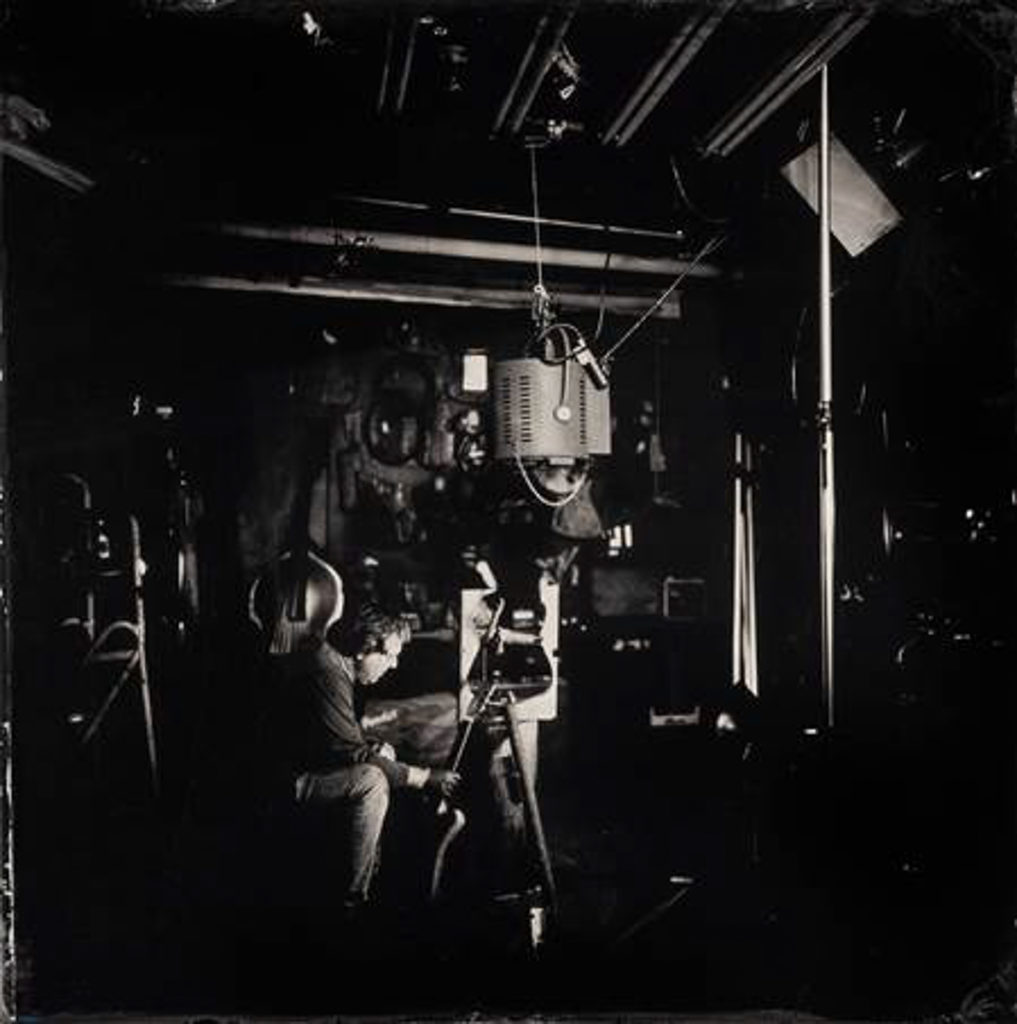
A dramatically lit black-and-white photo showing a white man sitting in front of some large camera equipment. In the background, you can see several stringed instruments leaning against and hanging on the wall.
Tim Duffy at work in his studio. Photograph courtesy of Music Maker Relief Foundation

Duffy’s process is not just taking a photograph – it’s also a theatrical event! Modern cameras can take hundreds of photographs in a minute. Duffy takes an hour to properly get just one photograph. Once he has his shot set up, the moment is captured instantly, and it cannot be retaken easily. In addition to the stress of getting it right on the first try, the studio itself can be intimidating. The giant camera glares at the sitter, and when combined with an extended blinding light, it can feel like the world has stopped for a moment. But these musicians do not shy away from the lenses. They are true performers and are not intimidated by the camera but rather seem to confront it and come out triumphantly.

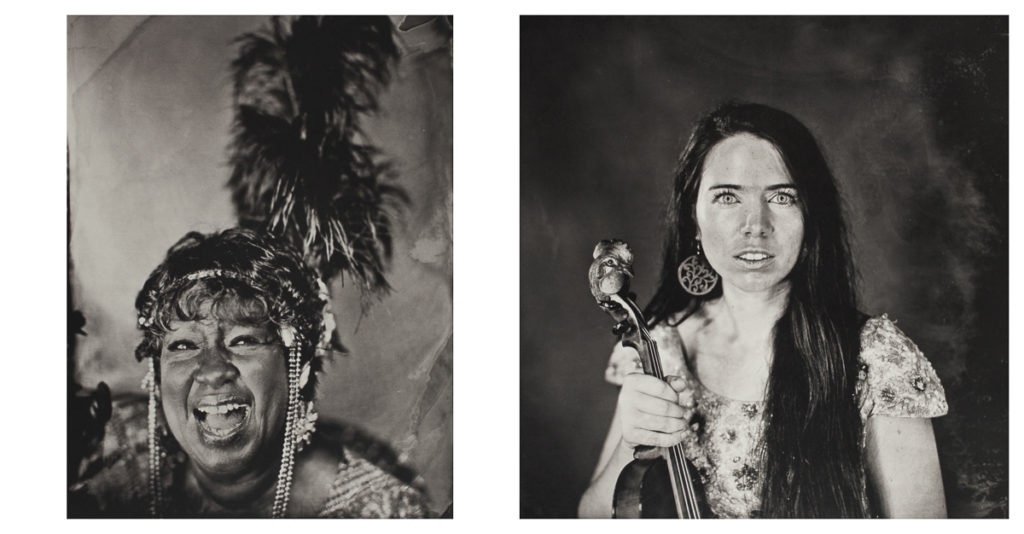
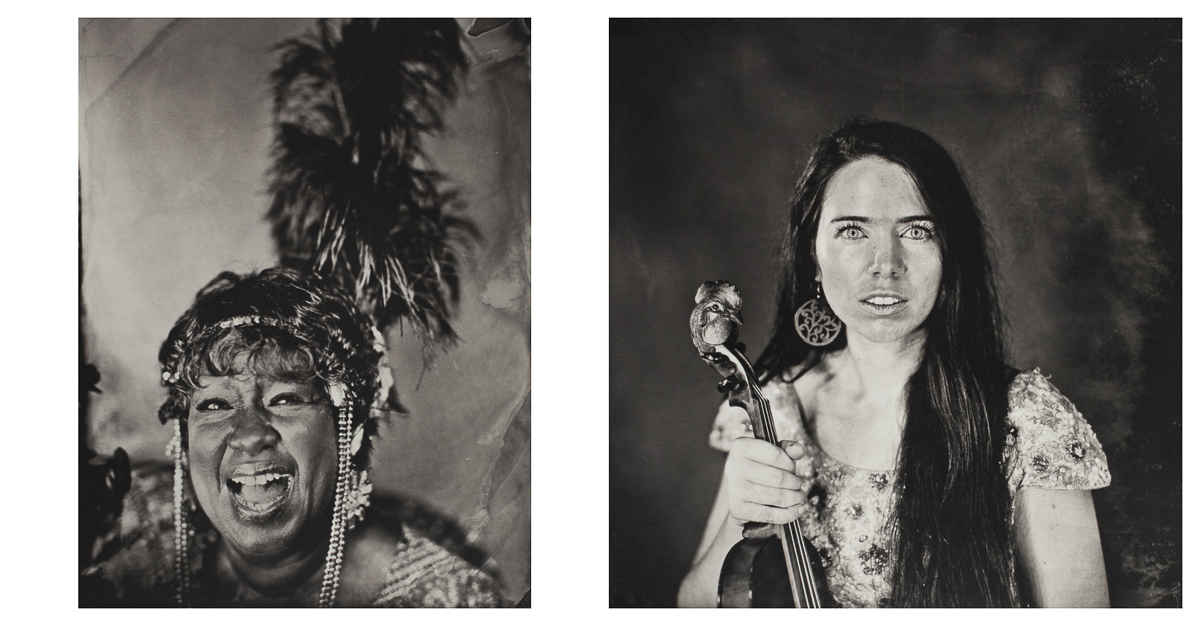
Left: Black-and-white image of a Black woman shown from the shoulders up. She is wearing a feathered headdress with hanging pearls and beads, and she has an exuberant look on her face.
Right: A white woman with long dark hair and intense blue eyes seen from the chest up. She is wearing big circular earrings and a sparkly top/dress, and she is holding a fiddle  with a rooster's head carved on the top of its neck.
Left: Pat “Mother Blues” Cohen. Right: Martha Spencer. Photographs by Tim Duffy, courtesy of Music Maker Relief Foundation

Roots musicians connect us to the past through music by carrying on these traditions and skills. Modern tintypes do something similar by challenging our sense of time visually. Duffy bridges this gap by using one to propel the other, and in the process, he shows us a new side to both.

The Our Living Past special exhibit will be on display at the museum through September 30, 2021. We are also hosting a concert performance by Pat “Mother Blues” Cohen on Saturday, September 25 at 7:00pm.

Erika Barker is the museum’s Curatorial Manager.

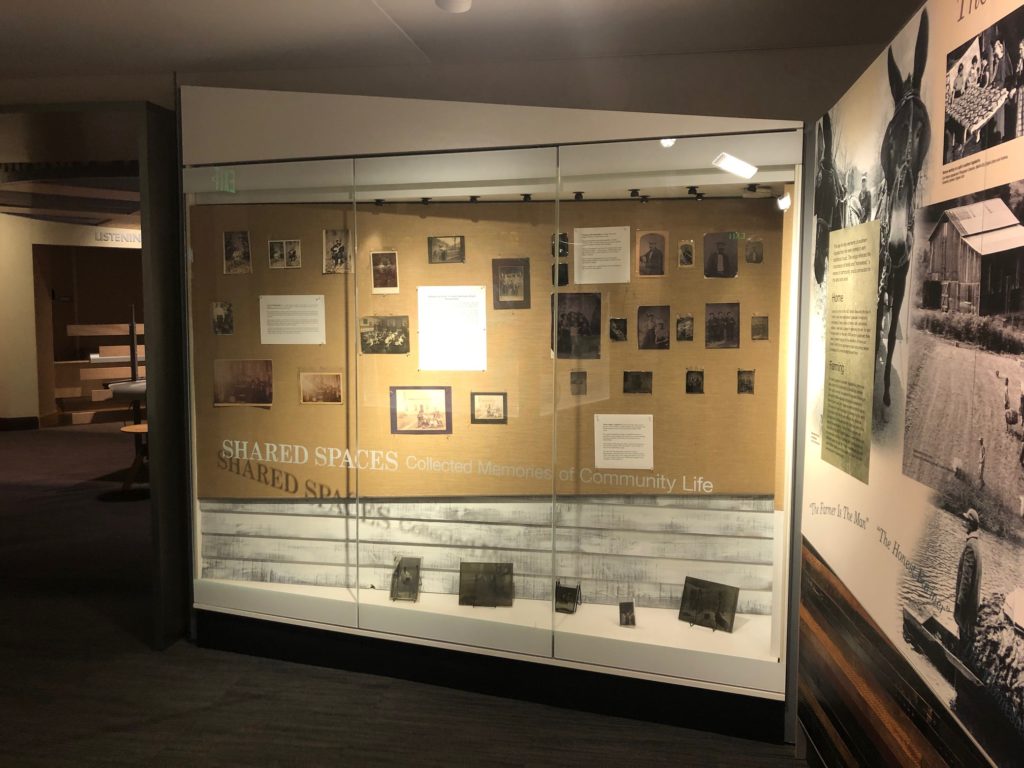
Image shows the Community Case where several photographs are displayed across the back wall of the case, along with explanatory text. Four original glass-plate negatives are arranged in the base of the case, along with a small tintype.
Our summer interns Gracie and Julia created a display on historic tintypes and other examples of early photography in the museum’s Community Case. Be sure to check it out if you visit the museum!
© Birthplace of Country Music Museum; photographs on loan from Nina Rizzo

Once Upon a Time: Remembering and Sharing Family Stories

“Do you remember when…?”

“Let me tell you about your grandmother’s apple butter…”

“Uncle Roger, I want to hear the story about the time you thought you’d swallowed a water dog!”

November is Family Stories Month, and even though we are still in the middle of a pandemic right now, that doesn’t mean that we can’t share family stories with each other – whether it be in smaller, more socially distanced gatherings; through Zoom or WhatsApp or FaceTime; by writing them down in journals and scrapbooks; or whatever method takes our fancy!

Recording and telling stories – especially family stories – is a big part of southern and Appalachian culture and tradition. From fictional folk tales to the recording of your clan’s names in the family Bible, from the poetry and the storytelling of the region’s music to the family anecdotes we share around the table – all of these are ways for us to pass on our history, big and small, and to remember the good and the hard times.

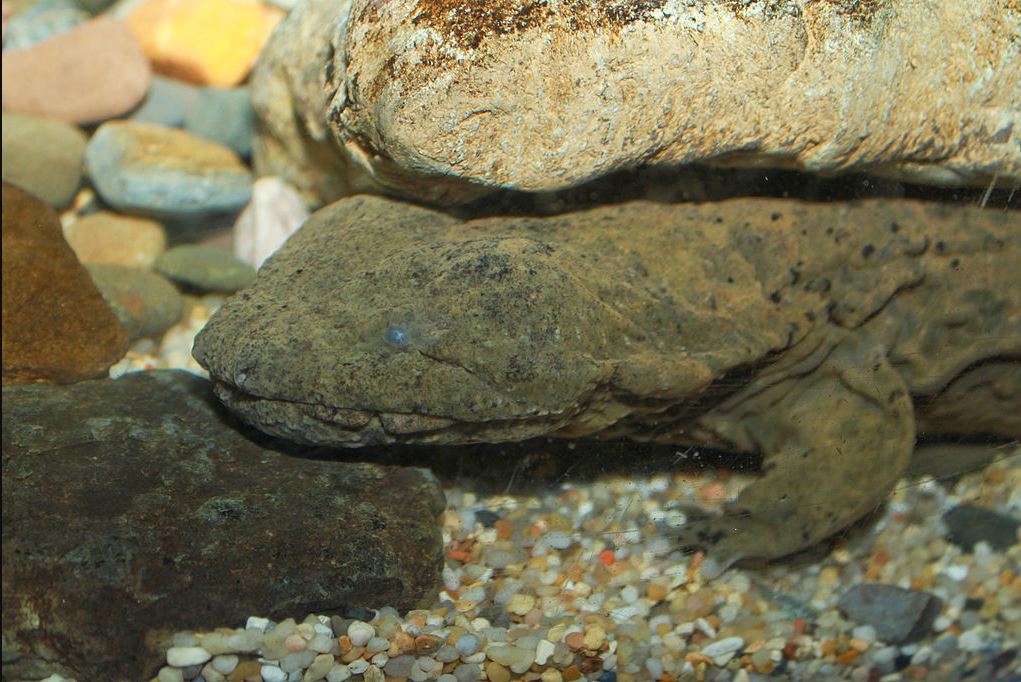
My family is full of story tellers (my Uncle Roger DID think he swallowed a water dog once, and it is my favorite story to hear, over and over again – for those who don’t know, water dog is another name for a hellbender salamander). On my mother’s side of the family, meals and gatherings are filled with tall tales, stories, remembrances, exaggerations, all told in a southern fashion – in other words, slow and often rambling into other tangential realms. On my father’s side of the family, a cousin’s interest in genealogy has led to family trees and records way beyond the stories we’ve told to each other about more recent ancestors and descendants.


A hellbender is a type of giant aquatic salamander – also known as water dog, snot otter, and mud devil, amongst others. How my uncle was convinced that he had swallowed a water dog – in all probability an impossibility – involved my mother and her sister and their desire to make their younger brother sweat. Image from Wikimedia Commons, photographer: Brian Gratwicke

Family stories – and other historical and personal recollections – told through oral histories is one way that museums and other cultural institutions “collect” data and content for exhibits, research, archives, and programs – and for future generations. Here at the Birthplace of Country Music Museum we have incorporated oral histories and family stories into our exhibits and programming in multiple ways:

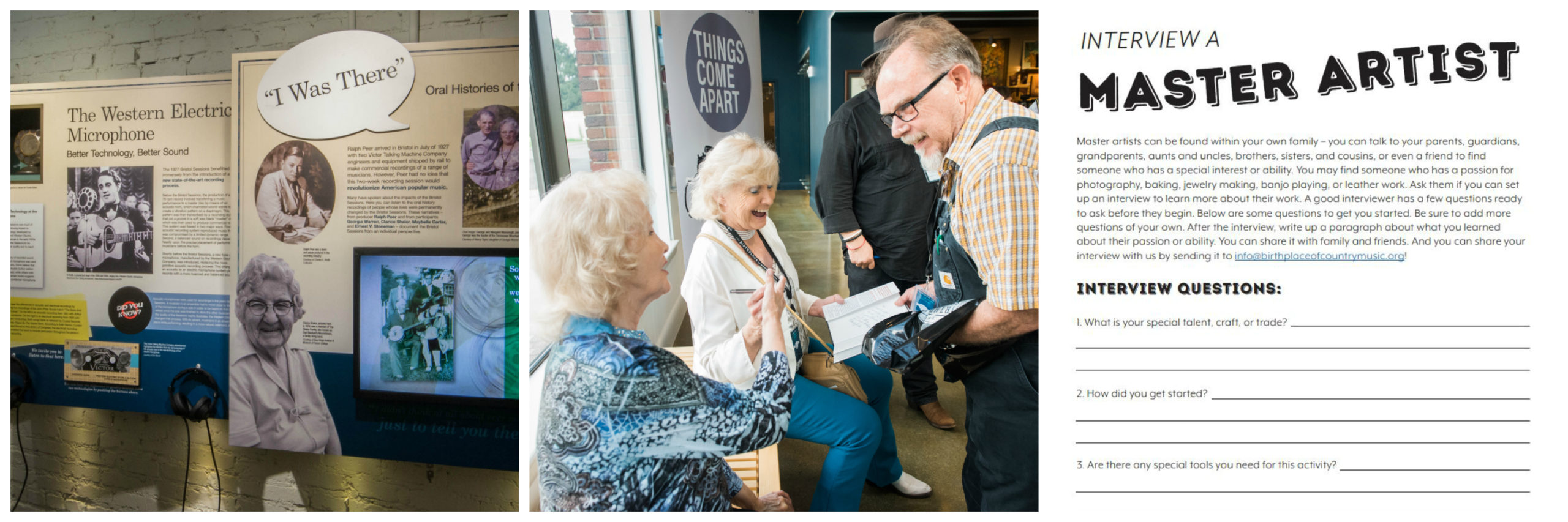
  • Upstairs in our permanent exhibits, a display titled “I Was There” shares excerpts from interviews with Ralph Peer, Ernest Stoneman, Maybelle Carter, Georgia Warren, and Clarice Shelor, giving first-person accounts of the 1927 Bristol Sessions.
  • In 2015 we held a “Tennessee Ernie Ford History Harvest,” an event where we invited members of the public to come to the museum to share any photographs or paper items, objects, and stories related to Ford, his life in Bristol, and his career. We scanned the images, newspaper articles, and other documents; photographed the objects; and spent several hours recording stories and memories of Ford, still a Bristol hero to so many. Not only did this give the public a chance to explore local history more deeply, but the resulting materials are now part of the museum’s archive and can be used for future educational and programming purposes. We hope to hold other “history harvests” in the future – for instance a hoped-for partnership with Black in Appalachia to record stories of African American musicians in this region.
  • At the museum’s symposium on the 90th Anniversary of the 1927 Bristol Sessions in 2017, we recorded oral histories by many of the descendants of the 1927 Bristol Sessions artists to learn more about the musicians who played and recorded here, to give context to the wider history, and to explore the impact that moment had on them, their families, and beyond. We have also interviewed different family members for blog posts, such as our post on Hattie Stoneman.

Recent educational work has focused on creating learning activity sheets, including one related to Real Folk, a special exhibit at the museum earlier this year. This activity sheet encourages children to find master artists or artisans in their family by talking to their parents, grandparents, and other relatives about special talents or skills they have or activities they enjoy doing, another route to learning more about your family.

Left: Focus in one "I Was There" panel shows the quote "I Was There" in a speech bubble at the top, three photographs interspersed with text, and a TV screen with the oral history video running.
Center: Two blondish/white-haired women sit on a bench laughing and talking with an man with glasses, short white beard, and overalls.
Right: The activity sheet has the title "Interview a Master Artist" at the top, with descriptive text and a list of interview questions below the title.

Left: The exhibit panel “I Was There” includes text, images, and a short video recording the memories of the 1927 Bristol Sessions by Ralph Peer and several musicians. Center: Roni and Donna Stoneman, daughters of Ernest and Hattie Stoneman, share memories and stories with a member of the public at the 90th Anniversary of the 1927 Bristol Sessions. Right: The “Interview a Master Artist” activity sheet provides some prompt questions for discovering your family’s hidden talents. All images © Birthplace of Country Music

There are lots of articles and guides out there to help you tell and record your own family stories. Here are just a few that can help get you started:

And if you want some inspiration, check out StoryCorps whose mission is “to preserve and share humanity’s stories in order to build connections between people and create a more just and compassionate world.” Over the years, they have recorded the stories of more than half a million people – from family stories to moments of history, from the small things to the big things in lives lived.

There are also tons of websites and books that will help you with some prompts to get the ball rolling on learning more about your family. Why don’t you try out a few of these questions at your next socially distanced family gathering?

  • What is your favorite story about your grandmother/father?
  • Where did you go to school, and what was your favorite subject?
  • Did you ever play a musical instrument? Which one?
  • Tell me about the places you have traveled.
  • What was the best concert you attended?
  • Did you play a sport in high school or college?
  • What is YOUR favorite family story?
  • Do you remember how you felt or what it was like when the Berlin Wall fell/Barack Obama became President/the Challenger space shuttle blew up – and, one day, when the COVID pandemic hit?

Finally, one last thing to remember: Family can be what you make of it – in other words, family stories can be those told by your relatives, but they can also be those told by the family you have created with your friends. All of these are part of your personal history and remembering them over the years will always bring you – and those you share them with – pleasure.

So start the conversation. Ask a few questions. Pull out some photographs to prompt the memories. Become the record-keeper and storyteller – for your family and friends!

The Power of Music: Suffrage Songs

Today is the 100th anniversary of the ratification of the 19th Amendment, which states “The right of citizens of the United States to vote shall not be denied or abridged by the United States or by any State on account of sex.” In other words, it finally gave American women the right to vote and be represented.

Congress ratified this amendment on June 4, 1919, but it still needed to be affirmed by 3/4 of the states in order to become law. Suffragettes and their supporters had been working for this day since 1832, and the very first amendment for women’s right to vote was introduced in 1878, taking 42 years to reach ratification. The road was long and hard with women fighting through words, negotiation and diplomacy, and acts of civil disobedience to gain the right to vote. American democracy has been a beacon to many outside our shores, but it makes one pause to think that women only gained this basic right 100 years ago.

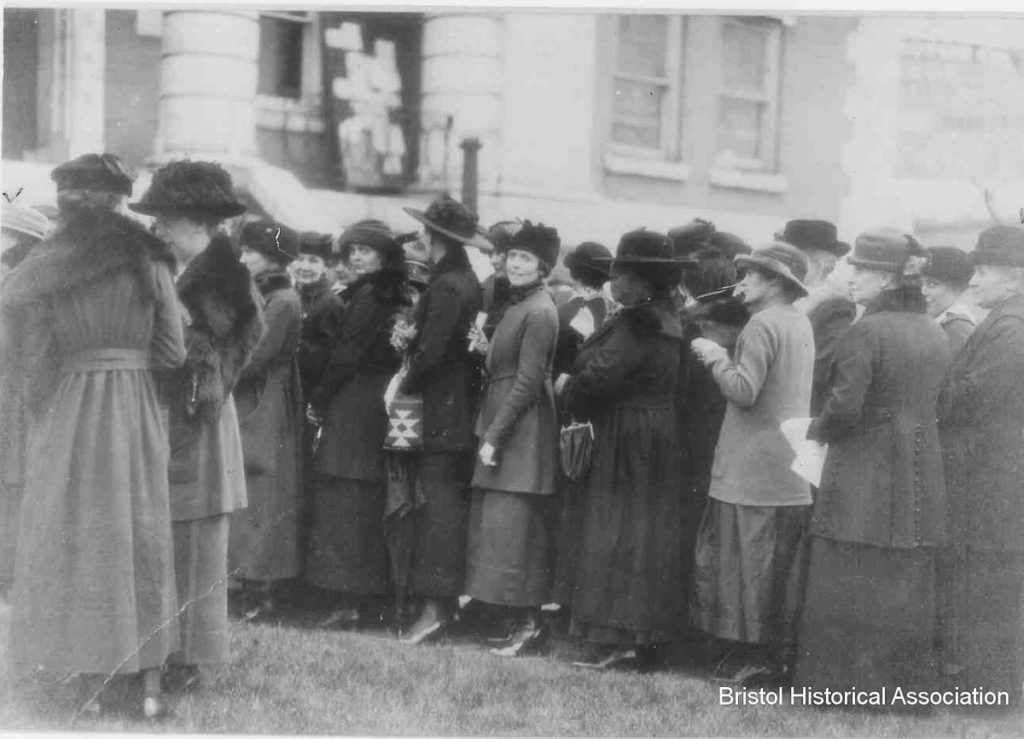
A line of women crowd in front of a building. They are wearing early 20th century clotes, and one of the women looks out from the line and directly at the camera.
Women line up to vote for the first time in Bristol, Tennessee-Virginia, after passage of the 19th amendment. Image courtesy of Bristol Historical Association

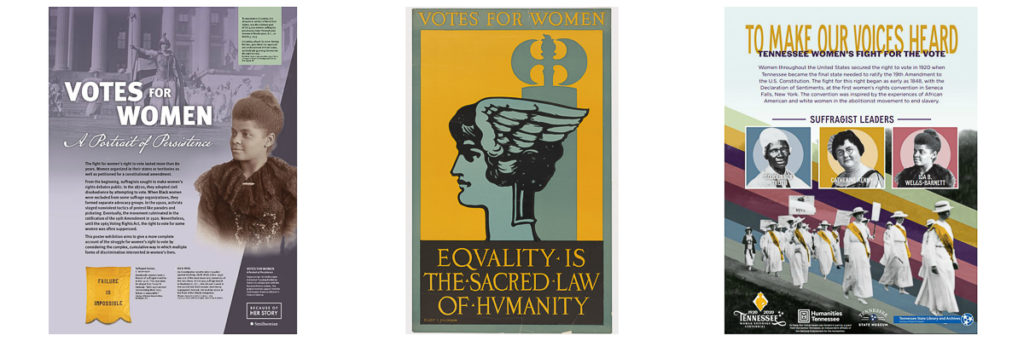
The Birthplace of Country Music Museum is fortunate to have two poster exhibits that explore this complex history, the people who fought to be recognized, and the acts that brought them to victory on August 18, 1920. The first – Votes for Women: A Portrait of Persistence – comes to us from the Smithsonian Institution Traveling Exhibition Service. This exhibit traces the story of women’s suffrage, of inclusion in and exclusion from the franchise, and of our civic development as a nation while also examining the relevance of this history to Americans’ lives today. The second – To Make Our Voices Heard: Tennessee Women’s Fight for the Vote, created by the Tennessee State Museum and the Tennessee State Library and Archives – digs deep into the history of the woman’s suffrage movement, Tennessee’s dramatic vote to ratify the 19th Amendment in 1920, and the years that followed. Both of these exhibits will be on display by September 1 and are definitely worth a visit over the next few months!

Right: The introductory panel for Votes for Women bears text and images on the subject, including a woman dressed in classical garb in front of a government building and a portrait of Ida B. Wells. Center: The graphic poster reads "Votes for Women" and "Equality is the sacred law of humanity" and bears the image of a woman's head with wings at her hair and a sculpture of a double-headed axe behind her. Left. The introductory poster for To Make Our Voices Heard has portraits of several suffrage leaders, text, and a picture of suffragettes marching.
Right and left: The introductory panels to the Votes for Women and To Make Our Voices Heard exhibits. Center: Graphic poster from the suffrage movement. Equality Is the Sacred Law of Humanity, c. 1903–1915; Lithograph by Egbert C. Jacobson Courtesy of Schlesinger Library, Radcliffe Institute for Advanced Study, Harvard University

As a music museum, there is one thing we know for sure: music has power and impact, and so I wanted to explore some of the songs that helped fuel the suffrage movement. Artists have long used songs to throw light on the world around them – for instance, Hazel Dickens and other musicians who highlighted the tribulations and dangers of Appalachian coal mining communities or the anthems, often with their origins in African American spirituals and traditional hymns, that powered Civil Rights activists in the struggle. Music is a way for people to express their contemporary burdens and their dreams for a better future.

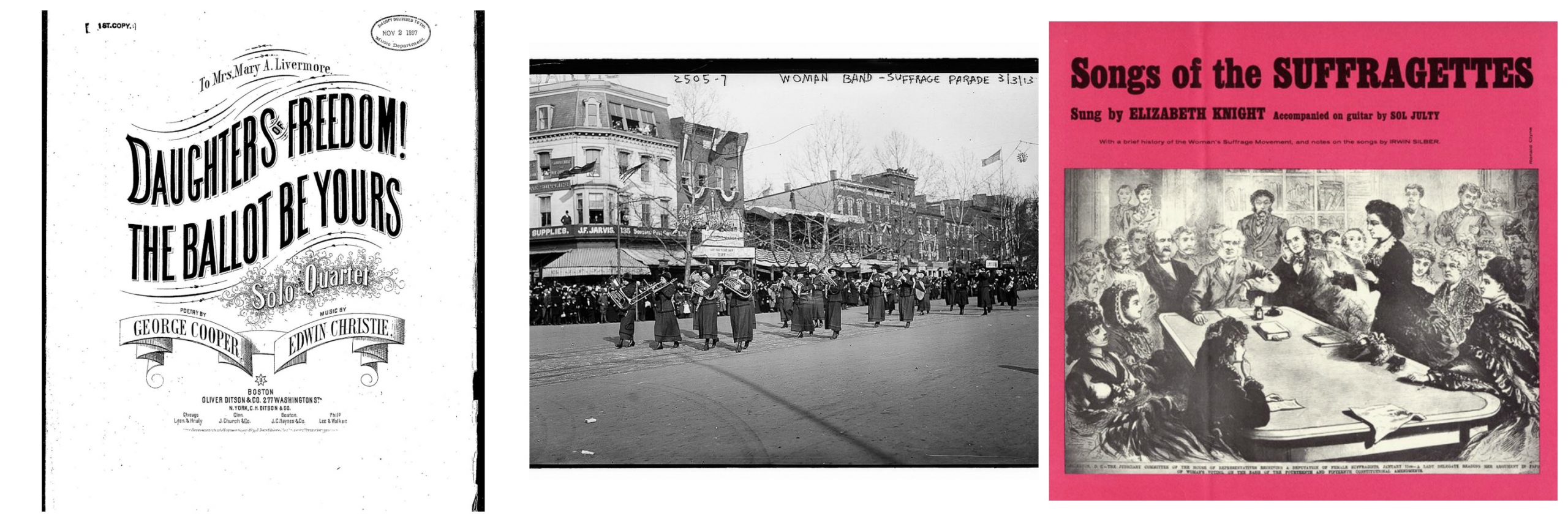
The women of the suffrage movement also lifted themselves up with song, highlighting the rights they were fighting for and inspiring them in that fight. The lyrics to these songs were often set to popular tunes or traditional hymns, thus making them easier to sing and remember. For instance, “Human Equality,” written in the 1870s by William Lloyd Garrison, was sung to the tune of another popular song used in support of labor reform and abolition. While not about women’s right to vote, the poem”Rights of Woman,” written by “A Lady” in 1795, declared women free and was later set to the tune of “My Country Tis of Thee.” “Daughters of Freedom” was published in 1871 and was composed by Edward Christie with lyrics by George Cooper, while a song by Frank Boylen from 1881 asked “Shall Women Vote?” America being the melting pot that it is, some songs also came from immigrant sources, such as “Damen Rechte (Suffragettes),” a popular Yiddish song that not only called for women’s right to vote but also extolled other freedoms and equality in society at large. Some songs were also written specifically for suffrage marches and meant to be played by brass bands, such as “Fall in Line.” Around 1880, D. Estabrook wrote “Keep Woman in Her Sphere,” which on first glance seems to be anti-women’s rights with various men declaring that women should stay in their traditional roles and not expect equal rights. However, the last verse turns this notion on its head with the assertion:

I asked him “What of woman’s cause?”
The answer came sincere —
“Her rights are just the same as mine,
Let woman choose her sphere.

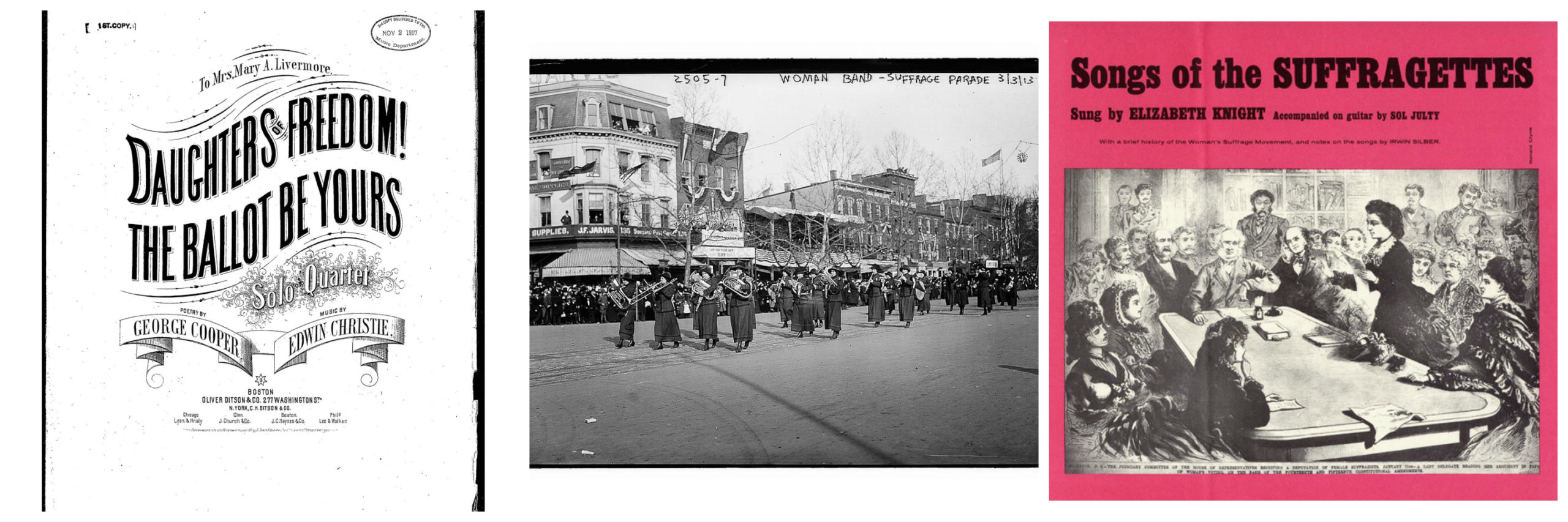
Left: The sheet music cover has bold script with the title of the song, and notes that it is for solo quartet and records the names of the composer and lyricist. Center: A female suffragette band marches down a wide city street. Left: The cover of the Songs of the Suffragettes album is bright pink and has an illustration of a suffrage meeting, with several people around a large table and an audience ranged behind them.
Right: Cover of the sheet music to “Daughters of Freed! The Ballot Be Yours.” Library of Congress. Music Division, Microfilm M 3500 M2.3.U6A44
Center: National American Woman Suffrage Association parade held in Washington, D.C., March 3, 1913. LC-B2- 2505-7, Bain News Service photograph collection, Library of Congress
Left: Unfortunately, very few suffragette songs were recorded at the time of their usage, but you can hear many of these rousing songs on the Smithsonian Folkways recording Songs of the Suffragettes, sung by Elizabeth Knight.

Where there was a fight for women’s rights, however, came societal and political push back – also expressed through music. Songs that mocked the suffragettes’ struggle and emphasized women’s “proper” place abounded, such as “Since My Margaret Became a Suffragette,” “The Anti-Suffrage Rose,” “Mind the Baby, I Must Vote Today,” and “Your Mother’s Gone Away to Join the Army” both published in the early 1910s. Various songs also questioned the other changes women were embracing, often deemed as “unladylike.” This was especially true as women pushed for less restrictive clothes like the “Bloomer costume,” which was attacked in the 1851 song “The Bloomer’s Complaint.” Women riding bicycles were also seen as a sign of these times; indeed, Susan B. Anthony viewed bicycles as doing “more to emancipate woman than any one thing in the world.” “Eliza Jane,” a song from 1895, brought all these horrors together – less restrictive clothing, bicycles, and the desire to vote!

Was there any connection between suffrage and the songs of early country music? I don’t know of any hillbilly songs that embrace the suffrage movement in song, but there are certainly a few songs that reflect the changes that were happening on this front and give hints to women moving beyond their stereotypical roles. For instance, The Carter Family’s “Single Girl, Married Girl,” recorded at the 1927 Bristol Sessions and sung only by Sara and Maybelle, contrasts the freedom of the singleton with the restrictions a married woman bears taking care of husband, babies, and home. And as with the anti-suffrage songs, there were also reactions from hillbilly musicians to the ways women’s roles were changing. Blind Alfred Reed, another 1927 Bristol Sessions singer, later recorded “Why Do You Bob Your Hair, Girls?,” which declared that “every time you bob it, you’re breaking God’s command,” and “Woman’s Been After Man Ever Since,” which bemoaned the early days of Eve in the Garden of Eden and all the ways women were trying to be like men in contemporary society. More disapproval of women’s ways can be found in Ira and Eugene Yates recording “Powder and Paint” from the Johnson City Sessions in 1929.

Finally, it’s worth noting a couple of great songs that teach the history of the suffrage movement and celebrate its achievement. The first is from a much-loved slice of my childhood, Schoolhouse Rock“Sufferin’ till Suffrage,” sung by the wonderful Etta James. And then, of course, there is Dolly Parton (it’s ALWAYS Dolly…). In 2018, she contributed to 27: The Most Perfect Album, “a collection of songs about the Constitutional amendments that have shaped our democracy, and yet are often at the center of fierce political debate.” Dolly’s song about the 19th amendment starts with a brief spoken introduction to the suffrage story, and soon transitions into a rousing song about the fight for the vote.