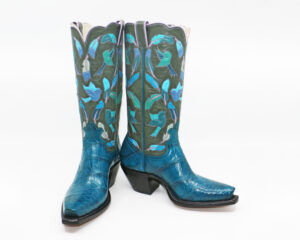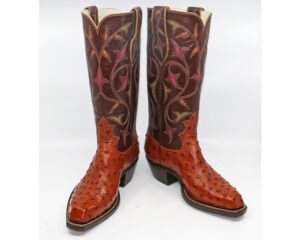


Lisa Sorrell is an award-winning master bootmaker and fine artist whose canvas is the cowboy boot. Based in Oklahoma, her works are inspired by the art of the cowboy boot and its heritage and tradition, and distinguished by intricate leather inlay, overlay, and topstitching.
This fall, the museum will host a cowboy boot exhibition featuring my work entitled Boot Scootin‘ History: The Craft and Stories of Cowboy Boots. In advance of the exhibit, let’s learn some cowboy boot-making terminology!
We’ll start with one of the most important phrases: BOOT TOPS. The upper part of a boot, where most of the decorative work happens, is the boot top. Each boot has one front panel and one back panel; together, they form the boot top. The boot tops are not called the Shaft.
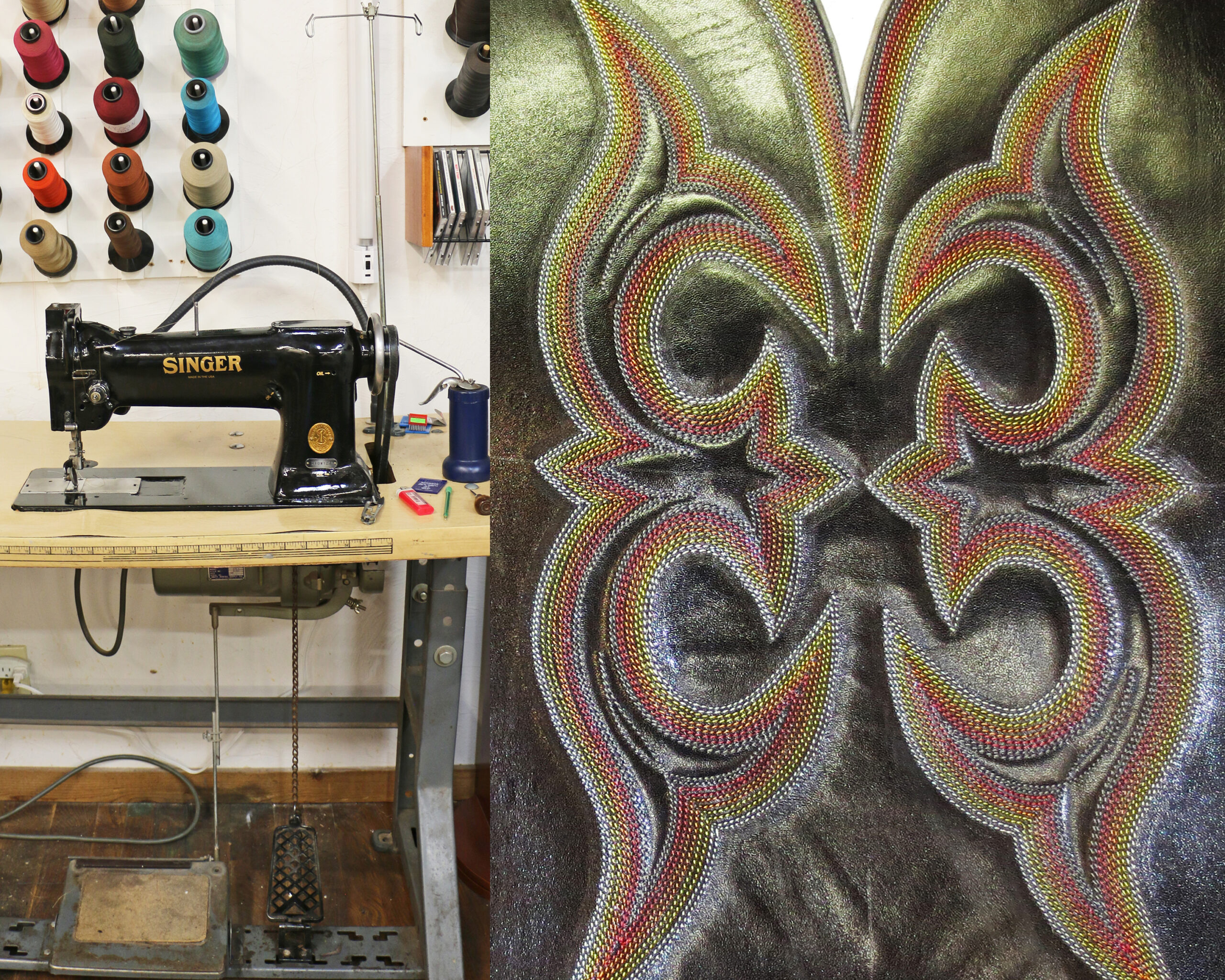
 The original embellishment to grace the tops of cowboy boots, the least expensive and the most common, is DECORATIVE STITCHING. The stitching can range from one single row to around ten rows. In my shop, the rows of stitching are done one row at a time on a single-needle, uncomputerized sewing machine. The machine that I personally use is a Singer from the 1940s. In this example, you can see ten rows of stitching, done on my old Singer.
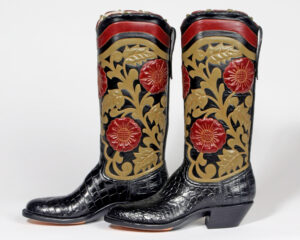
The first design technique that includes additional pieces and colors of leather, in addition to stitching, is INLAY. If you cut out a hole, such as a star, a flower, or a butterfly, and you put a different color of leather behind that hole, that’s inlay. It wasn’t long before cowboy boots sprouted colorful inlaid flowers and butterflies. It’s important to note that flowers and butterflies are traditional themes for cowboy boot tops. They were not considered feminine; they were simply common and accepted boot designs.
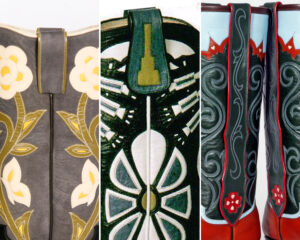 OVERLAY is an alternate way to add different colors of leather to a design. Inlay involves cutting a hole into a piece of leather and laying another piece of leather behind; overlay is cutting a shape and laying it on top. Once you master stitching, inlay, and overlay, they can be combined to create incredibly intricate designs.
Since cowboy boots are pull-on boots, with no laces or buckles to adjust the fit once they’re on, there is resistance for the proper fit when pulling them on, so the heel doesn’t slide around once it’s inside the boot. You need something to grab as you’re pulling on your boots, and those are called PULLS or EARS.
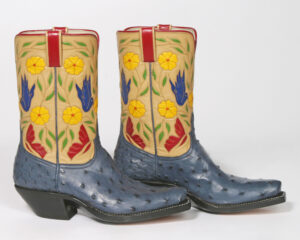
A cowboy boot sole is PEGGED with small wood pegs. Have you ever heard the saying “A square peg in a round hole?” Perhaps you thought that referred to someone who’s out of place, but really, it’s a good thing. The awl that punches the hole is round, but the wood pegs are square and larger than the awl. When you drive a square peg into the slightly smaller round hole, the tension created holds them tightly. 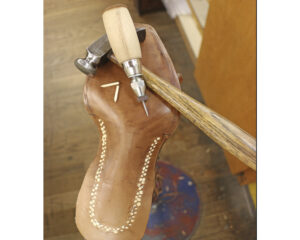
In closing, let’s talk more about that high cowboy boot heel. Jay Griffith, my first boot-making mentor, was born in Texas around 1920, and he made his first pair of boots at age 13. He worked in multiple boot shops over the course of his career, for and with some of the original architects of the cowboy boot. In other words, he was closely
connected to the origin of cowboy boots. I remember one day when a would-be customer came into the shop and unwisely began explaining to Jay the function of the high heel on a cowboy boot. Jay didn’t suffer fools gladly. I can clearly recall him practically chasing the guy out of the shop while yelling, “The purpose of a high heel is to look purty! And that’s spelled P – U – R – T – Y — PURTY!”
The Special Exhibit, Boot Scootin‘ History: The Craft and Stories of Cowboy Boots, will be on display at the Birthplace of Country Music Museum from October 14, 2025 – April 6, 2026.